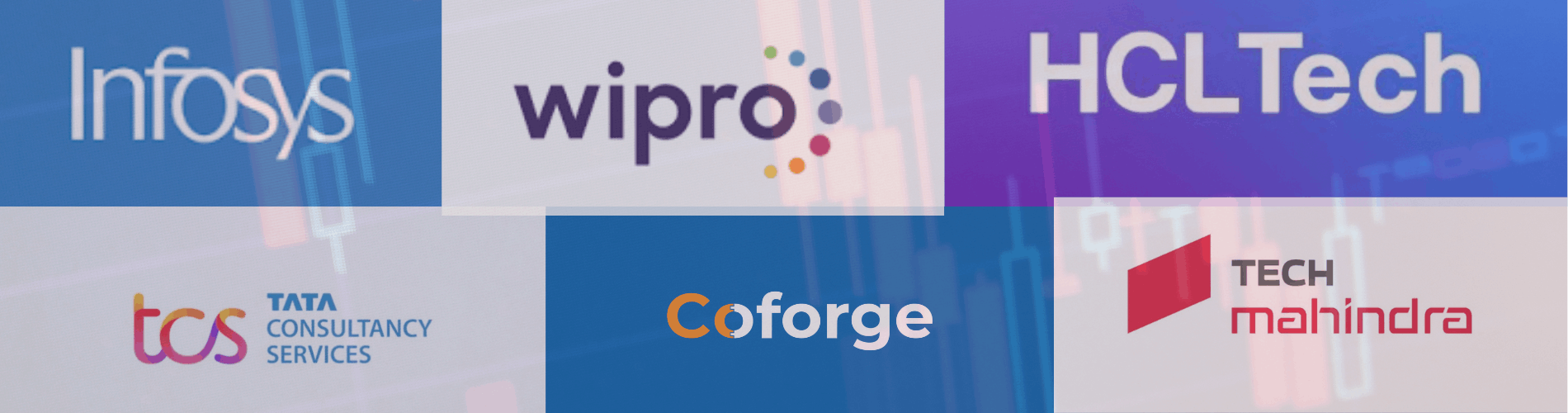

I’ve been following the Indian IT industry fairly closely over the last several weeks, though it feels like a pivotal moment. The stock prices of large Indian IT companies such as Infosys, TCS, and Coforge plummeted. The Nifty IT index was trading 4.03 per cent down at 33,588.80 with its components trading lower in the range of 4.03 per cent to 5.92 per cent. As an investor in this area, I’m wondering: what exactly is going on, and should we be panicking or seeing opportunity?
In this article, I aim to break down the key reasons behind today’s Indian IT stock declines, explain how AI developments and global economic indicators are impacting investor sentiment, and share my personal strategy and perspective for navigating this volatile market. You’ll also get some actionable insights on how I evaluate these changes in the context of long-term investing.
What I Saw in Today’s Market
I checked my trading terminal this morning and saw Coforge and Infosys dipping close to 5% each, with the latter diving to ₹1,425 per stock, a mark it had touched in terms of closing price back on April 17, 2025. TCS lost 4.2% to ₹3,610; Tech Mahindra was down by 4.5% at ₹1,195; Mphasis shed 4.3% to go down to ₹2,035. Even HCL Technologies and Wipro lost over 3% each, to ₹1,210 and ₹465, respectively.
These sharp declines immediately grabbed my attention. I watch these numbers closely because they represent market sentiment more than anything else. The losses look severe on paper, but it is crucial to delve deeper before coming down on one side or the other.
US Jobs Report and Its Ripple Effect
Today’s market reaction was strongly influenced by the US January jobs report. Employment rose by 517,000 jobs, higher than economists’ expectations of 450,000, and the unemployment rate fell to 4.3% from 4.5% in December. On the surface, this appears positive, suggesting a strong labour market.
However, the details tell a different story. Most of the gains were in healthcare (+320,000) and social assistance (+110,000), with other sectors largely flat. Economists such as FWDBONDS’s Christopher Rupkey said this high concentration of growth doesn’t necessarily mean there is broad economic strength, particularly in industries like IT Outsourcing that depend upon corporate and technology
In my opinion, this means that while the headline numbers are good, the actual impact on IT demand is minimal, which is why investors have some right to be sceptical.

AI-Driven Concerns Are Now Real
I’ve been following developments in AI closely in recent months, and it’s evident that many investors perceive AI as a substantial risk. Last week, Anthropic released plugins for its Claude Cowork agent, which can automate tasks in the realms of legal, marketing and sales or data analysis.
Although the changes may demonstrate creativity, they also point toward potential upheaval for established Indian IT service providers. Analysts forecast that AI could impact $50–60 billion in service contracts around the world over the next 3-5 years, particularly tasks related to routine data and professional services.
This explains why Wall Street reacted similarly: Microsoft was down by 2.2%, Alphabet dropped 2.4%, and the S&P 500 software index fell 2.6%. Even when the economy in the US looks solid, AI is creating a competitive input that investors are now beginning to factor into valuations.
Also Read: India’s Economic Growth Outlook: 7 strong IMF Insights as Global Risks and AI Reshape Growth
My Take on the Market Reaction
Here’s what I’m thinking personally: The market often overreacts to short-term news. A 4–5% correction in top Indian IT stocks may have felt alarming, but experience tells us that disciplined investors can find opportunities during such corrections.
For example, Infosys and TCS remain fundamentally strong. Infosys and TCS reported annual revenues of $25.7 billion and $26.5 billion, respectively, with solid global client bases and recurring revenue. While AI will disrupt some services, I believe the winners will be companies that adapt and integrate AI rather than those that stick purely to traditional IT services.
In my portfolio, this means I’m not panicking. Instead, I’m evaluating:
- Which companies are investing heavily in AI implementation?
- Which companieshave diverse global revenue streams?
- Which have strong long-term contracts and recurring revenue?
How I’m Adjusting My Strategy
If you’re an investor wondering what to do, here’s how I think about cases like this:
- Review exposure to high-risk IT stocks: Companies not prepared for AI disruption may face more pressure.
- Look for long-term entry points: Sharp corrections can create opportunities to buy quality stocks at lower valuations.
- Diversify across sectors: Even within tech, I balance investments between IT services, AI-enabled companies, and SaaS solutions.
- Monitor quarterly earnings closely: Revenue growth, margins and plans to adopt artificial intelligence are key indicators I monitor.
Why This Matters to Investors
A sharp downturn on any given day tends to rattle many retail investors. From where I stand, the secret is to understand what’s at work behind the move instead of reacting in an emotional vacuum.
In this case:
- Job growth in the US is booming for healthcare, but not in IT-related fields.
- AI is increasingly going to drive competition that threatens to disrupt particular IT services.
- Market corrections frequently are short-term responses to uncertainty and not long-term structural problems.
I think the key should be how IT companies make a shift to AI and retain their existing customer base. Those who successfully do so may well outperform their peers over the next 3–5 years.

Key Takeaways From My Analysis
- Short-term falls don’t always signal long-term trouble.
- Artificial intelligence is both a threat and an opportunity. Firms that seize A.I. are going to outperform.
- Diversification remains essential. While headwinds are being faced by the IT stocks, there appear to be some stable sectors.
A Personal Reflection
Writing this, I feel both cautious and optimistic. Volatility in the market is unnerving, but it also demonstrates that we need to look beyond headlines. For me, investing isn’t about treating every market tremor as a call to action; it’s about identifying the structural trends that will define the next decade.
AI is not a fad; it’s changing industries. And while Indian IT stocks may come under short-term pressure, companies that will adapt and innovate are likely to do well. That is the prism through which I carry out my investments.
Also Read: India-EU FTA: What a $50 Billion Trade Opportunity Means for the Next Decade
Disclaimer
I am not a licensed financial advisor. The content of this article is for educational and informational purposes only. Any investment decisions you make are at your own risk. Please consult a professional financial advisor before making investment choices.

Himani Soni
I’m Himani Soni, a finance content strategist with 2+ years at Investik Future. I decode market trends and simplify complex investing concepts into clear, actionable insights for the everyday investor.