
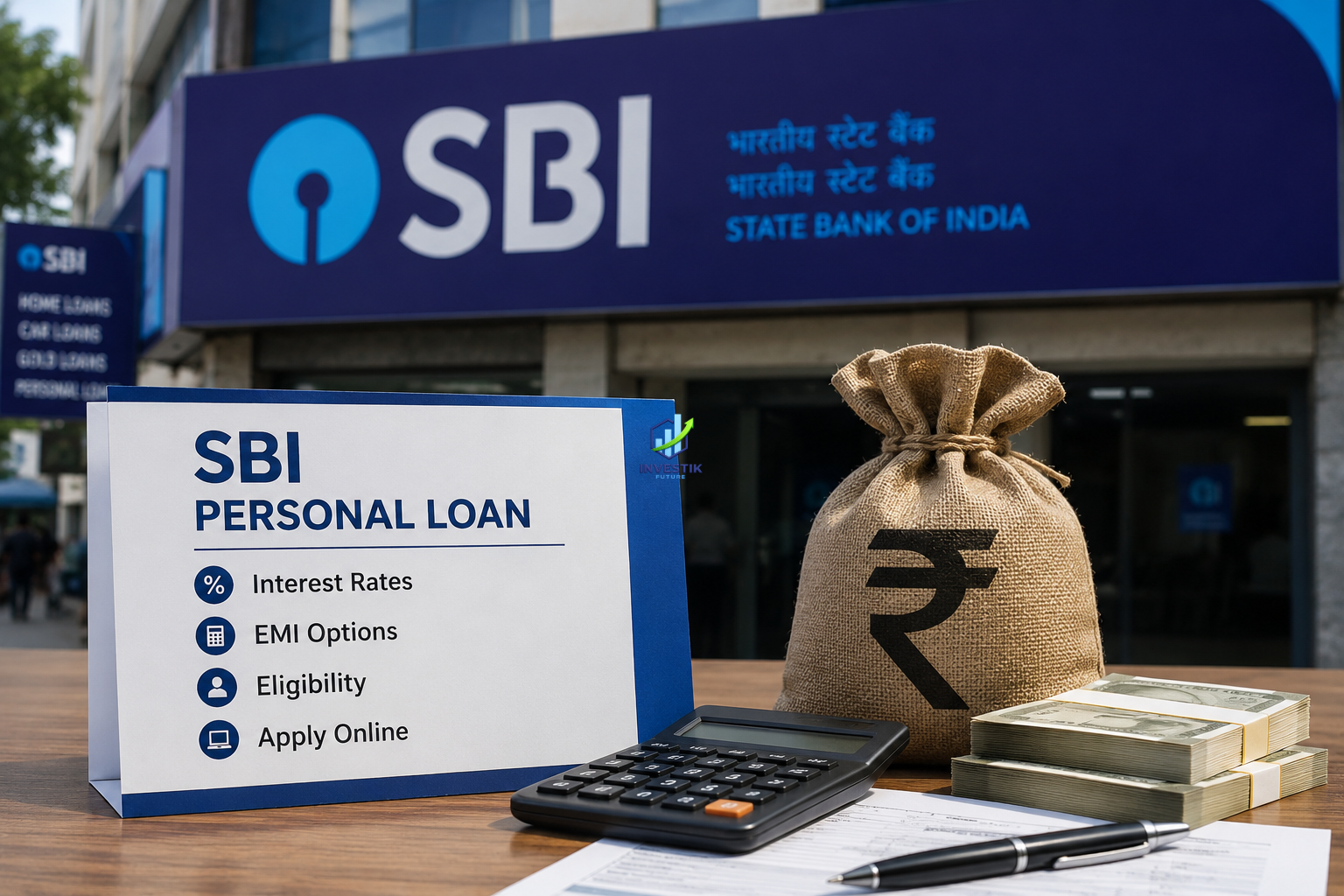

Quick answer
SBI Personal Loan interest rates currently range from 10.00% to 15.00% p.a. (effective 15 August 2025, based on the 2-year MCLR plus a spread), with loan amounts up to ₹35 lakh and tenures up to 7 years. It suits salaried, self-employed, and pension-income borrowers with a stable financial profile and a credit score above 700 who need funds for a genuine, clearly defined expense. Confirm the current rate, processing fee, and any time-bound promotional offer on SBI’s official interest rate page before applying, since terms change at the bank’s discretion.
If you’ve landed here searching for “SBI Personal Loan,” you probably want to know what it will actually cost you, whether you qualify, how much you can borrow on your salary, and whether SBI beats the NBFC or private bank offer sitting in your inbox right now.
Based on research of official SBI sources, RBI notifications, and publicly available lending data, this guide answers that with real EMI numbers, comparison tables, and the practical detail most personal loan pages leave out.
What is an SBI Personal Loan?
An SBI Personal Loan is an unsecured loan from State Bank of India that can be used for any personal need, such as medical bills, weddings, travel, debt consolidation, or home renovation, without pledging collateral. SBI’s official interest rate page lists personal loan rates from 10.00% to 15.00% p.a. (effective 15 August 2025), with loan amounts up to ₹35 lakh and tenures up to 7 years, depending on the scheme and applicant profile.
SBI doesn’t ask what you’re spending the money on. There’s no asset backing the loan, which is why the interest rate runs higher than secured loans, but approval is faster. SBI offers this to salaried employees, self-employed professionals, pensioners, and special categories like defence personnel and government staff, each with slightly different terms.
SBI’s personal loan pricing works differently from a Bajaj Finance or DMI Finance loan. SBI prices its personal loans off its 2-year MCLR plus a spread, so the final rate ties to the bank’s cost of funds rather than a flat NBFC risk-based slab. The breakdown below shows why that matters.
The question every borrower actually has is: should I take this loan, and what will it cost me? That’s the lens for everything below.
SBI Personal Loan at a glance: pros and cons
| Pros | Cons |
|---|---|
| Narrower, more predictable rate band (10 to 15% p.a.) than most private banks and NBFCs | Processing fee of up to 1.5% + GST applies on every loan |
| YONO pre-approved loans can be disbursed within minutes for eligible existing customers | Prepayment/foreclosure charges of up to 2 to 3% may apply on fixed-rate loans |
| PSU-bank credibility and a wide branch network for in-person support | Documentation is heavier for self-employed applicants (ITR, audited financials) |
| Dedicated schemes for pensioners, government staff, and defence personnel with relaxed terms | Longer tenures meaningfully increase total interest paid, even though EMI looks smaller |
| Loan amounts up to ₹35 lakh for qualifying salaried applicants | The advertised “starting from 10%” rate is reserved for the strongest credit profiles only |
SBI’s main advantage is predictability: its rate band is tied to a published MCLR formula rather than an opaque internal risk model. It’s rarely the fastest or most flexible option for borrowers who don’t already have a banking relationship with SBI.
Types of SBI Personal Loan schemes
SBI runs several named schemes, each targeting a different borrower type: SBI Xpress Credit for salaried employees, alongside Xpress Elite, Pension Loans, and special schemes for government and defence employees. Each carries its own rate and eligibility band.
Two people earning the same salary can get different SBI personal loan interest rates simply because they qualify for different schemes. If your salary account is with SBI, or you work for the government or defence services, check which scheme you fall under before applying, since this can directly affect your rate.
The main schemes:
- SBI Xpress Credit, the flagship personal loan for salaried individuals, including those whose salary is credited to an SBI account or another bank’s account.
- SBI Xpress Elite, a premium variant for higher-income salaried applicants, usually with a marginally better rate and a higher loan ceiling.
- SBI Quick Personal Loan for SBI account holders without a salary relationship with the bank, used for general personal needs.
- SBI Pension Loan for central/state government pensioners and family pensioners, with relaxed age limits in select variants.
- SBI Personal Loan for Government Employees, which carries preferential pricing during periods when SBI runs special government-employee offers.
- SBI Personal Loan for Defence, Para-Military, and Coast Guard personnel, a dedicated scheme with concessional rates offered on a time-bound promotional basis.
- YONO SBI Pre-Approved Personal Loan, a pre-qualified, instant-disbursal loan offered digitally to select existing customers based on their banking relationship and repayment history.
If you don’t know which of these applies to you, check via SBI’s net banking, YONO app, or branch before assuming the “starting rate” you saw online applies to your case.
SBI Personal Loan interest rate
SBI’s personal loan rate, effective 15 August 2025, is calculated as the 2-year MCLR (8.75%) plus a spread of 1.25% to 6.25%, giving an effective range of 10.00% to 15.00% p.a. This is the rate published on SBI’s official interest rate page, last updated 10 February 2026, and it’s subject to change with RBI’s monetary policy and SBI’s internal credit assessment.
The “10% starting rate” seen in headlines is not the rate most borrowers get. It’s the floor, reserved for applicants with the strongest credit profiles, salary relationships, and lowest risk spread. Based on the spread structure published by the bank, the realistic range for most salaried applicants without an SBI salary account tends to sit closer to 11.5% to 14% p.a.
| SBI Personal Loan component | Detail | Effective date / source |
|---|---|---|
| 2-Year MCLR | 8.75% | SBI official interest rate page |
| Spread over MCLR | 1.25% to 6.25% | SBI official interest rate page |
| Effective interest rate range | 10.00% to 15.00% p.a. | w.e.f. 15.08.2025 |
| Mean ROI (Q4 FY25, disclosed) | 12.68% | SBI official disclosure |
| Defence/Para-Military/Coast Guard special rate | 10.45% p.a. | Time-bound offer; SBI’s published validity window for this rate has lapsed. Confirm current status before applying |
| Government employee special rate | Time-bound promotional offer | Confirm current validity directly on SBI’s interest rate page before applying, as these offers are periodically renewed or withdrawn |
Don’t anchor your expectations to the lowest advertised number. Your actual rate depends on your credit score, income stability, existing relationship with SBI, and loan amount. Ask the bank for your specific spread in writing before signing, since this determines your real EMI burden over the full tenure.
Interest rates on official bank pages can change without much public notice, and third-party aggregator sites often show slightly different ranges (some list 10.05% to 15.05%, others 10.30% to 15.30%, others a higher band such as 10.55% to 16.60%) because they track promotional, scheme-specific, or outdated variants rather than the current base published rate. Treat the number on SBI’s own interest-rate page, checked on the date you apply, as the most authoritative baseline, not the number in this article or any other third-party source.
SBI Personal Loan eligibility
Salaried applicants generally need a minimum net monthly income in the range of ₹15,000 to ₹25,000 (the exact floor varies by scheme), an age between 21 and 58 years (higher for pensioners), and at least 1 to 3 years of work experience depending on the scheme. Self-employed applicants are assessed on income tax returns and business stability rather than a salary slip.
Eligibility shifts depending on which SBI scheme you fall into. Based on a review of publicly available eligibility criteria across SBI’s personal loan products, here’s the consolidated picture:
| Criteria | Salaried applicant | Self-employed | Pensioner |
|---|---|---|---|
| Minimum age | 21 years | 21 years | Varies by scheme |
| Maximum age at loan maturity | 58 years (or retirement age) | 65 years | Higher age limits in select pension-loan variants |
| Minimum net monthly income | ₹15,000 to ₹25,000 (scheme-dependent) | Assessed via ITR/turnover | Pension amount-based |
| Minimum work experience | 1 to 3 years (scheme-dependent) | 2+ years in current business | N/A |
| EMI/NMI ratio cap | Typically up to 50 to 65% of net monthly income, scheme-dependent | Same | Same |
| Loan amount | Up to 24x net monthly income, capped at ₹35 lakh | Assessed on income proof | Lower multiples of pension |
| Credit score preference | 700+ recommended; 760+ improves approval odds | Same | Same |
The “24 times net monthly income” formula is the real ceiling most salaried borrowers hit before the ₹35 lakh cap even becomes relevant. If your net monthly income is ₹35,000, your theoretical maximum eligibility is roughly ₹8.4 lakh, but your actual approved amount will likely be lower once SBI factors in existing EMIs and your debt-to-income ratio.
Many borrowers see the “up to ₹35 lakh” headline and assume that’s their personal ceiling. Your ceiling is set by your income, through the 24x-NMI formula, not by the product’s advertised maximum. Confusing the two is one of the most common reasons applicants get disappointed at the approval stage.
SBI Personal Loan salary vs eligibility: what you can actually borrow
SBI personal loan eligibility scales roughly with net monthly income, since the bank applies an income-multiple formula (commonly up to 24 times NMI) combined with an EMI-to-income ratio cap, typically kept around 50 to 65% of net monthly income across all existing obligations.
These are estimates based on standard formulas; your actual approved amount will depend on SBI’s internal credit assessment, existing liabilities, and the specific scheme you apply under.
| Net monthly salary | Approx. maximum loan eligibility (24x NMI, before EMI cap) | Illustrative range after EMI/income check |
|---|---|---|
| ₹15,000 | ₹3.6 lakh | ₹1.5 to 2.5 lakh |
| ₹25,000 | ₹6 lakh | ₹2.5 to 4 lakh |
| ₹35,000 | ₹8.4 lakh | ₹3.5 to 6 lakh |
| ₹50,000 | ₹12 lakh | ₹5 to 9 lakh |
| ₹75,000 | ₹18 lakh | ₹8 to 14 lakh |
| ₹1,00,000 | ₹24 lakh | ₹12 to 20 lakh |
If you earn ₹35,000 a month and see SBI marketing “loans up to ₹35 lakh,” that number is not relevant to you. The right-hand column is your real working range. Use this table as a sanity check if a calculator or agent quotes you a number far outside it, since a mismatch usually means a longer tenure, a co-applicant, or additional income documentation is being assumed.
Documents required for SBI Personal Loan
SBI requires standard KYC documents (PAN, Aadhaar), income proof (salary slips or ITR), bank statements, and passport-size photographs. Salaried applicants generally need fewer documents than self-employed applicants, who must additionally submit business proof and audited financials.
| Document category | Salaried applicant | Self-employed applicant |
|---|---|---|
| Identity proof | PAN Card, Aadhaar Card | PAN Card, Aadhaar Card |
| Address proof | Aadhaar, utility bill, or passport | Aadhaar, utility bill, or passport |
| Income proof | Last 3 months’ salary slips, Form 16 | ITR for the last 2 years, audited financials |
| Bank statements | Last 6 months | Last 6 to 12 months (business + personal) |
| Employment proof | Appointment/confirmation letter | Business registration/proof of existence |
| Photographs | Recent passport-size photos | Recent passport-size photos |
| Additional | Check-off letter from employer (for some schemes) | GST returns, business continuity proof |
If you apply via YONO SBI, many of these documents can be pulled digitally when your salary account and KYC are already with SBI. That’s a major reason existing SBI salary account holders tend to see faster, sometimes near-instant, approvals compared to outsiders applying fresh. Confirm exact document requirements and turnaround times with SBI directly, since these vary by branch and scheme.
SBI Personal Loan processing fees and charges
SBI charges a processing fee of up to 1.50% of the loan amount, subject to a minimum of around ₹1,000 and a maximum of around ₹15,000, plus applicable GST. This is a one-time, non-refundable charge collected at disbursal, separate from the interest paid over the loan tenure.
| Charge type | Amount | Notes |
|---|---|---|
| Processing fee | Up to 1.50% of the loan amount + GST | Min. ~₹1,000, Max. ~₹15,000 (varies by scheme) |
| Prepayment/foreclosure charge | Up to 2 to 3% of prepaid amount | Fixed-rate loans typically attract this; floating-rate variants may not |
| Penal interest on default | Additional 2% over applicable rate | Charged on the overdue amount for the default period |
| Documentation/stamp duty | Nominal, state-dependent | Varies by state stamp duty rules |
| Loan cancellation charge | May apply if cancelled post-sanction | Confirm with your branch before signing |
Processing fees and prepayment charges are often the silent cost borrowers overlook while comparing headline interest rates. A loan with a 0.5% lower rate but a 3% prepayment penalty can cost more overall if you plan to foreclose early. Calculate the total cost of borrowing, not just the advertised ROI.
SBI has, in some published scheme variants, offered prepayment-charge waivers for specific categories such as defence personnel or long-tenured government/corporate salary package holders, typically tied to conditions like a minimum holding period or refinancing under the same scheme. These waivers are scheme-specific and not guaranteed across all variants. Confirm directly with SBI whether one applies to your loan before assuming it does.
SBI Personal Loan tenure options
SBI personal loan tenure typically ranges from 6 months to 7 years (84 months), though the exact maximum often depends on the scheme. Pension loans, for instance, may be capped differently based on the borrower’s age and pension continuity rather than a flat number of years.
| Tenure | Best suited for | Trade-off |
|---|---|---|
| 6 to 12 months | Small, short-term needs (₹50,000 to 1 lakh) | Higher EMI, lowest total interest |
| 1 to 3 years | Medical, travel, moderate expenses | Balanced EMI and interest cost |
| 3 to 5 years | Wedding, renovation, debt consolidation | Lower EMI, moderate total interest |
| 5 to 7 years | Large loan amounts (₹5 lakh+) | Lowest EMI, highest total interest paid |
Choosing the longest tenure to minimise EMI is a common instinct, and it’s also the most common way borrowers end up paying significantly more in total interest. As a rule of thumb, choose the shortest tenure where the EMI still comfortably fits within 40 to 50% of your monthly surplus income, not your total income.
SBI Personal Loan EMI calculation: how it actually works
EMI is calculated using the reducing balance method: EMI = P × r × (1+r)^n / [(1+r)^n − 1], where P is the principal, r is the monthly interest rate, and n is the number of months. Running this formula, or SBI’s own EMI calculator, before applying shows your exact monthly outflow, a step most borrowers skip.
The figures below were calculated using this formula across SBI’s published 10% to 15% rate band, so you can see how dramatically tenure and credit profile affect your real cost.
₹50,000 personal loan EMI table
| Interest rate | 1 year | 2 years | 3 years |
|---|---|---|---|
| 10.00% p.a. | ₹4,396/mo (Interest: ₹2,750) | ₹2,307/mo (Interest: ₹5,374) | ₹1,613/mo (Interest: ₹8,081) |
| 12.50% p.a. | ₹4,454/mo (Interest: ₹3,450) | ₹2,365/mo (Interest: ₹6,769) | ₹1,673/mo (Interest: ₹10,217) |
| 15.00% p.a. | ₹4,513/mo (Interest: ₹4,155) | ₹2,424/mo (Interest: ₹8,184) | ₹1,733/mo (Interest: ₹12,398) |
For a small loan like ₹50,000, the rate difference between 10% and 15% barely changes your EMI by a few hundred rupees, but it does change your total interest paid by 50 to 55%. For small ticket sizes, prioritise a shorter tenure over chasing the lowest rate.
₹2,00,000 personal loan EMI table
| Interest rate | 2 years | 3 years | 5 years |
|---|---|---|---|
| 10.00% p.a. | ₹9,229/mo (Interest: ₹21,496) | ₹6,453/mo (Interest: ₹32,324) | ₹4,249/mo (Interest: ₹54,965) |
| 12.50% p.a. | ₹9,461/mo (Interest: ₹27,075) | ₹6,691/mo (Interest: ₹40,866) | ₹4,500/mo (Interest: ₹69,975) |
| 15.00% p.a. | ₹9,697/mo (Interest: ₹32,736) | ₹6,933/mo (Interest: ₹49,590) | ₹4,758/mo (Interest: ₹85,479) |
At ₹2 lakh, stretching from 3 years to 5 years cuts your EMI by roughly ₹2,200/month at a 12.5% rate, but adds nearly ₹29,000 in extra interest. That’s the trade-off you make every time you pick a lower EMI over a shorter tenure.
₹5,00,000 personal loan EMI table
| Interest rate | 3 years | 5 years | 7 years |
|---|---|---|---|
| 10.00% p.a. | ₹16,134/mo (Interest: ₹80,809) | ₹10,624/mo (Interest: ₹1,37,411) | ₹8,301/mo (Interest: ₹1,97,250) |
| 12.50% p.a. | ₹16,727/mo (Interest: ₹1,02,165) | ₹11,249/mo (Interest: ₹1,74,938) | ₹8,961/mo (Interest: ₹2,52,692) |
| 15.00% p.a. | ₹17,333/mo (Interest: ₹1,23,976) | ₹11,895/mo (Interest: ₹2,13,698) | ₹9,648/mo (Interest: ₹3,10,464) |
This answers one of the most searched questions: what is the EMI for a ₹5 lakh personal loan in SBI? At the bank’s lowest published rate of 10% p.a., a 5-year tenure gives an EMI of roughly ₹10,624. At the higher end of SBI’s range (15% p.a., realistic for many applicants without a strong credit profile), the same tenure pushes the EMI to nearly ₹11,895, and the total interest cost nearly doubles.
At 7 years, you pay nearly as much in interest as the principal itself at the higher end of the rate band (₹3.1 lakh interest on a ₹5 lakh loan at 15%). Long tenures on large loans are where SBI personal loans stop looking affordable. Run these numbers before committing to anything beyond 5 years. Use the Calculator Hub to test your own EMI scenarios across multiple tenures before applying.
SBI Personal Loan apply online ₹50,000: step-by-step
To apply for a ₹50,000 SBI personal loan online, existing SBI customers can use the YONO SBI app’s pre-approved or real-time personal loan section, while new customers apply through SBI’s online personal loan portal and complete KYC, income verification, and e-sign before disbursal.
Based on SBI’s published application process, here’s the practical sequence:
- Check pre-approval status first. If you’re an SBI account holder, log into YONO SBI and check the Pre-Approved Personal Loan or Real Time Personal Loan section. Many customers already have an offer waiting, which skips most manual verification.
- If no pre-approval exists, apply via SBI’s online personal loan portal. Enter your basic details, income, and loan amount required.
- Complete e-KYC. Aadhaar-based e-KYC speeds this up significantly compared to manual document upload.
- Upload income proof. Salary slips or Form 16 for salaried applicants; ITR for self-employed.
- Loan offer and rate disclosure. SBI shows your specific interest rate, processing fee, and EMI before you accept.
- E-sign the loan agreement. Digital signature via Aadhaar OTP in most cases.
- Disbursal. For pre-approved YONO loans, this can happen within minutes; for fresh applications with manual verification, it typically takes a few working days.
For a small amount like ₹50,000, the YONO pre-approved route is generally faster and requires less paperwork than a fresh application. Check your YONO app before going anywhere else. If you’re weighing this loan against a parallel home-improvement need, the Home Loan EMI Calculator can help you compare whether a personal loan or a home loan top-up is more affordable.
YONO SBI Personal Loan apply online: what’s different
YONO SBI’s personal loan feature offers two distinct products: Pre-Approved Personal Loan (PAPL) for instant, minimal-documentation disbursal to selected customers, and Real Time Personal Loan, which runs a faster but still verified underwriting process for a broader set of SBI customers.
- Pre-Approved Personal Loan (PAPL): SBI has already assessed your eligibility based on your banking relationship and history. Check eligibility by SMS-ing “PAPL” to 567676, or directly through the YONO app. If eligible, disbursal can be near-instant.
- Real-Time Personal Loan: Available to a wider base of SBI customers, this still requires income and KYC verification but is designed to be faster than a branch-based application.
The convenience of YONO’s instant loans is exactly what makes them risky for impulsive borrowing. Because the friction of a branch visit and manual paperwork is removed, it becomes easier to take a loan for a want rather than a need. If you’re using YONO specifically because it’s fast, pause and ask whether you’d still take this loan if it required a week-long branch process. If the answer is no, reconsider.
CIBIL score requirements for SBI Personal Loan
SBI hasn’t officially disclosed a fixed minimum CIBIL score requirement, but based on public lending patterns, applicants with a score of 700 and above have meaningfully better approval odds, and those above 760 typically get access to the lower end of SBI’s interest rate band. Check your own score directly through CIBIL’s official website before applying.
| CIBIL score range | Approval likelihood | Likely interest rate band | Practical implication |
|---|---|---|---|
| Below 650 | Low; may be rejected or asked for a co-applicant | Higher end (14 to 15%) if approved | Focus on score improvement before applying |
| 650 to 699 | Moderate | Mid-to-upper range (12 to 14%) | Approval is possible, but rate will be unfavourable |
| 700 to 759 | Good | Mid range (11 to 13%) | Reasonably competitive terms |
| 760 and above | Strong | Lower end (10 to 11.5%) | Best negotiating position |
If your score is below 700 and your loan need isn’t urgent, the highest-leverage move is spending 60 to 90 days paying down existing credit card balances and correcting any reporting errors on your CIBIL report. That single change can shift you into a meaningfully better rate band.
SBI Personal Loan for salaried employees, pensioners, and government staff
SBI prices and structures its personal loans differently across borrower categories: salaried employees get the standard Xpress Credit terms, pensioners get a dedicated Pension Loan product with different age-eligibility rules, and government/defence employees often receive preferential time-bound interest rates as recognition of income stability.
A few category-specific notes, based on SBI’s published scheme pages:
- Salaried employees with an SBI salary account typically get faster processing and sometimes marginally better rates than salaried applicants whose salary account is with another bank.
- Pensioners can access SBI Pension Loans, assessed against pension continuity rather than employment, carrying different age-eligibility rules than salaried schemes. Confirm the exact age cap for your specific variant with SBI.
- Government employees have periodically been offered special promotional interest rates by SBI. These are time-bound; reconfirm current validity directly on SBI’s website before assuming the rate applies, since promotional windows are renewed or withdrawn without much advance notice.
- Defence, Para-Military, and Coast Guard personnel have periodically had access to a dedicated concessional rate band, reflecting both income stability and a long-standing banking relationship many defence employees have with SBI through salary packages. As with the government employee offer, confirm the specific promotional window directly with SBI, since these offers expire and renew on a rolling basis.
If you fall into any of these categories, never accept the generic “starting from 10%” headline rate at face value. Ask specifically whether a category-based promotional rate is currently active, since these offers are time-limited and not always proactively disclosed by branch staff.
SBI vs HDFC vs ICICI Personal Loan: an honest comparison
Based on publicly available 2026 rate disclosures, SBI’s interest rate band (10 to 15% p.a.) is generally narrower and more predictable than HDFC’s (around 9.99 to 24% p.a.) or ICICI’s (around 9.99 to 16.50% p.a.), though private banks often have a more digitally streamlined process for non-relationship customers.
| Parameter | SBI | HDFC Bank | ICICI Bank |
|---|---|---|---|
| Interest rate range | 10.00% to 15.00% p.a. | ~9.99% to 24.00% p.a. | ~9.99% to 16.50% p.a. |
| Processing fee | Up to 1.50% (₹1,000 to ₹15,000) + GST | Varies by profile, often a few thousand rupees + GST | Up to 2% + taxes |
| Maximum loan amount | Up to ₹35 lakh | Higher ceiling for premium profiles | Up to ₹50 lakh |
| Disbursal speed | Fast for YONO pre-approved; standard for fresh applications | Generally fast, strong digital process | Fast, strong digital process |
| Rate predictability | Tied to MCLR + fixed spread band | Wider band, more profile-dependent | Wider band, more profile-dependent |
| Best suited for | Salary account holders, government/defence employees, risk-averse borrowers wanting a PSU bank relationship | Borrowers prioritising speed and willing to accept wider rate variability | Borrowers wanting higher loan ceilings and a strong digital UX |
Comparing only the lowest starting rate (around 9.99% from both private banks) is misleading, since their upper bands stretch far higher than SBI’s. SBI’s narrower band makes it more predictable for the average applicant, even when a private bank’s best-case rate is marginally lower. If your credit profile is only good rather than excellent, SBI’s worst-case scenario is often less punishing than HDFC’s or ICICI’s. Verify current rates directly with each bank, since all figures here are subject to change.
SBI Personal Loan vs NBFC personal loans (Bajaj Finance, Piramal, DMI, Muthoot)
For most salaried borrowers with a reasonable credit profile, SBI’s published rate band (10 to 15% p.a.) tends to be lower and tighter than NBFCs like Bajaj Finance, where published rates can range from around 10% at the very best case to over 30% p.a. for higher-risk borrower segments.
| Lender type | Published rate range | Typical disbursal speed | Best suited for |
|---|---|---|---|
| SBI (bank) | 10.00% to 15.00% p.a. | Minutes (YONO pre-approved) to a few days (fresh application) | Salaried/government/defence employees with stable income and decent credit score |
| HDFC/ICICI (private banks) | ~9.99% to 24% p.a. | Fast, strong digital UX | Borrowers prioritising speed and digital convenience |
| Bajaj Finance (NBFC) | ~10% to 31% p.a. (varies sharply by profile) | Very fast; minutes in many cases | Borrowers needing very fast disbursal, comfortable with a wider rate range |
| Other NBFCs (Piramal, DMI, Muthoot, etc.) | Generally higher than bank rates; varies significantly by lender and applicant risk profile | Fast, often digital-first | Borrowers with limited bank access, thin credit files, or urgent small-ticket needs |
NBFCs market speed and minimal documentation as their core advantage, and that’s genuinely true. The trade-off is a wider, less predictable rate band: the same borrower profile can get 10% from one NBFC and over 20% from another, depending on internal risk models that aren’t always transparent upfront. Banks like SBI publish a tighter, MCLR-linked band, giving a more reliable estimate of the likely rate before you even apply.
If your need is genuinely urgent and a bank’s processing time doesn’t work for you, an NBFC can be the right call. Confirm the exact rate offer in writing before accepting, since NBFC headline rates (“starting from 10%”) are frequently not representative of what most applicants actually receive.
Hidden charges in SBI Personal Loans most borrowers miss
Beyond the interest rate, SBI personal loans carry secondary costs, processing fees, GST on charges, prepayment penalties, penal interest on late EMIs, and documentation charges that can add a few percentage points to your effective cost of borrowing if not accounted for upfront.
| Hidden cost | What it means for you |
|---|---|
| GST on processing fee | Adds 18% on top of the quoted processing fee; a ₹5,000 fee effectively becomes ₹5,900 |
| Penal interest on default | An additional 2% charged on overdue amounts, compounding your cost if you miss EMIs |
| Loan cancellation charges | May apply if you cancel after sanction but before disbursal |
| Stamp duty | State-specific, often overlooked in EMI calculators |
| Amortisation schedule fee | Minor charge for physical copies of your repayment schedule |
Always ask for the total cost of borrowing (interest plus all fees, including GST), not just the interest rate, before signing. A loan that looks 0.5% cheaper on rate but has a higher processing fee can end up costing more overall, especially for shorter tenures where fees represent a larger share of the total cost.
Personal loan risks you should understand before borrowing
The core risk of any personal loan, including SBI’s, is that it’s unsecured high-cost debt with no asset cushion. Missing payments damages your credit score, triggers penal interest, and in persistent default cases can lead to legal recovery action, unlike secured loans where the bank can recover via collateral instead.
| Risk category | What can go wrong | How to mitigate |
|---|---|---|
| Income disruption | Job loss or a pay cut makes EMI unaffordable | Keep EMI under 40% of net income; maintain an emergency fund |
| Rate variability (where applicable) | If linked to a floating component, EMI/tenure can rise with rate hikes | Confirm whether your loan is fixed or floating before signing |
| Prepayment penalty trap | Wanting to close early but facing a 2 to 3% penalty | Factor this into your decision before choosing tenure |
| Credit score damage | Even one missed EMI can lower your CIBIL score for months | Set up auto-debit/ECS to avoid missed payments |
| Loan stacking | Taking a new loan to repay an existing one without fixing the root cause | Address the underlying cash flow issue, not just the symptom |
Before signing any personal loan, ask yourself one question: if my income dropped by 20% next month, would I still comfortably manage this EMI? If the answer is no, either reduce the loan amount, extend the tenure cautiously, or delay borrowing until your buffer is stronger.
If you’re reading this while dealing with serious financial distress, this article is for general financial planning only and isn’t a substitute for speaking with a qualified financial counsellor about your specific situation.
Why borrowers misuse SBI Personal Loan and personal loan calculator tools
Personal loan calculators are meant to help borrowers plan repayment, but many people use them to reverse-engineer the maximum loan amount they can technically qualify for, rather than what they can comfortably afford. This shift from what’s affordable to what’s approvable sits at the root of most loan-related financial stress.
A few behavioural patterns worth naming, based on commonly documented borrowing behaviour in personal finance research:
- Lifestyle inflation: taking a personal loan to fund a vacation, a gadget, a wedding, or a scale-up that wouldn’t be possible from current income, effectively borrowing against a future self that has to absorb the EMI.
- Emotional borrowing: applying during a moment of stress, urgency, or social pressure (a family emergency, a wedding deadline) without comparing rates or reading terms carefully, simply because the YONO app makes it available in minutes.
- Loan stacking: taking a second or third personal loan to manage EMIs on an existing one, which compounds the debt burden rather than resolving it.
- Credit card debt traps: using a personal loan to pay off credit card debt without changing the spending behaviour that created the balance, leading to the same debt cycle recurring.
- Ignoring emergency funds: treating a personal loan as a substitute for an emergency fund rather than building genuine savings, which leaves no buffer if a second unexpected expense arises during the loan tenure.
- Overestimating repayment capacity: calculating EMI affordability based on gross income rather than net disposable income after rent, existing EMIs, and essential expenses, leading to EMI commitments that look fine on paper but strain monthly cash flow in practice.
| Borrower mistake | Why it happens | Better approach |
|---|---|---|
| Borrowing the maximum eligible amount | Calculator shows it, so it feels approved by the system | Borrow only what the specific need requires |
| Choosing longest tenure for lowest EMI | EMI looks more affordable on paper | Calculate total interest cost, not just EMI |
| Skipping rate comparison across lenders | Urgency or trust in one familiar bank | Spend 30 minutes comparing at least 2 to 3 lenders |
| Not reading prepayment clause | Focus is on getting approved, not on exit terms | Read prepayment and foreclosure terms before signing |
| Using loan for non-essential lifestyle spend | Easy access via YONO removes friction | Apply the “would I still do this if it took a week” test |
The calculator is a planning tool, not a permission slip. Ask what’s the smallest loan that solves your actual problem, on the shortest tenure you can comfortably manage, rather than the maximum loan you can get. If you’re also running SIPs alongside a potential new EMI, the SIP Calculator can show how pausing or continuing your investments affects long-term wealth creation while you carry the loan.
Debt management: keeping your SBI Personal Loan under control
Effective debt management means keeping your total EMI obligations (across all loans and credit cards) under roughly 40 to 50% of your net monthly income, building a buffer of 3 to 6 months of expenses before taking on new debt, and prioritizing repayment of higher-interest debt first. Investik Future’s Wealth Bachat Formula is a useful framework for structuring your savings alongside any ongoing EMI, so debt repayment doesn’t come entirely at the cost of building wealth.
If you already have an SBI personal loan and are managing it alongside other obligations: track your total EMI-to-income ratio monthly rather than just at the time of taking the loan, since salary changes or new EMIs can quietly push this ratio into unhealthy territory. Pay more than the minimum EMI whenever you have surplus cash, provided the prepayment penalty math still works in your favour at that tenure stage. Avoid taking a new loan to service an existing one; that’s a sign of a structural cash flow problem, not a financing problem, and needs a budgeting fix, not a new loan. If you’re an active investor, the Position Size Calculator can help you see whether a new EMI obligation should change how much capital you’re comfortable putting at risk elsewhere.
Why SBI Personal Loan applications get rejected
Common reasons for SBI personal loan rejection include a low CIBIL score, high existing debt-to-income ratio, unstable employment history, inconsistent income documentation, and errors or mismatches in KYC details.
| Rejection reason | What’s happening | How to avoid it |
|---|---|---|
| Low CIBIL score | Score below the bank’s internal comfort threshold | Check your score before applying; resolve disputes first |
| High EMI/income ratio | Existing EMIs already consume too much of your income | Pay down existing debt before applying for more |
| Unstable employment | Frequent job changes or short tenure at current employer | Wait until you’ve completed at least 1 year at current job |
| Income documentation mismatch | Salary slips don’t match bank statement credits | Ensure your documents are internally consistent |
| KYC/address mismatch | Aadhaar/PAN details don’t match application | Update KYC records before applying |
| Existing loan default history | Past missed payments visible on credit report | Clear any past dues and wait for credit history to improve |
If you’ve been rejected once, don’t reapply immediately with the same profile: each hard inquiry can further dent your score. Identify the specific reason (ask the bank directly, or pull your CIBIL report) and address that root cause before reapplying after a few months.
Responsible borrowing: a practical checklist
Responsible borrowing means taking only the loan amount your specific need requires, on the shortest tenure your cash flow can manage, after comparing at least two to three lenders, and only after confirming the EMI fits comfortably within your net disposable income.
Before applying for any SBI personal loan, run through this checklist: is this expense genuinely necessary, or could it wait until you’ve saved for it instead? Have you calculated the EMI for at least two tenure options and compared the total interest cost, not just the monthly outflow? Do you have at least a partial emergency fund remaining after this loan, so a second financial shock doesn’t push you into default? Have you read the prepayment and penal interest clauses, not just the headline rate? Are you borrowing because of a genuine need, or because the YONO app made it available in three taps? If long-term, tax-efficient saving is also part of your plan, the PPF Calculator is worth checking before taking on new short-term debt that could compete with long-term contributions.
Who should take an SBI Personal Loan? A borrower suitability table
SBI Personal Loan suits borrowers with stable income, a decent credit score, and a genuine short-to-medium-term funding need. It’s less suitable for those with irregular income, an already high debt load, or a need that could be met through existing savings instead.
| Borrower profile | Suitability | Why |
|---|---|---|
| Salaried, SBI account holder, stable job, CIBIL 750+ | High suitability | Best rate access, fastest processing via YONO |
| Salaried, account elsewhere, decent credit, stable job | Good suitability | Competitive rates, slightly slower processing |
| Self-employed with consistent ITR history | Moderate suitability | Approved, but rate and amount depend heavily on documented income |
| Pensioner with stable pension credit | Good suitability | Dedicated scheme structured around pension continuity |
| Borrower with existing high EMI burden (40%+ of income) | Low suitability | High rejection risk; consider debt consolidation carefully first |
| Borrower seeking funds for discretionary lifestyle spend with no repayment buffer | Not suitable | Risk of debt stress outweighs short-term convenience |
Suitability isn’t just about whether SBI will approve you. It’s about whether taking this loan, at this time, genuinely improves your financial position rather than solving a short-term cash crunch at the cost of a longer-term burden.
Plan your loan and finances with these free calculators
Before committing to any EMI, model your numbers properly rather than relying on rough mental math. Investik Future’s Calculator Hub lets you cross-check your repayment capacity against your other financial goals, useful since a personal loan EMI rarely exists in isolation from your savings and investment commitments.
If you’re simultaneously running SIPs while considering a loan, the SIP Calculator helps you see whether pausing or continuing your investments alongside a new EMI still keeps you on track for your goals. For those weighing a parallel home loan obligation, the Home Loan EMI Calculator gives a clearer picture of your total monthly debt load when comparing both EMIs side by side.
If part of your reasoning for taking a personal loan involves market-linked investments, the Stock Average Calculator and Position Size Calculator can help you avoid over-leveraging on the investment side while also carrying loan EMIs. And if your long-term planning includes a debt-free retirement, the PPF Calculator is worth checking before taking on new short-term debt that could compete with long-term contributions.
Why you can trust this guide
This guide was researched using SBI’s official interest rate disclosures, publicly available RBI monetary policy notifications, Ministry of Finance publications, and cross-checked rate comparisons across major banks and NBFCs from their respective official sources. It was independently reviewed under Investik Future’s editorial policy and last updated in June 2026 based on publicly available information at the time of writing. Interest rates, fees, and eligibility criteria are determined solely by SBI and are subject to change at the bank’s discretion.
Verify current terms on SBI’s official personal loan page or with your branch before applying. This article is for educational purposes only and doesn’t constitute financial advice; Investik Future is not a financial advisor, and readers should evaluate their own financial situation or consult a qualified professional before borrowing.
Investik Future final verdict on SBI Personal Loan
SBI Personal Loan is a sound choice for salaried, self-employed, or pension-income borrowers with a stable financial profile who need funds for a genuine personal expense and value rate predictability over the fastest possible disbursal. It’s a weaker fit for those with irregular income, an already strained EMI-to-income ratio, or a discretionary spending need that savings could cover instead.
Consider an SBI personal loan if you have a stable income source, a credit score above 700, and a clearly defined need where the loan amount and tenure have been calculated rather than assumed. Avoid it, or at least pause, if your existing EMI burden already exceeds 40% of your net income, if the expense is discretionary and could be delayed in favour of saving instead, or if you’re borrowing primarily because a digital app made the process frictionless rather than because the need is genuinely urgent.
Borrow when the need is real, time-bound, and the EMI has been stress-tested against a temporary income drop, not simply when you’ve been pre-approved by YONO. SBI’s narrower, MCLR-linked rate band makes it the more predictable choice for most salaried borrowers, while NBFCs remain useful for genuinely urgent, smaller-ticket needs where speed outweighs a few percentage points of rate uncertainty. Use calculators to find the smallest loan and shortest tenure that solves your problem, not the largest amount you can technically qualify for.
If you’re still deciding, the most useful next step is running your own numbers through an EMI calculator, comparing at least one bank and one NBFC offer, and only then visiting SBI’s official personal loan page or Investik Future’s Calculator Hub to take the next step.
Mostly asked terms
What is the processing fee for SBI personal loan?
Up to 1.50% of the loan amount plus GST, typically subject to a minimum of around ₹1,000 and a maximum of around ₹15,000, depending on the scheme.
Can I prepay my SBI personal loan?
Yes, but fixed-rate loans typically carry a prepayment charge of up to 2 to 3% of the prepaid amount. Some scheme variants have offered waivers for specific borrower categories; confirm directly with SBI whether one applies to your loan.
How do I apply for SBI personal loan online?
Through SBI’s online personal loan portal or the YONO SBI app, where existing customers can check pre-approved offers before completing KYC and income verification.
What is YONO SBI Pre-Approved Personal Loan?
A digitally pre-qualified loan offer based on your existing banking relationship with SBI, allowing near-instant disbursal with minimal additional documentation for eligible customers.
What CIBIL score is needed for SBI personal loan?
SBI hasn’t disclosed an official minimum, but a score of 700+ improves approval odds significantly, while 760+ typically unlocks the lower end of the interest rate band.
Read more from Investik Future
If you’re planning your finances beyond borrowing, you may also find these guides helpful:
- How MF Return Calculator Can Help You Plan Wealth, on how mutual fund return projections can help you estimate long-term wealth creation and make better investment decisions.
- Best Performing Mutual Funds in India, covering category-wise top-performing mutual funds, historical returns, risks, and investor suitability across different market cycles.
- Equity Mutual Funds: Types, Returns & Strategy, on Large-Cap, Mid-Cap, Small-Cap, Flexi Cap, ELSS, and sector funds, along with practical portfolio allocation strategies for Indian investors.
At Investik Future, our goal is to help readers make better financial decisions by understanding both borrowing and investing opportunities through research-driven, practical guides. Read more from Himani and the team on the Investik Future blog.
FAQs
PAN, Aadhaar, recent salary slips or ITR, recent bank statements, and passport-size photographs, with additional business proof for self-employed applicants. At SBI's published rate band of 10 to 15% p.a., a 5-year tenure gives an EMI of roughly ₹10,624 at the lowest rate and ₹11,895 at the highest rate, based on standard EMI calculations. Confirm the current rate band on SBI's official page before relying on this figure. Based on the income-multiple formula, the theoretical maximum is around ₹8.4 lakh, but after factoring in EMI-to-income limits, a realistic range is closer to ₹3.5 to 6 lakh. As of the rate effective from 15 August 2025 (last confirmed on SBI's official page on 10 February 2026), SBI's personal loan interest rate ranges from 10.00% to 15.00% p.a., based on the 2-year MCLR plus a spread. Check SBI's current page, since this rate is subject to revision. Salaried individuals generally aged 21 to 58 with minimum net monthly income requirements that vary by scheme, self-employed professionals with consistent ITR history, and pensioners under a dedicated pension loan scheme.What documents are required for SBI personal loan?
What is the EMI for a 5 lakh personal loan in SBI?
How much personal loan can I get on a ₹35,000 salary in SBI?
What is the personal loan interest rate in SBI?
Who is eligible for SBI personal loan?
ARN Disclosure: Investik Future is an AMFI-registered Mutual Fund Distributor. ARN-341107 — Verify on AMFI ↗. Komal Thakur is the content author and digital marketer; the ARN registration belongs to Investik Future, not to the author personally.