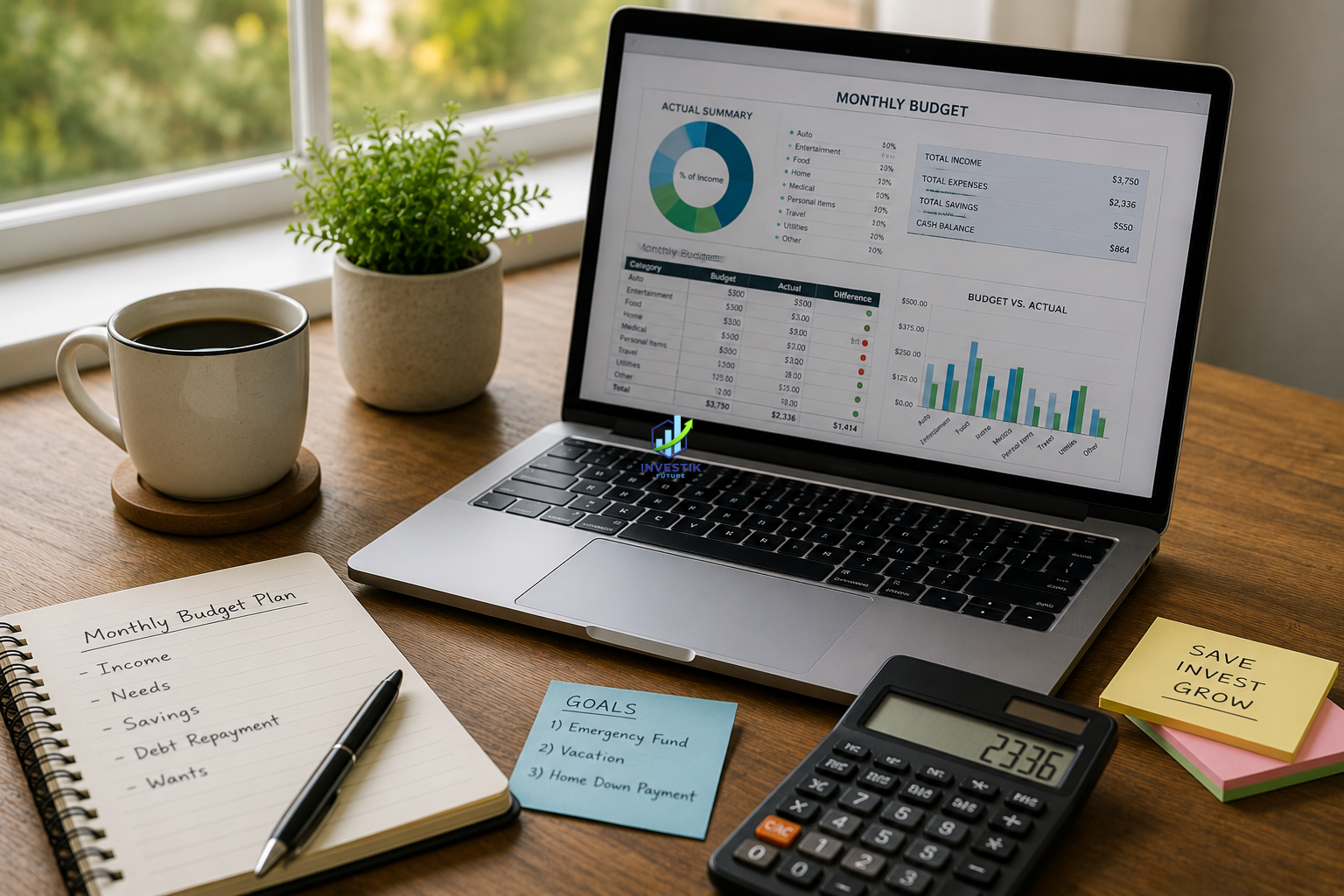

Most budgets die in the second week. Someone downloads a spreadsheet, fills in last month’s rent and grocery bill, feels good about it, then forgets it exists by the 10th. The problem isn’t willpower. The problem is that most budgets are built to track spending after the fact instead of directing it before the fact.
A monthly budget that actually works does one job: it tells your money where to go before the month starts, and it survives contact with a real paycheck, a real festival season, and a real medical bill. Building a monthly budget that actually works isn’t about a stricter spreadsheet. It’s about the order you assign money to goals. This guide covers the full process, from your first income calculation to the exact checklist you can run every month for the next ten years.
You can build this system on paper, in a spreadsheet, or with the free tools on the Investik Future calculators page. What matters is the order of operations, which we’ll walk through step by step.
Why most monthly budgets fail
Three reasons show up again and again.
They track the past instead of planning the future. A budget that only records what you spent last month is a diary, not a plan. It tells you what happened. It doesn’t tell your money what to do next.
They ignore irregular expenses. Insurance premiums, school fees, festival gifts, and annual subscriptions don’t show up every month, so they get left out of the plan entirely. Then October arrives with a school fee and a Diwali budget at the same time, and the whole system collapses.
They start with expenses instead of goals. Most people list rent, groceries, and EMIs first, then see what’s left for savings. Flip that order and savings becomes the thing that gets protected, not the thing that gets whatever survives.
A working budget fixes all three. It looks forward, plans for irregular costs, and pays your goals first.
Step 1: Calculate your real monthly income
Start with the number that actually lands in your bank account, not your CTC.
For salaried employees under the new tax regime for FY 2026-27, the slab structure looks like this:
| Annual income slab | Tax rate |
|---|---|
| Up to ₹4,00,000 | Nil |
| ₹4,00,001 to ₹8,00,000 | 5% |
| ₹8,00,001 to ₹12,00,000 | 10% |
| ₹12,00,001 to ₹16,00,000 | 15% |
| ₹16,00,001 to ₹20,00,000 | 20% |
| ₹20,00,001 to ₹24,00,000 | 25% |
| Above ₹24,00,000 | 30% |
A standard deduction of ₹75,000 applies to salaried income, and a rebate under Section 87A brings tax liability to zero for taxable income up to ₹12 lakh, which means gross salary up to roughly ₹12.75 lakh a year can be effectively tax-free for many salaried taxpayers. Slab rates and rebate limits change with each Union Budget, so check the Income Tax Department’s official portal before you rely on these figures for filing.
Once tax and any employer deductions like EPF are removed, you’re left with your net monthly income. That’s the number your entire budget is built on. If your income varies month to month (freelance work, commission, business income), use the average of your lowest three months from the last year, not your best month. Building a budget on your best month guarantees a shortfall in your worst one.
Step 2: Track spending for 30 days before you plan anything
Before assigning a single rupee to a category, spend one month simply recording where money goes. Use a notebook, a notes app, or a bank statement export. The goal isn’t to judge the spending. It’s to see the real pattern.
Most people are surprised by two categories: food delivery and subscriptions. A ₹250 delivery order three times a week is ₹3,000 a month, or ₹36,000 a year, which is close to a full month’s rent for many renters in tier-2 cities. You can’t fix a number you haven’t seen.
Step 3: Sort expenses into three buckets
Once you have real data, split every expense into three groups.
Fixed: rent, EMIs, insurance premiums, school fees, internet. These don’t change month to month and usually can’t be cut quickly.
Variable necessary: groceries, fuel, electricity, phone bills. These change with usage but you can’t eliminate them.
Discretionary: dining out, entertainment, shopping, subscriptions. These are the first place to look for adjustments, because cutting here doesn’t threaten your basic stability.
This split matters because it tells you where flexibility actually exists. Cutting a fixed EMI mid-month isn’t realistic. Cutting two dinners out is.
Step 4: Choose the right monthly budgeting method
There’s no single correct method. The right one depends on how much structure you want and how variable your income is.
| Method | How it works | Best for |
|---|---|---|
| 50/30/20 rule | 50% needs, 30% wants, 20% savings and debt repayment | Salaried employees with stable income who want a simple starting framework |
| Zero-based budgeting | Every rupee of income is assigned a job, so income minus allocations equals zero | People who want tight control and have irregular expenses to plan for |
| Envelope system | Cash or virtual “envelopes” for each category; spending stops when the envelope is empty | People who overspend on discretionary categories and need a hard stop |
| Pay-yourself-first | Savings and investments are moved out on salary day, before any spending happens | Anyone who struggles to save what’s “left over” at month-end |
Many people who make a budget work long-term actually combine two of these: pay-yourself-first for savings, and 50/30/20 for everything else. The point isn’t to follow one system perfectly. It’s to pick a structure you’ll still be using in month six.
Step 5: Pay your goals first, not last
This is the single change that separates budgets that survive from budgets that don’t.
On salary day, move money to savings and investments before you touch anything else. If you wait until month-end to see what’s left, the answer is almost always “not much,” because spending naturally expands to fill available money.
A common allocation for someone earning ₹60,000 a month net looks like this:
| Category | Allocation | Amount |
|---|---|---|
| Rent and utilities | 30% | ₹18,000 |
| Groceries and household | 15% | ₹9,000 |
| EMIs and insurance | 15% | ₹9,000 |
| SIP and long-term investing | 15% | ₹9,000 |
| Emergency fund | 5% | ₹3,000 |
| Discretionary spending | 15% | ₹9,000 |
| Buffer for irregular costs | 5% | ₹3,000 |
If you’re setting up a Systematic Investment Plan for the first time, the SIP calculator on Investik Future shows how a fixed monthly amount grows over time, which makes it easier to decide how much of that 15% to commit before you see the number shrink your take-home pay.
Step 6: Build an emergency fund before anything else grows
An emergency fund is 3 to 6 months of essential expenses, kept in a liquid instrument like a savings account, a liquid mutual fund, or a sweep-in fixed deposit. It is not an investment. Its only job is to exist when a job loss, medical bill, or major repair shows up.
Without this fund, any unplanned expense gets paid for with a credit card or a loan, which turns a one-time cost into a recurring one with interest attached. Building this fund is usually the first goal a working budget should fund, even before increasing SIP amounts.
For the portion of an emergency fund you want to keep completely safe and government-backed, a Public Provident Fund account currently earns 7.1% per annum, tax-free, though PPF has a lock-in and isn’t meant for money you might need on short notice. Keep the truly liquid portion of your emergency fund in an instrument you can access within a day or two.
Step 7: Automate every transfer
Set up automatic transfers on salary day for SIPs, PPF contributions, and emergency fund top-ups. Automation removes the decision from the moment you have the least discipline, which is right after you’ve been paid and everything feels affordable.
Most banks and mutual fund platforms let you schedule a standing instruction for the day after salary credit. This single step does more to keep a budget alive than any spreadsheet formula.
Step 8: Review and adjust every month, not every year
A budget isn’t a document you write once. Spend 15 minutes at the start of each month checking three things: did any category go over, did any fixed expense change, and does the plan for next month need adjusting for something known in advance, like a festival, a renewal premium, or a family event.
This monthly review is what separates a system from a one-time exercise. Annual budgets go stale by March. Monthly reviews stay accurate.
How inflation affects your monthly budget over time
A fixed budget written once and never revisited quietly loses value as prices rise. Retail inflation in India has moved in a band roughly between 3% and 6% over recent years, and the Reserve Bank of India targets 4% with a tolerance band of plus or minus 2 percentage points. You can track current figures directly on the RBI’s data portal.
In practical terms, this means the ₹9,000 you allocate to groceries this year will likely need to be higher next year, even if your habits don’t change. Building in a small annual increase to variable-necessary categories, rather than being surprised by it, keeps the budget realistic instead of aspirational.
Common monthly budgeting mistakes to avoid
Forgetting annual and irregular expenses. Insurance renewals, school admission fees, and annual subscriptions should be divided by 12 and set aside monthly, not treated as a surprise when the bill arrives.
Setting a discretionary budget at zero. A budget with no room for enjoyment gets abandoned within weeks. Build in a reasonable amount for things you actually enjoy, and treat it as non-negotiable, not as something to feel guilty about.
Copying someone else’s percentages exactly. The 50/30/20 split works differently for someone paying Mumbai rent versus someone in a smaller city with lower housing costs. Adjust the framework to your actual fixed costs before applying it.
Not accounting for EMI stacking. Taking a personal loan, a car loan, and a credit card EMI at the same time can push fixed obligations past 40-50% of income, which leaves too little room for savings or discretionary spending. Keep total EMI obligations, ideally, under 40% of net income.
Treating credit card limits as available income. A budget should be built on your income, not on how much credit is available to you.
Sample monthly budget checklist for every month
- Confirm net income for the month, including any variable or bonus income
- List all fixed expenses due this month, including annual costs divided by 12
- Confirm SIP, PPF, and emergency fund transfers are scheduled for salary day
- Review last month’s discretionary spending against the plan
- Check for any known upcoming expense in the next 60 days
- Adjust one category if last month’s actual spending was consistently off
- Confirm emergency fund balance still covers 3 to 6 months of expenses
Budgeting at different life stages
First job: Prioritize building the emergency fund and starting a small SIP, even ₹1,000 to ₹2,000 a month, before increasing lifestyle spending. The habit matters more than the amount at this stage.
Mid-career with a family: Fixed costs typically rise (school fees, larger rent, insurance for dependents). Revisit the 50/30/20 split, since fixed costs often exceed 50% at this stage, and adjust discretionary spending down rather than cutting into savings.
Approaching retirement: Shift focus from accumulation to preservation. A higher share of the budget should go toward low-risk instruments, and discretionary spending often needs a fresh look as income sources change closer to retirement.
Frequently asked questions
How much of my income should go to savings? 20% is a common starting target under the 50/30/20 rule, but the right number depends on your fixed costs and goals. Someone with low fixed costs can often push savings higher; someone with high rent or EMI obligations may need to build up to 20% gradually.
Should I budget before or after paying EMIs? EMIs are fixed obligations and should be listed first, alongside rent and insurance. Savings then get allocated from what remains after fixed costs, ideally before discretionary spending, not after.
What if my income changes every month? Base your fixed-cost budget on your average from the lowest three months of the past year. In months where income is higher than that average, direct the surplus to savings or the emergency fund rather than increasing lifestyle spending.
Is a spreadsheet enough, or do I need an app? Either works. What matters is that you review it monthly and that transfers to savings happen automatically rather than manually.
Keeping your monthly budget that actually works on track
The framework above only works if you revisit it. A monthly budget that actually works isn’t the one with the most detailed categories. It’s the one you still check on day one of every month, six months from now. Treat the review in Step 8 as non-negotiable, and the rest of this system holds.
Related reading
For a deeper look at how compounding works once your SIP contributions are automated, see what an SIP is and how it works.
A monthly budget that actually works isn’t a restrictive document. It’s a small number of automated decisions made once, on salary day, that protect your goals before your spending has a chance to compete with them. Start with one month of honest tracking, pick a structure you can sustain, and automate the transfers that matter most. The system gets easier every month you keep it running.
ARN Disclosure: Investik Future is an AMFI-registered Mutual Fund Distributor. ARN-341107 — Verify on AMFI ↗. Komal Thakur is the content author and digital marketer; the ARN registration belongs to Investik Future, not to the author personally.