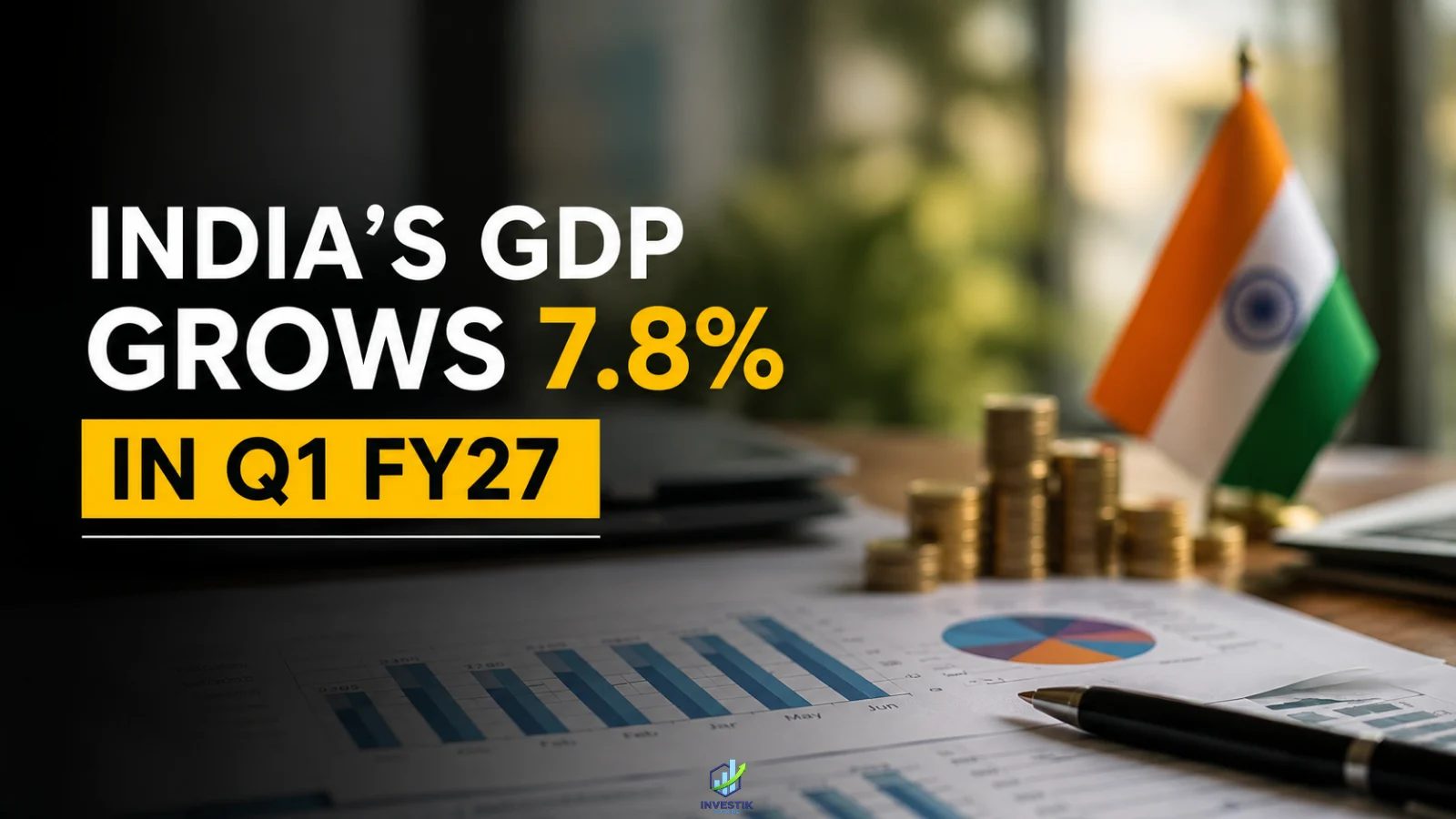

India’s economy grew 7.8% in the first quarter of FY27 (April–June 2026), beating both market expectations and the Reserve Bank of India’s own 7% estimate for the quarter. The data, released by MoSPI on August 31, has renewed the focus on where India’s full-year FY27 growth could eventually land.
In this article, we’ll look at what drove this growth, how it compares with what was expected, what economists are now saying about the rest of FY27, and what it could mean if you’re tracking the economy as an investor.
India’s GDP Grew 7.8% in Q1 FY27: What Happened?
On August 31, the Ministry of Statistics and Programme Implementation (MoSPI) released its estimate for India’s GDP growth in the April–June quarter of FY27. The number came in at 7.8%, ahead of the RBI’s 7% estimate and the 7.1% forecast.
Real GDP simply means the size of the economy after adjusting for inflation. If prices go up but the actual amount of goods and services produced stays the same, real GDP growth won’t show any increase; it only counts genuine growth in output. That’s why economists prefer this number over nominal GDP when judging how the economy is actually doing.
In rupee terms, real GDP for Q1 FY27 came in at about ₹81.36 lakh crore, up from ₹75.46 lakh crore in the same quarter last year. Nominal GDP (which does include the effect of price rises) grew even faster, at 10.3%, touching ₹88.27 lakh crore.
What made the number stand out is the backdrop it came against. The quarter also saw significant disruption from the West Asia conflict, including higher energy prices and supply-chain concerns. Growing 7.8% despite that pressure is why the figure caught so much attention, and why Prime Minister Narendra Modi publicly welcomed the data.
Why Did India’s Economy Grow 7.8%?
A few things worked together to push growth higher this quarter.
Investment was one of the biggest drivers of growth. Gross fixed capital formation, essentially spending on things like factories, machinery, roads and buildings, grew close to 12% in the quarter. Capital spending by the central government, state governments and public sector companies together rose faster than it did a year ago. Bank of Baroda’s chief economist Madan Sabnavis pointed out that capital formation’s share of the economy has risen meaningfully, helped by private investment in areas like data centres, power and metals.
Exports held up well. Despite global uncertainty, exports grew by around 12% during the quarter, adding to overall demand.
Manufacturing stayed strong. Factory output grew by more than 9%, a healthy pace given the disruptions to input costs during the quarter.
Services kept doing the heavy lifting. Financial services, real estate and professional services grew the fastest among all sectors, at over 12%, showing that India’s large services economy continues to expand at a solid clip.
Consumers kept spending, though a little more slowly. Private consumption, money spent by ordinary households, grew around 7%. This matters because household spending makes up the largest single chunk of India’s economy, so even modest growth here adds up.
Agriculture grew steadily. Farm output expanded by a bit over 3.5%, a reasonable number even with an uneven start to the monsoon.
How Does the 7.8% Growth Compare With Expectations?
Before the data came out, the RBI had projected growth of around 7% for this specific quarter, and a Reuters poll of economists had pegged it at 7.1%. The actual number beat both comfortably.
A beat like this matters for a simple reason: it tells policymakers, businesses and investors that the economy has more momentum than the models suggested. When growth surprises on the upside during a quarter marked by an external shock, it usually gets read as a sign of underlying strength rather than a one-off blip.
What Was the Earlier FY27 GDP Growth Forecast?
Before the Q1 data was out, the Economic Survey, presented in Parliament in January 2026, had projected real GDP growth for the full FY27 year in a range of 6.8% to 7.2%. This projection was based on the information available at that time, months before actual Q1 numbers were in hand.
It’s worth being clear that this was an early-year projection, not a live forecast updated for the latest data. Around February 2026, the Chief Economic Adviser had already nudged this range up slightly, to around 7% to 7.4%, even before the Q1 numbers arrived. The RBI, separately, has been working with a more conservative full-year FY27 estimate of 6.7%.
These are different numbers from different institutions, made at different points in time, not competing claims about the “real” figure.
Are Economists Raising Their FY27 Growth Forecasts?
This is where the Q1 data has made the biggest difference. Within hours of the government’s release, several private economists and rating agencies began revising their full-year FY27 estimates upward.
CareEdge Ratings’ chief economist Rajani Sinha raised her FY27 growth estimate to 7.3%, up from 7% earlier. ICRA, which had been holding its FY27 forecast at 6.7%, raised it to 7.1% after the print. India Ratings & Research’s Devendra Pant and Bank of Baroda’s Madan Sabnavis also said FY27 growth could now cross 7%.
Not everyone has turned equally optimistic. Brickwork Ratings’ Rajeev Sharan noted that the quarter’s strength came from a genuine pickup in investment, but flagged that a tougher year-on-year comparison base in the second half of the year, along with softer demand from abroad, could slow the pace. Brickwork has kept its FY27 estimate closer to 6.7%.
Put together, several private forecasts have now moved to around 7% or above. The RBI’s official full-year number, still at 6.7% as of its last review, hasn’t been revised since the data, a reminder that one strong quarter doesn’t automatically rewrite every institution’s outlook.
Can India Maintain This Growth Through FY27?
It’s tempting to look at a strong first quarter and assume the rest of the year will follow the same script. Economists are being careful not to do that, and for good reason.
A few things could help growth stay elevated:
- Continued government and private capital spending
- Steady household consumption, especially if inflation stays low
- Resilient manufacturing and services activity
- Exports holding up if global trade conditions don’t worsen further
But there are real risks too:
- The West Asia conflict and its effect on crude oil prices could resurface
- A slower global economy could dent India’s exports
- Food prices and monsoon progress remain something to watch, since they affect both inflation and rural demand
- The comparison base gets tougher in the second half of the year, since growth was already high in the same period last year.
CEA V. Anantha Nageswaran struck a similar note, saying domestic demand and investment remain the key supports for growth, but food prices, the monsoon and global uncertainty are worth watching closely in the months ahead.
What Could Drive India’s Growth in the Coming Quarters?
A few specific things are worth tracking if you want a sense of where growth is headed next.
Consumption: Are households still spending at a healthy pace, or is that slowing as the base effect from last year’s festive season fades?
Investment: Is the pickup in capital spending by companies and the government continuing, or was this quarter’s surge partly front-loaded?
Manufacturing: Can factories keep growing at this pace once input costs from the West Asia disruption work their way through?
Services: Financial services, real estate and IT have been the standout performers; can that continue?
Exports: With global demand uncertain, can Indian exporters keep finding buyers abroad?
None of these factors work in isolation; they tend to move together, which is why economists look at the whole picture rather than any single number.
What Does Stronger GDP Growth Mean for Investors?
A stronger economy generally supports business activity, which can translate into better corporate earnings, more hiring, and stronger consumer demand over time. That’s the basic link between GDP growth and company performance.
But it’s important to be clear about something: strong GDP growth does not automatically mean stock markets will rise. Stock prices are shaped by a mix of factors, company earnings, valuations, interest rates, global market trends, and investor expectations, among others. A good GDP number is one input into that picture, not the whole story. Markets often move on expectations about the future rather than reacting mechanically to a single data release, so it’s worth treating this as useful context rather than a trading signal on its own.
What Should Investors Watch Next?
A few things worth keeping an eye on over the coming months:
- The next GDP releases: Q2 FY27 data will show whether this pace of growth is holding up or cooling off.
- RBI policy decisions: the central bank’s view on inflation and growth will shape interest rate decisions, which matter for borrowing costs and markets.
- Inflation trends: especially food prices, since they affect both household spending power and monetary policy.
- Government capital spending: a big driver of this quarter’s growth, so its pace going forward matters.
- Corporate investment activity: whether private companies keep expanding capacity.
- Manufacturing and export data: both were strong this quarter and are worth tracking for signs of continuation or slowdown.
- Global economic conditions: since India’s exports and capital flows are tied to how the rest of the world is doing.
Conclusion
The 7.8% Q1 growth is a positive start to FY27, but it’s too early to assume the same pace will continue right through the year. The next few quarters will show whether strong domestic demand and investment can keep growth at these elevated levels, especially as global risks like the West Asia situation and trade conditions continue to evolve.




FAQs
What is India's real GDP growth in Q1 FY27?
India's real GDP grew 7.8% in the April–June quarter of FY27 (2026-27), according to MoSPI data released on August 31, 2026. This was higher than the 6.9% growth recorded in the same quarter of the previous year.
Why did India's GDP grow 7.8% in Q1 FY27?
Growth was led by strong capital investment (up nearly 12%), robust exports (up around 12%), solid manufacturing output (up over 9%), and continued momentum in financial and professional services, alongside steady household consumption.
What is India's GDP growth forecast for FY27?
Forecasts vary. The RBI projects 6.7% for the full year. The Economic Survey had earlier projected 6.8%–7.2%. After the strong Q1 print, several private economists have raised their estimates to a 7%–7.3% range.
Has India's FY27 GDP forecast changed after the Q1 data?
Yes, several private economists and rating agencies, including CareEdge Ratings and India Ratings & Research, raised their FY27 growth estimates after the Q1 data, though some, like Brickwork Ratings, have stayed more cautious given a tougher base in the second half of the year.
What is real GDP growth?
Real GDP growth measures how much an economy's output of goods and services has increased after removing the effect of inflation. It gives a clearer picture of whether the economy is actually producing more, rather than just showing higher prices.
ARN Disclosure: Investik Future is an AMFI-registered Mutual Fund Distributor. ARN-341107 — Verify on AMFI ↗. Himani Soni is the content author and digital marketer; the ARN registration belongs to Investik Future, not to the author personally.