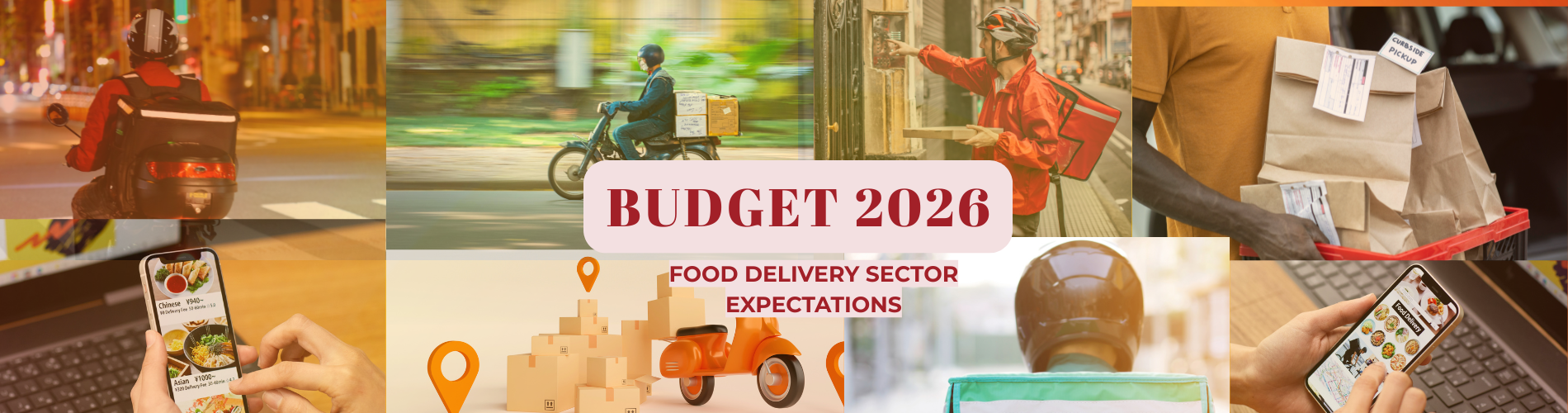

As someone who watches market trends, consumer behaviour, and policy shifts for a living, the food delivery sector in India has been one of my most fascinating and increasingly concerning case studies over the past decade. The rapid rise of on‑demand food ordering isn’t just a convenience story. It’s a structural shift in how Indians eat, work, and spend money.
Today, this sector is worth tens of billions of dollars, employs millions, and has fundamentally changed the economics of restaurants big and small. According to industry estimates, India’s online food delivery market was about ₹66,000 crore in 2023 and is expected to touch around ₹2.1 lakh crore (~$25+ billion) by 2030, growing at roughly 18% CAGR. But if Budget 2026 fails to address some hard challenges this ecosystem faces, we may soon witness a period of contraction, not expansion.
In this article, I’ll explain why I believe targeted tax rationalisation and policy support in the upcoming Union Budget isn’t just desirable, it’s essential.
From Convenience to Economic Cornerstone
When I first started tracking the food delivery market, I viewed it mostly through the lens of consumer tech adoption. Smartphones, cheap data, and digital payments together are equal to a new convenience economy.
But over the years, what seemed like a convenience trend has become an economic anchor. Platforms like Zomato and Swiggy don’t just bring meals to your doorstep; they form a revenue lifeline for restaurants, cloud kitchens, suppliers, delivery partners, and logistics providers.
For many urban restaurants today, deliveries make up 30–60% of total revenue, sometimes more. For cloud kitchens, delivery isn’t just an option; it’s the only business model.
This growth, to me, is remarkable. But it’s also misleading if we look only at top‑line value without accounting for real industry stress.
Where the Growth Story Starts to Strain
Let’s be honest: the demand side is still strong. People eat out less often but order in more. Urban lifestyles remain busy. India’s young population continues to upgrade its consumption patterns.
But beneath this surface are structural cost pressures that most consumers and increasingly many investors tend to overlook:
Rising Input Costs Squeezing Margins
I’ve spoken directly with restaurant owners who tell me raw material prices, fuel costs, utilities, rent, and labour have all grown faster than their revenues.
Even as order volume increases, profit doesn’t, far from it. Small and mid‑sized restaurants, particularly, can barely absorb cost increases, let alone platform commissions or delivery charges. For them, the economics are barely sustainable.
GST: A Tax Architecture That Needs Rethinking
This brings us to a crucial point: taxation under the Goods and Services Tax (GST), and why I think its current structure unintentionally hurts the ecosystem.
The original vision of GST was simplification and the elimination of cascading taxes. But in practice:
- Delivery charges attract 18% GST
- Both packaging and service costs often fall into taxable categories
- There’s ambiguity about how different components should be taxed
For consumers, this often means higher final prices. For restaurants and platforms, it means squeezed margins and complex compliance.
And here’s what I find most ironic: a tax meant to simplify has become a barrier, especially for smaller players who lack deep accounting teams.
Platforms: Caught Between Regulation and Growth
Delivery apps operate in a tough balancing act:
- They must comply with taxes and regulations
- They need to support restaurants
- They must retain price‑sensitive consumers
- They’re under pressure to subsidise delivery and discounts to maintain market share
Higher tax outgoes shrink their ability to offer incentives. Consequently, users order less frequently, restaurants earn less, and the glue that held this ecosystem together, affordable convenience, unravels.
This is why I’ve been vocal in investor circles: policy choices today affect user behaviour tomorrow.

The Case for Targeted Tax Relief in Budget 2026
Industry associations and restaurateurs aren’t asking for handouts. They want smart policy decisions. Here’s what I believe should be on the government’s agenda:
- Rationalise GST on Delivery‑related Services: Not a blanket cut, but clear rules and lower effective rates on components like delivery charges and packaging.
- Simplify Tax Compliance: Micro and small restaurants struggle with complex filings. Faster digital processes, threshold exemptions, or simplified schemes would help.
- Incentivise Digital Transition: SME restaurants that depend on delivery platforms should get targeted relief as they digitise operations, similar to export incentives in other sectors.
Rising Compliance Pressure: More Than Just Taxes
Beyond GST, restaurants face a maze of compliance requirements, licensing, labour codes, local inspections, renewal fees, and more. Many owners have to hire consultants just to stay compliant.
This adds an administrative tax, invisible but real.
In Budget 2026, easing such compliance friction should be part of the conversation. For example:
- Streamlined licensing across states
- One‑window approval systems
- Reduced renewal costs for SMEs
If India wants this ecosystem to scale sustainably, red tape must be reduced at multiple junctures.
Why This Matters Beyond Food Delivery
When I talk about this sector, I’m not just talking about eating food. I’m talking about:
- Jobs for millions of delivery riders
- Entrepreneurship for restaurant owners
- Growth for cloud kitchens and food tech startups
- Logistics efficiencies that spill into other digital services
A slowdown here would ripple across adjacent sectors, logistics, employment, urban consumption, payments, and real‑time delivery services.

What I’d Like to See From Budget 2026
If I had a seat at the Budget table, and metaphorically, I do as someone who follows policy closely, here’s what I would urge:
- Policy that Enables, Not Burdens: Rational taxation, digital‑first compliance, and incentives for sustainable business models.
- Clarity Over Ambiguity: Resolve confusion over which delivery fees attract GST and how to treat platform commissions.
- Support for Small Businesses: Not in the form of subsidies alone, but through structural relief that lowers operational cost and compliance complexity.
A Word to Investors and Stakeholders
My belief is this: the viability of India’s food delivery market hinges as much on policy as on technology. Investors should look beyond top‑line growth and ask:
- Are margins sustainable?
- Is compliance an overhang?
- What happens if consumer subsidies disappear?
- How does tax policy affect unit economics?
These questions will determine whether the current enthusiasm translates into long‑term value or a short‑lived boom.
Closing Thoughts
India’s food delivery ecosystem isn’t just a market; it’s a stirring example of how digital adoption can reshape traditional industries. But growth without policy support and tax clarity can quickly hit a structural wall.
It all comes down to Budget 2026. It presents a pivotal opportunity. Thoughtful reforms can unlock productivity, preserve jobs, and propel the sector toward sustainable expansion.
And if we miss this moment? We might find ourselves debating downsizing instead of scaling up a conversation I sincerely hope we avoid.
Also Read: Union Budget 2026: Jan Vishwas 3.0 and What Structural Reforms Mean for Investors
Disclaimer
The views expressed here are my own, based on industry trends, interviews with stakeholders, and economic indicators. This article is for informational purposes only and does not constitute financial or tax advice.

Himani Soni
I’m Himani Soni, a finance content strategist with 2+ years at Investik Future. I decode market trends and simplify complex investing concepts into clear, actionable insights for the everyday investor.