

Economic Survey 2026 is one of the most consequential documents in India’s public policy calendar, and every January, it inevitably draws my attention. It’s more than a statistics report; it’s a statement of economic philosophy, a roadmap for the year ahead, and often, an investment treasure of insights for investors and financial planners like myself.
Presented in Parliament just before the Union Budget, this year’s Economic Survey 2026 is no different, and what impressed me is its mix of optimism with realism. It showcased an economy that’s firing on multiple cylinders domestically, while also navigating global uncertainty with a mix of caution and confidence.
Before I dive deeper into the key takeaways, here’s why this matters for you as an investor
- It provides a macroeconomic backdrop against which corporate earnings, market sentiment, and investment flows will evolve.
- It provides clues about future policy reform, taxation, and fiscal priorities.
- It signals structural shifts in savings, consumption, and production patterns.
- And most importantly, it sets expectations for the Budget, where fiscal decisions directly impact markets and investor behaviour.
So let’s unpack the narrative in a language that’s practical, personal, and useful.
Growth Story: Steady, Not Spectacular, But Strategic
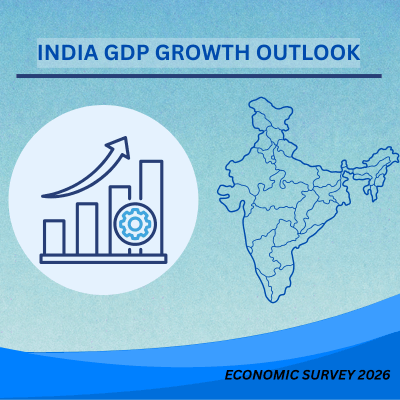
One of the most talked-about numbers this year is the projected GDP growth band of 6.8%–7.2% for FY27. This reflects a modest moderation compared to earlier estimates, but not a crisis, but instead a calibration amid global slowdowns and supply chain disruptions.
In my view, this is precisely what you want from a resilient economy: growth that isn’t overheating, but isn’t faltering either. And importantly, it is supported in domestic demand; consumption accounts for a significant share of GDP, and this strength supports both equities and corporate earnings forecasts.
Economic Survey 2026 on Household Investing Trends
One line from the Economic Survey 2026 that made me sit up was the rapid shift in savings behaviour. Household allocation to equities and mutual funds has jumped significantly over the past decade, and SIP contributions have multiplied multiple times.
For years, I’ve argued that India’s investor base is fundamentally changing; it’s not just about gold, real estate or bank FDs anymore. Retail participation in equity markets is a sign of financial maturity and a growing appetite for market-linked growth.
This trend, when connected to behavioural insights, supports one of my long-held views: the Indian investment psyche is evolving from risk-averse saving to risk-smart investing. And that’s bullish for capital markets in the long run.
Global Risks Are Real, But India Isn’t Helpless
I’ve always been sceptical of headlines that depict India as immune or isolated from global forces. The Economic Survey 2026 doesn’t sugarcoat it: from geopolitics and weak exports to currency volatility, risks loom large.
The depreciation of the rupee highlights how interconnected we are in today’s financial world.
What I appreciate is that the Survey frames these not as shake-the-ground calamities but as manageable headwinds. And for investors, that’s crucial: challenge is strategic positioning.
Structural Reforms as Growth Multipliers
Beyond numbers, the Economic Survey 2026 highlights significant shifts in policy execution and regulatory thinking. One example that caught my attention was the shift toward a technology-driven tax system using behavioural insights, in an effort to reduce compliance friction and improve voluntary tax compliance.
It may sound niche, but this nudge-based approach has far-reaching implications:
- Lower compliance costs for small businesses.
- Greater predictability in tax revenues.
- Improved ease of doing business, which, in turn, attracts investment.
To me, this says a lot about how India is embracing next-gen governance tools, and that’s something investors should watch closely.
Education, Talent, and the Future of Work
One lesser-highlighted but critically important aspect of the Economic Survey 2026 was its focus on internationalisation of education, which will open doors for foreign campuses, mutual recognition of degrees, and talent attraction strategies.
From an economic viewpoint, this signals an understanding that future competitiveness isn’t just about factories or tech parks, it’s about human capital. A more globally integrated education system could mean:
- Higher-skilled workforce.
- Improved innovation potential.
- Attractive conditions for MNCs and knowledge-intensive sectors.
Investors ignoring this aspect might miss one of the secular drivers of India’s long-term economic competitiveness.
The Consumer Remains King, But Jobs Matter
Domestic demand is what’s driving the growth story, but there’s a flip side: job creation continues to be an area of concern. Economic surveys and independent surveys alike show concerns about unemployment, underemployment, and skill mismatches.
So while we see strong consumption, a balanced recovery should translate to robust employment growth, especially in manufacturing and services.
The Budget Is the Next Act, And the Survey Sets the Stage
If you’re wondering what comes next, it’s the Union Budget. And the Survey’s narrative is essentially the prelude to that moment: growth anchored in domestic demand, structural reforms, fiscal discipline, and calibrated risk management.
Expect the Budget to build on these themes, whether it’s through targeted capital expenditure, tax rationalisation, or incentives for strategic sectors.
A Personal Closing Thought
I don’t want to oversell it. I finished reading this year’s Economic Survey feeling cautiously optimistic. We are not being promised meteoric growth. Instead, we’re offered a sensible, grounded assessment of India’s economic trajectory, one rooted in domestic strengths, aware of global realities, and built on long-term reform momentum.
Also Read: Union Budget 2026: EPS Minimum Pension Hike, Key Demands and What Pensioners Can Expect
Disclaimer
This article is for informational and educational purposes only. It is the author’s personal opinion and does not constitute professional financial advice. Investment decisions should be based on individual research, risk tolerance, and consultation with qualified financial advisors.

Himani Soni
I’m Himani Soni, a finance content strategist with 2+ years at Investik Future. I decode market trends and simplify complex investing concepts into clear, actionable insights for the everyday investor.