

When it comes to IPOs, I always try to separate hype from reality. And as someone who closely follows India’s SME market and retail investor behaviour, I found Davin Sons Retail’s IPO a fascinating case study. In this article, I’ll walk you through the IPO from start to finish, the subscription frenzy, business fundamentals, listing reality, and what it means for investors like us.
By the end of this article, you’ll understand why SME IPOs like this are high-risk but potentially rewarding, how oversubscription and grey market trends work, and what I personally learned from tracking this IPO in real-time. I’ll also provide some guidance on what to look for when looking at other SME-style opportunities.
Why I Paid Attention to Davin Sons Retail IPO
I have a habit of monitoring IPOs in areaswhere growth and diversification collide. Davin Sons Retail immediately caught my attention for two reasons:
- Strong financial growth: The company’s revenue increased from ₹3.91 crore in FY23 to ₹13.39 crore in FY24, and its profit after tax jumped from ₹0.56 crore to ₹1.64 crore over this period.
- Diversified business model: With a business of garment manufacturing and FMCG distribution, the company is diversified in terms of revenue, which is unusual to find in SME based companies coming to IPO.
Those numbers and business operations made me convinced this wasn’t just another IPO fad. The story had a lot of meat to it that I wanted to dig into.
IPO Basics — What You Should Know
Here’s what I saw, as I looked through the details of the filing. Davin Sons Retail has fixed the issue price at ₹55 per share to raise ₹8.78 crore through the fresh issue of shares at par. For me, as a retail investor, the minimum lot was 2,000 shares, which meant I had to invest that much at least in order to apply for one lot.
The IPO opened for subscription on January 2, 2025, and closed on January 6, 2025. The allotment was scheduled to take place shortly thereafter, they said, adding that the company aimed to be listed on the BSE SME platform. The money was used to buy a warehouse, for partial financing of working capital and general corporate purposes.
The reason why I found this IPO very interesting was that this firm has two businesses: garment manufacturing and FMCG distribution. Both of these markets are doing well, and most small-to-medium enterprises (SMEs) would think themselves fortunate to have a shot at one, let alone both, through Davin Sons Retail.
Subscription Frenzy — What It Meant to Me
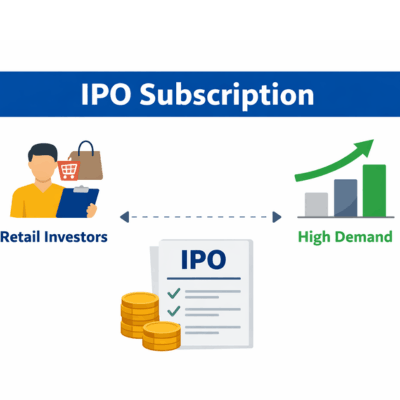
By the time its I.P.O. closed for bidding, it was oversubscribed 120.8 times, with retail investors subscribing at a rate of 164.78 times.
It was fascinating to see this play out in real time. Oversubscribe is an indicator of demand, but it also says something about investor psychology:
- Many participants likely jumped in due to fear of missing out.
- The low issue size amplified subscription multiples, creating massive numbers that may not reflect long-term fundamentals.
For me, this was a reminder that high demand can be exciting, but it’s no guarantee of profits, especially in SME listings where liquidity is limited.
Grey Market Premium — A Cautious Signal
Before the listing, the grey market premium (GMP) was quoted at around ₹15 over the high end of the ₹55-60 per share price band, indicating that shares could list at about ₹70.
What I’ve learned through the years, however, is that GMP can be speculative. It does give a sense of market sentiment, but it’s not foolproof. I’ve found that just solely looking at GMP can tell a very skewed story, particularly in the case of SMEs where odd-lots make up a greater part of trading volume and even small blocks of stock have an out-sized impact on price.
Listing Reality — Lessons Learned
With a robust subscription and good GMP, Davin Sons Retail IPO is also listed below its IPO cost at nearly ₹44.
Seeing this live reinforced something I always tell readers: High subscription and GMP don’t always translate to listing profits.
SME IPO prices are often very close , and the liquidity is lower; initial market sentiment can be volatile. This is an important point when looking for short-term profits.
Business Fundamentals — What I Focused On
Numbers can be misleading on their own. I looked at Davin Sons Retail’s business through the lens of its long-term potential:
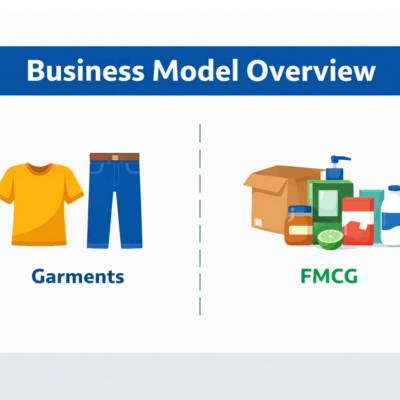
- Garment manufacturing: Designs and makes readymade clothing for other brands, from denim jackets, jeans, and shirts.
- FMCG distribution: Distributes products for large FMCG companies in India.
This dual approach provides me with the comfort of diversification in risk, an objective met with SME. But the company is still young, and so it has a short history and limited operating stability. Meanwhile, with these kinds of SME listings, you never get any institutional participation, so liquidity and price stability are lost.
Who This IPO Suits — My Take
From my perspective, Davin Sons Retail is not for casual, short-term investors. Here’s how I think about it:
Best suited for:
- Investors seeking exposure to SMEs
- For those who can tolerate volatility and low liquidity
- People looking to hold medium to long-term
Not suited for:
- Investors seeking quick listing gains
- Those risk-averse or expect guaranteed returns
I always remind readers: understanding the SME market dynamics is crucial before investing.
Key Takeaways From My Experience
Here are a few key lessons I learned while following this IPO:
- Oversubscription is not equal to guaranteed profit. The reality of the market can sometimes differ from the hype.
- GMP is sentiment, not a valuation. Use it cautiously.
- Liquidity is crucial post-listing. Don’t assume an easy exit.
- Business fundamentals still matter. Strong growth helps but doesn’t immunise against volatility.
For me, this I.P.O. served as a reminder that knowledge, patience and diligence will always trump speculation.
Also Read: Shadowfax Technologies IPO Lists at 9% Discount After Weak Market Debut
Disclaimer
This article is for educational and informational purposes only. It is not investment advice. All investing involves risk, including loss of principal. As always, do your own research and consult a financial professional before investing.

Himani Soni
I’m Himani Soni, a finance content strategist with 2+ years at Investik Future. I decode market trends and simplify complex investing concepts into clear, actionable insights for the everyday investor.