

Union Budget 2026: 10 Key Takeaways Shaping India’s Next Growth Phase

Every Union Budget creates noise. But not every Budget changes how I think about risk, opportunity, and capital allocation.
Table of Contents
ToggleBudget 2026, presented by Finance Minister Nirmala Sitharaman, is one of those rare budgets where the real story isn’t hidden in flashy announcements; it’s embedded in the policy direction. When I step back and look at it as an investor, not a headline reader, a few clear themes stand out: discipline over populism, infrastructure over consumption sugar rush, and structure over speculation.
Let me break down what actually matters to me, and why this Budget subtly reshapes how I view India’s next growth phase.
1. Fiscal Discipline Is No Longer Just a Promise — It’s a Pattern
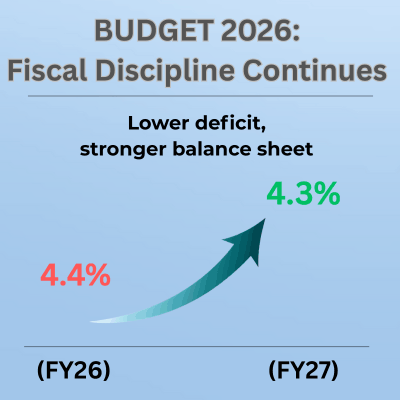
The fiscal deficit target for FY27 has been set at 4.3% of GDP, slightly lower than the current year’s 4.4%. On paper, that looks incremental. In reality, it’s important.
What I like here is consistency. India is not trying to grow recklessly. Instead, it’s sending a message to global investors and rating agencies: Growth will be funded responsibly.
This matters because sustained fiscal discipline lowers borrowing costs, stabilises currency expectations, and ultimately improves equity risk premiums. For long-term investors like me, this is the boring-but-beautiful part of policy-making.
2. Debt-to-GDP Glide Path: Quietly One of the Strongest Signals
The government has reaffirmed its plan to bring India’s debt-to-GDP ratio down to ~50% by FY31, with FY27 projected at 55.6%.
Why do I care?
Because high debt restricts future flexibility. Lower debt gives policymakers room to act during global shocks, something we will face again. This Budget doesn’t chase short-term applause; it protects India’s balance sheet.
From an asset-allocation perspective, this strengthens the long-term case for Indian equities relative to other emerging markets.
3. Record Capital Expenditure: This Is Where the Budget Truly Speaks
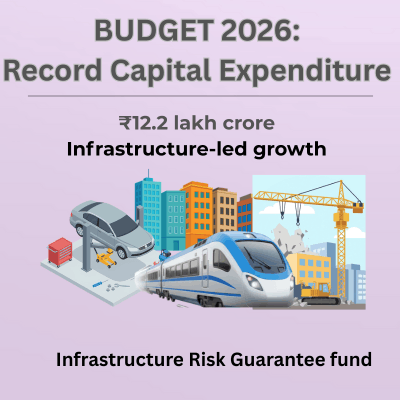
Capital expenditure crossing ₹12.2 lakh crore is not just a number; it’s a statement.
Infrastructure spending has a multiplier effect that consumption handouts don’t. Roads, railways, logistics, energy, these improve productivity, reduce friction, and crowd in private investment.
What caught my attention even more was the proposed Infrastructure Risk Guarantee Fund. Partial credit guarantees can unlock lending where banks are otherwise hesitant. That’s how stalled projects move again.
4. India Is Positioning Itself as a Global Data & AI Hub
One of the most under-discussed but transformative announcements is the tax holiday till 2047 for global cloud service providers using data centres in India.
This is strategic. India isn’t just saying “build data centres here.” It’s saying: build your digital future here.
AI, cloud computing, and data storage are foundational layers of tomorrow’s economy. Ensuring Indian participation through resellers while attracting global players strikes a smart balance.
For investors, this strengthens the long-term thesis for:
- Data centre infrastructure
- Power & cooling solutions
- Digital services ecosystems
5. MSMEs Finally Get Structural Support, Not Just Lip Service
The ₹10,000 crore SME Growth Fund, combined with a top-up to the Self-Reliant India Fund, signals a shift from survival-mode support to scale-focused backing.
Mandatory use of the TReDS platform for CPSE payments is especially meaningful. Delayed payments kill small businesses faster than bad demand.
Liquidity + compliance support + mentoring via “Corporate Mitras” is how you actually build SME champions, not with slogans.
6. Derivatives Speculation Gets a Reality Check
Raising the Securities Transaction Tax (STT) on futures and options is controversial, and honestly, overdue.
India’s derivatives volumes had started resembling a casino rather than a hedging market. Excess leverage doesn’t build wealth; it redistributes it, usually upward.
As someone who believes markets should reward patience and capital discipline, I see this as a healthy cooling mechanism, not a market killer.
7. Buybacks Now Taxed as Capital Gains: Cleaner Capital Allocation
Taxing buybacks in the hands of shareholders aligns them more closely with dividends. It removes arbitrage-driven financial engineering and nudges companies toward transparent capital-return policies.
For promoters, the additional tax ensures buybacks are used for genuine value creation, not tax efficiency.
8. Rare Earth Corridors: Strategic, Not Cosmetic
Dedicated rare earth corridors across Odisha, Kerala, Andhra Pradesh, and Tamil Nadu are about more than mining.
They’re about:
- Supply chain security
- EV and renewable manufacturing
- Reducing geopolitical vulnerability
This is a long-gestation policy, exactly the kind markets tend to ignore early and reward late.
9. High-Speed Rail & Freight Corridors: Logistics Is the Hidden Growth Engine
Seven new high-speed rail corridors and a dedicated freight corridor from Dankuni to Surat reinforce something I’ve believed for years: logistics efficiency is India’s biggest untapped advantage.
Lower logistics costs = higher margins + faster commerce + greener growth.

10. TCS Cut on Overseas Education & Medical Remittances: Small Change, Real Relief
Bringing down the TCS under LRS to 2% on education and medical remittances gives instant liquidity for families. Sure, TCS is adjustable down the line, but cash flow doesn’t count for much in life.
This move quietly supports middle-class households without distorting fiscal math.
My Final Take: This Budget Isn’t Loud — It’s Confident
Budget 2026 doesn’t scream optimism. It demonstrates control.
That’s what I value most as an investor.” Genuine structural reforms, fiscal discipline, an infrastructure-first approach and focused interventions provide the environment to allow long-term capital to compound.
Markets may react emotionally in the short term. But policies like these work slowly and reward those who stay patient.
Also Read: Budget 2026: Why Real Estate Stocks May See Selective Gains, Not a Broad Rally
Disclaimer
This article reflects my personal views and interpretation of the Union Budget 2026 from an investor’s perspective. It is not investment advice. Readers should consult a qualified financial advisor before making any investment decisions. Market investments are subject to risk.