

Budget 2026: Why Real Estate Stocks May See Selective Gains, Not a Broad Rally

As someone who closely tracks Indian equities, I’ve learnt one thing the hard way: not every Budget move lifts an entire sector. Real estate, especially, has become far more nuanced than it was a decade ago.
Table of Contents
ToggleGoing into Union Budget 2026, real estate stocks are once again grabbing headlines. But unlike earlier cycles where policy support meant a broad rally, I believe this Budget’s impact will be highly stock-specific, with clear winners and quiet laggards.
In this article, I want to break down how I’m thinking about real estate stocks this Budget, which segments actually stand to benefit, and why affordability, not luxury, remains the real policy focus.
Why Budget 2026 Matters More for Housing Than Headlines Suggest
At first glance, real estate doesn’t look like a stressed sector anymore. Sales have recovered, inventory levels are healthier, and balance sheets are cleaner than they were after the NBFC crisis.
But here’s the catch. Much of this recovery is already priced into valuations. In fact, housing prices in several key markets have already moved sharply higher, with certain regions like Delhi-NCR recording over 20% year-on-year price appreciation, driven largely by premium and upper mid-income demand. So Budget 2026 isn’t about rescuing the sector, it’s about deciding which business models get the next leg of growth.
From what I’m seeing, the government’s housing narrative remains consistent:
- Focus on end-user demand
- Support volume-driven housing
- Avoid speculative or luxury-led distortions
Data from recent housing reports also shows that homes priced above ₹1 crore now account for nearly 45–50% of total sales value in major cities, while the share of homes priced below ₹50 lakh has steadily declined over the past few years. That alone tells me this won’t be a “buy everything” Budget for real estate investors.
Affordable and Mid-Income Housing: Still the Policy Sweet Spot
If there’s one theme I’m confident about, it’s that affordable and mid-income housing continues to sit at the centre of policy thinking.
Past initiatives like:
- PMAY (Housing for All)
- SWAMIH Fund for stalled projects
have shown that the government prefers structural demand creation over short-term sops.
Going into Budget 2026, expectations are building around:
- Higher PMAY allocations
- Expansion of affordability definitions
- Tax incentives that directly help first-time buyers
If the affordable housing price threshold is revised upwards, it could quietly unlock demand in urban markets, especially in Tier-1 fringes and Tier-2 cities.
From an investor’s lens, this matters because developers with exposure to this segment see both volume growth and faster inventory churn.

Why I’m More Positive on Select Developers Than the Sector as a Whole
This is where selectivity comes in. Developers who balance:
- Affordable or mid-income exposure
- Strong execution track record
- Conservative leverage
are structurally better placed than pure luxury players.
Companies with diversified portfolios across price points tend to:
- Absorb policy changes faster
- Maintain sales velocity even in tight liquidity cycles
- Deliver more predictable cash flows
That’s why I’m personally more comfortable analysing developers that benefit from policy continuity, rather than hoping for fresh incentives aimed at premium housing.
Luxury Housing: Stable Demand, Limited Policy Tailwinds
Luxury housing isn’t struggling, but it’s also not the government’s priority. Demand in premium housing has remained relatively resilient, driven by:
- High-income professionals
- NRI inflows
- Wealth diversification
Because of that resilience, I don’t expect direct fiscal incentives for luxury housing in Budget 2026.
At best, we may see:
- Faster approvals
- Execution-related easing
- Regulatory simplification
These help operations, but they don’t dramatically shift demand curves. So while luxury-focused developers may continue performing operationally, I don’t see Budget-led upside being a major trigger for this segment.
Tax Measures I’m Watching Closely as an Investor
For me, the real Budget triggers aren’t grand announcements; they’re small tax tweaks that move buyer psychology.
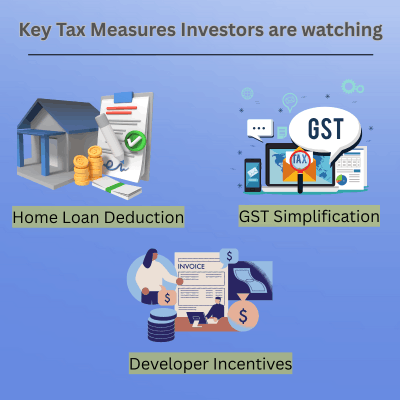
Three areas I’m watching closely:
1. Home Loan Interest Deduction (Section 24)
Deduction for home loan interest (Section 24). This is the most popular and most discussed tax exemption. Higher interest deduction limits would:
- Improve housing affordability
- Encourage fence-sitters to convert into buyers
- Support demand in mid-income projects
Any small upward revision would have the power to significantly raise sentiment.
2. GST and Stamp Duty Rationalisation
Full-scale GST reform is probably off the table, but any simplification or relief could:
- Reduce transaction friction
- Improve transparency
- Support organised developers
3. Developer-Side Incentives
Tax holidays or execution support for affordable housing developers could quietly improve project viability, something markets often price in later.
Valuations Are No Longer Cheap—That Changes the Game
One reality investors must accept: Real estate stocks are no longer trading at distress valuations. The easy gains from balance-sheet clean-up are behind us.
That means:
- Earnings quality matters more
- Execution consistency matters more
- Brand equity matters more
Post-Budget, I expect investors to reward:
- Developers with strong pre-sales visibility
- Clean cash flow profiles
- Disciplined land acquisition strategies
The days of buying real estate stocks purely on policy hope are mostly gone.
How I’m Positioning My Thinking Post-Budget
Personally, I’m approaching real estate stocks with:
- Moderation, not aggression
- Stock-specific conviction, not sectoral bets
- Longer holding periods, not short-term Budget trades
Budget 2026 may shape sentiment, but execution over the next 12–24 months will decide returns. For investors willing to look beyond headlines, this Budget could still offer opportunities, but only if expectations stay grounded.
Also Read: Budget 2026: Why India’s Food Delivery Ecosystem Is Seeking Tax Relief Amid Rising Cost Pressures
Disclaimer
This article is for informational and educational purposes only and reflects my personal views as an investor. It does not constitute investment advice, stock recommendations, or a solicitation to buy or sell any securities. Readers should consult a qualified financial advisor before making any investment decisions. Market investments are subject to risk, including loss of capital.