
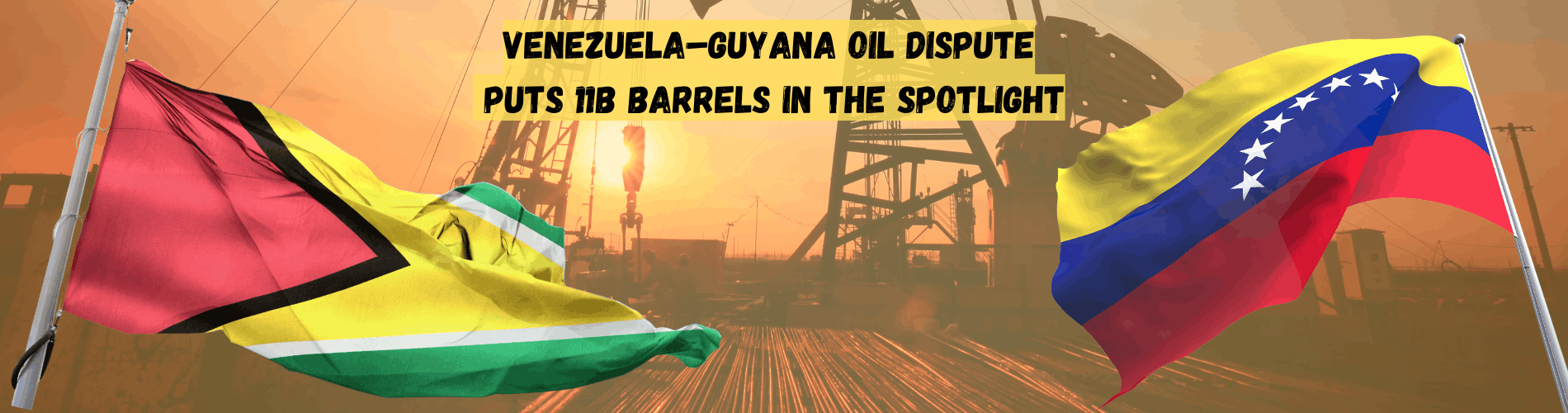
Guyana’s rapid rise as a global oil producer has taught me a crucial lesson about markets: when geopolitical headlines break, prices often move before the underlying facts are clear. A single headline can shift crude prices by 2–5% intraday, even if the underlying news later proves exaggerated or misleading. Recently, I’ve seen claims circulating about a U.S. military move in Venezuela. As someone who verifies macro signals before factoring them into strategy, I want to state clearly:
There is no verified public evidence confirming such an intervention has taken place. In this article, instead of repeating speculation, I want to break down what actually matters for investors the numbers, the incentives, and the real strategic stakes.
The Real Points Investors Should Focus On
The true geopolitical risk isn’t a sudden military action. It’s the long-running territorial dispute between Venezuela and Guyana over the Essequibo region.
Essequibo covers roughly 159,500 square kilometers, about two-thirds of Guyana’s total land area, and holds significant resource potential:
- Estimated billions of barrels of offshore oil reserves
- Large untapped gold deposits
- Diamond reserves
- Timber and freshwater assets
For investors, land disputes matter only when resources are involved. This one checks every box.
The Oil Discovery That Changed the Equation
In 2015, Exxon Mobil discovered major offshore crude reserves near Guyana’s coast. Since then:
- Guyana’s GDP growth has exceeded 40% in peak years
- Oil production has crossed 600,000 barrels per day
- Forecast output could reach 1.2 million barrels/day by 2028
To put that into perspective, that would place the small nation among the top 20 oil producers globally remarkable for a country with a population of under 1 million.
Major players operating offshore projects include Chevron and CNOOC, meaning the region isn’t just a local dispute anymore it’s a multinational capital zone.
Why Venezuela Still Presses Its Claim
The territorial disagreement dates back to 1899, when an arbitration tribunal awarded the territory to Britain. Venezuela has rejected that ruling for more than 120 years.
The case is now before the International Court of Justice, which could ultimately deliver a binding ruling. However, Caracas disputes the court’s authority, which complicates enforcement scenarios.
Politically, Nicolás Maduro has strong domestic incentives to keep the claim alive. Venezuela’s economy has contracted by more than 70% since 2013, one of the steepest peacetime declines in modern history. In these settings, territorial nationalism can often become a political weapon.
The Strategic Role of the United States
The United States has three vital interests in the region:
- Protecting energy investments
- Supporting a democratic oil-producing partner
- Countering rival geopolitical influence
Comments like those by Marco Rubio, who has warned of consequences for any act of aggression, suggest that Washington is taking the region seriously. That doesn’t necessarily mean military action, but it does heighten the geopolitical stakes.
When American corporate assets and shipping lanes are at stake, history shows that diplomatic pressure and security cooperation become more prevalent.
Also Read: Venezuela Bond Bet Pays Off With 30% Gain
What Markets Often Misprice
From my perspective, markets tend to overreact to dramatic narratives but underprice structural shifts. The real question isn’t whether conflict will happen tomorrow. It’s how likely each scenario is over time and what that means for capital flows.
Right now, the most realistic outlook looks like this when translated into plain analysis: The highest-probability scenario, likely above 60% odds based on current diplomatic signals, is a prolonged stalemate. That would keep oil production stable and markets calm.
A moderate-risk scenario, perhaps around 25–30% probability, involves limited border or naval tensions. That kind of friction could push crude prices up $5–$10 per barrel temporarily because traders price in supply risk.
The lowest-probability scenario, probably under 10%, would be direct military confrontation. That would create a global shock, potentially sending oil prices above $120 per barrel, depending on supply disruption scale.

Why Energy Giants Prefer Stability, Not Conflict
There’s a myth that oil companies benefit from war. In reality, they benefit from predictability.
Offshore drilling platforms can cost $1–3 billion each to build and deploy. Insurance premiums for rigs and tankers can rise 20–40% during regional tensions. Shipping delays alone can erase quarterly profit gains.
Risk intelligence firms like Verisk Maplecroft regularly note that even minor geopolitical instability can slow project timelines by months, which translates into billions in deferred revenue.
The Overlooked Investor Signal: Capital Movement
Most headlines frame this issue as a territorial dispute. I see it as a capital-flow story. If tensions rise:
- Emerging-market funds may pull allocations
- Regional currencies could depreciate 5–15%
- Commodity traders increase speculative positions
If tensions ease:
- Infrastructure investment accelerates
- Exploration budgets expand
- Energy equities tied to the region rally
So the real trade isn’t politics, it’s volatility cycles.
Could Conflict Actually Happen?
It’s possible, but several structural factors reduce the odds:
- Several large economies have financial investments in Guyana’s oil production
- Venezuela already faces heavy sanctions constraints
- Global energy markets rely on new supply sources
In the past, when several powerful countries have had economic exposure to the same neighborhood, their disputes tend to remain contained. Tensions are bound to rise, but full-blown hostilities become economically illogical for all involved.
My Personal Investment Framework for Situations Like This
Whenever I analyze geopolitical hotspots, I apply a three-layer filter:
- Structural Reality: The oil exists. That guarantees long-term strategic relevance.
- Political Incentives: Leaders gain domestic support by taking strong positions.
- Market Behavior: Traders overreact short term and normalize later.
Applying that framework here tells me something important: Short-term headlines are noise. Long-term energy development is signal.
Indicators I’m Personally Watching
Instead of sensational claims, I track measurable indicators:
- Progress in international court proceedings
- New offshore drilling licenses
- Military patrol activity levels
- Diplomatic visits and defense agreements
- Marine insurance pricing trends
These are the signals that move markets before headlines do.
Final Thoughts
After years of studying markets, I’ve noticed a pattern: Fear travels faster than facts, but money moves only on confirmed reality.
- The territorial dispute is real.
- The oil wealth is real.
- The geopolitical rivalry is real.
But dramatic narratives often run ahead of evidence. For investors, the edge comes from staying grounded in verified data while others react emotionally. In situations like this, discipline is more profitable than drama.
Also Read: Venezuela Market Surge 130%: Huge Opportunity or Risk?
Disclaimer
This article reflects personal analysis for informational and educational purposes only. It does not constitute investment advice, geopolitical prediction, or financial recommendation. Readers should verify developments through official sources and consult a licensed financial advisor before making investment decisions