
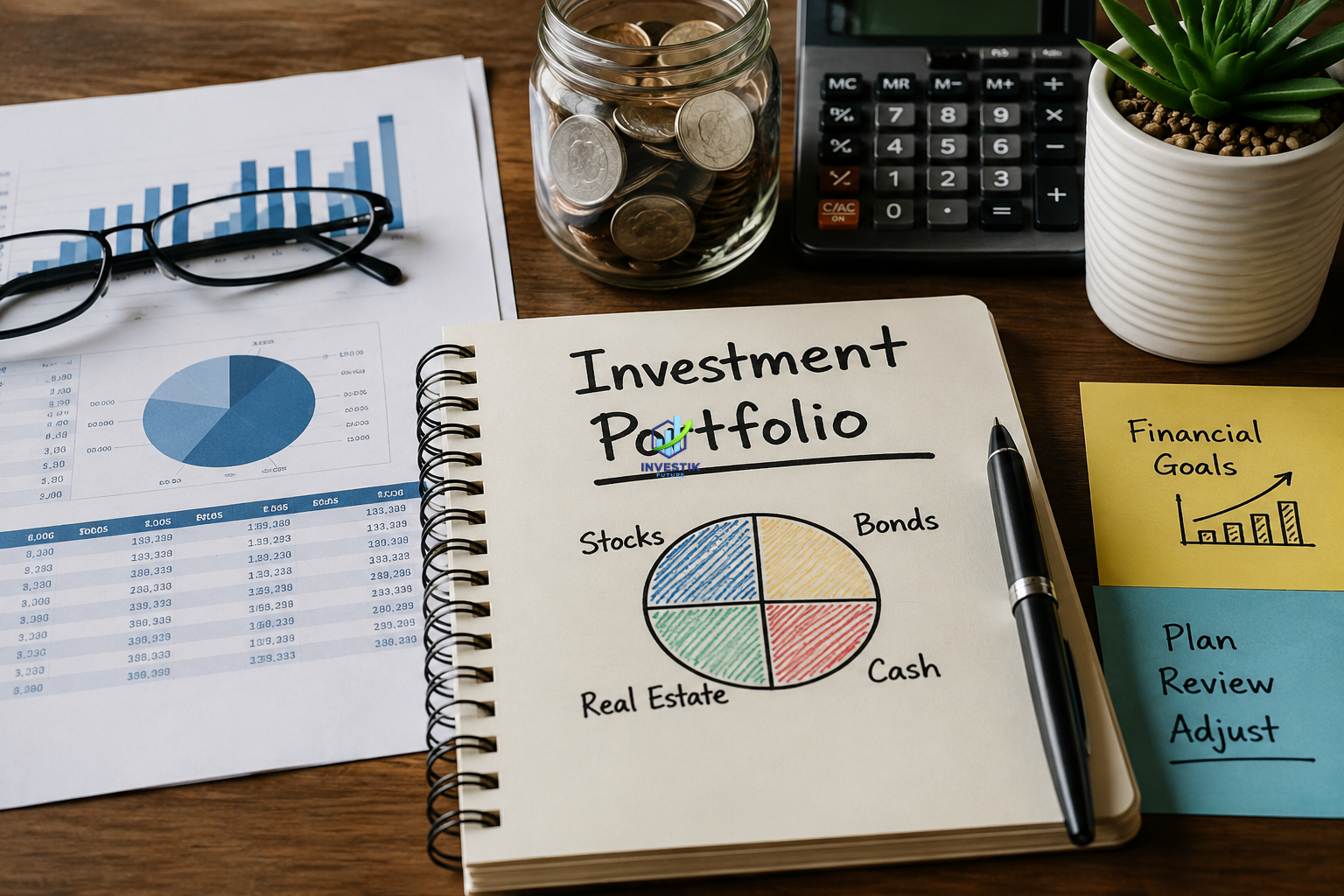

An investment portfolio for beginners is not a single stock tip or a hot mutual fund someone mentioned at a family gathering. It’s a structured collection of assets, equity, debt, gold, and cash, built around your goals, your time horizon, and how much risk you can actually sleep through.
Most first-time investors skip this structure. They open a demat account, buy 3 stocks their cousin recommended, add a random mutual fund from an Instagram reel, and call it a portfolio. Six months later, one stock has crashed 40%, the mutual fund is a large-cap fund they didn’t need, and they have no idea what to do next.
This guide fixes that. It walks through every step of building an investment portfolio for beginners, from defining goals to choosing asset classes, taxation rules, common mistakes, and a practical checklist you can act on today. For broader reading on where India’s investing ecosystem fits together, Investik Future covers markets, mutual funds, and personal finance in more depth than we can fit in one article.
What an investment portfolio actually is
A portfolio is the full set of assets you hold: stocks, mutual funds, bonds, fixed deposits, gold, EPF, PPF, real estate, and cash. The word matters because it shifts your thinking from “which stock should I buy” to “how should my money be split across asset classes.”
Three ideas define a good portfolio:
Asset allocation. The percentage split across equity, debt, gold, and cash. This single decision explains most of a portfolio’s long-term return and volatility, more than which specific fund or stock you pick within each category.
Diversification. Spreading money within an asset class so a single company or sector failing doesn’t wreck your entire plan. Ten stocks across 8 sectors behave very differently from 10 stocks in the same sector.
Time horizon. How long the money stays invested before you need it. A goal 20 years away can absorb equity volatility. A goal 18 months away cannot.
Get these three right, and the specific fund or stock choice becomes a secondary decision. Get them wrong, and no amount of stock-picking skill saves the portfolio.
Why beginners need a structure, not stock tips
New investors usually start with a question like “which stock should I buy first?” That’s the wrong starting question.
The right starting question is: what is this money for, and when do I need it back?
A portfolio built stock-by-stock, based on tips, news headlines, or what’s trending, tends to end up concentrated in 1 or 2 sectors, mismatched with the investor’s actual time horizon, and abandoned the first time the market falls 15%. A portfolio built around goals and allocation survives market cycles because the investor understands why each piece exists.
Structure also removes emotional decision-making. If you know your equity allocation is 60% because your goal is 12 years away, a market correction doesn’t tempt you to sell in panic. You already accounted for volatility when you set the allocation.
Step 1: Define your financial goals before choosing a single investment
Every rupee in a portfolio should be working toward something specific. Vague goals like “grow my money” lead to vague portfolios.
Write down 3 things for each goal:
- What the goal is (retirement, a home down payment, a child’s education, an emergency fund)
- When you need the money (in years)
- How much you’ll need, adjusted for inflation
Example breakdown:
| Goal | Time horizon | Target amount (today’s value) | Inflation-adjusted target |
|---|---|---|---|
| Emergency fund | Immediate | ₹3,00,000 | ₹3,00,000 (no adjustment needed) |
| Home down payment | 5 years | ₹15,00,000 | ₹19,50,000 (at 6% inflation) |
| Child’s higher education | 15 years | ₹25,00,000 | ₹60,00,000 (at 6% inflation) |
| Retirement | 25 years | ₹5,00,00,000 | ₹2,15,00,00,000 (at 6% inflation) |
The retirement number looks extreme, but it reflects how inflation compounds over 25 years. This is exactly why long-horizon goals need equity exposure: fixed deposits and PPF alone rarely outrun inflation over multi-decade periods.
Each goal above needs a different asset mix. A 5-year goal can’t sit entirely in equity. A 25-year goal sitting entirely in a savings account is a slow way to lose purchasing power.
Step 2: Understand your risk profile honestly
Risk tolerance has 2 parts: your ability to take risk (based on income stability, dependents, existing savings) and your willingness to take risk (based on temperament).
A 28-year-old with a stable salary and no dependents has high risk capacity. If that same person panics and sells every time the Nifty drops 5%, their willingness to take risk is low. The portfolio should respect the lower of the 2, because a portfolio you abandon during a downturn locks in losses regardless of how well it was designed.
Quick self-assessment questions:
- If your portfolio dropped 20% in 3 months, would you sell, hold, or add more?
- Do you have 6 months of expenses in an emergency fund, separate from your investments?
- Is this money needed in the next 3 years for a specific expense?
- Do you have dependents relying on your income right now?
Answers of “I’d sell” or “no emergency fund” or “yes, needed soon” push you toward a more conservative allocation, regardless of your age.
Step 3: Learn the core asset classes
An investment portfolio for beginners typically draws from 5 asset classes. Each behaves differently in different market conditions, and that difference is the entire point of building a portfolio instead of holding one asset.
| Asset class | Typical role | Volatility | Liquidity |
|---|---|---|---|
| Equity (stocks, equity mutual funds) | Long-term growth, beats inflation | High | High (except lock-in products) |
| Debt (bonds, debt funds, FDs) | Stability, regular income | Low to moderate | Moderate to high |
| Gold (sovereign gold bonds, gold ETFs) | Inflation hedge, crisis diversifier | Moderate | Moderate to high |
| Real estate | Long-term asset, rental income | Low (price), very low (liquidity) | Low |
| Cash and cash equivalents | Emergency access, short-term needs | Very low | Very high |
Equity gives the highest long-term return potential among these, and history shows it also gives the sharpest short-term drawdowns. It suits goals more than 5 to 7 years away.
Debt instruments, including government bonds, corporate bonds, and debt mutual funds, provide steadier returns and cushion a portfolio when equity markets fall. You can read how the stock market works for the mechanics behind equity price movement, which makes the case for debt as a stabiliser clearer.
Gold has historically moved differently from equity during periods of high inflation or geopolitical stress, which is why most allocation models keep a small gold sleeve, typically 5% to 10%, rather than 0% or 30%.
Real estate ties up large sums of capital and is hard to sell quickly, so for a first portfolio, most beginners are better served starting with financial assets and adding real estate later once the base portfolio is established.
Cash covers your emergency fund and near-term needs. This sits outside your growth portfolio, not inside it.
Step 4: Decide your asset allocation
Asset allocation is the percentage split across the classes above. There’s no single correct allocation. There’s a correct allocation for your goals, age, and risk profile.
A commonly used starting rule: subtract your age from 100 to get a rough equity percentage. A 25-year-old gets roughly 75% equity; a 55-year-old gets roughly 45%. This rule is a starting point, not a formula to follow blindly, since it ignores your specific goals and risk capacity.
Sample allocation models by investor profile:
| Investor profile | Equity | Debt | Gold | Cash/Emergency fund |
|---|---|---|---|---|
| Conservative (near-term goal, low risk tolerance) | 20% to 30% | 50% to 60% | 5% to 10% | 10% to 15% |
| Moderate (5 to 10 year goal, balanced risk tolerance) | 45% to 60% | 25% to 35% | 5% to 10% | 10% |
| Aggressive (10+ year goal, high risk tolerance) | 65% to 80% | 10% to 20% | 5% to 10% | 5% to 10% |
A 26-year-old saving for retirement 30 years away, with a stable job and an emergency fund already in place, fits the aggressive model. A 45-year-old saving for a child’s college fee due in 4 years fits the conservative model, even though the same person’s retirement bucket might sit in the moderate or aggressive category. One person can, and usually should, run multiple allocation models for different goals at once.
Step 5: Choose the right investment vehicles
Once you know your allocation, the next decision is which products to use inside each bucket.
Direct stocks. Buying individual company shares gives full control but requires research time, sector knowledge, and the discipline to size positions correctly. A position size calculator helps limit how much of your capital sits in any single stock, which reduces the damage from one bad pick.
Equity mutual funds. A fund manager picks stocks on your behalf, spreading your money across dozens of companies in one purchase. This suits beginners who want equity exposure without picking individual stocks. Different categories, large-cap, mid-cap, small-cap, and flexi-cap, carry different risk levels; a broader look at equity mutual fund types, returns, and strategy explains how to pick among them.
Index funds and ETFs. These track an index like the Nifty 50 or Sensex rather than relying on a fund manager’s stock picks, usually at a lower expense ratio. For beginners who want simple, broad equity exposure without researching individual fund managers, this is often the most straightforward starting point. Our guide on what ETFs are in India covers how they trade and what to check before buying one.
Systematic Investment Plans (SIPs). Rather than investing a lump sum, a SIP invests a fixed amount every month into a mutual fund. This removes the pressure of timing the market and builds a habit of regular investing. Beginners often ask whether SIP or lump sum investing is better; the honest answer is that SIPs suit most beginners because they smooth out purchase price over market cycles and match how salaried income actually arrives. A full explainer on what SIP is, its benefits, and how it works walks through the mechanics, and you can model your own numbers with the SIP calculator before committing to a monthly amount.
Debt instruments. Public Provident Fund (PPF), fixed deposits, debt mutual funds, and government bonds cover the stability portion of a portfolio. PPF, in particular, suits long-term, low-risk savings due to its tax treatment and government backing.
Gold. Sovereign Gold Bonds and gold ETFs are generally more efficient than physical gold for a portfolio, since they avoid making charges and storage risk while still tracking gold prices.
If you’re unfamiliar with how mutual funds pool money and generate returns in the first place, this guide on what a mutual fund is covers the basics before you pick specific funds.
How to evaluate a mutual fund before you invest
Picking a fund by last year’s return alone is one of the most common beginner errors. A better checklist looks at:
Category fit. Confirm the fund actually matches the role you want it to play. A “large-cap fund” should hold mostly large, established companies; a fund labelled “flexi-cap” can move across market capitalisations at the manager’s discretion, which changes its risk profile.
Expense ratio. This is the annual fee charged as a percentage of your investment. A large-cap fund charging 2% versus one charging 1% doesn’t sound like much, but over 20 years, that difference compounds into a meaningfully lower final corpus.
Track record across market cycles. A fund’s 1-year return during a bull run tells you little. Check how the fund performed during at least one market downturn, such as 2020 or 2022, relative to its category average.
Fund manager tenure and fund house consistency. A fund that changed managers 3 times in 5 years carries more uncertainty than one with a stable management team and a consistent investment process.
AUM (Assets Under Management) size. Very small AUM can mean higher volatility in returns; very large AUM in small-cap or mid-cap categories can sometimes make it harder for the fund to enter and exit positions efficiently. Neither extreme is automatically disqualifying, but both are worth a second look.
None of these factors work well in isolation. A fund with a low expense ratio but a poor 5-year track record relative to its benchmark isn’t a good pick just because it’s cheap.
SIP versus lump sum: a closer look
The SIP-versus-lump-sum debate often gets treated as a permanent rule, when it’s really a situational decision.
A SIP works well when your money arrives as regular income, since it matches how salaries are paid and removes the temptation to time the market. It also averages your purchase price across market highs and lows over the SIP period, which reduces, though doesn’t eliminate, the risk of investing everything right before a downturn.
A lump sum can outperform a SIP when markets are rising steadily over the investment period, simply because the entire amount was invested earlier. The tradeoff is that a lump sum invested right before a sharp correction sits at a loss for longer than a staggered SIP would.
For a beginner without a large lump sum available, this debate is often moot: SIPs are the practical, achievable route. For someone who receives a bonus, inheritance, or other windfall, splitting it into a systematic transfer plan (STP) over 3 to 6 months, moving from a liquid fund into equity gradually, offers a middle path between the 2 extremes.
Step 6: Build diversification within each asset class
Allocation splits money across asset classes. Diversification spreads it within each class, so a single company, sector, or fund manager’s mistake doesn’t derail the whole portfolio.
Within equity:
- Spread across market capitalisations (large-cap, mid-cap, small-cap) rather than concentrating in one
- Spread across sectors (banking, IT, pharma, consumer goods, manufacturing) rather than 1 or 2 sectors
- Avoid holding more than 5 to 8 individual stocks if you’re managing them yourself as a beginner, since tracking more than that well becomes difficult without a research process
Within debt:
- Mix short-duration and medium-duration instruments to manage interest rate sensitivity
- Avoid concentrating debt exposure in a single issuer’s bonds or a single company’s fixed deposit
Across fund houses:
- If you hold multiple mutual funds, check for overlap. 2 large-cap funds from different fund houses often hold many of the same top stocks, which reduces the actual diversification benefit you think you’re getting
A portfolio of 15 stocks that are all IT companies is not diversified. A portfolio of 5 stocks across 5 different sectors, backed by 2 equity mutual funds in different categories, is more genuinely diversified even with fewer individual holdings.
Where the emergency fund fits
The emergency fund deserves its own explanation, since it’s often the step beginners skip entirely in their hurry to start investing.
An emergency fund is 3 to 6 months of essential expenses, rent, groceries, EMIs, insurance premiums, kept in instruments you can access within a day or two: a savings account, a sweep-in fixed deposit, or a liquid mutual fund. It is not part of your growth portfolio and shouldn’t be counted toward your equity or debt allocation.
The purpose is narrow: covering a job loss, medical emergency, or urgent repair without forcing you to redeem equity investments at a bad time. An investor with a strong equity portfolio but no emergency fund often ends up selling that portfolio at the worst possible moment, precisely when markets are down and cash is tight for unrelated reasons.
Freelancers and business owners, whose income varies month to month, often need a larger buffer, closer to 9 to 12 months of expenses, compared to a salaried employee with predictable income.
Step 7: Open the right accounts and start
What you need before your first investment:
- PAN card (mandatory for any investment in India)
- Aadhaar-linked bank account for KYC and fund transfers
- Demat and trading account if you plan to buy stocks or ETFs directly
- Completed KYC through a KRA (KYC Registration Agency), usually done automatically when opening an account with a broker or mutual fund platform
Practical first steps, in order:
- Build your emergency fund first, in a savings account or liquid fund, before investing in equity
- Open a demat and trading account with a SEBI-registered broker if you plan to buy stocks or ETFs
- Complete KYC for mutual fund investing through any AMC or a mutual fund platform
- Start with 1 or 2 mutual funds matching your allocation model rather than 8 funds on day 1
- Set up SIPs for a fixed monthly amount tied to your goals
- Add direct stock exposure gradually, only after you’re comfortable with mutual fund basics, and only with money you can afford to research properly
Rushing to a 15-stock, 6-mutual-fund portfolio in month 1 usually creates a mess that’s harder to untangle later than it would have been to build slowly and correctly.
Sample starter portfolios
These are illustrative starting points, not personalised recommendations. Your actual portfolio should reflect your specific goals, income, and risk profile.
Portfolio A: Age 25, aggressive, 25+ year horizon (retirement-focused)
| Component | Allocation |
|---|---|
| Large-cap or flexi-cap equity mutual fund | 30% |
| Mid-cap and small-cap equity mutual funds | 25% |
| Index fund (Nifty 50 or Sensex) | 15% |
| Debt fund or PPF | 20% |
| Gold ETF or Sovereign Gold Bond | 10% |
Portfolio B: Age 40, moderate, 10-year horizon (child’s education)
| Component | Allocation |
|---|---|
| Large-cap equity mutual fund | 30% |
| Flexi-cap equity mutual fund | 20% |
| Debt mutual fund | 30% |
| Fixed deposit | 10% |
| Gold ETF | 10% |
Portfolio C: Age 55, conservative, 5-year horizon (near-retirement)
| Component | Allocation |
|---|---|
| Large-cap equity mutual fund | 20% |
| Debt mutual fund | 40% |
| PPF or Senior Citizen Savings Scheme | 25% |
| Fixed deposit | 10% |
| Gold ETF | 5% |
Taxation on your investment portfolio
Taxes affect your real, post-tax return, so understanding them matters as much as picking good funds. The rules below reflect the framework introduced through the Finance (No. 2) Act, 2024, which remains the operating structure for capital gains taxation as of 2026. Tax rules do change over budget cycles, so confirm the current rates before filing.
Capital gains tax on equity (Section 111A and 112A):
| Holding period | Classification | Tax rate |
|---|---|---|
| 12 months or less | Short-Term Capital Gains (STCG) | 20% flat |
| More than 12 months | Long-Term Capital Gains (LTCG) | 12.5% on gains above ₹1.25 lakh per financial year |
This applies to listed equity shares and equity-oriented mutual funds (funds holding at least 65% in domestic equity), provided Securities Transaction Tax (STT) has been paid.
Debt mutual funds: Units purchased on or after 1 April 2023 are taxed at your income tax slab rate regardless of how long you hold them, following changes under Section 50AA. Units bought before that date follow the older holding-period rules.
SIP-specific tax detail that catches beginners off guard: each SIP instalment is treated as a separate purchase with its own holding period. If you redeem your entire SIP investment after exactly 12 months, only your first instalment qualifies for LTCG treatment; the remaining 11 instalments, each less than a year old, are taxed as STCG. Most fund houses apply FIFO (first-in-first-out) at redemption, so a single withdrawal can include both LTCG and STCG components.
A worked example: Suppose you invested a lump sum of ₹5,00,000 in an equity mutual fund and sold it after 18 months for ₹6,50,000, a gain of ₹1,50,000. Since ₹1,25,000 of long-term gains is exempt, you’d pay 12.5% tax only on the remaining ₹25,000, which works out to ₹3,125, excluding cess and surcharge.
Losses: Short-term capital losses can be set off against both STCG and LTCG. Long-term capital losses can only be set off against LTCG. Both can be carried forward for up to 8 assessment years if reported on time.
For the authoritative source on investor protections and grievance mechanisms around your investments, SEBI’s official investor education resources are worth bookmarking, and AMFI’s mutual fund investor resources cover fund categorisation rules directly from the mutual fund industry body.
Common mistakes beginners make
Chasing last year’s best-performing fund. A fund that returned 45% last year attracts new money precisely because of that number, but past performance doesn’t predict next year’s return, and chasing it often means buying in after a rally rather than before one.
No emergency fund before investing in equity. Without 3 to 6 months of expenses set aside, a medical bill or job loss forces you to redeem equity investments at whatever price the market happens to be at, sometimes at a loss.
Over-diversifying into too many funds. Holding 12 mutual funds doesn’t make a portfolio more diversified if 8 of them are large-cap funds with 70% overlapping holdings. It just adds complexity and tracking effort.
Ignoring asset allocation entirely. Picking individual stocks or funds without deciding the equity-debt-gold split first is like decorating a house before deciding how many rooms it needs.
Panic-selling during corrections. Equity markets fall 10% to 20% periodically as part of normal market cycles. Selling during these periods locks in a loss that a patient investor with the right time horizon wouldn’t have realised.
Mixing insurance and investment. Traditional insurance-cum-investment products (like some ULIPs and endowment plans) often deliver lower returns than a term insurance policy plus a separate mutual fund investment would. Keep insurance and investment goals separate wherever possible.
Not reviewing the portfolio at all. A portfolio built in year 1 and never checked again drifts away from the intended allocation as different assets grow at different rates.
Reviewing and rebalancing your portfolio
Rebalancing means bringing your portfolio back to its intended allocation after market movements shift the percentages.
Example: You start with 60% equity and 40% debt. After a strong equity market year, your portfolio drifts to 72% equity and 28% debt, since equity grew faster. Rebalancing means selling some equity and adding to debt to return to your original 60:40 split, which also means locking in some equity gains and buying debt at a relatively better point.
How often to rebalance:
- Annually, on a fixed date (many investors use a birthday or financial year-end)
- Or when any asset class drifts more than 5 to 7 percentage points from its target allocation, whichever comes first
What to check during a review:
- Has your allocation drifted from the target?
- Has your risk profile or time horizon changed (new dependents, nearing a goal deadline, income change)?
- Are any funds consistently underperforming their category benchmark over 3+ years?
- Is there unnecessary overlap between funds you hold?
Rebalancing isn’t about predicting the market. It’s a mechanical discipline that forces you to sell high and buy low without needing to guess market direction.
Frequently asked questions
How much money do I need to start an investment portfolio?
You can start a SIP with as little as ₹500 per month through most mutual fund platforms. There’s no minimum net worth required to begin; the structure matters more than the starting amount.
What’s a good example of a beginner’s first investment portfolio?
A simple starting example is a large-cap or flexi-cap equity mutual fund SIP, a debt fund or PPF contribution, and an emergency fund in a savings account or liquid fund, adjusted to your specific goals and time horizon as described in the sample portfolios above.
Should I invest in stocks or mutual funds first as a beginner?
Most beginners are better served starting with mutual funds or index funds, since they provide instant diversification without requiring stock-picking research. Individual stocks can be added gradually once you understand fund investing and have built research habits.
How many stocks or funds should a beginner portfolio hold?
For direct stocks, 5 to 8 across different sectors is manageable for a beginner. For mutual funds, 3 to 5 funds across different categories usually covers a full allocation without unnecessary overlap.
Is it better to invest a lump sum or use a SIP?
For beginners investing from regular income, SIPs match the reality of getting paid monthly and reduce the risk of investing a large sum right before a market downturn. Lump sum investing can work when a windfall arrives, ideally spread across a few months rather than deployed all at once.
How do I track my portfolio’s performance?
Compare returns against a relevant benchmark, such as the Nifty 50 for large-cap equity funds, rather than judging a fund in isolation. Most mutual fund platforms and the SIP calculator can help you check whether your actual returns are tracking your original plan.
Your first investment portfolio checklist
- Write down your specific goals, amounts, and time horizons
- Build a 3 to 6 month emergency fund before investing in equity
- Complete an honest risk assessment, not just an age-based rule
- Decide your equity, debt, gold, and cash allocation percentages
- Choose 3 to 5 mutual funds or ETFs matching that allocation
- Set up SIPs tied to specific goals rather than random amounts
- Avoid buying individual stocks until you understand fund investing
- Diversify within equity across market cap and sector
- Check for fund overlap if holding multiple mutual funds
- Review and rebalance annually or when allocation drifts 5%+
- Understand the LTCG and STCG rules that apply to your holdings
- Keep insurance and investment as separate decisions
Building a first investment portfolio is less about finding a perfect stock and more about getting the structure right: clear goals, honest risk assessment, sensible allocation, real diversification, and the discipline to review it periodically. Get that foundation in place, and the specific fund or stock choices become far easier decisions to make.
Related reading: For a deeper look at how monthly cash flow feeds into investing consistently, see our guide on building a monthly budget that actually works, and browse the Investment Guides category and Mutual Funds category for more on specific products mentioned here.
ARN Disclosure: Investik Future is an AMFI-registered Mutual Fund Distributor. ARN-341107 — Verify on AMFI ↗. Komal Thakur is the content author and digital marketer; the ARN registration belongs to Investik Future, not to the author personally.