
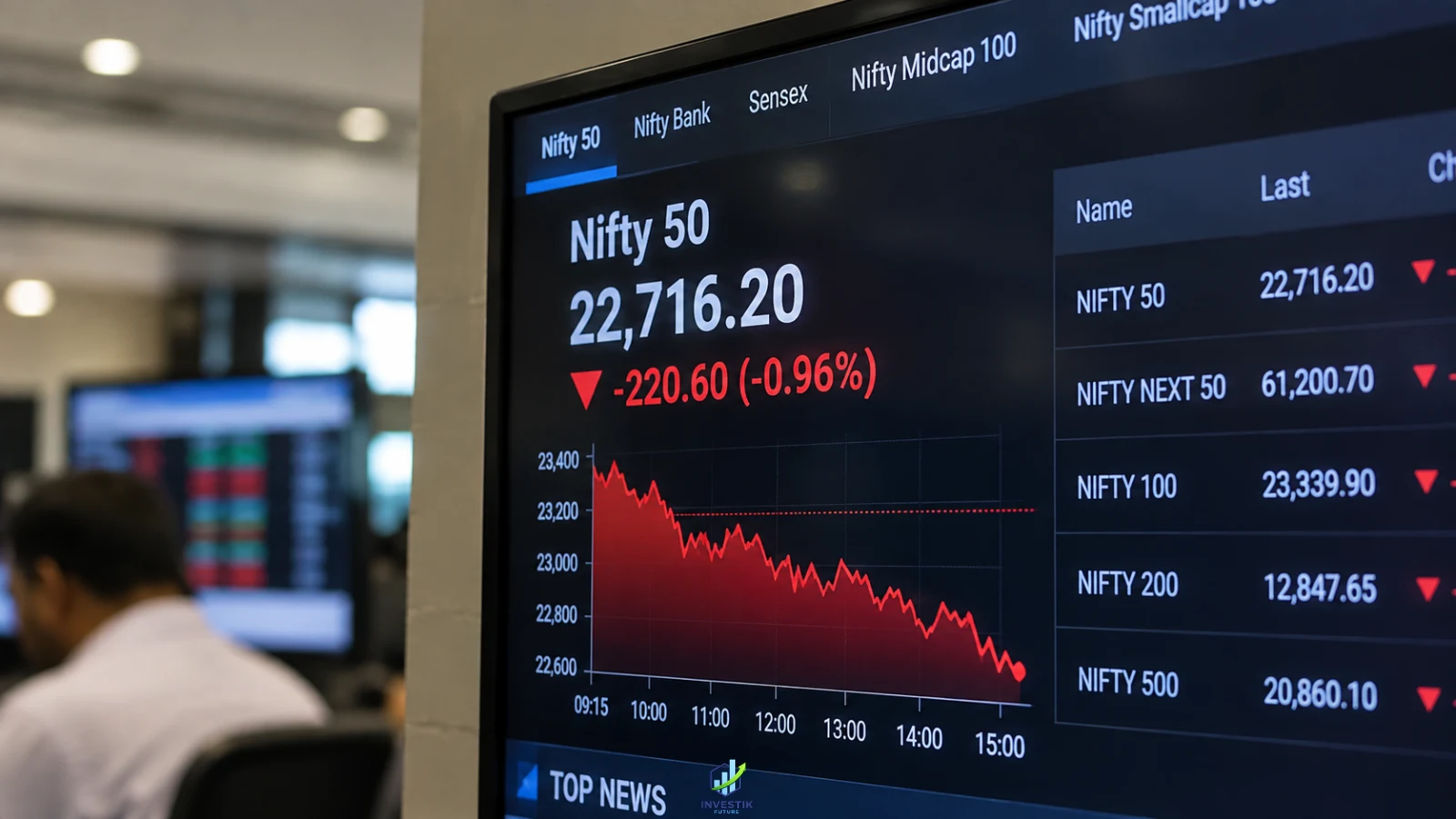

The Nifty 50 was heading towards a weak September, with the index down about 5.7% through September 29. It closed at 24,080.40 on August 31 and at 22,716.20 on September 29.
Foreign investors kept selling Indian shares, and the rupee stayed close to ₹96 per dollar. Brent crude moved above $100, and US bond yields rose to their highest level since 2007. Weakness in IT and insurance stocks added to the pressure at home.
This article looks at how the Nifty performed in September 2026, the five factors behind the fall, and what investors may want to watch in October.
Nifty 50 Falls in September: How the Month Played Out
| Metric | September 2026 |
| Nifty 50 at start of month (August 31 close) | 24,080.40 |
| Nifty 50 at September 29 close | 22,716.20 |
| Change | -1,364.20 points (about -5.7%) |
| Lowest level on September 29 (intraday) | 22,569.65 |
The index touched a six-month low of 22,569.65 on September 29 before recovering about half of its intraday loss. It is now roughly 14% below its record high of 26,373.20.
The fall was broad. 40 of the 50 Nifty stocks were lower in September through September 29. It was also steady rather than sudden, though there were sharper days too. On Thursday, September 24, all 16 major sector indices ended lower.
5 Key Factors Behind the Nifty 50 Decline
1. Foreign Investor Selling
Foreign portfolio investors (FPIs) are overseas funds and institutions that buy Indian shares and bonds. You will also see the older term FII, for foreign institutional investors, used for the same group.
They matter because they hold large stakes in the big companies that make up the Nifty. When they sell in bulk, prices of those stocks come under pressure.
As reported, foreign investors sold more than $2.17 billion of Indian equities in September by Tuesday. That is roughly ₹20,000 crore at current exchange rates. Depository data showed a smaller net figure of ₹17,131 crore up to September 25, because it counts money that FPIs put into IPOs. The exchange selling alone was higher.
Domestic institutions, mainly mutual funds fed by monthly SIPs, softened the blow. Provisional data show they bought ₹52,617 crore of shares between September 1 and 25. That slowed the fall but did not stop it.
2. Rupee Weakness
The rupee spent much of the month near ₹96 per dollar. It closed at about 95.81 on September 25, a few paise from its record low.
Foreign selling is one reason. When FPIs sell Indian shares, they convert the rupees back into dollars, which adds to dollar demand. Oil importers also need more dollars when crude gets costlier.
A weak rupee hurts stocks in two ways. Foreign investors earn less when their returns are converted back into dollars. Imports also become costlier for Indian companies, which can squeeze margins.
3. High Crude Oil Prices
India imports most of the crude oil it uses. When oil prices rise, the country has to pay more dollars for the same quantity.
Think of a household whose fuel bill keeps rising while its income stays the same. A country in that position ends up with a wider import bill, a weaker rupee and higher costs for many companies. Higher fuel costs can also push up inflation.
Oil rose through September because of the US-Iran conflict around the Strait of Hormuz. Brent closed at $101.21 on September 9, its highest close since May 22. By September 29, Brent was around $105 to $106 a barrel.
4. Rising US Bond Yields
A US Treasury yield is the return the US government pays on the money it borrows. The 10-year yield is the one most people track.
When it rises, safe dollar investments start paying more. Global funds may then move money out of riskier markets such as India and into US bonds. That is why investors in Indian stocks watch it closely.
Yields rose sharply this month. The 10-year yield was just below 4.8% earlier in September. It reached 5.23% on September 25, its highest level since 2007, and Reuters reported it above 5.27% on September 29.
The US Federal Reserve also raised its benchmark rate by 25 basis points on September 16, taking the target range to 3.75%-4%.
5. Weak Sentiment at Home: Earnings Worries
Not everything came from outside India. Investors are nervous ahead of the September-quarter results season, and IT companies were a particular worry. CLSA’s commentary on September 22 said management demand commentary before the results remained cautious.
Insurance stocks also fell on concerns over proposed changes to insurance commission structures.
These domestic concerns added to the pressure from global factors and made it harder for the market to recover.
Which Sectors Were Hit the Most?
IT was the weakest large sector. The Nifty IT index was down about 11% in September, compared with a roughly 5.7% fall in the Nifty 50 through September 29. Infosys and Wipro touched 52-week lows on September 29. Concerns over US demand, technology spending and the global interest-rate environment weighed on the sector.
Broader markets fell as well. Business Standard reported the Nifty Midcap 150 down 7% in September. Insurance stocks stayed weak. Pharma and metal stocks offered some support on September 29.
What Should Investors Watch Next?
Here are the things worth tracking in October. NSE and BSE are closed on October 2 for Gandhi Jayanti.
- FPI flows: Whether foreign selling slows or continues will shape sentiment in large-cap stocks.
- Crude oil and West Asia: Oil prices affect India’s import bill, inflation, and company costs.
- Rupee-dollar movement: The rupee near its record low keeps pressure on foreign investor returns.
- US Treasury yields and the Fed: Any new signal on interest rates moves global money flows.
- Corporate earnings: September-quarter results will show how companies are coping with higher costs and slower demand.
- Domestic economic data: Inflation and growth numbers show how India’s economy is holding up.
- Global markets: Moves in US and Asian markets often set the tone for Indian stocks.
Key Takeaway
The Nifty 50 was down about 5.7% in September through the 29th because several pressures arrived together. Foreign investors sold, the rupee weakened, crude oil rose, and US yields hit multi-year highs. Worries about IT earnings and insurance rules added to the mood at home. No single reason explains the fall, so investors are tracking both global and domestic signals.










FAQs
Why did the Nifty 50 fall in September 2026?
Several factors combined. Foreign investors kept selling, the rupee weakened, Brent crude rose above $100, and US bond yields climbed to their highest since 2007. Weakness in IT and insurance stocks added to the pressure.
How much did the Nifty 50 fall in September 2026?
The Nifty closed at 24,080.40 on August 31 and at 22,716.20 on September 29. That is a fall of about 5.7%, with one trading session left in the month at that point.
Why do FPI outflows affect the Nifty 50?
FPIs hold large stakes in big listed companies. When they sell heavily, share prices fall, and the Nifty falls with them. Sustained selling can also weaken the rupee.
How does a weak rupee affect the Indian stock market?
It cuts the dollar returns of foreign investors and raises import costs for companies. Both can hurt sentiment. Exporters can gain in rupee terms, but that does not always offset broader selling.
What should investors watch after the September 2026 market decline?
Key things to watch are FPI flows, crude oil, the rupee, US Treasury yields, and the Fed's next move. Corporate results and domestic economic data are also important.
ARN Disclosure: Investik Future is an AMFI-registered Mutual Fund Distributor. ARN-341107 — Verify on AMFI ↗. Komal Thakur is the content author and digital marketer; the ARN registration belongs to Investik Future, not to the author personally.