
India’s High-Speed Rail Moment: Why Budget 2026 Could Redefine How We Travel, Trade and Invest
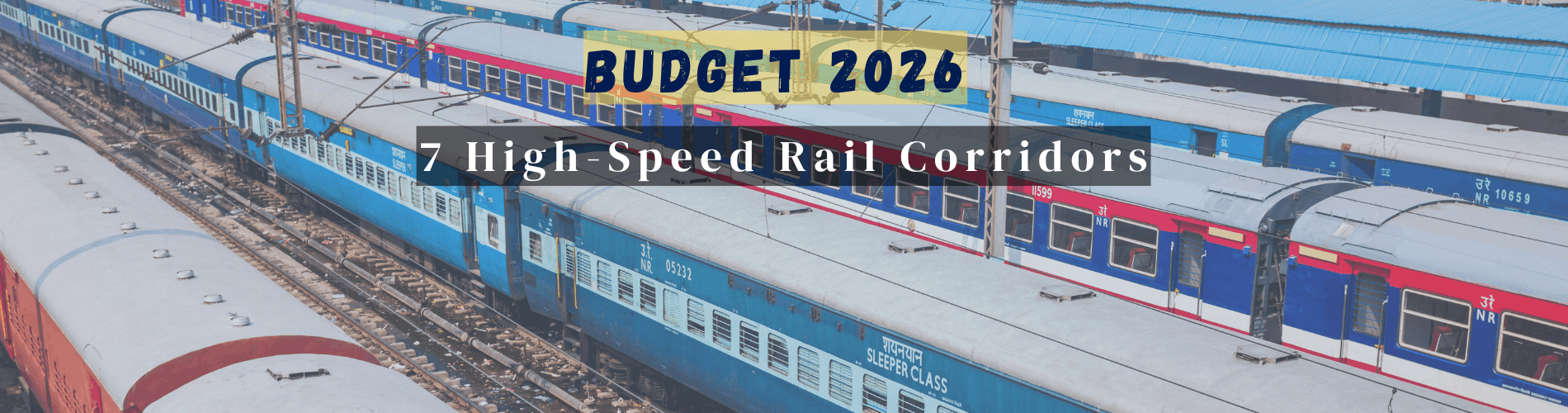
When I look back at Union Budgets of the past, very few announcements were transformational. Budget 2026–27 is different. The government’s decision to announce seven new high-speed rail corridors across India is not just about faster trains; it’s about reshaping economic geography, investment flows, and how Indians move between cities.
Table of Contents
ToggleFor investors like us, this isn’t merely a transport story. It’s a multi-decade infrastructure and growth narrative unfolding in real time.
With nearly 4,000 km of proposed high-speed corridors and an estimated investment of ₹16 lakh crore, India is laying the foundation for a rail-based mobility upgrade on a scale we haven’t seen before.
This article breaks down what those high-speed rail announcements really mean, not just from a transportation lens, but from a macroeconomic and investor’s perspective. I’ll walk through the proposed corridors, the expected reduction in travel time, the massive capital expenditure push for Indian Railways, and how safety, freight logistics, and sustainability fit into the larger picture.
More importantly, I’ll explore why this rail expansion matters for India’s future growth, how it could reshape regional economies, and what long-term investors should watch as India builds a faster, greener and more connected rail network over the coming decade.
Why High-Speed Rail Matters More Than We Think
India has long relied on roads and short-haul flights for inter-city travel. Both are under pressure, highways are congested, airports are crowded, and aviation costs are rising. High-speed rail quietly solves all three problems.
From an economic perspective, faster rail connectivity does three powerful things:
- Shrinks travel time between economic hubs
- Expands labour mobility without mass migration
- Encourages regional industrial clustering
In simple terms, cities stop operating in isolation. They start functioning as integrated economic corridors.
The 7 High-Speed Rail Corridors: India’s New Growth Spine
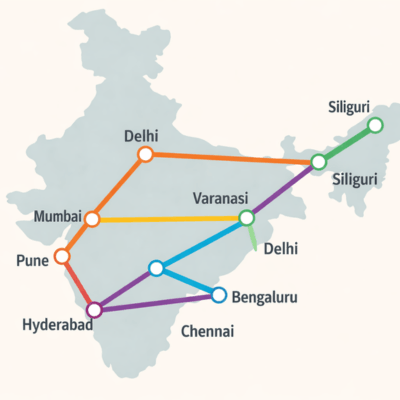
The seven proposed corridors announced in Budget 2026 are strategically designed to connect industrial, IT, financial and cultural centres:
- Mumbai – Pune
- Pune – Hyderabad
- Hyderabad – Bengaluru
- Hyderabad – Chennai
- Chennai – Bengaluru
- Delhi – Varanasi
- Varanasi – Siliguri (via Patna)
What stands out to me is the southern high-speed triangle, Chennai, Bengaluru and Hyderabad. These three cities already power India’s IT, manufacturing and startup ecosystem. High-speed rail turns them into a single, tightly linked economic zone.
Travel Time Compression: The Real Game Changer
One of the most underestimated benefits of high-speed rail is time compression.
When Mumbai–Pune becomes a 45–48 minute journey, or Chennai–Bengaluru drops to just over one hour, the definition of “daily commute” changes completely.
Same-day business meetings, faster freight movement support, and weekend leisure travel all become practical. Over time, this leads to:
- Reduced pressure on metro cities
- Growth of Tier-2 and Tier-3 urban centres
- Rising real estate and commercial activity along corridors
This is a silent but powerful driver of balanced regional growth.
Railways Get a Massive Capex Push — And It’s Intentional
Budget 2026–27 allocates a record ₹2.93 lakh crore in capital expenditure for Indian Railways. This isn’t accidental. It signals a long-term shift in how the government views rail infrastructure, not as a cost centre, but as a growth engine.
Key focus areas include:
- High-speed passenger corridors
- Safety upgrades and automation
- Dedicated freight capacity
- Station redevelopment and multimodal hubs
This kind of sustained capex is exactly what long-term investors should pay attention to.

Safety Takes Centre Stage, And That’s Reassuring
Infrastructure expansion without safety is a red flag. Thankfully, Budget 2026 avoids that trap.
An allocation of ₹1.20 lakh crore exclusively for safety stood out to me. Initiatives like:
- Rapid rollout of Kavach (automatic train protection)
- Track, wagon and locomotive modernization
- CCTV coverage across stations and trains
- Upgraded electrical and signalling systems
These investments explain why railway accidents have reportedly fallen sharply over the years. For passengers, this builds trust. For investors, it reduces long-term operational risk.
Freight Corridors: The Unsung Backbone of Growth
While passenger trains grab headlines, freight corridors quietly move the economy.
There’s a newly proposed 2,052-km East–West Dedicated Freight Corridor, connecting Dankuni (West Bengal) to Surat (Gujarat), that could be a logistics game-changer. It will:
- Decongest busy passenger routes
- Increase access to the ports of the West Coast
- Lower logistics costs for industries
Given that existing freight corridors are already nearing capacity, this move feels proactive rather than reactive, a rarity in infrastructure planning.
Environmental Angle: Rail as a Climate Solution
There’s another layer here that investors often overlook: sustainability.
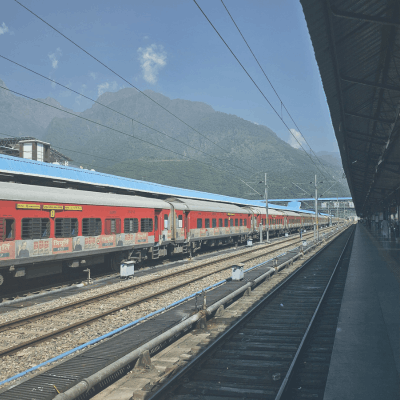
Rail transport is nearly 95% less polluting than road transport. With more than 99.5% electrification on broad gauge in the country, railways are becoming one of the most environmentally friendly modes of mass transportation
High-speed rail aligns perfectly with India’s climate commitments while supporting economic expansion, a rare win-win.
What This Means for Investors Like Us
From an investing perspective, high-speed rail generates positive secondary and tertiary opportunities:
- Infrastructure & EPC companies
- Rolling stock and signalling manufacturers
- Suppliers of cement and steel, as well as electrical equipment
- Logistics, warehousing and industrial parks
- Urban real estate near stations and corridors
The key is patience. Rail infrastructure doesn’t produce overnight returns, but it compounds value quietly over decades.
Final Thoughts: A Structural Shift, Not a One-Time Announcement
To me, the Budget 2026 rail push is more than just about faster trains. It marks a structural change in the way India plans mobility, trade and urban growth.
High-speed rail won’t replace flights entirely. It won’t solve every transport problem. But it will reshape economic behaviour, city relationships and investment opportunities in ways that will become visible only years from now. And by the time the impact is obvious, the biggest gains will already be behind us.
Also Read: Union Budget 2026: 10 Key Takeaways Shaping India’s Next Growth Phase
Disclaimer
This article is for informational and educational purposes only and should not be considered financial or investment advice. The views expressed are personal opinions based on publicly available information. Readers are advised to conduct their own research or consult a certified financial advisor before making any investment decisions.