
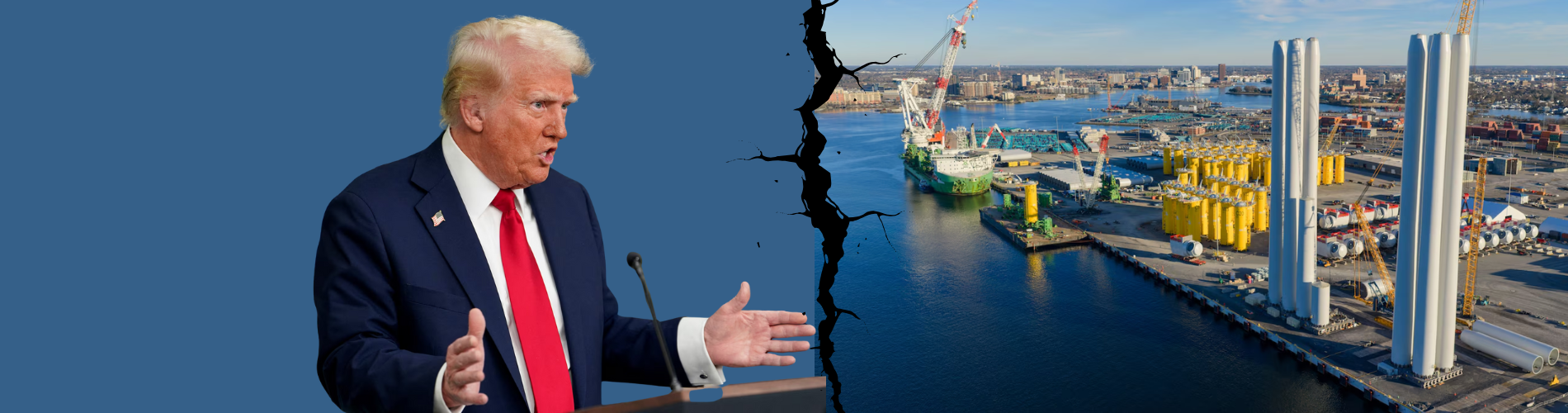
When I saw headlines that the administration of Donald Trump halted several offshore wind projects, my first instinct wasn’t political; it was analytical. I immediately opened market charts. Within minutes, one signal stood out: Dominion Energy shares had fallen about 4%.
For casual readers, that might look like a routine market fluctuation. But from where I sit as someone who tracks policy-driven investment shocks, that drop is a warning sign. Because when a single policy decision hits infrastructure, utilities, foreign developers, and long-term energy planning all at once, it usually means something much bigger is unfolding beneath the surface.
In this article, I break down what the halt of major offshore wind projects really means beyond the headline. I’ll walk through the market reaction, why certain energy stocks dropped instantly, how policy risk is reshaping investor sentiment, and what this could signal for the future of U.S. power infrastructure, electricity prices, and long-term energy investments.
The Policy Move That Shook Investors
The administration ordered a pause on multiple offshore wind projects under construction along the U.S. East Coast. The largest among them, Coastal Virginia Offshore Wind, was designed as a 176-turbine installation capable of powering more than 600,000 homes once completed.
And it wasn’t alone. Four other projects were halted:
- Vineyard Wind 1
- Revolution Wind
- Sunrise Wind
- Empire Wind 1
Combined, these developments could supply electricity to more than 2 million homes. That’s not just energy capacity, that’s infrastructure scale. When projects of that magnitude stall, markets don’t treat it as routine policy noise. They treat it as a structural shift.
Why the Government Pressed Pause on Wind Projects
Officials from the Interior Department said the decision was based on national-security concerns flagged by the Pentagon. The worry is that turbine blades and tall reflective towers could interfere with radar systems, creating false targets or obscuring real ones.
Interior Secretary Doug Burgum explained that the pause is intended to give federal agencies time to evaluate mitigation strategies with developers and state authorities.
From a market standpoint, though, investors rarely wait for full technical reviews. They react instantly to uncertainty, especially regulatory uncertainty. That’s exactly what we saw in the price action.

Market Reaction After Trump Halts Wind Projects
Dominion’s nearly 4% drop grabbed attention, but it wasn’t the only reaction.
- Danish developer Orsted plunged roughly 11%.
- Norwegian energy major Equinor slipped about 1%.
That spread tells me something important: markets are differentiating exposure levels. Companies heavily dependent on U.S. offshore wind saw sharper declines, while diversified firms with broader energy portfolios experienced milder reactions. In other words, investors aren’t abandoning energy; they’re repricing risk.
Why Dominion Became the Market’s Focal Point
Dominion wasn’t singled out by policy, but it became the stock traders’ focus because its halted project is the largest and closest to completion. The company has argued that the development is essential not only for clean energy but for grid stability, especially in Virginia, where electricity demand is surging.
Northern Virginia is the world’s biggest data-centre hub, and power demand is rising rapidly due to artificial-intelligence infrastructure. Dominion warned that delays could threaten reliability for military installations, civilian systems, and high-performance computing facilities.
From an investor’s lens, that’s a crucial insight: The government halted projects designed to meet rising electricity demand at the exact moment demand is accelerating.
That mismatch is why the stock reaction matters more than the percentage drop itself. The market is trying to price a future where demand is certain, but supply projects are uncertain.
Also Read: Trump’s 25% Tariff Threaten India’s $1.2B Exports
Political Reactions Add Another Layer of Risk
Policy shocks rarely stay confined to economics. Political reactions quickly amplified the story.
Senate Minority Leader Chuck Schumer criticised the decision and warned it could increase electricity costs. Meanwhile, Virginia Governor Glenn Youngkin supports the project despite being from the same party as the president, highlighting how state-level economic interests can clash with federal priorities.
Incoming governor Abigail Spanberger, who campaigned on lowering power costs partly through renewable expansion, also supports offshore wind.
Whenever leaders across party lines agree on infrastructure but federal policy blocks it, investors start to anticipate legal and regulatory battles. And markets hate drawn-out uncertainty more than they hate bad news.

Courts Could Still Change the Story
There’s also precedent suggesting this pause might not be final. Judge Patti Saris of the U.S. District Court for the District of Massachusetts previously ruled that an earlier order halting wind permits was unlawful. That decision showed courts are willing to intervene when policy actions are judged inconsistent with administrative law.
If legal challenges emerge again, the market could swing back just as quickly as it dropped. That’s why I see this not as a single event but as the start of a volatility phase.
What I’m Watching as an Investor
Whenever I analyse policy-driven sell-offs, I look for second-order effects. Here’s what I’m tracking now:
- Capital Rotation: If offshore wind faces prolonged delays, money may flow into alternative power sectors such as natural gas, nuclear, or grid storage.
- Supply-Demand Imbalance: Electricity demand from AI, data centres, and electrification isn’t slowing. If supply projects stall, power prices could rise.
- Policy Premium: Investors may start assigning higher risk premiums to renewable-energy projects, dependent on federal approvals.
- Global Ripple Effects: International developers involved in U.S. projects could reassess investment strategies, affecting renewable deployment worldwide.
My Personal Interpretation of the 4% Drop
Markets often communicate more through price action than headlines. Dominion’s decline isn’t catastrophic, but it is symbolic.
To me, that 4% drop signals:
- Uncertainty about project timelines
- Fear of additional regulatory hurdles
- Concern about cost overruns
- And scepticism about policy consistency
In other words, the stock didn’t just fall because of a halted project. It fell because investors suddenly had to reassess the entire risk framework around U.S. renewable infrastructure.

The Bigger Narrative Few Are Talking About
The most overlooked part of this story isn’t the politics or the market drop. It’s the timing. The U.S. is entering a phase of explosive electricity demand growth driven by:
- Artificial intelligence
- Electrified transport
- Data-center expansion
- Reshoring of manufacturing
Halting large-scale power projects during a demand surge is like slowing highway construction while traffic doubles. Eventually, congestion shows up somewhere, often in prices.
That’s why I see this moment not just as a policy decision but as a stress test for America’s energy transition timeline.
Final Takeaway
Yes, the headline says wind projects were stopped, and a major utility’s shares fell 4%. But what I see is much larger:
- A regulatory shock
- A sector repricing
- A political-economic clash
- And a potential turning point for energy investors
Short-term traders may focus on the stock dip. Long-term investors, though, should focus on what caused it. Because policy doesn’t just move markets for a day, it reshapes them for years.
Disclaimer
This article reflects personal analysis and opinion for informational purposes only and should not be considered financial or investment advice. Markets involve risk, and readers should conduct their own research or consult a qualified advisor before making investment decisions.