


You’ve decided to start investing in the stock market. You download a brokerage app, complete the registration process, and suddenly you’re asked to open a Demat account. If you’re wondering what a Demat account is, why you need one, and whether it’s different from a trading account, you’re not alone. These are some of the first questions almost every new investor asks.
While opening a Demat account has become easier than ever, understanding its purpose is just as important. Knowing how it works can help you invest with greater confidence and avoid common beginner mistakes.
This article explains what a Demat account is, how it works, why it’s important, what you can store in it, how it’s different from a trading account, the charges involved, and whether you need one before investing in stocks, ETFs, IPOs, and mutual funds.
Demat Account at a Glance
A Demat account, short for “dematerialised account,” is where your shares and other eligible investments live in electronic form. Instead of paper share certificates that could get lost, damaged, or forged, everything sits safely as digital entries linked to your name.
You need one because Indian stock exchanges no longer accept physical shares for trading. If you want to buy or sell stocks, hold IPO allotments, or invest in things like bonds and ETFs, a Demat account is the starting point.
Almost anyone planning to invest in the stock market needs one, whether you’re a first-time investor putting in a small amount or a seasoned trader managing a large portfolio.
Many beginners assume a Demat account and a trading account are the same. In reality, they serve different purposes, and understanding that difference is one of the first steps toward becoming a confident investor.
What Is a Demat Account?
Think of a Demat account as a digital locker for your investments. Instead of keeping physical share certificates at home or in a bank locker, all your shares, bonds, ETFs, and other eligible securities are stored electronically in one place.
Here’s why this matters. Until the late 1990s, buying shares in India meant physically receiving a paper certificate for every company you invested in. Transferring shares meant filling out forms, submitting original certificates, and waiting weeks for the process to complete. It was slow, and it left a lot of room for fraud, theft, and simple paperwork errors.
The Demat system fixed this. Your shares now exist as numbers in an electronic account, the same way your salary sits as a number in your bank account rather than as stacks of cash. When you buy shares, they get credited to your Demat account. When you sell, they get debited. No paperwork, no physical handling, no risk of a certificate going missing.
Why Do You Need a Demat Account?
Here’s why a Demat account isn’t optional if you want to invest in listed securities.
You need it to buy shares: When you purchase stock through your broker, the shares are electronically transferred into your Demat account. Without one, there’s simply nowhere for the exchange to deposit what you’ve bought.
You need it to hold investments safely: Once shares land in your Demat account, they stay there securely until you decide to sell. There’s no risk of physical damage, theft, or the certificate becoming invalid over time.
You need it to sell shares: Just as buying credits your account, selling debits the shares out of it. The Demat account is the record that proves you actually own what you’re trying to sell.
It eliminates the need for paper certificates: Everything that used to involve physical documents and courier services now happens digitally, often within seconds.
How Does a Demat Account Work?
Let’s understand this with an example.
Say you decide to buy 10 shares of a company through your broker’s app. Here’s what happens behind the scenes:
- You place a buy order through your trading account, specifying the stock and quantity.
- The order goes to the stock exchange (NSE or BSE), where it’s matched with a seller’s order.
- The trade gets executed, and the exchange confirms the transaction.
- Settlement happens, where the shares move from the seller’s Demat account to yours, and the money moves from your bank account to the seller’s. In India, this settlement is completed on a T+1 basis, meaning it happens one working day after the trade date.
- The shares appear in your Demat account, and you can check this through your broker’s app or through the consolidated account statement issued monthly by the depository.
The good news is that all of this happens automatically in the background. As an investor, you don’t need to manage the transfer yourself; your broker, the stock exchange, and the depositories handle the entire settlement process.
Selling works in reverse. You place a sell order, the exchange matches it with a buyer, and once the trade settles, the shares are debited from your Demat account while the sale proceeds are credited to your bank account.
The bigger question is: who actually keeps track of all this? That’s where depositories come in. In India, there are two depositories, NSDL (National Securities Depository Limited) and CDSL (Central Depository Services Limited). They don’t deal with investors directly. Instead, they work through Depository Participants, or DPs, which are usually your broker or bank. Think of the depository as the central record-keeper, and your DP as the local branch you actually interact with.
What Can You Store in a Demat Account?
A Demat account isn’t limited to just equity shares. It can hold a range of eligible securities, including:
- Shares of listed companies
- ETFs (Exchange Traded Funds)
- Bonds, including corporate and government bonds
- Government Securities (G-Secs)
- REITs (Real Estate Investment Trusts)
- InvITs (Infrastructure Investment Trusts)
- Mutual fund units held in electronic form, where the investor chooses this route
In simple terms, if it’s a security that trades on an exchange or is issued in dematerialised form, your Demat account can probably hold it.
Demat Account vs Trading Account
This is where most beginners get confused, and it makes sense, because the two accounts are opened together and work as a pair.
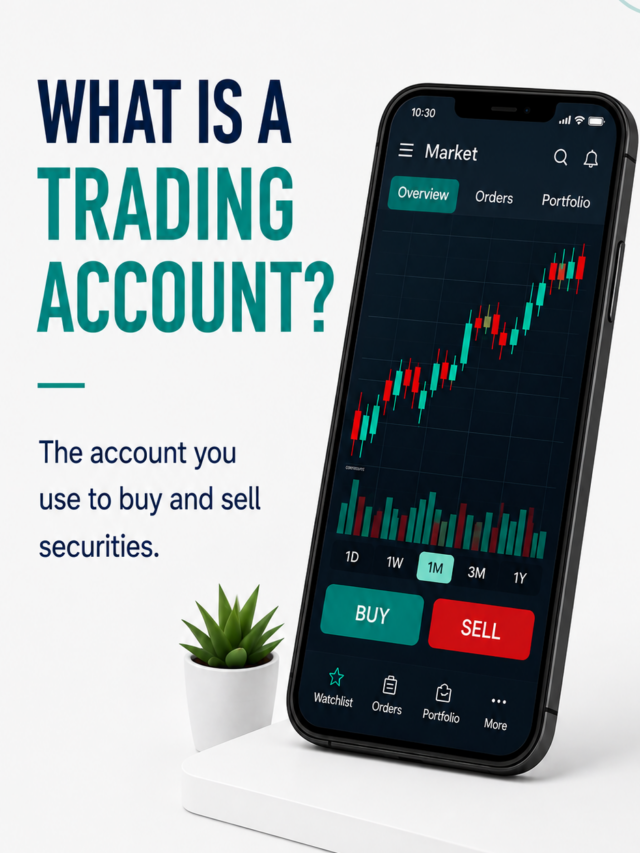
A trading account is what you use to place buy and sell orders on the stock exchange. A Demat account is where the shares you buy actually get stored. One handles the transaction, the other handles the storage.
| Feature | Demat Account | Trading Account |
| Purpose | Stores your shares and securities electronically | Used to place buy and sell orders |
| Function | Acts like a storage locker | Acts like a gateway to the stock exchange |
| Linked to | NSDL or CDSL (depositories) | Stock exchanges (NSE, BSE) |
| What moves through it | Shares, bonds, ETFs, and other securities | Buy and sell instructions and funds |
| Can you have one without the other? | Not useful for trading without a trading account | Not functional without a linked Demat account |
Here’s a simple way to remember it: your trading account is like the checkout counter where you place your order, and your Demat account is like the warehouse where your purchase actually gets stored afterward.
Demat Account vs Bank Account
Another common mix-up is between a Demat account and a bank account, and it’s easy to see why. Both feel like places where your money or assets “live.”
But here’s where they differ. A bank account holds your money. A Demat account holds your investments, like shares, bonds, and ETFs. When you buy shares, money moves out of your bank account, and shares move into your Demat account. When you sell, it works the other way around.
You can’t deposit cash directly into a Demat account, and you can’t hold shares in a bank account. They serve completely different purposes but work together every time you make a trade.
Do You Need a Demat Account for Mutual Funds?
In simple terms, no, not necessarily.
If you’re investing directly through an Asset Management Company (AMC), either through their website, app, or a platform like a registrar’s portal, you don’t need a Demat account. Your mutual fund units are tracked separately in what’s called a folio, based on your PAN and KYC details.
However, if you invest through certain broker platforms, or if you choose to hold your mutual fund units in dematerialised form instead of the regular statement-based format, they can be credited to your Demat account. It’s optional, not compulsory.
The one place where a Demat account is essential is ETFs. Since ETFs trade on the stock exchange just like shares, you cannot buy or hold them without one.
Who Should Open a Demat Account?
- Beginners: who want to start investing in stocks, even with a small amount, need one before their very first trade.
- Long-term investors: who plan to hold shares for years benefit from the safety and convenience of electronic holdings.
- Traders: who buy and sell frequently rely on it for every single transaction.
- IPO investors: need a Demat account to apply for an IPO, since any shares allotted are credited directly into it.
If investing in the stock market is on your radar in any form, a Demat account is one of the first things you’ll need to set up.
Can You Open a Demat Account Without Buying Shares?
Yes. Opening a Demat account doesn’t mean you have to start investing immediately. Many people open one first and begin investing later, once they’ve done their research or feel ready to take the next step. There’s no requirement to buy shares as soon as your account becomes active, and an empty Demat account doesn’t cost you anything extra beyond the usual maintenance charges, if any apply.
Documents Required
Opening a Demat account today is largely paperless, but you’ll typically need:
- PAN card
- Aadhaar card
- A recent passport-size photograph
- Proof of address (if different from Aadhaar)
- Bank account details, usually a cancelled cheque or bank statement
- Income proof, required by some brokers for trading in derivatives
How to Open a Demat Account
Here’s how the process usually works with most brokers today:
- Fill in your basic details like name, PAN, and mobile number on the broker’s app or website.
- Complete your KYC by uploading your PAN and Aadhaar for verification.
- Verify your identity through Aadhaar-based e-KYC or a video verification call, depending on the broker.
- Link your bank account for future transactions.
- E-sign the account opening form using your Aadhaar-linked mobile number, which completes the process digitally.
Most brokers today can get your account up and running within a day, sometimes within a few hours.
Charges You Should Know About
In simple terms, a Demat account isn’t always free to maintain, so it helps to know what you might be charged for.
- Account opening fee: Many discount brokers have done away with this entirely, though some full-service brokers may still charge a small one-time fee.
- Annual Maintenance Charges (AMC): This is the annual recurring fee that is required to keep your account operational and may range from zero up to a few hundred rupees depending upon your broker. However, if your net investment remains under a specific limit, then as per SEBI guidelines, you have an option of getting a Basic Services Demat Account (BSDA), which will help you save on AMC.
- Transaction charges: You need to pay transaction charges while selling shares; however, a small fee is deducted by the depository and then charged via your broker. No transaction charge is levied while buying shares.
- Other possible fees: You may have to pay for additional services such as conversion of physical to electronic shares and pledging shares as collateral against margin.
These vary from broker to broker and thus should be compared before making a choice.
Benefits of Having a Demat Account
- Safety: No risk of losing, damaging, or misplacing physical certificates.
- Convenience: Buying, selling, and tracking investments all happen from one app or platform.
- Speed: Transactions settle within a day instead of taking weeks, as they did in the paper-certificate era.
- Consolidation: All your holdings, across companies and asset types, sit in a single account instead of scattered paperwork.
- Easy transfers: Shares can be transferred, pledged, or gifted electronically without physical hassle.
- Easier IPO applications: Any shares you’re allotted in an IPO get credited directly to your Demat account, with no paperwork on your end.
- Automatic corporate actions: Benefits like bonus shares, dividends, and rights issues are credited directly to your account without you having to do anything.
- Portfolio tracking: Since everything sits in one place, it’s easy to see your complete investment picture at a glance, instead of piecing it together from different sources.
Common Mistakes Beginners Make
- Confusing Demat and Trading accounts and not realizing they serve different purposes despite being opened together.
- Ignoring AMC charges, which quietly add up over the years even if you’re not actively trading.
- Opening multiple accounts unnecessarily, which makes it harder to track holdings and can mean paying AMC to more than one broker.
- Not updating KYC details, which can lead to a frozen or restricted account when your information doesn’t match records with the depository.
Final Verdict
A Demat account is one of the first building blocks of stock market investing. While opening one takes only a few minutes today, understanding how it works can save you from confusion later. Imagine it as a secured digital locker that helps you keep your investments secure and accessible whenever needed. Once you know the basic idea behind it and how different it is from other accounts such as trading or banking accounts, you will be well-prepared for embarking upon your investing experience.
A Demat account is not just any other account that you create while registering yourself with a brokerage firm, but a base on which modern stock market investing is built. Once you know about its functionality, terms like trading account, IPOs, ETFs,s and shareholding will no longer be complicated for you. Whether you wish to start investing or want to learn about how the stock market functions, understanding the importance of a Demat account will prove to be very helpful.




FAQs
What is a Demat account?
It's an electronic account that holds your shares and other eligible securities in digital form, replacing the need for physical share certificates.
Is a Demat account mandatory?
Yes, if you want to trade or hold shares and ETFs on the Indian stock exchanges, a Demat account is compulsory. It's optional for mutual fund investments made directly through an AMC.
Can I have more than one Demat account?
Yes, you can open Demat accounts with different brokers. Just keep in mind that each one may come with its own AMC and other charges.
Can I open a Demat account online?
Yes, most brokers today offer a fully online, paperless process using Aadhaar-based e-KYC, which can be completed within minutes to a day.
Can I invest in mutual funds without one?
Yes, you can invest directly through an AMC's website, app, or a registrar platform without ever needing a Demat account, unless you specifically choose to hold your units in dematerialised form.
ARN Disclosure: Investik Future is an AMFI-registered Mutual Fund Distributor. ARN-341107 — Verify on AMFI ↗. Komal Thakur is the content author and digital marketer; the ARN registration belongs to Investik Future, not to the author personally.