
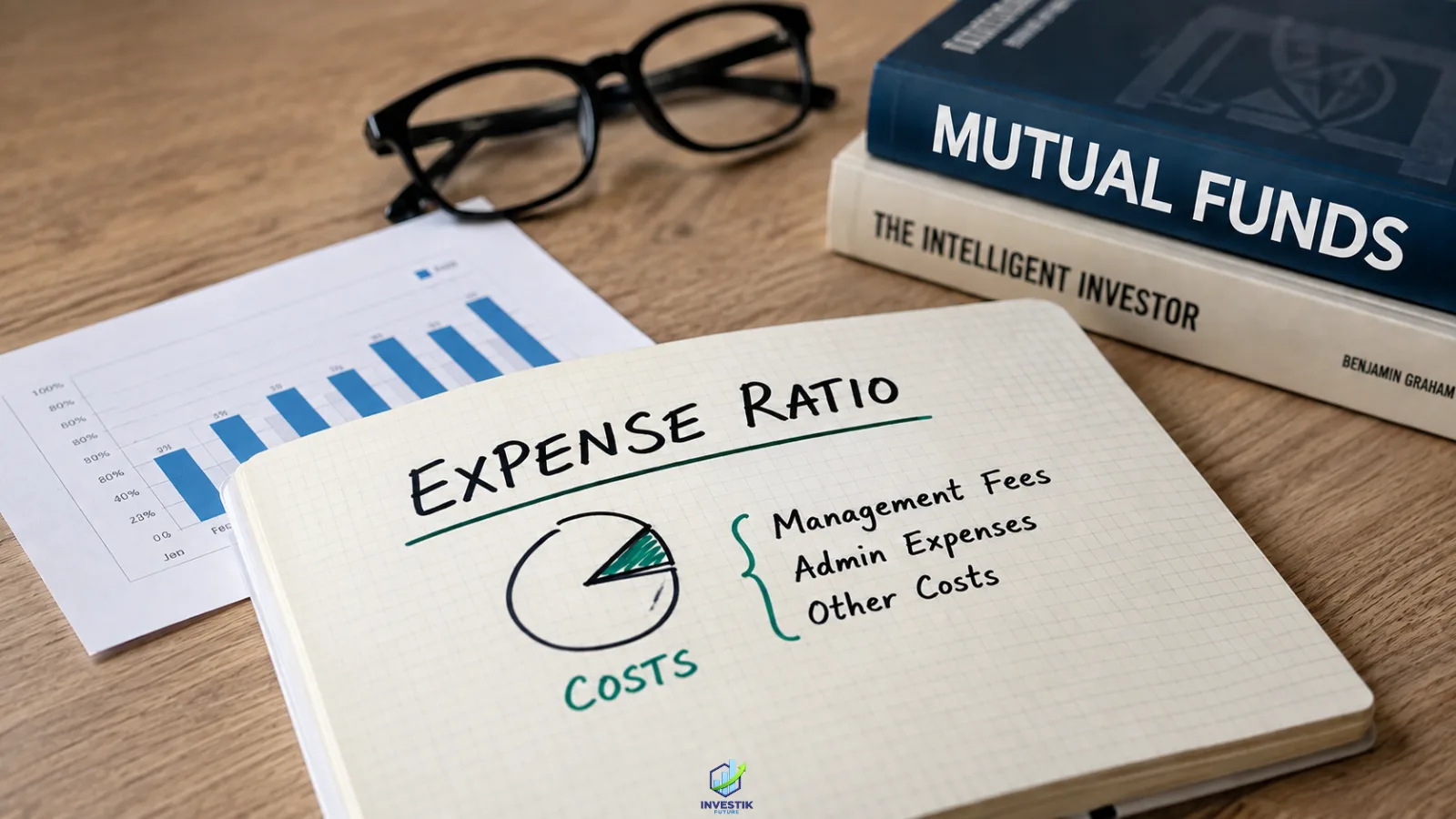

Most people researching mutual funds spend their time comparing past returns, star ratings, and fund manager reputations. Almost nobody spends five minutes on the one number that’s actually working against them every single day: the expense ratio. It’s small, it’s boring, and it never shows up as a line item you can point to. Which is exactly why it’s so easy to ignore.
This article walks through what the expense ratio in a mutual fund really is, why it exists in the first place, how it quietly shapes your returns over the years, and how to think about it when you’re actually choosing between funds, instead of treating it as the deciding factor or, worse, not looking at it at all.
Quick Summary
| Topic | Summary |
| What is Expense Ratio? | The yearly fee a fund charges for managing your money, taken as a percentage of your investment |
| Who Pays It? | Everyone in the fund, in proportion to how much they’ve invested |
| How Is It Charged? | Built into the daily NAV, you won’t see it as a separate deduction |
| Does It Reduce Returns? | Yes. Whatever return you see quoted is already after this cost |
| Is Lower Always Better? | Not really; a fund that costs a bit more but performs better can still win out. |
| Where Can You Check It? | Fund factsheet, the AMC’s website, or apps like Groww, ET Money, or Zerodha Coin |
What Is an Expense Ratio in a Mutual Fund?
Put simply, it’s the fee a mutual fund charges every year to manage your money. A fund with a 1% expense ratio is taking roughly 1% of your invested amount annually to cover the cost of running things.
You won’t get a bill for it. There’s no debit in your bank statement, no email confirmation. It gets worked into the fund’s NAV calculation quietly, day after day, which is exactly why so few investors ever notice it happening.
That money goes to the Asset Management Company running the fund, the people picking stocks, doing the research, and keeping everything compliant with SEBI’s rulebook.
Why Do Funds Even Charge This?
Because running a fund costs money, and none of it is trivial. There’s a fund manager and research team whose entire job is deciding what to buy and sell. A registrar is handling your account statements and transactions in the background. There’s compliance, technology, customer support; all of it needs funding from somewhere.
If you’re invested in a Regular Plan, there’s an extra layer here too: distributor commission. Someone helped you invest, or advised you along the way, and they get paid out of that expense ratio. Direct Plans skip this part entirely, which is why they usually cost less.
So How Does This Actually Affect My Returns?
Here’s the bit most people get wrong. Every return figure you see for a fund, on an app, on the AMC’s site, wherever, is already net of the expense ratio. You’re not paying it on top of what’s shown. It’s already subtracted.
Say a fund’s underlying holdings genuinely grew 12% in a year, and the fund charges 1.5%. What you’d actually see reported is closer to 10.5%. Nobody sends you an invoice for that 1.5%; it’s baked in through the NAV, invisibly, every day.
Over a year, that’s not much to worry about. But stretch it across fifteen or twenty years of compounding and that “small” 1-1.5% starts to look a lot bigger by the time you actually need the money.
Suppose you invest ₹10 lakh for 20 years. Fund A charges 0.30%, Fund B charges 1.50%. Assuming both generate the same gross return before costs, Fund A ends up leaving you with a noticeably larger corpus, simply because more of your money stays invested and keeps compounding year after year instead of being chipped away by fees. The gap doesn’t look like much in year one. By year twenty, it’s real money.
Does the Expense Ratio Affect SIP Returns Too?
Yes, and this trips up a lot of first-time SIP investors. Whether you’re investing a lump sum or running a monthly SIP, the expense ratio works the same way; it’s deducted through the NAV, not billed to you separately. Every SIP instalment buys units at a NAV that already reflects the fund’s costs, so there’s no special SIP exemption or separate fee structure to worry about. The mechanics don’t change; only the frequency of your investment does.
Does a Higher Expense Ratio Mean the Fund Is Worse?
Not automatically, and this is where a lot of quick advice oversimplifies. An actively managed fund, where someone’s actually researching and picking individual stocks, costs more to run than a fund that just tracks an index. That’s not a red flag by itself; it’s just the nature of active management.
Index funds and other passive options don’t need that level of hands-on decision-making, so their costs stay low almost by design.
The real question isn’t “is this fund expensive,” it’s “is this fund earning its cost?” An active fund that reliably beats its benchmark by a healthy margin has justified its higher fee. One that barely keeps pace with the index while charging active-fund prices hasn’t.
Direct vs Regular Mutual Funds: How the Expense Ratio Differs
This comparison gets searched a lot, and for good reason; it’s one of the clearest ways the expense ratio shows up in your actual returns.
| Aspect | Direct Plan | Regular Plan |
| Distributor commission | Excluded | Included |
| Expense ratio | Lower | Higher |
| Best suited for | Investors comfortable doing their own research | Investors who want ongoing guidance |
| Long-term returns | Slightly higher, thanks to lower costs | Slightly lower, due to the added commission |
| Convenience | You’re on your own | Someone’s there to help |
The same fund, run by the same manager, holding the same stocks, can carry two different expense ratios depending on which plan you pick. That gap is the distributor’s cut, nothing more. The portfolio, the fund manager, and the investment strategy stay identical across both plans; the only thing that changes is that Regular Plans fold in a distributor commission, which pushes the expense ratio up. It’s a common misconception that Direct and Regular Plans are somehow different products. They’re not. They’re the same fund with a different price tag attached.
Is Cheaper Always Better?
Not really, no. It’s a fair instinct: lower fees, more money left for you, but cost is only one piece of the puzzle. A fund charging a bit more that consistently delivers stronger returns can still leave you better off than the cheapest option in its category.
The better question isn’t “which fund costs the least,” it’s “which fund gives me the most for what it costs.” Sometimes that’s the cheap one. Sometimes it isn’t.
Key Takeaway
- Don’t pick a fund just because it has the lowest expense ratio.
- Compare expense ratios within the same category, not across categories.
- Weigh performance, consistency, and risk alongside cost, not instead of it.
What Is a Good Expense Ratio for Mutual Funds?
There’s no magic number here; it really depends on the category you’re comparing within:
Index funds sit at the bottom of the cost scale, often comfortably under 1%, since there’s barely any active decision-making involved. Large cap funds run a bit higher, reflecting the active research that goes into picking among well-established names. Flexi cap funds tend to cost more still, given their broader mandate across market caps. Mid cap and small cap funds are usually the priciest of the lot, because tracking smaller, less-covered companies takes more legwork.
Rather than fixating on an exact percentage, it’s more useful to just compare a fund against others in its own category. A small cap fund and an index fund were never going to cost the same thing, and that’s fine.
Who Decides the Expense Ratio?
The AMC sets the number, but it doesn’t get a free hand. SEBI caps how high the expense ratio can go, and those caps aren’t uniform; they vary by fund category and shrink as a fund’s assets under management grow. An equity fund with a much larger AUM is expected to charge less proportionally than a smaller one, since the fixed costs of running it get spread across a bigger base.
This is also why an index fund and a small cap fund from the same AMC can carry very different expense ratios even though the same company manages both. The category and the fund size do most of the work in determining where that number lands.
How to Check a Mutual Fund’s Expense Ratio
Funds are required to disclose it, so it’s not hidden; you just need to know where to look. The AMC’s website carries the most current figure for each scheme. The monthly factsheet lists it too, right alongside portfolio holdings and fund manager details.
If you’re using Groww, ET Money, or Zerodha Coin, the expense ratio is usually right there on the fund’s page, often next to a comparison with similar funds. AMFI’s website is another option if you want an industry-wide view across AMCs.
Expense Ratio vs Exit Load: What’s the Difference?
These two get confused constantly, but they’re doing completely different jobs.
| Aspect | Expense Ratio | Exit Load |
| What it is | Ongoing fee for managing the fund | One-time fee for leaving too early |
| When it applies | Every year, deducted daily | Only if you redeem before a set period |
| Purpose | Pays for running the fund | Discourages short-term exits |
| Who it applies to | Every investor, always | Only investors who redeem early |
Think of the expense ratio as the cost of staying invested, and the exit load as the cost of leaving too soon. Cross the minimum holding period and the exit load simply stops applying.
How Expense Ratio Differs from Brokerage Charges
If you also trade stocks or ETFs, it’s easy to lump these together, but they’re unrelated. Brokerage is what you pay a broker to actually execute a trade. The expense ratio is a fund-management cost that has nothing to do with buying or selling.
Invest in a regular mutual fund scheme (not an ETF), and you likely won’t run into brokerage charges at all. The expense ratio is really the only recurring cost you’re dealing with.
What Should You Consider Besides the Expense Ratio?
While the expense ratio is an important cost to compare, it shouldn’t be the only factor driving your decision. Look at how consistently the fund has performed across different market cycles, how much risk it takes compared to similar funds, the fund manager’s experience, portfolio diversification, and whether the investment strategy matches your financial goals.
The expense ratio becomes most useful when you’re comparing two funds with similar performance, risk profile, and investment objective. In such cases, choosing the lower-cost fund can make sense. However, a slightly higher expense ratio isn’t necessarily a drawback if the fund has consistently delivered better risk-adjusted performance over the long term.
Final Verdict
The expense ratio is an important cost to consider, but it shouldn’t be the deciding factor when choosing a mutual fund. A lower expense ratio can help improve your long-term returns, but only when the fund also delivers consistent performance, manages risk effectively, and aligns with your investment goals.
Instead of looking for the cheapest fund, focus on finding one that offers the best overall value. Comparing costs alongside performance, fund management, portfolio quality, and investment strategy will help you make more informed decisions and build wealth with greater confidence over the long term.



FAQs
What's a good expense ratio for a mutual fund?
Depends entirely on the category. Index funds run lowest; small and mid cap funds run highest. Compare within the same category, not across.
Is the expense ratio deducted daily?
Yes, it's worked into the NAV calculation every day rather than taken out as one lump sum.
Does expense ratio reduce NAV?
Yes. The NAV you see already accounts for it.
Which funds tend to have the lowest expense ratio?
Index funds and ETFs, generally, since there's no active stock-picking involved.
Can the expense ratio change over time?
Yes, AMCs can revise it within SEBI's limits, and any change has to be disclosed to investors.
ARN Disclosure: Investik Future is an AMFI-registered Mutual Fund Distributor. ARN-341107 — Verify on AMFI ↗. Komal Thakur is the content author and digital marketer; the ARN registration belongs to Investik Future, not to the author personally.