
If you have ever changed rupees for dollars before a trip, swiped a forex card in London, or watched the USD/INR rate move on the news, you have already touched the forex market. What is the forex market and how does it work, in plain terms? It is the global marketplace where one country’s currency gets bought or sold for another, 24 hours a day, five days a week, across banks, brokers, companies, and individual traders.
This guide is built to answer that question completely, for readers in India, the US, the UK, and anywhere else currencies get traded. By the end, you will understand what the forex market is, how it works at a mechanical level, who runs it, how a trade actually settles, what it costs, how it is taxed in India, and how to avoid the mistakes that wipe out most new traders in their first year. You will not need another article after this one.
We publish this as part of our Forex coverage at Investik Future, where we break down markets in plain language backed by primary data.
What is the forex market?
The forex market, short for foreign exchange market, is the global system where currencies are exchanged for one another at an agreed rate. Forex stands for “foreign exchange.” Every time a company imports goods, a tourist travels abroad, an investor buys a foreign stock, or a central bank adjusts its reserves, a currency conversion happens somewhere inside this market.
There is no single building or exchange floor for this. Unlike the NSE or the NYSE, the forex market is over-the-counter (OTC). Trades happen directly between two parties, or through an electronic network connecting banks, brokers, and trading platforms, rather than on a centralized exchange. According to the Bank for International Settlements’ 2025 Triennial Survey, global daily forex turnover reached USD 9.6 trillion in April 2025, up 28% from 2022. No other financial market, including equities and bonds combined, comes close to that volume.
To put that number in context: USD 9.6 trillion changes hands in the forex market in a single day. That is roughly 3.5 quadrillion dollars over a year of trading days. Around 88% of all trades still involve the US dollar on one side, the euro sits second, and the Japanese yen and British pound follow.
A short history of the forex market
Understanding how this market came to look the way it does helps explain a lot of its current rules.
For most of the 20th century, currencies didn’t float freely. Under the gold standard, which lasted until the 1930s in most major economies, currencies were pegged to a fixed amount of gold. After World War II, the Bretton Woods system (1944) pegged major currencies to the US dollar, which was in turn pegged to gold at USD 35 an ounce. Central banks defended these fixed rates directly.
That system broke down in 1971, when the US suspended the dollar’s convertibility to gold. By 1973, major economies had moved to a floating exchange rate system, where currency values are set by market supply and demand rather than a fixed peg. This is the system in place today, and it’s the reason exchange rates move constantly instead of staying fixed.
Electronic trading platforms in the 1990s and 2000s opened the market to retail participants for the first time; before that, forex trading was almost entirely the domain of banks and large institutions. That shift is why a retail trader in Mumbai or Manchester can now open a position from a phone, something that simply didn’t exist 30 years ago.
Types of forex market: the four layers
A common search query is “types of forex market,” and the honest answer is that forex is not one single market. It is four connected layers, each serving a different purpose.
1. Spot market This is the largest and simplest layer. Two parties agree to exchange currencies at the current market rate, with settlement typically within two business days (T+2). Most retail forex trading and everyday currency exchange happens here.
2. Forward market Two parties lock in an exchange rate today for a transaction that will settle on a specific future date. Companies use forwards to hedge against currency risk, for example, an Indian IT exporter locking in a USD/INR rate three months ahead so a client payment isn’t eroded by rupee depreciation.
3. Futures market Similar to forwards, but standardized and traded on a regulated exchange like the NSE or CME, with a clearing house guaranteeing settlement. Futures reduce counterparty risk compared to private forward contracts.
4. Swap and options market A swap is an agreement to exchange currency now and reverse it later at a pre-agreed rate, commonly used by banks to manage short-term funding. An option gives the buyer the right, but not the obligation, to exchange currency at a set rate before a future date. Per the BIS 2025 survey, FX swaps make up the largest single instrument category within total turnover, ahead of spot transactions.
| Market type | Settlement | Primary users | Main purpose |
|---|---|---|---|
| Spot | T+1 to T+2 | Retail traders, tourists, banks | Immediate currency need |
| Forward | Custom future date | Exporters, importers | Hedging future payments |
| Futures | Standardized dates | Institutions, active traders | Hedging with exchange guarantee |
| Swap/Options | Varies | Banks, corporates, funds | Funding management, optional hedging |
Who controls the forex market?
No single government, bank, or exchange controls the global forex market. It is decentralized by design. That said, several bodies shape how it functions in each country:
- Central banks (the US Federal Reserve, the European Central Bank, the Bank of Japan, and India’s Reserve Bank of India) set interest rates and intervene occasionally to stabilize their currency, which moves exchange rates.
- Commercial and investment banks like JPMorgan, Deutsche Bank, and Citi act as the largest market makers, quoting prices to each other and to clients.
- Regulators oversee brokers and market conduct. In India, currency derivatives trading on exchanges falls under the Securities and Exchange Board of India (SEBI), while cross-border currency movement is governed by the RBI under the Foreign Exchange Management Act (FEMA), 1999. In the US, the Commodity Futures Trading Commission (CFTC) and National Futures Association (NFA) regulate retail forex brokers. In the UK, it’s the Financial Conduct Authority (FCA).
- The BIS does not regulate the market but collects the turnover data (like the 9.6 trillion dollar figure above) that the entire industry uses as its benchmark.
So the honest answer to “who controls the forex market” is: nobody controls it outright, but central banks and national regulators each control their own currency’s rules and their own country’s brokers.
Who trades in the forex market?
Understanding the participants explains why the market never really sleeps.
- Central banks trade to manage reserves and influence their currency’s value.
- Commercial banks trade on behalf of clients and for their own accounts, forming the backbone of the interbank market.
- Corporations convert currency for trade, payroll, and to hedge future revenue.
- Institutional investors such as pension funds and mutual funds convert currency when buying foreign assets.
- Hedge funds and proprietary trading firms trade speculatively, betting on short-term rate movements.
- Retail traders are individuals trading through online brokers. Per the BIS survey cited earlier, retail flow is estimated at around USD 242 billion a day, only about 2.5% of total turnover, small in share but consistently present.
How does forex trading work, step by step?
This is the part most guides skip past. Here is how does forex trading work step by step, from opening an account to closing a position.
Step 1: Currencies are always quoted in pairs. You never buy a currency in isolation; you buy one and sell another simultaneously. EUR/USD at 1.0850 means 1 euro buys 1.0850 US dollars. The first currency is the “base,” the second is the “quote.”
Step 2: You choose a direction. If you believe the euro will strengthen against the dollar, you “go long” EUR/USD (buy). If you believe it will weaken, you “go short” (sell).
Step 3: The trade is quoted with a spread. Brokers show a bid price (what they’ll buy from you) and an ask price (what they’ll sell to you). The difference is the spread, and it’s how many brokers earn revenue instead of charging a flat commission. On EUR/USD, a typical retail spread might be 0.6 to 1.2 pips during liquid hours.
Step 4: You trade in lot sizes. A standard lot is 100,000 units of the base currency. A mini lot is 10,000, a micro lot is 1,000. Most beginners start with micro lots to control risk.
Step 5: Leverage multiplies your exposure. A broker might offer 1:30 leverage (common under EU/UK retail rules) or higher elsewhere. With 1:30 leverage, USD 1,000 of your capital controls a USD 30,000 position. This magnifies both gains and losses.
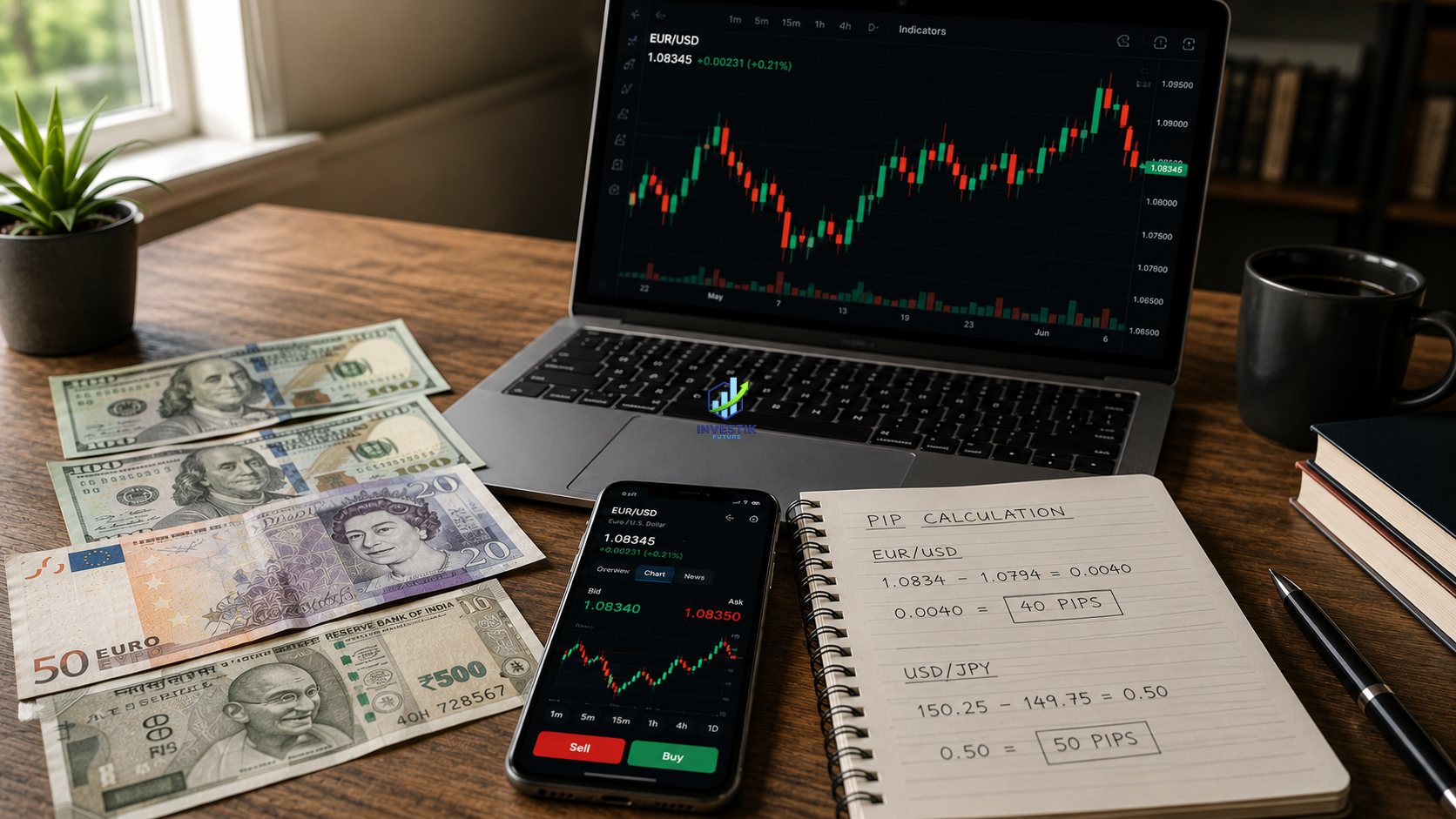
Step 6: Price moves are measured in pips. A pip is typically the fourth decimal place in most pairs (0.0001) or the second decimal in yen pairs (0.01). If EUR/USD moves from 1.0850 to 1.0900, that’s a 50-pip move.
Step 7: You close the position and settle the difference. Profit or loss is the pip movement multiplied by the lot size, before spread and any overnight financing charges (called swap or rollover fees) if the position stays open past 5 p.m. New York time.
A worked example
Say you buy 1 standard lot (100,000 units) of EUR/USD at 1.0850 and sell it later at 1.0900.
- Pip movement: 50 pips
- Pip value on a standard lot of EUR/USD: approximately USD 10 per pip
- Profit before costs: 50 × USD 10 = USD 500
If you had used a micro lot (1,000 units) instead, the same 50-pip move would be worth about USD 0.50 per pip, or USD 25 total. This is why lot size, not just market direction, decides how much money is actually at risk.
Margin, margin calls, and how leverage actually works
Leverage sounds abstract until you see the margin math behind it.
Say a broker requires 3.33% margin, which is the same as 1:30 leverage. To open 1 standard lot of EUR/USD (100,000 units, worth roughly USD 108,500 at 1.0850), you’d need to deposit about USD 3,613 as margin. The remaining USD 104,887 is effectively borrowed from the broker.
Your account equity is your deposited capital plus or minus any floating profit or loss on open positions. If the trade moves against you and your equity falls close to your required margin, the broker issues a margin call, a warning to add funds or reduce your position. If equity keeps falling and breaches the broker’s stop-out level (commonly 50% to 100% of required margin, depending on the broker), the platform automatically closes your position to prevent a negative balance.
This is the mechanism most new traders don’t fully grasp: leverage doesn’t just multiply your potential profit, it also compresses how much adverse price movement your account can absorb before a forced closure. A 1:30 leveraged position can be wiped out by a much smaller adverse move than an unleveraged one. This is precisely why regulators like the FCA and ESMA cap retail leverage at 1:30 for major pairs, while some offshore brokers advertise 1:500 or higher, which sharply raises the risk of a margin call on ordinary volatility.
Forex market hours and trading sessions
The forex market runs continuously from Monday morning in Wellington/Sydney to Friday evening in New York, because as one financial centre closes, another opens.
| Session | Approx. IST timing | Approx. GMT timing | Character |
|---|---|---|---|
| Sydney | 3:30 AM – 12:30 PM | 10:00 PM – 7:00 AM | Lower volume, early trend signals |
| Tokyo | 5:30 AM – 2:30 PM | 12:00 AM – 9:00 AM | Yen pairs active |
| London | 12:30 PM – 9:30 PM | 8:00 AM – 5:00 PM | Highest liquidity, ~38% of global turnover |
| New York | 6:30 PM – 3:30 AM | 1:00 PM – 10:00 PM | Overlaps London, high volatility |
The London-New York overlap (roughly 5:30 PM to 9:30 PM IST) is when the deepest liquidity and tightest spreads typically show up, since both major hubs are trading simultaneously. London alone accounts for close to two-fifths of global forex turnover, more than any other single hub.
Major, minor, and exotic currency pairs
- Major pairs: pairs that include the US dollar and one other heavily traded currency, such as EUR/USD, USD/JPY, GBP/USD, and USD/CHF. These carry the tightest spreads and highest liquidity. The 2025 BIS data shows the seven major pairs’ combined share of global turnover has actually fallen, from 85% in 2022 to about 66.3% in 2025, as trading in the Chinese yuan and other pairs expands.
- Minor pairs (crosses): pairs that exclude the US dollar, like EUR/GBP or AUD/JPY.
- Exotic pairs: a major currency paired with a currency from a smaller or emerging economy, such as USD/INR, USD/TRY, or USD/ZAR. Spreads here are wider and liquidity thinner.
Forex market vs stock market: the key differences
| Factor | Forex market | Stock market |
|---|---|---|
| Trading hours | 24 hours, 5 days a week | Fixed hours (NSE: 9:15 AM–3:30 PM IST) |
| Structure | Decentralized, OTC | Centralized exchange |
| What you trade | Currency pairs | Company shares |
| Typical leverage | Higher (varies by regulator) | Lower, regulator-capped |
| Daily turnover (global) | ~USD 9.6 trillion | A fraction of forex turnover |
| Price driver | Interest rates, trade flows, geopolitics | Company earnings, sector trends |
Both markets reward the same discipline: position sizing, a plan, and patience. Retail investors researching one often end up exploring the other; if you’re comparing the two, our guide on how the stock market works is a useful companion read.
Forex trading and regulation in India
This is where “what is the forex market and how does it work in India” search intent gets specific. For resident Indians, forex activity is governed by two separate frameworks:
- Retail currency derivatives: You can legally trade currency futures and options on Indian exchanges like the NSE and BSE, but only in INR-based pairs (USD/INR, EUR/INR, GBP/INR, JPY/INR). This is regulated by SEBI.
- Overseas forex trading platforms: Trading in non-INR pairs (like EUR/USD) through international, unregistered forex brokers is not permitted for Indian residents under FEMA regulations, since it falls outside the RBI’s Liberalised Remittance Scheme (LRS) framework for such activity. Many overseas platforms marketing to Indian traders operate in a legal grey zone; residents should stick to SEBI-regulated exchanges for currency derivatives.
For everyday currency conversion, such as sending money abroad for education, travel, or medical treatment, Indian residents use the Liberalised Remittance Scheme (LRS), which allows remittances of up to USD 250,000 per financial year per person. Since April 1, 2026, the applicable Tax Collected at Source (TCS) rules work as follows:
- No TCS applies on the first ₹10 lakh remitted in a financial year, combined across all purposes and banks.
- Beyond ₹10 lakh, TCS for education and medical remittances was reduced from 5% to 2% under Budget 2026.
- TCS collected is not an extra cost; it’s adjustable against your total income tax liability, or refundable when you file your ITR if you have no offsetting liability.
- Remittances for overseas tour packages carry a different TCS structure and no ₹10 lakh exemption band in some cases, so always check current rates before booking.
Always verify current rates directly on the RBI’s official LRS FAQ page or with your bank before remitting, since these thresholds have changed twice in three budget cycles.
Why exchange rates move: the real drivers
An exchange rate is simply the price of one currency in terms of another, and like any price, it moves on supply and demand. The main forces are:
- Interest rate differentials: Higher rates in a country tend to attract foreign capital seeking better returns, increasing demand for that currency.
- Inflation: Lower inflation generally supports a currency’s purchasing power and relative value over time.
- Trade balance: A country that exports more than it imports usually sees more demand for its currency.
- Political and economic stability: Investors prefer currencies from countries with predictable policy and low geopolitical risk.
- Central bank intervention: The RBI, for instance, occasionally buys or sells dollars to smooth excessive INR volatility, without targeting a fixed rate.
- Market sentiment and speculation: Short-term flows from traders betting on data releases (like US non-farm payrolls or India’s CPI print) can move rates within minutes.
Economic indicators that move currency markets
Traders watch a recurring set of scheduled data releases because these are the events most likely to cause a sharp, short-term move in a currency pair.
| Indicator | Released by | Why it moves currency |
|---|---|---|
| Interest rate decisions | Central banks (Fed, ECB, RBI, BoE) | Directly changes the return on holding that currency |
| Non-farm payrolls (NFP) | US Bureau of Labor Statistics | Signals US economic strength, moves USD pairs sharply |
| Consumer Price Index (CPI) | National statistics offices | Signals inflation, which feeds into rate decisions |
| GDP growth | National statistics offices | Broad measure of economic health |
| Purchasing Managers’ Index (PMI) | Private survey providers (e.g., S&P Global) | Early signal of manufacturing/services momentum |
| Trade balance | Customs/trade departments | Shows currency demand from imports vs exports |
Knowing when these are scheduled (most brokers and financial news sites publish an economic calendar) matters more for short-term traders than for long-term investors, since volatility around these releases can spike sharply within seconds.
Fundamental vs technical analysis in forex
Most forex participants lean on one of two broad approaches, often blended together.
Fundamental analysis looks at the economic health, interest rate policy, and political stability behind a currency, using the indicators in the table above. A fundamental trader might go long the US dollar ahead of an expected Fed rate hike, on the reasoning that higher US rates will draw in more capital.
Technical analysis studies price charts directly, using patterns, support and resistance levels, and indicators like moving averages or the Relative Strength Index (RSI) to time entries and exits, largely independent of the underlying economic story. A technical trader might enter EUR/USD purely because price bounced off a level it has respected multiple times before.
Neither approach is objectively “correct.” Institutional desks typically combine both: fundamentals to decide direction, technicals to decide timing.
Common forex trading strategies
- Scalping: Opening and closing many trades within minutes, aiming for small pip gains repeated often. Requires low spreads and fast execution; not practical for beginners due to the volume of decisions required.
- Day trading: Opening and closing positions within a single day, avoiding overnight swap charges and gap risk from news released while markets are shut.
- Swing trading: Holding positions for several days to a few weeks, aiming to capture a broader directional move, typically based on a mix of technical setups and fundamental context.
- Position trading: Holding for weeks to months, driven almost entirely by fundamental views like interest rate cycles.
- Carry trade: Borrowing in a low-interest-rate currency (historically the Japanese yen) to buy a higher-interest-rate currency, profiting from the rate differential as long as the exchange rate doesn’t move against the position enough to erase the gain. This strategy can unwind violently when rate differentials shift, or volatility spikes, as seen in past yen carry trade unwinds.
Currency correlations: why pairs don’t move in isolation
Currency pairs often move together or in opposite directions because they share a common currency or because underlying economies are linked. For example, EUR/USD and GBP/USD frequently move in the same direction, since both are priced against the US dollar and European economic sentiment often affects both the euro and the pound together. USD/CHF, on the other hand, has historically moved opposite to EUR/USD, since the Swiss franc often strengthens under the same conditions that weaken the dollar against the euro.
Why this matters practically: holding EUR/USD and GBP/USD long positions at the same time isn’t really two independent bets, it’s closer to one large, concentrated bet on US dollar weakness. Traders who don’t check correlations often end up with far more concentrated risk than they intended.
How to choose a forex broker
Since the forex market has no central exchange, your broker is effectively your gateway to the market, and broker selection matters as much as strategy. Check for:
- Regulatory status: Confirm registration with a recognized regulator, SEBI (for INR currency derivatives in India), the FCA (UK), the CFTC/NFA (US), or ASIC (Australia). Cross-check the registration number directly on the regulator’s own website, not just the broker’s claim.
- Segregated client funds: Regulated brokers are typically required to hold client deposits in accounts separate from company operating funds.
- Spread and commission transparency: Compare typical spreads on major pairs during liquid hours, and check for hidden fees on withdrawals or inactivity.
- Negative balance protection: Some regulators require brokers to guarantee retail clients can’t lose more than their deposited balance, even during extreme volatility.
- Execution quality: Look for published slippage and execution statistics rather than marketing claims alone.
- Leverage caps: Higher advertised leverage isn’t a benefit; it’s a higher-risk product, and regulated brokers in major jurisdictions cap it for retail clients for this reason.
Risks and common mistakes beginners make
Forex trading carries real, sometimes underestimated, risk. Being aware of these mistakes matters more than any indicator or strategy:
- Overusing leverage. A 1:100 leveraged position moves your account 100 times faster in both directions. Most beginner losses come from position sizes too large for the account, not from being “wrong” about direction.
- No stop-loss. Trading without a predefined exit point turns a small, manageable loss into an account-ending one.
- Ignoring the spread and swap costs. Frequent short-term trading can quietly erode returns through repeated spread costs.
- Trading unregulated or offshore brokers. Fund safety depends entirely on the broker’s regulatory status; always verify registration with SEBI (for Indian exchanges), the FCA, the CFTC/NFA, or ASIC before depositing money.
- Treating forex as a guaranteed income source. Marketing that promises fixed monthly returns from currency trading is a red flag; genuine market participants report variable results and drawdown periods.
- Not accounting for tax and reporting obligations, especially for Indian residents dealing with LRS limits and TCS.
A practical beginner’s checklist
- Understand pips, lots, and leverage before placing a single trade
- Practice on a demo account for at least 4 to 8 weeks
- Choose a broker regulated by SEBI (for INR pairs), FCA, CFTC/NFA, or an equivalent authority
- Start with micro lots and low leverage
- Always use a stop-loss order
- Keep position size below 1 to 2% of account capital per trade
- Track every trade in a journal, including the reasoning, not just the outcome
- Understand your country’s tax treatment of forex gains before you start
- Never trade money you cannot afford to lose
Frequently asked questions
What is the forex market?
It’s the global, decentralized marketplace where currencies are bought and sold against one another, with roughly USD 9.6 trillion changing hands every day as of April 2025.
What is the forex market and how does it work for beginners?
For a beginner, it works by pairing two currencies, choosing a direction based on which one you expect to strengthen, and trading a chosen lot size through a regulated broker, with profit or loss determined by pip movement.
How does forex trading work step-by-step?
Quote the pair, decide direction, pick a lot size, apply (or avoid) leverage, place the trade with a stop-loss, and close it to realize the pip-based profit or loss, as detailed in the step-by-step section above.
What is the forex market and how does it work in India?
Indian residents can legally trade INR-based currency derivatives on SEBI-regulated exchanges like the NSE, while other cross-border currency needs fall under the RBI’s FEMA and LRS rules.
The forex market is used to transact for what?
International trade payments, tourism, remittances, corporate hedging, foreign investment, and speculative trading all rely on the forex market to convert one currency into another.
Who controls the forex market?
No single entity does; central banks, national regulators like SEBI, the FCA, and the CFTC, and major commercial banks each influence their own slice of it.
What is forex market, in one line?
It’s the market where the world exchanges currencies, 24 hours a day on weekdays, entirely without a central exchange.
What is a pip and a lot in forex?
A pip is the smallest standard price movement in a currency pair (usually the fourth decimal place), and a lot is the unit size of a trade, with a standard lot equal to 100,000 units of the base currency.
Is forex trading legal in India?
Yes, for INR-based currency derivatives traded on SEBI-regulated exchanges like the NSE and BSE. Trading non-INR pairs through unregistered offshore brokers falls outside RBI/FEMA permissions for resident individuals.
Conclusion
The forex market isn’t complicated once you separate its three layers: what it is (a decentralized currency marketplace), how it works (pairs, pips, lots, and leverage settled through brokers and banks), and who’s actually in it (from central banks down to retail traders like you). With global turnover at USD 9.6 trillion a day, it’s the largest financial market on Earth, and understanding its mechanics is genuinely useful whether you’re sending money abroad, hedging a business, or considering your first trade.
Before you place real money on the line, revisit the checklist above, confirm your broker’s regulatory status, and start small. If you’re building your broader investment base alongside this, our guides on the SIP calculator and what a mutual fund is are good next reads on our Mutual Funds section.
ARN Disclosure: Investik Future is an AMFI-registered Mutual Fund Distributor. ARN-341107 — Verify on AMFI ↗. Komal Thakur is the content author and digital marketer; the ARN registration belongs to Investik Future, not to the author personally.