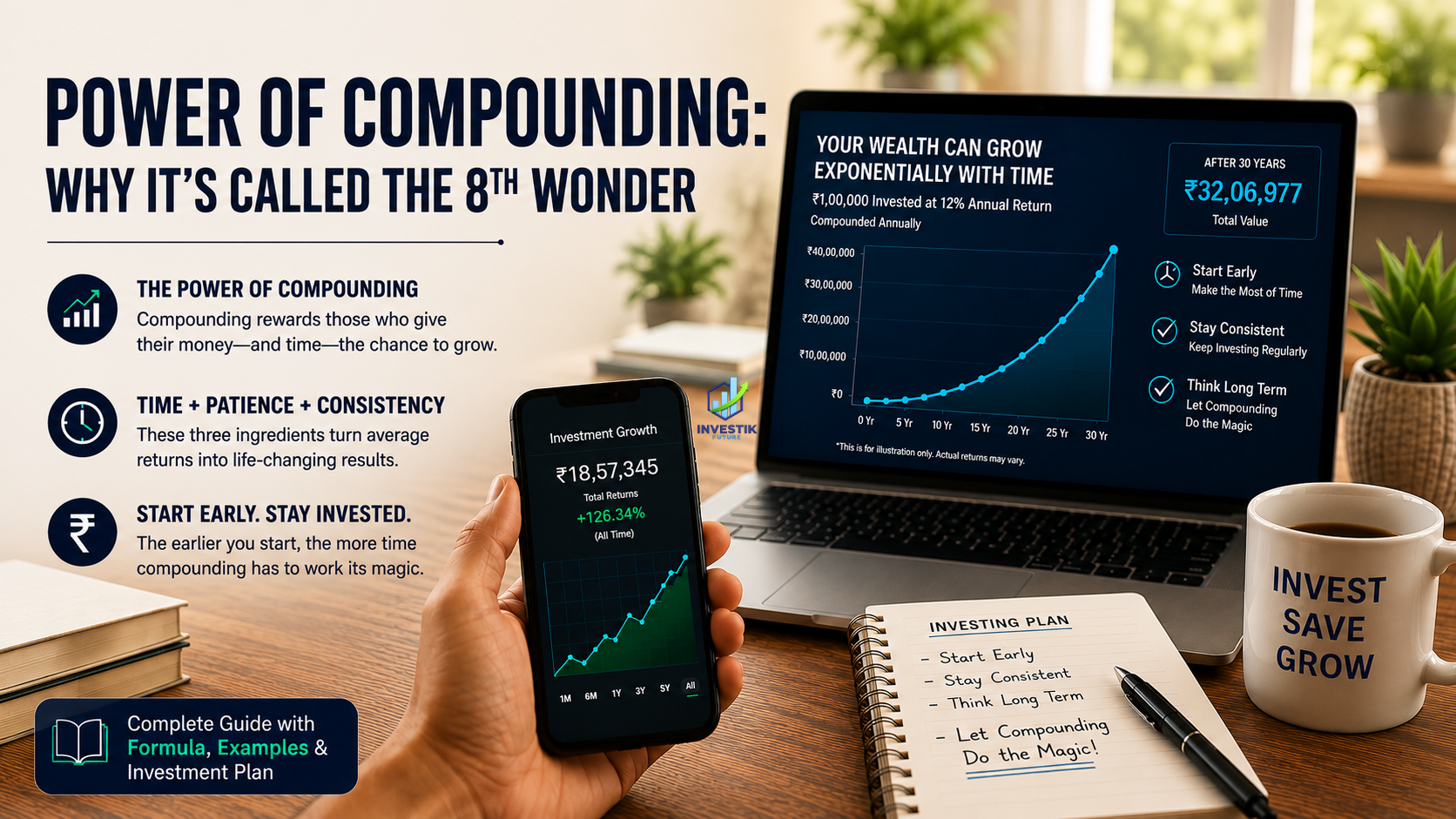

Compounding is the process by which an investment grows because it earns returns not just on the money you put in, but also on the returns that money has already earned. Run it for long enough, and the growth curve stops looking like a straight line and starts looking like a hockey stick. That single mechanical fact, repeated year after year, is why the power of compounding is often called the 8th wonder of the world.
This guide covers the full topic end to end: the definition, the formula, why Albert Einstein and Charlie Munger are both quoted on it, real numeric examples using 2026 Indian interest rates and tax rules, how compounding works for investors in the US, UK, and other countries, common mistakes, and a step-by-step plan to put compounding to work in your own portfolio. You will not need a second article after this one.
At Investik Future, we build financial literacy content that stays accurate for years, not weeks, so treat this as a reference guide you can return to.
What Is Compounding? Meaning and Definition
Compounding means earning returns on your original investment (the principal) plus on all the interest or gains that investment has already generated. Every cycle, the base on which returns are calculated gets bigger, so the returns themselves get bigger.
Contrast this with simple interest, where returns are calculated only on the original principal, cycle after cycle, with no reinvestment of past gains.
Simple Interest vs Compound Interest
| Feature | Simple Interest | Compound Interest |
|---|---|---|
| Base for interest calculation | Original principal only | Principal + accumulated interest |
| Growth pattern | Linear (straight line) | Exponential (curved, accelerating) |
| Best suited for | Short-term loans, some fixed deposits | Long-term wealth building |
| Example (₹1,00,000 at 10% for 20 years) | ₹3,00,000 | ₹6,72,750 |
The gap between the two columns above is the entire argument for starting to invest early. Both start with the same ₹1,00,000. Only the calculation method is different, and the compound interest outcome is more than double.
A Short History of Compound Interest
Compound interest is not a modern financial product. Babylonian clay tablets from around 2400 BCE already record interest calculations on grain and silver loans, and some historians treat these as the earliest evidence of compounding concepts in trade. Ancient Roman law, by contrast, capped and often banned compound interest (called usura usurarum) because lawmakers viewed runaway debt growth as socially destabilising for borrowers.
The mathematical formalisation most investors recognise today came much later, through European banking and actuarial work in the 17th and 18th centuries, as insurers and lenders needed reliable formulas to price long-term contracts. Richard Price, an 18th-century mathematician, is often credited with popularising long-range compound interest illustrations, some of which calculated (somewhat fancifully) what a single coin invested at the time of Christ would be worth centuries later. The core lesson from that history has not changed: compounding rewards patience and long duration far more than it rewards a large starting sum.
The Compound Interest Formula
The standard compound interest formula used by every calculator, bank, and mutual fund fact sheet is:
A = P (1 + r/n)^(n × t)
Where:
- A = final amount (maturity value)
- P = principal (initial investment)
- r = annual interest rate (as a decimal)
- n = number of times interest compounds per year
- t = number of years
Worked Example
Suppose you invest ₹1,00,000 as a one-time lump sum in an equity-oriented mutual fund that compounds annually and delivers a long-term average return of 12% per year, for 20 years.
A = 1,00,000 × (1 + 0.12)^20 A = 1,00,000 × 9.646 A ≈ ₹9,64,600
Your ₹1,00,000 principal turns into a return component of roughly ₹8,64,600, more than eight times your original investment, without you adding a single extra rupee. That extra amount exists purely because of compounding, and it is the practical answer to what the power of compounding is when someone asks it in plain numbers.
Why Is Compounding Called the 8th Wonder of the World?
The “7 wonders of the world” are physical structures: the Great Pyramid of Giza, the Colosseum, the Taj Mahal, and similar landmarks recognised for their scale and permanence. Calling compounding the 8th wonder is a way of saying that the mathematics of exponential growth is just as remarkable, except it operates quietly, inside a bank statement or a mutual fund portfolio, rather than in stone.
What Is the Meaning of 8th Wonder?
An “8th wonder” is a popular label given to something so impressive that it deserves a place alongside history’s greatest engineering and architectural achievements, even though it does not fit the original list. Bridges, stadiums, and technologies have all been informally nicknamed the 8th wonder over the decades. In personal finance, compound interest earned this nickname because of how dramatically it changes outcomes over long periods, using nothing more than time and a fixed rate of return.
What Did Einstein Say Was the 8th Wonder of the World?
Albert Einstein is widely quoted as calling compound interest the eighth wonder of the world, adding that those who understand it earn it, and those who don’t pay it. There is no verified primary source, letter, or lecture where Einstein actually said this. Financial educators and journalists have repeated the attribution for decades because it captures the idea well, but researchers and quote historians treat it as folklore rather than a documented Einstein quote. The idea behind the quote holds up mathematically even if the attribution does not.
What Did Charlie Munger Say About Compounding?
Charlie Munger, the late vice chairman of Berkshire Hathaway, spoke often and directly about compounding, and unlike the Einstein quote, his views are extensively documented in interviews, letters, and speeches. Munger’s consistent message was that the first rule of compounding is to never interrupt it unnecessarily. He argued that patience combined with a long runway does more for an investor’s wealth than trying to time markets or chase short-term gains. His own net worth, built alongside Warren Buffett over more than six decades at Berkshire Hathaway, is frequently used as a real-world case study of what letting compounding run uninterrupted for a lifetime can achieve.
Why Compounding of Interest Is Considered the 8th Wonder of the World
Three mechanical properties of compounding explain the reputation:
- Growth accelerates instead of staying flat. In simple interest, ₹100 growing at 10% adds exactly ₹10 every year, forever. In compound interest, the ₹10 earned in year one starts earning its own interest in year two, so the annual addition keeps rising.
- Time matters more than the amount invested. A rupee invested at age 25 has more compounding cycles ahead of it than a rupee invested at age 45, even if the older investor puts in a larger sum.
- The gains are invisible in the early years and unmissable in the later years. Most of the compounding effect shows up in the final third of the investment period, which is exactly when investors are tempted to quit and take profits.
The Power of Compounding: How Small Amounts Grow Into Wealth
The clearest way to see the power of compounding is to compare two investors with different starting ages, using an assumed long-term equity return of 12% per year.
| Investor | Monthly SIP | Start Age | Years Invested | Total Invested | Value at Age 55 |
|---|---|---|---|---|---|
| Investor A | ₹5,000 | 25 | 30 | ₹18,00,000 | ≈ ₹1.76 crore |
| Investor B | ₹5,000 | 35 | 20 | ₹12,00,000 | ≈ ₹50 lakh |
Investor A puts in only ₹6,00,000 more than Investor B over the full period, but ends up with more than three times the final corpus. The 10 extra years at the start of the investing life account for the entire gap. This is the practical, numeric version of the power of compounding, and it is the single most repeated lesson in long-term investing.
Rule of 72: A Quick Mental Shortcut
The Rule of 72 estimates how many years it takes an investment to double at a given annual rate. Divide 72 by the interest rate.
| Annual Return | Years to Double (Rule of 72) |
|---|---|
| 6% | 12 years |
| 7.1% (PPF, 2026 rate) | ≈ 10.1 years |
| 8% | 9 years |
| 10% | 7.2 years |
| 12% | 6 years |
| 15% | 4.8 years |
At a 12% assumed return, ₹1,00,000 doubles roughly every 6 years. Over 30 years, that is 5 doubling cycles: ₹1,00,000 → ₹2,00,000 → ₹4,00,000 → ₹8,00,000 → ₹16,00,000 → ₹32,00,000. Notice how the last doubling alone (from ₹16 lakh to ₹32 lakh) adds more value than the first four doublings combined. That is compounding’s acceleration effect in action.
Compounding Frequency: Annual, Quarterly, Monthly, Daily
Compounding frequency changes the outcome even when the stated annual rate is identical, because interest gets added to the principal more often.
| Compounding Frequency | ₹1,00,000 at 8% for 10 years |
|---|---|
| Annually (n=1) | ₹2,15,892 |
| Quarterly (n=4) | ₹2,19,112 |
| Monthly (n=12) | ₹2,19,976 |
| Daily (n=365) | ₹2,20,257 |
The difference between annual and daily compounding here is small in percentage terms but grows meaningfully on larger principal amounts and longer durations. This is why the fine print on a fixed deposit or recurring deposit always specifies the compounding frequency, and why it is worth checking before you compare two products with the same headline rate.
Real-World Examples of Compounding in India (2026 Data)
Public Provident Fund (PPF)
The PPF interest rate for the July–September 2026 quarter (Q2, FY 2026-27) stands at 7.1% per annum, compounded annually, a rate that has stayed unchanged since April 2020. If you invest the maximum permitted ₹1,50,000 per year for the full 15-year lock-in at this rate, your maturity value works out to approximately ₹40.68 lakh, against a total investment of ₹22.5 lakh. That is roughly ₹18.18 lakh earned purely from compounding, and under Section 10 of the Income Tax Act, both the interest and the maturity amount are completely tax-free, making PPF an EEE (Exempt-Exempt-Exempt) instrument.
Systematic Investment Plan (SIP) in Equity Mutual Funds
A monthly SIP of ₹5,000 for 20 years at an assumed 12% annual return (a commonly used long-term average for diversified equity funds, not a guaranteed figure) compounds monthly at roughly 1% per period. Using the future value of annuity formula, the corpus works out to approximately ₹49.9 lakh against a total investment of ₹12 lakh, meaning close to ₹37.9 lakh comes purely from compounding and market growth. Actual SIP returns vary with market performance and are never guaranteed, unlike PPF.
Employees’ Provident Fund (EPF)
EPF works on the same compounding principle as PPF, with both employee and employer contributions earning annually compounded, government-notified interest, making it one of the largest sources of long-term retirement compounding for salaried Indians, since contributions continue automatically every month across an entire career.
Compounding 8th Wonder: Taxation Rules Investors Must Know (India, FY 2025-26)
Compounding builds wealth, but taxes decide how much of that wealth an investor actually keeps. Under the Finance Act 2024 framework, which continues to apply for FY 2025-26 (AY 2026-27):
- Long-term capital gains (LTCG) on listed equity shares and equity-oriented mutual funds are taxed at 12.5%, with the first ₹1.25 lakh of gains in a financial year exempt from tax.
- Short-term capital gains (STCG) on the same equity assets, where units are held for less than 12 months, are taxed at a flat 20%.
- Debt mutual funds purchased on or after April 1, 2023, are always treated as short-term gains and taxed at the investor’s income slab rate, regardless of how long the units are held.
- PPF and EPF remain fully tax-exempt under their EEE status, making them useful for investors who want compounding without any tax drag at withdrawal.
These rates are reviewed periodically by the Ministry of Finance and Parliament, so always confirm the current figures on the Income Tax Department’s official portal or with a qualified tax professional before filing.
How Compounding Works Outside India: US, UK, and Global Investors
The mathematics of compounding is identical everywhere. What changes across countries is the vehicle used to harness it and the tax wrapper around it.
| Country | Common Compounding Vehicle | Typical Long-Term Nominal Return Assumption |
|---|---|---|
| India | PPF, EPF, equity mutual fund SIPs | 7-8% (debt), 10-12% (equity, long-term) |
| United States | 401(k), Roth IRA, S&P 500 index funds | Historically around 9-10% annualised for broad equity indices over multi-decade periods |
| United Kingdom | ISAs (Individual Savings Accounts), workplace pensions | 5-8% depending on asset allocation |
| Australia | Superannuation funds | 6-8% depending on the fund’s growth allocation |
In every case, the same three variables decide the outcome: the rate of return, the compounding frequency, and the number of years invested. An American investor contributing early to a 401(k) or a UK saver maxing out an ISA every year is applying the same principle a PPF investor in India uses, just wrapped in a different account structure and tax rule.
In the United States, employer-matched 401(k) contributions add an extra layer to compounding, since the employer match itself starts compounding alongside the employee’s own money from day one, effectively increasing the principal for free. In the United Kingdom, ISAs let gains and interest compound completely free of capital gains tax and income tax within the annual allowance, which is functionally similar to how PPF works in India. Investors in Australia benefit from compulsory superannuation contributions, which means compounding often starts automatically from a person’s very first paycheck, regardless of whether they consciously choose to invest.
The practical takeaway for any investor, in any country, is the same: identify the tax-advantaged compounding vehicle available in your jurisdiction, use it consistently, and avoid interrupting the compounding cycle for short-term needs that could be met through a separate emergency fund instead.
Common Mistakes Investors Make With Compounding
- Starting late. Delaying investment by even 5 years can cut the final corpus by 40% or more over a 25-30 year horizon, because the missed years are usually the ones where the base amount is smallest and least painful to invest.
- Interrupting the compounding cycle. Withdrawing gains mid-way, switching funds frequently, or stopping SIPs during market corrections resets the growth curve and gives up the accumulated acceleration.
- Confusing simple interest products with compounding ones. Some fixed-return schemes pay simple interest, which grows in a straight line, not a curve. Always check the product’s fine print.
- Underestimating inflation. A 7% nominal return in an environment with 5-6% inflation delivers a much smaller real return. Long-term compounding calculations should be checked against realistic inflation assumptions for the specific goal being planned.
- Ignoring tax drag. Frequent buying and selling of equity investments triggers repeated short-term capital gains tax, which quietly reduces the effective compounding rate over time.
Step-by-Step: How to Put the Power of Compounding to Work
- Start now, with any amount. The exact sum matters less than the number of years the money stays invested.
- Automate contributions. A monthly SIP or a recurring PPF contribution removes the temptation to time the market or skip a month.
- Pick the right vehicle for the goal. Use our SIP calculator for equity mutual fund goals and our PPF calculator for fixed, tax-free long-term goals.
- Reinvest all returns. Choose growth options over dividend or interest payout options wherever the goal is long-term wealth creation, so every rupee of return keeps compounding instead of being paid out.
- Increase contributions over time. Raising your SIP amount by even 10% every year (a step-up SIP) meaningfully increases the final corpus without requiring a lump-sum jump in savings.
- Avoid interrupting the cycle. Resist withdrawing during market corrections. Read our guide on what an SIP is and how it works if you are unsure how monthly investing behaves through market cycles.
- Review, don’t churn. An annual portfolio review is enough for most long-term investors. Frequent switching resets compounding and adds tax and transaction costs.
Why Compounding Feels Slow, Then Feels Fast
Most new investors underestimate compounding because human intuition is built for linear thinking, not exponential thinking. Looking at a portfolio after year one or two, the growth often looks similar to what a simple savings account would have delivered, and it is easy to conclude that investing “isn’t working.” The mathematics tells a different story: in the early years, the base amount is simply too small for the exponential curve to show a visible bend.
This is also the psychological reason most people give up on SIPs or long-term investment plans during the first market correction. The visible loss feels larger than the invisible, still-building compounding effect underneath it. Investors who stay invested through at least one full market cycle, typically 7 to 10 years, are the ones most likely to see the acceleration phase that makes compounding worth the wait.
Pros and Cons of Relying on Compounding for Wealth Creation
| Pros | Cons |
|---|---|
| Requires no active trading skill, just time and consistency | Needs a long horizon to show meaningful results; the first several years look unremarkable |
| Works across asset classes: FDs, PPF, EPF, mutual funds, stocks | Market-linked compounding (equity) carries volatility and no guaranteed rate |
| Small, regular contributions can build large corpora | Inflation and taxes both reduce the effective, real compounding rate |
| Mathematically predictable for fixed-rate products like PPF | Easy to underestimate psychologically, since the growth curve looks flat early on |
Compound Interest Calculator: How to Use One Correctly
A compound interest calculator needs four inputs to work: the principal amount, the expected annual rate of return, the compounding frequency, and the investment tenure in years. For SIP-based investing specifically, use a dedicated SIP calculator rather than a generic compound interest calculator, since SIP math involves a series of monthly contributions rather than a single lump sum. You can run your own numbers using our SIP calculator, which handles the monthly contribution structure automatically, or explore mutual fund options for wealth building if you are deciding which fund category fits your goal.
For broader reading on how mutual funds are structured and regulated, the Securities and Exchange Board of India (SEBI) publishes investor education material at sebi.gov.in, and the Association of Mutual Funds in India (AMFI) maintains investor resources at amfiindia.com. For interest rate and monetary policy context that affects fixed-income compounding, the Reserve Bank of India’s official site at rbi.org.in is the primary source. Global investors comparing compounding concepts across markets can also refer to Investopedia’s explanation of compound interest and market data from NSE India.
Compounding Checklist: Action Steps for Every Investor
- Calculate your current monthly surplus available for investing
- Choose a mix of fixed-rate (PPF, EPF) and market-linked (equity mutual fund) compounding vehicles based on your goal and risk appetite
- Start a SIP, even if it is a small amount, rather than waiting to save a larger lump sum
- Set up auto-debit so contributions are automatic and not dependent on memory or willpower
- Choose growth options, not payout options, for long-term goals
- Review your portfolio once a year, not every week
- Increase your contribution amount whenever your income rises
- Avoid withdrawing during market downturns
- Track your goal’s real (inflation-adjusted) target, not just the nominal number
Glossary of Compounding Terms
Principal: The original sum of money invested or borrowed, before any interest or returns are added.
Rate of return: The percentage gain (or loss) an investment generates over a given period, usually expressed annually.
Compounding frequency: How often earned interest gets added back to the principal (annually, quarterly, monthly, or daily).
Future value: The projected value of an investment at a specific point in the future, based on an assumed rate of return and time period.
CAGR (Compound Annual Growth Rate): A single, smoothed annual growth rate that describes how an investment grew from its starting value to its ending value, ignoring the year-to-year fluctuations in between.
Reinvestment: The practice of using earned interest, dividends, or capital gains to buy more of the same investment, rather than withdrawing them as cash.
Real return: The rate of return after subtracting the effect of inflation, which shows the actual increase in purchasing power an investment delivers.
Step-up SIP: A systematic investment plan where the monthly contribution amount increases automatically at set intervals, usually annually, to keep pace with rising income.
Frequently Asked Questions
Is compound interest always better than simple interest for the investor?
For anyone saving or investing money, yes, since returns build on themselves. For anyone borrowing money, compound interest works against the borrower, since unpaid interest gets added to the principal and starts accruing its own interest, which is why credit card debt grows so quickly when only minimum payments are made.
How long does compounding take to show a noticeable effect?
Most long-term investors notice a meaningful acceleration after 10 to 15 years, though the exact timing depends on the rate of return and how consistently contributions are made.
Can compounding work with a small monthly amount like ₹500 or ₹1,000?
Yes. The rate and the number of years matter more than the size of each contribution. A small SIP started at age 22 can outperform a much larger SIP started at age 35, purely because of the extra compounding cycles.
Does compounding apply to debt and loans as well as investments?
Yes. Loans, credit cards, and some debt instruments compound in the borrower’s disfavour, which is why paying down high-interest debt early is often mathematically as valuable as investing.
Conclusion
Compounding is not a trick, a strategy, or a product. It is a mathematical property of money that grows when returns are reinvested rather than withdrawn. Whether the vehicle is a PPF account earning 7.1%, an equity mutual fund SIP targeting a long-term 12% average, or a US-based 401(k) tracking a broad index, the same formula and the same principle apply: start early, stay invested, and let each cycle of returns generate its own returns.
The reason compounding earned the nickname “8th wonder of the world” is that its results look unremarkable for years and then look extraordinary all at once, simply because time was allowed to do the work. Whether or not Einstein actually said it, the underlying claim holds up in every worked example in this guide. Charlie Munger’s version of the same idea, backed by six decades of documented results at Berkshire Hathaway, is the more reliable citation, but the lesson is identical: protect the compounding cycle, and let it run.
ARN Disclosure: Investik Future is an AMFI-registered Mutual Fund Distributor. ARN-341107 — Verify on AMFI ↗. Komal Thakur is the content author and digital marketer; the ARN registration belongs to Investik Future, not to the author personally.