

When people open their first investment account, they usually run into three terms at once: bank account, trading account, and Demat account. It’s a fair question to ask why you need all three just to buy a few shares. The short answer is that each one does a different job. Your bank account holds your money, your Demat account holds your shares, and your trading account is what lets you actually place the buy or sell order.
This article walks through what a trading account is, how it works step by step, and how it’s different from a Demat account.
What Is a Trading Account?
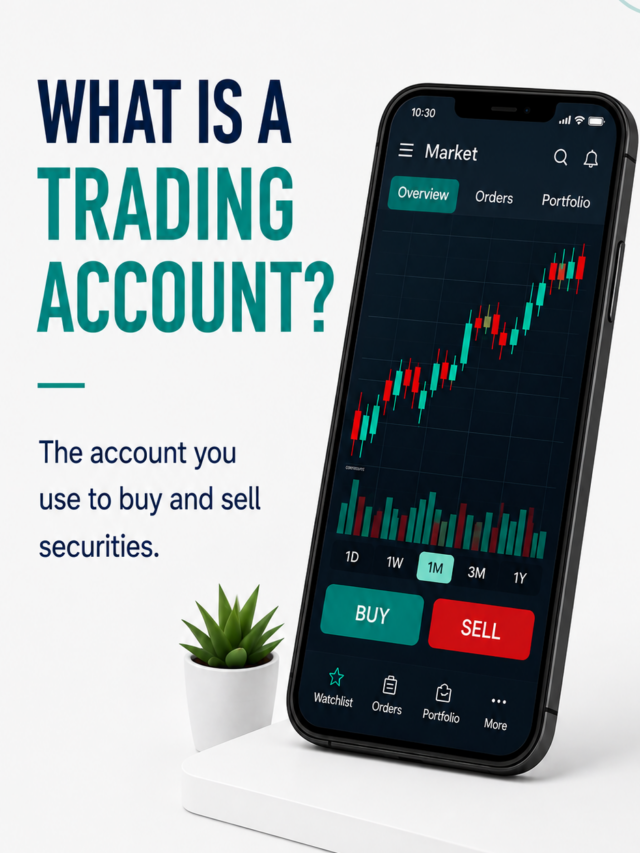
A trading account is the account you use to place buy and sell orders on a stock exchange like the NSE or BSE.
It’s opened with a stockbroker, and it acts as the link between you and the exchange. Every time you tap “Buy” or “Sell” on a broker’s app, you’re using your trading account to send that instruction to the market.
It’s easy to confuse this with a Demat account, but they’re not the same thing. A trading account doesn’t hold your shares. It’s simply the tool you use to transact. Once the trade is settled, the shares are credited to your Demat account, which is where they actually sit.
How Does a Trading Account Work?
Here’s what happens behind the scenes when you buy or sell shares.
Step 1: You have funds available. Before placing an order, you need money in your linked bank account or already transferred into your trading account, depending on your broker’s setup.
Step 2: You place a buy order. Say you want to buy 10 shares at ₹500 each. You enter this in your broker’s app, choosing an order type such as market or limit.
Step 3: The order is sent to the exchange. Your broker, acting as a registered member of the NSE or BSE, routes your order to the exchange. Your account carries a unique client code attached to every trade.
Step 4: The trade gets executed. Whether it executes immediately, partially, or not at all depends on the order type and whether matching buyers or sellers exist at your price.
Step 5: The shares are credited to your Demat account. Once the trade settles, the shares move into your Demat account. The trading account itself doesn’t hold onto them.
Step 6: When you sell, the process reverses. You place a sell order, shares are debited from your Demat account, and once settled, the proceeds land in your linked bank account.
Trading Account vs Demat Account
This is the question most beginners actually want answered, so here it is laid out directly.
| Feature | Trading Account | Demat Account |
| Main purpose | Placing buy and sell orders | Holding securities electronically |
| Holds shares? | No | Yes |
| Used to place orders? | Yes | No |
| Connected to stock exchange? | Yes, through your broker | Indirectly, through the depository |
| Main function | Executes transactions | Holds securities |
The way to remember it: a trading account is used to buy and sell, and a Demat account is used to hold what you’ve bought. Neither one replaces the other. They’re built to work together.
Do You Need Both a Trading and Demat Account?
For regular buying and holding of listed shares in electronic form, yes, you’ll generally need both. Your trading account handles the transaction, while the Demat account holds the shares after purchase.
The one exception worth knowing about is cash-settled derivatives, such as certain futures and options contracts, where nothing is actually delivered into a Demat account. But for regular equity investing, which is what most beginners start with, you’ll need both accounts working together, along with a linked bank account for the money side.
Trading Account vs Demat Account vs Bank Account
Since all three tend to get mentioned together, here’s how they divide the work:
| Account | What It Does |
| Bank account | Holds and transfers your money |
| Trading account | Places your buy and sell orders |
| Demat account | Holds your securities electronically |
So if you buy 10 shares of a company, the money leaves your bank account, the order is placed and executed through your trading account, and the shares end up sitting in your Demat account. All three accounts are usually linked, so this happens without you needing to move anything manually.
What Can You Buy or Sell Through a Trading Account?
What you can trade depends on your broker and the segments activated on your account. Common examples include equity shares, ETFs, and in some cases derivatives (futures and options), commodities, and currency contracts. Not every account gives access to every product by default; segments like F&O or commodities usually need separate activation with their own eligibility checks. It’s worth confirming exactly what’s enabled before assuming you can trade in a particular segment.
How to Open a Trading Account
Opening a trading account today is largely digital:
- Choose a SEBI-registered broker.
- Fill out the account opening application, usually online.
- Complete KYC, typically Aadhaar-based e-KYC or video-based In-Person Verification (IPV).
- Submit your PAN, address proof, and bank account details.
- Complete verification and activate the segments you plan to use, such as equity or derivatives.
Requirements vary slightly between brokers, so check your chosen broker’s current onboarding process rather than assuming every provider asks for identical documents.
What Are Trading Account Charges?
Charges vary quite a bit between brokers, so it helps to understand the categories rather than expect one fixed number:
- Brokerage, charged per trade. Full-service brokers often charge a percentage of trade value, while discount brokers tend to charge a flat fee per order.
- Account opening charges, which some brokers waive and others don’t.
- Annual maintenance charges (AMC), which are generally associated with the Demat account rather than the trading account, are often reduced or waived for smaller portfolios under SEBI’s Basic Services Demat Account framework.
- Statutory charges, including Securities Transaction Tax (STT), exchange transaction charges, GST, and stamp duty, which apply on every trade and can’t be waived by any broker.
Since pricing structures differ by broker, check the current fee schedule of whichever one you’re considering rather than treating any single figure as standard industry-wide.
Is a Trading Account Safe?
Trading accounts opened with SEBI-registered brokers operate within a regulated framework, with oversight from SEBI, the exchanges, and the depositories. That structure protects you from things like unauthorised account misuse and gives you a formal grievance route through SEBI’s SCORES platform if something goes wrong with your broker.
A regulated setup provides a framework for safer and more transparent transactions, but it doesn’t protect you from losses caused by falling share prices.
Common Mistakes Beginners Make
A few patterns show up repeatedly among first-time investors:
- Confusing a trading account with a Demat account, and assuming one can substitute for the other
- Picking a broker purely on low brokerage without checking other charges
- Placing orders without fully understanding the order type
- Taking on leverage without understanding the downside
- Assuming a trading account somehow guarantees profits
- Sharing login credentials with anyone
- Ignoring a broker’s SEBI registration and regulatory standing
Most of these mistakes happen because beginners start trading before understanding how their account and orders work.
Trading vs Investing
It’s worth separating these two ideas, since a trading account gets used for both. Trading generally means buying and selling more frequently to benefit from short-term price movements. Investing usually means holding assets for a longer stretch based on their underlying value and your own goals.
Having a trading account doesn’t mean you have to become an active trader. Plenty of people use it simply to buy shares or ETFs and hold them for years, checking in only occasionally.
What Should You Look for When Choosing a Trading Account?
Rather than chasing the lowest brokerage alone, weigh a few things together: SEBI registration and exchange membership, brokerage structure relative to how often you plan to trade, other charges like AMC and transaction fees, platform reliability during high-volume market hours, ease of use, customer support and grievance handling, which products and segments are available, and research tools if that matters to your approach.
If you’re also new to the Demat side of things, it may help to first understand how a Demat account works, since it plays a different role from your trading account even though the two are often opened together.
Final Verdict
A trading account is what lets you buy and sell shares, while a Demat account is where those shares are held after you buy them. Your bank account handles the money, so all three work together when you invest in listed shares. When choosing a broker, look beyond brokerage and consider the full fee structure, platform reliability, customer support and regulatory standing. A trading account makes investing possible, but it doesn’t remove the risk of losing money when markets fall.




FAQs
What is a trading account?
A trading account is the account you use to place buy and sell orders on a stock exchange, opened through a SEBI-registered broker.
Is a trading account different from a Demat account?
Yes. A trading account is used to place orders, while a Demat account holds the securities you've bought in electronic form.
Do I need both a trading and Demat account?
Yes, for regular equity investing you need both. Your trading account executes the transaction, and your Demat account holds the shares afterward.
Can I buy shares without a trading account?
No. You need a trading account to place buy or sell orders on a stock exchange.
What documents are needed to open a trading account?
Commonly required documents include PAN, address proof, a bank account for linking, and photographs, though exact requirements can vary by broker.
ARN Disclosure: Investik Future is an AMFI-registered Mutual Fund Distributor. ARN-341107 — Verify on AMFI ↗. Komal Thakur is the content author and digital marketer; the ARN registration belongs to Investik Future, not to the author personally.