
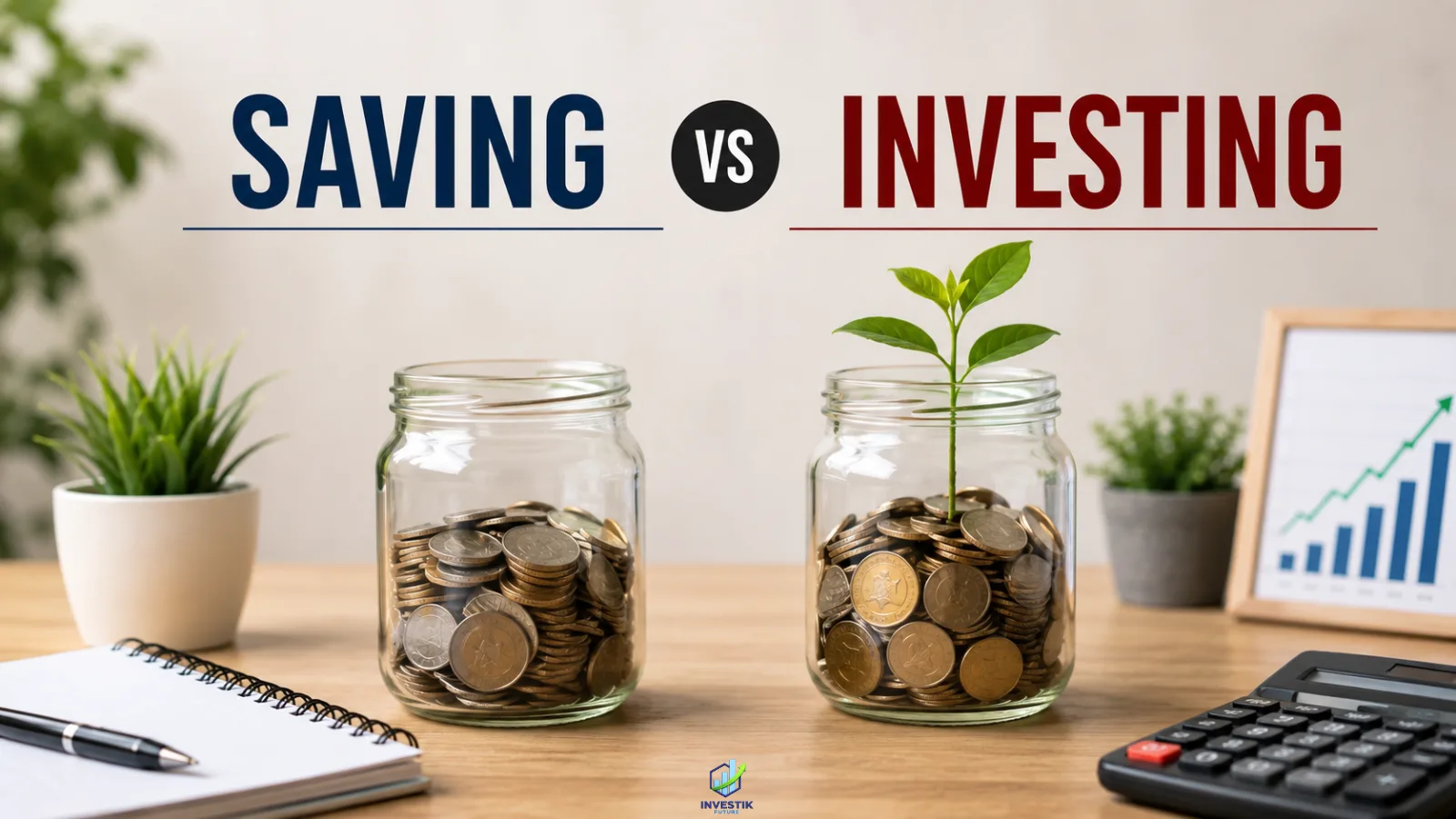

Saving and investing may sound like two ways of doing the same thing: putting money aside for the future. But they actually serve different purposes. Understanding the difference between saving vs investing can help you decide where your money should go based on when you’ll need it and what you’re saving for. Saving is generally about keeping money accessible for emergencies and near-term expenses, while investing gives your money the potential to grow over the long term, with some risk along the way.
So, should you save first, invest first, or do both? That depends largely on when you’ll need the money and what you’re trying to achieve with it.
This article breaks down what separates saving from investing, when each one makes sense, whether you actually need both, and how to figure out where your money should go first.
What Is Saving?
Saving simply means setting money aside and keeping it safe rather than spending it. The main aim isn’t aggressive growth; it’s keeping the money available and relatively stable when you need it.
People usually save for things like rent, monthly bills, an upcoming expense, or a cushion in case something goes wrong: a medical bill, a job loss, or a broken laptop you need for work. The common thread is that this money needs to be accessible, often on short notice.
Common places people keep savings include a regular savings account or a fixed deposit. These aren’t completely without risk. Bank deposits are generally much more stable than market-linked investments, although inflation can reduce their purchasing power over time. That stability is exactly the point.
What Is Investing?
Investing means putting your money into assets such as stocks, mutual funds, bonds, ETFs, and similar instruments, with the expectation that the value could grow over months or years. Unlike a savings account, there’s no fixed, guaranteed outcome here.
This is the basic trade-off with investing: the potential for higher returns usually comes with higher uncertainty. Markets go up, but they also go down, sometimes sharply and without warning. An investment that’s worth ₹50,000 today could be worth less next month. It could also be worth a lot more in ten years. Nobody can promise you which one it’ll be in the short run.
That uncertainty is exactly why investing is generally suited to money you won’t need for a while, money that can afford to sit through the ups and downs.
Saving vs Investing: Key Differences
| Feature | Saving | Investing |
| Main purpose | Keep money safe and accessible | Grow money over time |
| Typical time horizon | Short term | Usually long term |
| Risk | Low | Varies, but generally higher than saving |
| Potential return | Modest, relatively predictable | Higher potential, but not guaranteed |
| Access to money | Usually quick and easy | Can take time, and value may be down when you need it |
| Suitable for | Emergencies, near-term goals, everyday buffer | Long-term goals like retirement or wealth building |
The exact time horizon isn’t fixed; it depends on what the money is for. But looking at this table, the pattern becomes pretty clear. Saving trades higher returns for safety and speed. Investing trades some of that safety for a shot at real growth.
Saving vs Investing: A Simple Example
Say you have ₹1 lakh, and you know you’ll need it in the next six months for something specific, maybe a deposit, a family expense, or a planned purchase. Putting that money into a volatile investment might seem tempting if it’s had a good run recently, but you’d be taking on real risk for a very short window. If the market dips right when you need the money, you may end up pulling it out at a loss.
Now imagine a different ₹1 lakh, money you’re setting aside for a goal that’s 10 or 15 years away, like your retirement or your child’s education. Here, a temporary dip in value matters a lot less, because you have time on your side to ride it out and potentially recover, and then some.
Same amount of money, two very different timelines, two very different answers.
When Should You Save?
Saving generally makes more sense when: You’ll need the money soon, or you’re not sure exactly when you’ll need it. This includes your emergency fund, upcoming planned expenses, rent, or household costs. The priority here is keeping the money accessible and relatively stable when you need it, rather than chasing higher returns.
When Should You Invest?
Investing tends to make more sense when you’re working toward something further out, retirement, a long-term wealth goal, or any objective that’s several years away. A longer runway gives your money more time to recover from short-term dips, but it doesn’t make the risk disappear. Markets can stay down longer than you’d expect, and even long-term investors need to be comfortable with that.
Can You Save and Invest at the Same Time?
Yes, and for most people, this is really how it plays out in practice. It’s rarely an either-or decision.
A simple way to think about your income is splitting it across everyday expenses, savings for near-term needs, and investments for long-term goals. How much goes into each bucket depends entirely on your own situation, your income, your existing savings, any debt you’re paying off, your goals, and how much risk you’re personally comfortable with. There’s no single formula that works for everyone.
What Should You Build First: Savings or Investments?
This is where a lot of beginners get stuck. If you don’t have any savings cushion yet and you have ongoing financial obligations, it’s usually worth building at least a basic buffer before putting meaningful money into investments. Without that cushion, an emergency could force you to sell investments at a bad time just to cover a bill.
That said, this isn’t a strict rule that applies identically to everyone. Someone with more stable income and fewer obligations might feel comfortable starting to invest small amounts while their savings are still building up. There’s no fixed number of months of expenses that suits every situation; it depends on your job stability, dependents, and overall comfort with risk.
How Inflation Affects Saving and Investing
Here’s something that often gets missed: money sitting in a savings product with a low return can actually lose purchasing power over time if inflation runs higher than what you’re earning. If something costs ₹100 today and costs ₹110 a year or two from now, your money needs to grow at least that much just to keep up; otherwise, you can buy less with it than before.
This is one of the reasons people turn to investing for long-term goals, since some investments have the potential to outpace inflation over the long term. But it’s not automatic. Investing doesn’t guarantee you’ll beat inflation; it just gives you a shot at it that a savings account typically doesn’t.
Common Mistakes Beginners Make
A few patterns show up again and again with people new to managing money:
- Investing money you’ll need soon. This turns a short-term need into unnecessary risk.
- Keeping all long-term money in cash. This can mean missing out on potential growth over the years.
- Investing without an emergency cushion. This leaves you exposed if something goes wrong.
- Chasing recent returns. Picking an investment just because it did well recently, without understanding why, is a common trap.
- Treating investment returns as guaranteed. Returns fluctuate, and expecting steady income from them often leads to disappointment.
- Confusing saving with wealth creation. Saving protects what you already have; investing is generally what builds it up over time.
Saving vs Investing: Which Is Better?
Neither is automatically better; they solve different problems. Saving is generally more suitable when you need the money soon, want easy access, and care most about protecting the principal. Investing may be more suitable when your goal is further out, you can handle some ups and downs along the way, and you’re aiming for higher growth over time.
For most people, the real answer isn’t choosing one over the other. It’s using each one for what it’s actually good at.
Final Verdict
Saving and investing aren’t competing with each other; they’re built to do different jobs with your money. Saving gives you accessibility and stability for the things you need soon, while investing gives your long-term money a chance to grow, in exchange for taking on some risk. The goal isn’t to pick a side. It’s to understand which job each one should do and use saving and investing accordingly.




FAQs
What is the difference between saving and investing?
Saving keeps your money safe and accessible for near-term needs. Investing puts your money into assets that can grow over time, but with some risk involved.
Is saving better than investing?
No. Neither is universally better; it depends on your goal and how soon you'll need the money.
Is investing riskier than saving?
Yes, generally. Investments can lose value, especially in the short term, while savings products are typically more stable.
Should I save before I invest?
In most cases, yes. Having a basic savings cushion before investing meaningfully helps you avoid selling investments at a bad time during an emergency.
Can I save and invest at the same time?
Yes. Many people split their income between everyday expenses, short-term savings, and long-term investments.
ARN Disclosure: Investik Future is an AMFI-registered Mutual Fund Distributor. ARN-341107 — Verify on AMFI ↗. Komal Thakur is the content author and digital marketer; the ARN registration belongs to Investik Future, not to the author personally.