
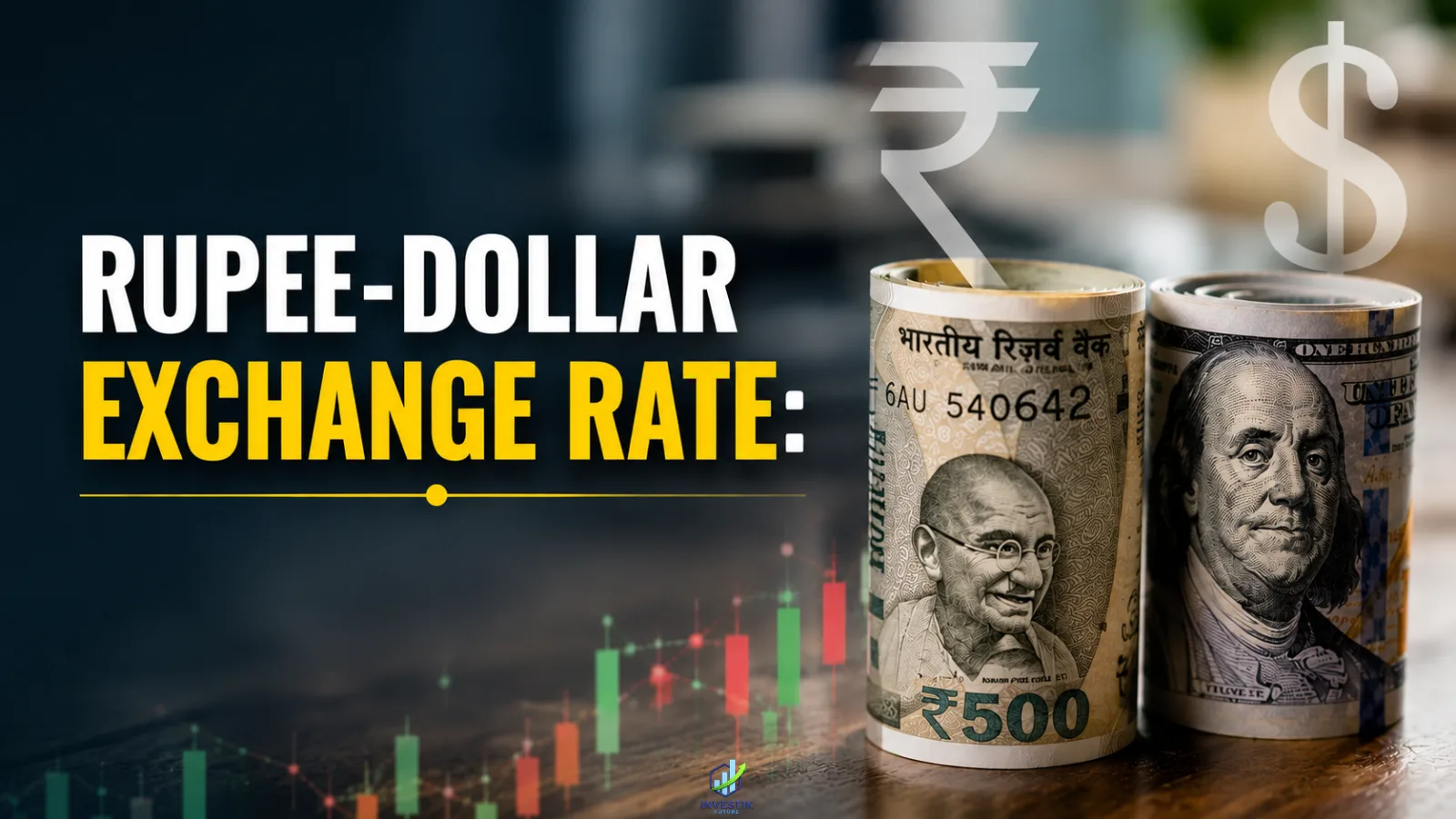

You’ve probably heard it on the news more times than you can count: “The rupee fell against the dollar today.” Or maybe: “USD/INR hit a new high.” But what does that rupee-dollar exchange rate actually mean, and why does it keep happening?
In simple terms, the rupee moves against the dollar because the demand and supply of the two currencies keep shifting. Trade, interest rates, oil prices, foreign investment, and global market mood all play a part. Let’s break down exactly how.
Why Does the Rupee Rise or Fall Against the Dollar?
The rupee rises when demand for rupees, relative to dollars, gets stronger. It falls when demand for dollars, relative to rupees, gets stronger.
Several things influence this balance: how much India imports and exports, what foreign investors are doing with their money, what interest rates look like in India versus the US, how expensive crude oil is, and how nervous or confident global markets feel at any given time. None of these work alone. They interact, sometimes pulling in opposite directions.
How the Rupee-Dollar Exchange Rate Works
The USD/INR rate simply tells you how many rupees it takes to buy one US dollar.
If USD/INR = ₹90, it means US$1 costs ₹90.
If it moves to ₹92, the rupee has weakened; it now takes more rupees to buy the same one dollar. If it moves to ₹88, the rupee has strengthened; fewer rupees are needed for that same dollar.
That’s really all the jargon you need to follow the rest of this article.
What Factors Affect the Rupee-Dollar Exchange Rate?
The rupee-dollar exchange rate can change for several reasons, and there is rarely just one explanation for a move. Some factors come from India’s economy, while others are linked to the US or global markets. Here’s a closer look at the key factors that can influence how the rupee moves against the dollar.
Demand for Dollars
India needs dollars for a lot of everyday reasons: paying for imported crude oil, buying foreign machinery, settling bills with overseas suppliers, funding a child’s education abroad, or simply booking an international holiday.
When this demand for dollars rises sharply, say, because imports are surging, it can put pressure on the rupee, since more rupees are being exchanged for dollars to meet that demand.
Imports and Exports
Imports: When Indian companies buy goods from abroad, they usually need to pay in dollars. More imports can mean more dollar demand.
Exports: When Indian exporters sell goods overseas, they earn foreign currency, and much of that gets converted back into rupees. Stronger export earnings can support rupee demand.
It’s tempting to say “more imports = weaker rupee,” but that’s oversimplified. Trade is just one of several factors pushing and pulling currency demand at any given time.
Crude Oil Prices
This one matters more for India than for most countries, simply because India imports a large share of the crude oil it uses, and oil is generally priced in US dollars globally.
When crude prices rise, India’s oil import bill tends to grow, which can increase dollar demand and put some pressure on the rupee.
That said, this isn’t an automatic rule. Other factors, such as strong foreign investment inflows, for instance, can offset the impact of costlier oil. So it’s inaccurate to say “whenever oil rises, the rupee falls.” It’s more of a tendency than a certainty.
Interest Rates in India and the US
Interest rates affect how attractive it is to hold money in a particular currency.
When Indian interest rates are relatively attractive compared with other markets, Indian assets such as government bonds can become more appealing to some foreign investors, potentially supporting demand for the rupee.
When the US Federal Reserve raises rates, it can encourage some global investors to move money toward dollar-denominated assets and away from emerging markets like India.
Interest rates matter, but they’re not the only lever. A single rate decision rarely moves the currency on its own.
Foreign Investment Flows
Foreign Institutional Investors (FIIs) and Foreign Portfolio Investors (FPIs) buy and sell Indian stocks and bonds regularly.
When they bring money into Indian markets, they typically convert dollars into rupees first, which can support the rupee. When they pull money out (say, due to global uncertainty or better opportunities elsewhere), they convert rupees back into dollars, which can weaken the rupee.
Large, sudden FII/FPI outflows are one of the more visible triggers behind sharp rupee moves.
Inflation
Inflation affects the purchasing power of a currency over time. If inflation remains higher in India than in the US for a prolonged period, the rupee can lose purchasing power relative to the dollar over time. However, inflation is only one of several factors that influence the exchange rate.
One month’s inflation number rarely moves USD/INR on its own. It’s the sustained trend that matters more.
RBI Intervention
A common misconception is that the RBI “fixes” the rupee’s value. It doesn’t. The rupee is largely market-determined, based on the forces described in this article.
What the RBI can do is step in using its foreign-exchange reserves or other tools to manage excessive volatility or unusually disorderly movements, without trying to lock the rupee at a fixed level.
US Economic Conditions
Since the rupee is being measured against the dollar, developments in the US economy can have a significant effect on the exchange rate.
Stronger-than-expected US inflation, robust jobs data, healthy GDP growth, or hawkish signals from the Federal Reserve can often strengthen the dollar globally, which, in turn, can weaken the rupee even if nothing has changed in India at all.
Global Risk Sentiment
When global investors get nervous because of geopolitical tension, financial-market stress, or fears of a global slowdown, money often moves toward assets seen as safer, and the US dollar is one of the currencies that tends to benefit from this behavior.
This “flight to safety” can strengthen the dollar against many currencies at once, including the rupee, regardless of what’s happening in India specifically.
What Happens When the Rupee Weakens?
A weaker rupee touches everyday life in ways people don’t always connect to the exchange rate.
Things that can get more expensive:
- Imported electronics and gadgets
- Petrol, diesel, and other fuel-related costs
- Imported raw materials used by Indian manufacturers
- Overseas education
- International travel
Who can benefit:
- Export-oriented companies, whose foreign earnings convert into more rupees
- Businesses with significant foreign-currency revenue
- Some exporters, depending on their cost structure
A weaker rupee doesn’t hit everyone the same way; it depends on whether you’re a buyer or a seller of foreign currency.
What Happens When the Rupee Strengthens?
The reverse situation has its own set of winners and losers.
- Imports may become relatively cheaper
- Foreign travel may cost less in rupee terms
- Studying abroad may become somewhat less expensive
- Exporters may receive fewer rupees for the same foreign-currency earnings
Again, the real-world impact depends heavily on the person or business involved.
A Simple Example
Say you owe someone abroad $1,000.
If $1 = ₹85, that payment costs you ₹85,000.
If $1 = ₹90, the same payment now costs ₹90,000.
That’s ₹5,000 more for the same dollar amount, just because the exchange rate moved. This is why USD/INR movements matter well beyond the stock market ticker.
Does a Weaker Rupee Always Mean Bad News?
No. A weaker rupee can hurt importers, students studying abroad, and travelers, but it can help exporters and companies earning revenue in foreign currency.
Similarly, a stronger rupee isn’t automatically good news for every business either. Whether a currency move helps or hurts depends entirely on which side of the transaction you’re on.
What Should Investors Watch to Understand the Rupee?
If you want to keep an eye on where the rupee might be headed, here’s what tends to matter:
- USD/INR movement: the rate itself, tracked over time rather than day-to-day
- RBI policy decisions: signals on interest rates and market intervention
- US Federal Reserve decisions: since they influence global dollar strength
- Crude oil prices: a key input into India’s import bill
- India’s trade deficit: a broad measure of import-export balance
- Foreign investment flows: FII/FPI activity in Indian markets
- India’s foreign-exchange reserves: a cushion the RBI can draw on
- US inflation and employment data: drivers of Fed policy expectations
- Global risk sentiment: geopolitical and financial-market stress
Rupee-Dollar Exchange Rate: The Key Takeaways
The rupee-dollar exchange rate isn’t driven by one single factor; it’s shaped by multiple forces working together: trade flows, interest rates, oil prices, foreign investment, inflation, RBI actions, US economic conditions, and global sentiment, all pulling in different directions at different times.
So the next time you hear that the rupee has risen or fallen against the dollar, the more useful question isn’t just how much it moved; it’s why it moved, and which of these factors played the biggest role.





FAQs
Why does the Indian rupee fall against the dollar?
It typically falls when demand for dollars rises relative to rupees, often due to higher oil import costs, foreign investment outflows, a stronger US dollar globally, or a widening trade deficit.
Why does the Indian rupee strengthen against the dollar?
It tends to strengthen when demand for rupees rises relative to dollars, through stronger foreign investment inflows, higher export earnings, or a weaker dollar globally, among other factors.
What factors affect the USD/INR exchange rate?
Trade balance, crude oil prices, interest rate differentials between India and the US, foreign investment flows, inflation, RBI intervention, US economic data, and global risk sentiment all play a role.
How do crude oil prices affect the Indian rupee?
Since India imports much of its crude oil in dollars, rising oil prices can increase dollar demand and put pressure on the rupee, though other factors can offset this.
How do US interest rates affect the rupee?
Higher US interest rates can make dollar-denominated assets more attractive to global investors, which can strengthen the dollar and put pressure on the rupee.
ARN Disclosure: Investik Future is an AMFI-registered Mutual Fund Distributor. ARN-341107 — Verify on AMFI ↗. Komal Thakur is the content author and digital marketer; the ARN registration belongs to Investik Future, not to the author personally.