
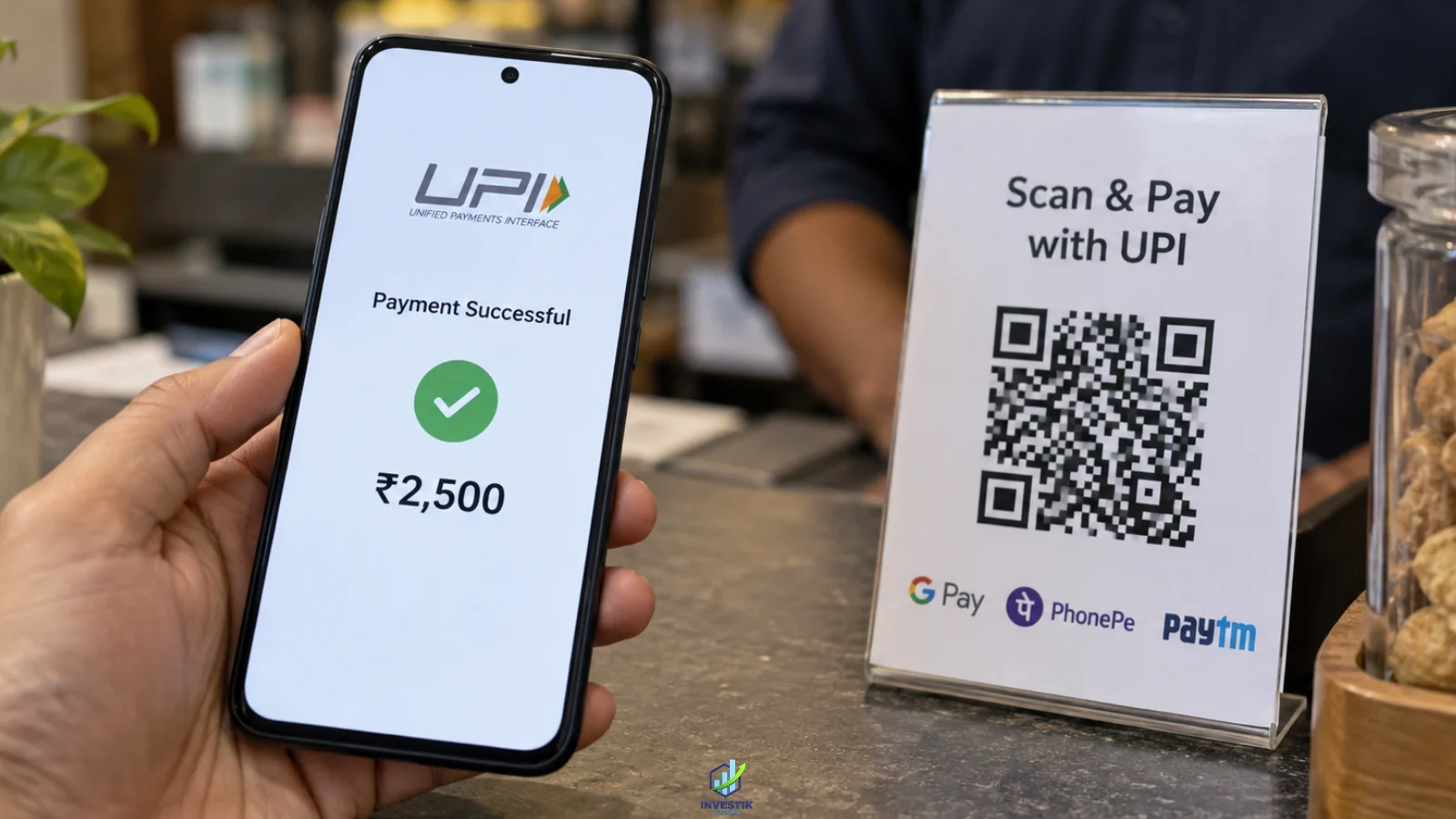

UPI payments are set to see a change from October 15, 2026, with a new Merchant Discount Rate (MDR) applying to certain merchant transactions above ₹2,000. However, this does not mean customers will suddenly have to pay a fee every time they use UPI. Person-to-person transfers will remain free, while eligible merchant payments above the ₹2,000 threshold will be subject to the new MDR framework. Here’s what is changing, who pays the fee, and what it means for everyday UPI users.
What Has Changed in UPI Charges?
From October 15, 2026, a new rule kicks in for UPI payments made to shops and businesses (not for sending money to friends or family). Specified merchant-side UPI transactions above ₹2,000 will attract an MDR of 0.4%.
Here’s the part that matters most to you as a customer:
- Sending money to another person (P2P) is still completely free, no matter the amount.
- Paying a shop ₹2,000 or less, still free.
- Paying a shop more than ₹2,000, a 0.4% fee may apply, but it’s paid by the merchant’s side, not deducted from your payment.
Will Customers Have to Pay 0.4% on UPI Payments?
No. As things stand under the new framework, customers are not directly charged the MDR. The government has clarified that MDR is not a charge on customers, and banks have been advised to ensure that merchants do not pass the MDR on to customers.
What Is MDR?
MDR stands for Merchant Discount Rate. Think of it as a small service fee that a shopkeeper’s bank charges for handling a digital payment.
Say you run a mobile shop. A customer pays you ₹10,000 through a card machine. The bank that gave you that machine takes a small cut, maybe ₹100 or ₹200, before the rest lands in your account. That cut is the MDR. It has existed for card payments for years.
Regular UPI transactions have operated under a zero-MDR framework since 2020, when the government introduced measures to support zero charges for such transactions. Now, six years later, a limited MDR framework is being introduced for specified merchant-side UPI transactions above ₹2,000.
The key difference from a “customer fee”: MDR is deducted from what the merchant receives, not added on top of what the customer pays. If you pay ₹5,000, ₹5,000 is deducted from your account. The MDR is settled within the merchant payment ecosystem.
What Does the ₹2,000 Rule Mean?
The ₹2,000 figure is a threshold, not a price tag. It decides whether a merchant payment falls under the new MDR rule at all.
- ₹500 UPI payment to a shop below ₹2,000: no MDR at all.
- ₹2,000 UPI payment to a shop right at the line, still free (the rule applies only to amounts above ₹2,000).
- ₹5,000 UPI payment to a shop, above the threshold, so 0.4% MDR applies: that’s ₹20, and it comes out of the merchant’s side, not yours.
- ₹20,000 UPI payment to a shop: 0.4% MDR again, this time ₹80, still borne by the merchant.
Notice something important: even in the examples above, ₹2,000, you still pay exactly the amount shown.
Who Pays the UPI MDR?
The MDR is distributed among participants in the payment ecosystem, including banks, payment service providers, and UPI application providers. It’s split between the customer’s issuing bank, the merchant’s acquiring bank, and the UPI app or payment service provider that processed the transaction.
The MDR is settled within the merchant-payment ecosystem and is not added to the amount paid by the customer.
What About Payments Below ₹2,000?
This is the good news for daily life: most of what you spend money on stays exactly as free as before.
- ₹300 for groceries is free, no MDR.
- ₹1,500 for a restaurant bill is free, no MDR.
- Exactly ₹2,000 for anything is still free, since the rule only bites above this number.
Given how India actually spends through UPI, small, everyday amounts, officials estimate that around 96% of all merchant transactions will remain completely unaffected by this rule. If your UPI use is mostly small daily payments and sending money to people, you likely won’t notice any change at all.
What About Large UPI Transactions?
For bigger payments, the 0.4% MDR applies, but it’s capped so it doesn’t spiral for very large amounts.
- A ₹3,000 payment attracts a 0.4% MDR, which works out to ₹12, paid by the merchant.
- A ₹50,000 payment attracts a 0.4% MDR, which works out to ₹200.
- For any payment of ₹75,000 or more, the MDR is capped at ₹300, regardless of the transaction amount.
So if you pay ₹2 lakh at, say, a jewellery shop, the MDR stays at ₹300; it doesn’t keep climbing with the amount.
What Is the ₹5 Flat MDR?
A few categories of merchants don’t follow the standard 0.4% rate. Instead, they attract a small, fixed fee of ₹5 per transaction (above ₹2,000), regardless of how big the payment is. These categories include:
- Fuel purchases
- Insurance premium payments
- Telecom bill payments
- Railway bookings
- Agricultural inputs
These sectors tend to see either very high transaction volumes or payments with thin margins, so a flat, predictable fee was chosen instead of a percentage that could add up quickly on things like a large fuel bill or a yearly insurance premium.
Separately, payments related to mutual funds, securities, stockbrokers and dealers will attract an MDR of 0.02%, capped at ₹300 per transaction.
What About Small Merchants?
Small merchants aren’t left to absorb this fee just for existing. Eligible small merchants covered under the existing zero-MDR framework will continue to remain outside the MDR.
The rule is aimed more at larger, high-value merchant transactions than at these small merchants.
P2P vs P2M UPI: What Is the Difference?
| Type | Meaning | Example | What happens under the new framework? |
| P2P | Person-to-Person: sending money to an individual | Paying your friend back ₹1,000 for dinner | Always free, no MDR, any amount |
| P2M | Person-to-Merchant: paying a business for goods or services | Paying a clothing store ₹4,000 by scanning its QR code | Free up to ₹2,000; 0.4% MDR (paid by merchant) above ₹2,000, subject to exemptions and caps |
UPI Charges Before and From October 15, 2026
| Transaction | Before October 15 | From October 15 |
| P2P UPI payment | Free | Free |
| P2M payment up to ₹2,000 | Free | Free |
| P2M payment above ₹2,000 (general merchants) | Free | 0.4% MDR, capped at ₹300, paid by merchant side |
| Specified categories (fuel, insurance, telecom, railways, agricultural inputs) above ₹2,000 | Free | Flat ₹5 MDR, paid by merchant side |
| Small merchants under zero-MDR scheme | Free | Free |
Why Has NPCI Introduced This Framework?
The government and NPCI have introduced a revised MDR framework, following deliberations by the UPI and Services Steering Committee. The government and NPCI have said the framework is intended to support the long-term sustainability of UPI and the costs involved in maintaining and expanding the payment ecosystem. The idea is to keep everyday UPI payments free while introducing a limited MDR on certain higher-value merchant transactions.
It’s worth noting this debate isn’t one-sided; some fintech and trader groups have criticised the move as a step back from India’s zero-fee digital payments push, while others in the payments industry have long argued that a completely free system isn’t financially sustainable. Both views have been part of the public conversation around this change.
Will Google Pay, PhonePe or Paytm Charge Users?
This is a common point of confusion, so it’s worth separating clearly:
- UPI is the underlying payment system; it doesn’t itself charge you anything under this framework.
- UPI apps (Google Pay, PhonePe, Paytm, and others) are just the interface you use to make a UPI payment.
- MDR is a fee inside the merchant-payment chain, not a fee charged to you by the app you’re using.
The new MDR framework does not introduce a separate customer fee for using UPI. Any future customer-facing fee would require separate terms or an announcement and should not be confused with the MDR.
What Changes for Ordinary UPI Users?
Here’s a quick, practical rundown:
- Sending money to another person, no change, always free.
- Paying a shop for something under ₹2,000, no change, still free.
- Paying a bill depends on the category. Most bill payments below ₹2,000 stay free; larger ones may involve MDR on the merchant’s end, or a flat ₹5 for fuel, insurance, telecom, railways, and agricultural inputs.
- Even with a larger merchant payment, you still pay exactly the amount shown. The 0.4% fee, where it applies, is settled between the merchant and the banks involved, not added to your bill.
For the vast majority of people using UPI for daily spending, this change happens quietly in the background and doesn’t touch what leaves your account.
Key Takeaway
Starting October 15, 2026, UPI introduces a small fee called MDR, but only on merchant payments above ₹2,000, and it applies at a rate of 0.4% (capped at ₹300 for payments of ₹75,000 and above, with some categories at a flat ₹5). Sending money between people (P2P) stays completely free, as do most everyday shop payments up to ₹2,000.
This fee is settled within the merchant-payment ecosystem and is not directly charged to the customer. Around 96% of merchant transactions are expected to stay unaffected, so for most ordinary UPI users, day-to-day payments won’t change at all.







FAQs
Will UPI become chargeable from October 15, 2026?
Not for ordinary use. Sending money to people stays free, and so do most shop payments. A small fee applies only to merchant payments above ₹2,000, and it's paid by the merchant's side of the transaction.
What is the new UPI ₹2,000 rule?
It's the threshold above which a merchant UPI payment can attract an MDR fee. Payments of ₹2,000 or less remain completely free.
What is UPI MDR?
Merchant Discount Rate is a fee charged for processing a digital payment, generally paid by the merchant to the banks and providers involved, not by the customer.
Who pays the 0.4% UPI MDR?
It's shared mainly between the customer's issuing bank, the merchant's acquiring bank, and the UPI app or payment service provider, all on the merchant side of the transaction chain.
Will customers have to pay 0.4% on UPI payments?
No. Customers pay the exact amount shown on their screen. The MDR is deducted from what reaches the merchant, not added to what the customer pays.
ARN Disclosure: Investik Future is an AMFI-registered Mutual Fund Distributor. ARN-341107 — Verify on AMFI ↗. Komal Thakur is the content author and digital marketer; the ARN registration belongs to Investik Future, not to the author personally.