
When you open a mutual fund factsheet, it can be difficult to know which details to focus on. Terms such as NAV, AUM, benchmark, and expense ratio may look confusing, especially if you are new to investing.
Knowing how to read a mutual fund factsheet can help you understand where a fund invests, how it has performed, what it costs, and how much risk it carries. Here are seven key things to check before investing.
This article explains how to read a mutual fund factsheet and the seven key details to check before investing, including returns, expense ratio, portfolio holdings, risk, and fund size.
What Is a Mutual Fund Factsheet?
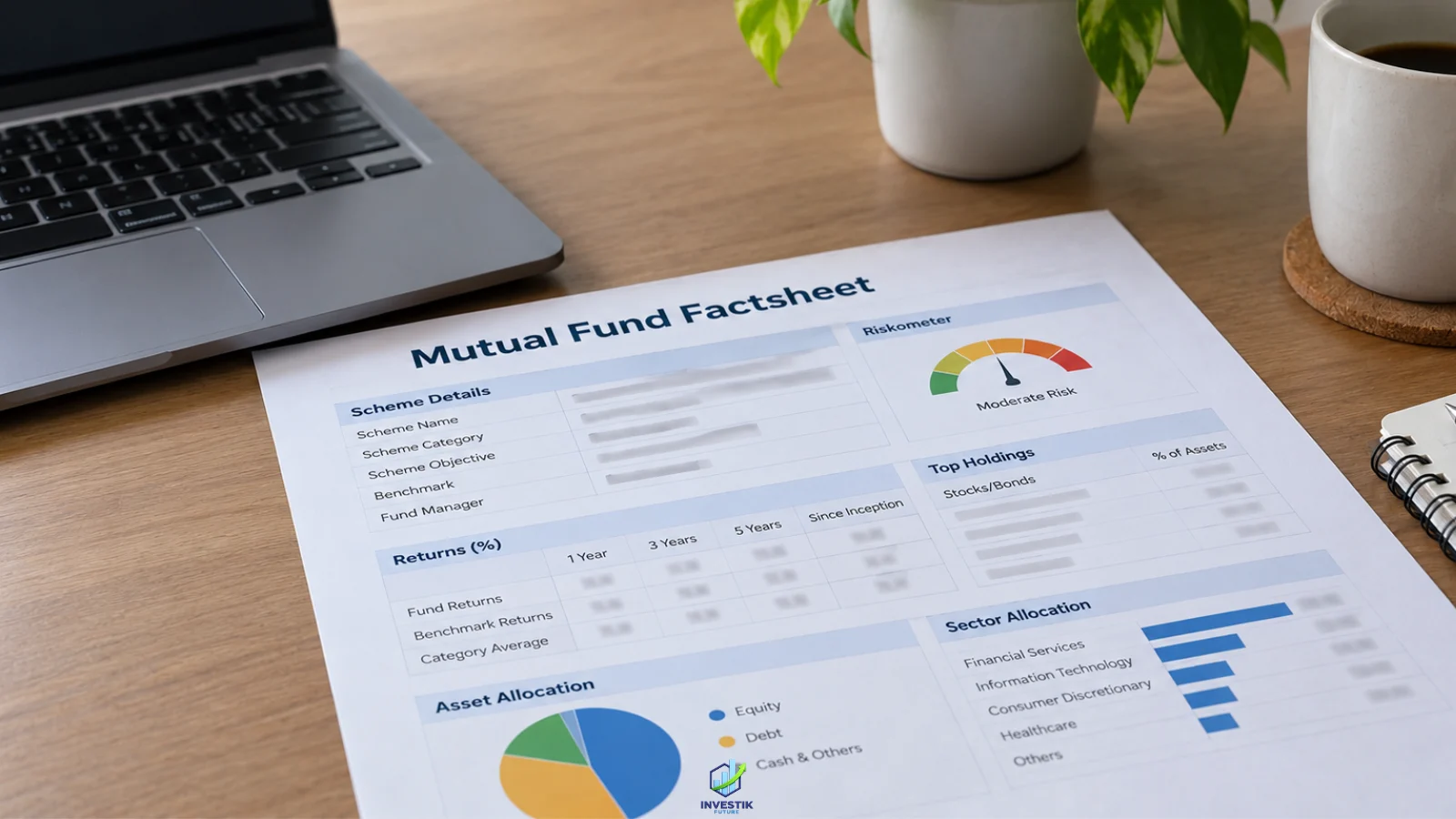
A mutual fund factsheet is a short document that an asset management company (AMC), also called a fund house, publishes for each of its schemes. It gives a snapshot of the fund: its objective, returns, portfolio, costs, size, risk level, and fund manager.
Think of it as a snapshot of the fund. It presents key information about the scheme, helping investors understand its investments, costs, performance, and risk.
You can usually find factsheets on the official websites of fund houses. AMFI, the industry body, also has a dedicated page where you can download monthly factsheets.
How to Read a Mutual Fund Factsheet: 7 Things to Check
1. Fund Objective and Category
The objective tells you what the fund is trying to do. It might aim for long-term growth, regular income, or a mix of both.
The category tells you how the fund goes about it. A large-cap equity fund mainly invests in big, established companies. A small-cap fund invests in smaller companies, which can be more volatile. A liquid fund holds very short-term debt and is generally lower in risk than equity funds, though it is not risk-free. Funds within the same category can also behave differently, so the category is a starting point, not the full picture.
What to look for: Check that the objective matches your goal. If you need money in two years, a fund built for ten-year growth may not suit you.
2. Past Performance and Benchmark Returns
Every factsheet shows how the fund has performed over periods such as one, three, and five years. Next to it, you will see the benchmark returns. A benchmark is a market index the fund is measured against, such as the Nifty 50.
Comparing the two tells you whether the fund did better or worse than the market segment it invests in. A 12% return sounds good until you see the benchmark returned 14%.
What to look for: Look at the longer periods, such as three and five years, not just the last year. A fund that did well in one strong year may not have done well otherwise. Also remember that past performance does not guarantee future returns.
3. Expense Ratio
The mutual fund expense ratio is the yearly fee the fund house charges to run the fund. It is shown as a percentage of your investment and is deducted from the fund’s assets. You never pay it separately, but it reduces your returns.
Costs matter more over long periods. If one fund charges 0.5% a year and a similar one charges 1.5%, the second fund has to earn more just to match the first. How much this affects your final returns depends on how each fund actually performs, so cost is one factor to weigh, not the only one.
What to look for: Compare the expense ratio with similar funds in the same category. Also check whether you are looking at the direct plan or the regular plan, since direct plans usually have a lower expense ratio.
4. Portfolio Holdings and Sector Allocation
The mutual fund portfolio section shows where your money actually goes. You will usually see the top mutual fund holdings, which are the largest stocks or bonds the fund owns. You will also see the sector allocation, which shows how much is invested in banking, IT, pharma, and so on.
This matters because a fund can look diversified on paper and still lean heavily on a few companies or one sector. If a single sector makes up a big share of the portfolio, the fund will feel that sector’s ups and downs more strongly.
What to look for: Check how much the top five or ten holdings account for. Check whether any one sector dominates. Ask yourself whether you are comfortable with that concentration.
5. Riskometer and Investment Risk
The mutual fund Riskometer shows a scheme’s assessed risk level, ranging from Low to Very High across six categories: Low, Low to Moderate, Moderate, Moderately High, High and Very High. Fund houses review it monthly, and the rating can change as the scheme’s risk profile changes.
The Riskometer is a useful first filter, but it is not a promise. A fund marked “Very High” can see sharp falls. A “Low” rating does not mean you cannot lose money.
What to look for: Match the risk level to your own comfort. If a 20% fall in your investment would keep you awake at night, a high-risk fund may not suit you, however good its returns look. Check the Riskometer each time you review the fund.
6. Assets Under Management (AUM)
AUM is the total amount of money the fund is managing on behalf of all its investors. It gives you a sense of the fund’s size.
A smaller AUM does not automatically make a fund worse, just as a larger AUM does not guarantee better performance. Consider the fund’s category, investment strategy, and track record alongside its size.
What to look for: Treat AUM as background. Compare it with similar funds, and see whether it has been growing or shrinking steadily.
7. Fund Manager and Portfolio Changes
The fund manager makes the day-to-day investment decisions. The factsheet names the manager and often shows how long they have run the fund. It also helps to compare the current portfolio with earlier months.
A change in manager can change how a fund is run. A big shift in sectors or holdings, with no clear reason, is worth noticing too. A manager’s record does not guarantee future results, so use this section to understand the fund, not to predict it.
What to look for: Check how long the current manager has been in charge. Look at whether the portfolio has stayed in line with the fund’s stated objective.
Where Can You Find a Mutual Fund Factsheet?
The easiest place is the official website of the fund house. The steps are simple:
- Open the AMC’s website.
- Look for a section called “Downloads,” “Factsheets,” or “Statutory Disclosures.”
- Choose the latest month and download the file.
- Find your fund’s page in the document.
Mutual fund portfolio disclosures are published monthly. Always check the reporting month on the factsheet, as portfolio holdings, returns, and risk details can change.
Common Mistakes to Avoid
- Choosing a fund only because of recent high returns. A strong last year says little about what comes next.
- Ignoring the expense ratio. It looks small, but it is charged every year.
- Overlooking risk. Higher returns may involve higher risk, so check the Riskometer and understand the fund’s investment strategy before investing.
- Comparing funds from different categories. A small-cap fund and a debt fund are built for different purposes. Compare funds within the same category.
- Treating the factsheet as a guarantee. It describes what has happened, not what will happen.
Final Takeaway
Learning how to read a mutual fund factsheet will not tell you which fund will do best. It does help you understand what you are buying, what it costs, and how much risk you are taking.
Use the factsheet alongside your own financial goals, the time you can stay invested, and how much risk you can handle. If you are unsure, a SEBI-registered investment adviser can help.
FAQs
What is a mutual fund factsheet?
It is a short monthly document published by a fund house. It summarises a scheme's objective, returns, portfolio, costs, risk level, and fund manager.
How often should investors check a mutual fund factsheet?
Factsheets come out monthly. Read one before you invest, then review it every few months, or whenever you want to see how your fund is doing.
Which details are most important in a mutual fund factsheet?
Start with the objective, returns against the benchmark, expense ratio, portfolio holdings, and the Riskometer. AUM and fund manager details add useful context.
Does a higher return mean a mutual fund is better?
Not always. A higher return may come with higher risk or higher costs. Compare funds in the same category, over longer periods, and against the benchmark.
Where can I download a mutual fund factsheet?
You can download it from the official website of the fund house, usually under "Downloads" or "Factsheets." AMFI's website also has a page for monthly factsheets.
ARN Disclosure: Investik Future is an AMFI-registered Mutual Fund Distributor. ARN-341107 — Verify on AMFI ↗. Komal Thakur is the content author and digital marketer; the ARN registration belongs to Investik Future, not to the author personally.