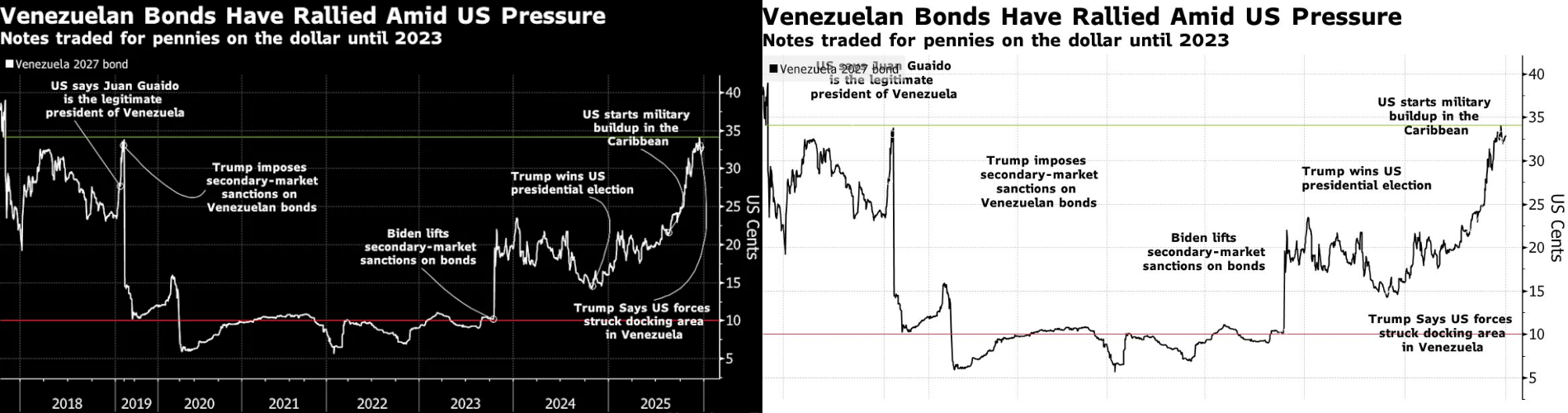

Venezuela bonds have a way of reminding me that markets are driven as much by narratives as they are by numbers. When I saw these defaulted securities suddenly surge, I knew this wasn’t just another rally; it was a signal. A complicated one. Over the weekend, news broke that Nicolás Maduro had been unexpectedly seized by the United States, triggering a wave of speculation about a political transition. By Monday, the market had already reacted aggressively.
Venezuelan government bonds and those linked to PDVSA jumped sharply, in some cases by nearly 30%, pushing prices closer to 40 cents on the dollar. For instruments that have been in default since 2017, that’s not just a bounce; it’s a re-rating of expectations. But as I dug deeper, one question stayed with me: Is this the beginning of a recovery story, or just another speculative spike?
In this article, I look at the sudden interest in Venezuela’s defaulted bonds after a dramatic political development and what that might signal to global investors. Through a personal lens, I dissect whether this rally indicates that we’re seeing an actual turnaround based on potential debt restructuring and policy shifts or if it’s just a speculative response to uncertainty. More importantly, I take a look at the risks and complexities involved, as well as some of the key determinants that might shape Venezuela’s financial future from here.
What’s Driving the Venezuela Bonds Sudden Rally?
From what I see, the rally isn’t about improved fundamentals, at least not yet. It’s about hope. Markets are forward-looking, and right now, investors are betting on a political reset. If the U.S., under Donald Trump, backs a transitional leadership, possibly Delcy Rodriguez, it could open doors that have been shut for years.
These include:
- Restoration of diplomatic ties
- Easing of sanctions
- Most importantly, formal debt restructuring talks
Even JPMorgan had hinted at a “strong bounce,” suggesting that markets would prioritise political clarity over unresolved risks in the short term. And that’s exactly what we’re seeing.
The Bigger Picture: A $150 Billion Puzzle
Here’s where things get complicated, and honestly, where I become cautious. Venezuela’s debt situation isn’t just large. It’s massively tangled.
- Around $60 billion in defaulted bonds
- Total external obligations are estimated between $150-170 billion
- Exposure to multiple stakeholders:
- Multilateral lenders like development banks
- Bilateral creditors such as China (~$13–15 billion)
- Private institutional investors
This isn’t a straightforward restructuring. It’s a multi-layered negotiation involving politics, law, and economics. When I compare it mentally, the closest parallel isn’t a typical emerging market default; it’s something like the Greek debt crisis of 2012, which took years to resolve and still left scars.
Why I Think the Optimism Might Be Premature
Yes, prices have surged. But I’m not fully convinced the upside is as straightforward as the market suggests. Here’s why:
- Political Uncertainty Isn’t Gone: A change in leadership does not equate to stability. Venezuela’s domestic dynamics are complicated, and transitions don’t often flow easily.
- Debt Restructuring Will Be Painful: According to estimates:
- A 50% haircut on existing bonds
- New instruments with long maturities (up to 20 years)
- Coupons are possibly around 4–5%
That’s hardly a dream scenario for current bondholders.
- Oil Is the Real Variable: Everything comes down to how much oil Venezuela can recover. If oil output doesn’t normalise:
- GDP recovery stalls
- Debt repayment capacity weakens
- Bond valuations could hit a ceiling
And right now, that recovery is still uncertain.
The Investor Dilemma: Chase the Rally or Wait?
This is where I stop for a moment.
On one hand:
- The rally indicates actual potential change
- Initial investors in distressed businesses often receive disproportionate rewards
On the other:
- A lot of the optimism is already priced in
- Execution risks remain extremely high
Even veteran investors are wondering how much more upside there is. Personally, I see this as a classic high-risk, high-uncertainty trade, not a clear long-term investment, at least not yet.
What I’m Watching Next
If you’re tracking this story like I am, here are the key triggers that matter:
- Clear political transition roadmap
- Formal announcement of restructuring talks
- Sanction relief signals from the U.S.
- Oil production data trends
- Creditor coordination (this will be crucial)
Until these pieces fall into place, the story remains incomplete.
Final Thoughts: A Turning Point or a Temporary Spike?
Markets love a good comeback story, and Venezuela might just become one.
But right now, we’re not looking at a recovery. We’re looking at the possibility of one. And in investing, that distinction matters. For me, this rally is fascinating, but it’s also a reminder that not every surge signals stability. Sometimes, it just signals speculation dressed as optimism.
Also Read: 10-Year Treasury Yield Falls Ahead of Crucial 2025 Data
Disclaimer
This article is solely for informative and educational purposes and is not financial advice. Investing in sovereign debt that is distressed or has defaulted involves significant risk, including principal loss. Readers should do their own research and consult a financial adviser before making any investment decisions.

Himani Soni
I’m Himani Soni, a finance content strategist with 2+ years at Investik Future. I decode market trends and simplify complex investing concepts into clear, actionable insights for the everyday investor.