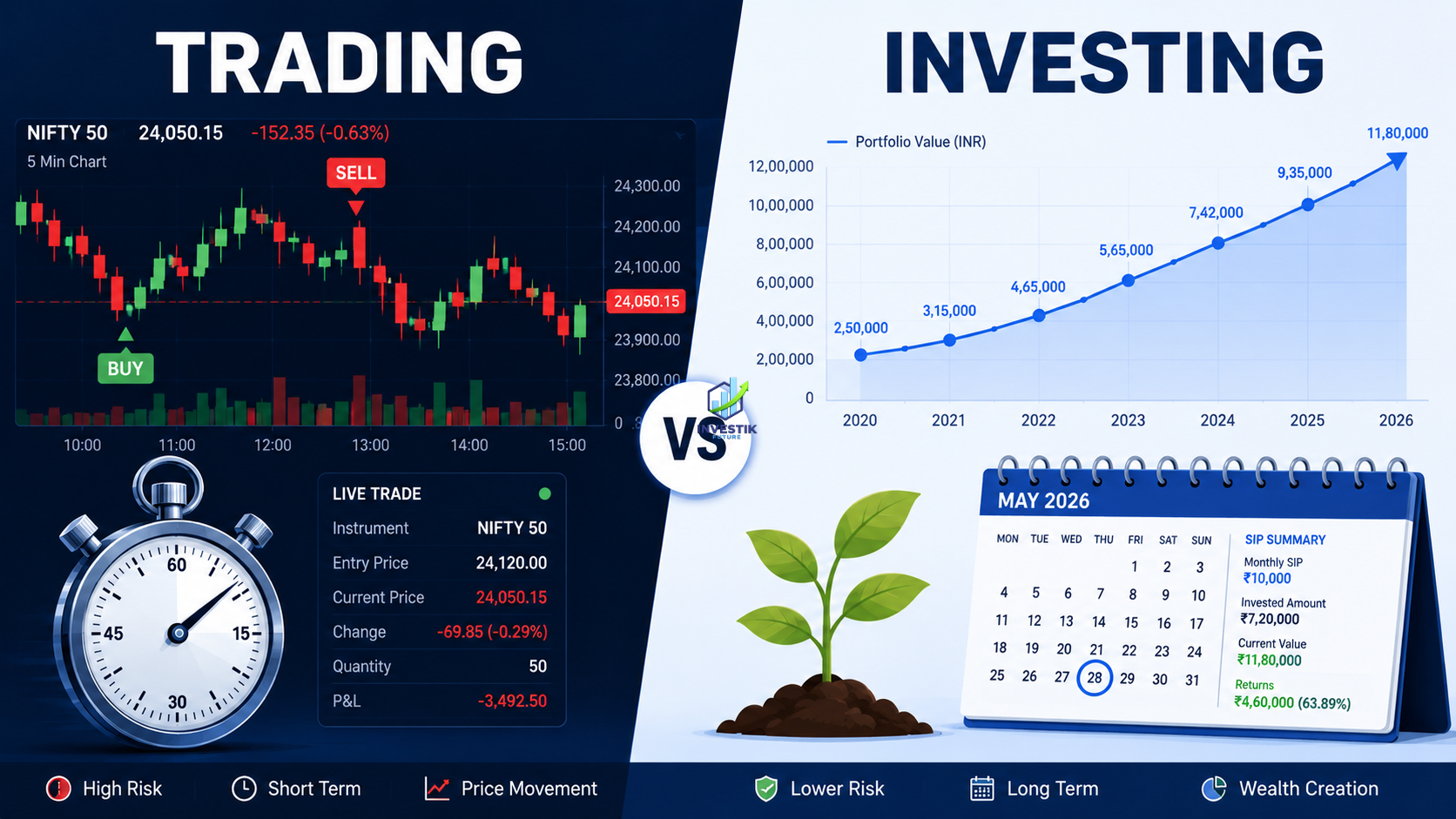

Trading and investing both put money into the stock market, but they answer different questions. Trading asks: where will the price go in the next few hours, days, or weeks? Investing asks: will this business be worth more in 5, 10, or 20 years?
That single difference in time horizon changes almost everything else: how much risk you carry, how much tax you pay, how much time the activity demands, and what skills actually help you.
This guide covers the difference between trading and investing in full: definitions, risk profiles, tax treatment in India for FY 2026-27, the tools each approach needs, common mistakes, and a practical checklist for choosing between them. For a broader grounding in how the stock market works, start there first if you’re completely new to markets, then come back to this comparison.
What is trading
Trading means buying and selling financial instruments, stocks, options, futures, currencies, over short periods to profit from price movement. A trader doesn’t need to believe a company will grow over 10 years. A trader needs the price to move in a predictable direction over a shorter window.
Common trading styles:
- Scalping. Positions held for seconds to minutes. Aims for small, frequent gains.
- Intraday trading. Positions opened and closed within the same trading day, so no overnight exposure.
- Swing trading. Positions held for a few days to a few weeks, riding a short-term price swing.
- Positional trading. Positions held for weeks to a few months, based on a technical or event-driven view.
Traders rely heavily on technical analysis: chart patterns, moving averages, volume, and momentum indicators. Understanding the different order types (market, limit, stop-loss) matters more to a trader than reading an annual report.
What is investing
Investing means putting money into an asset with the expectation that its underlying value will grow over years, through business growth, compounding, or both. Investors care about earnings, management quality, competitive position, and valuation, not the next week’s price action.
Common investing approaches:
- Value investing. Buying businesses trading below their estimated intrinsic worth.
- Growth investing. Buying businesses expected to grow revenue and profit faster than the market average.
- Index investing. Buying a fund that tracks a broad market index instead of picking individual stocks.
- SIP-based investing. Investing a fixed amount at fixed intervals into mutual funds, letting the power of compounding do the heavy lifting over time.
Investors read balance sheets, cash flow statements, and industry trends. Short-term volatility is noise they’re expected to sit through, not a signal to act on.
Trading vs investing: side-by-side comparison
| Factor | Trading | Investing |
|---|---|---|
| Time horizon | Minutes to a few months | Years to decades |
| Primary tool | Technical analysis, charts | Fundamental analysis, financials |
| Risk level | High, amplified by leverage | Lower, but not zero |
| Time commitment | Daily or near-daily monitoring | Periodic review, quarterly or annually |
| Emotional demand | High; requires strict discipline | Lower; requires patience |
| Tax treatment (India, listed equity) | Business income or STCG at 20% | LTCG at 12.5% above ₹1.25 lakh/year |
| Typical instruments | Intraday stocks, F&O, currencies | Stocks, mutual funds, index funds, bonds |
| Success driver | Timing and risk control | Time in the market and business selection |
| Capital needed to start meaningfully | Can be small, but leverage raises real exposure | Can start with as little as a monthly SIP |
Risk management: trading vs investing
Risk shows up differently in each activity.
For traders, risk is managed trade-by-trade. A stop-loss caps how much a single position can lose. Position sizing decides how much capital goes into any one trade, which is why a position size calculator is a standard part of a trader’s toolkit, not an optional extra. Leverage through futures and options magnifies both gains and losses, so a trader who risks 2% of capital per trade survives a losing streak; one who risks 20% doesn’t.
For investors, risk is managed through diversification, asset allocation, and time. Holding 15-20 stocks across sectors reduces single-company risk. Holding equity alongside debt and gold smooths out portfolio swings. The main investor risk isn’t a single bad trade; it’s panic-selling during a downturn and locking in a loss that would have recovered given time.
Capital gains tax on trading and investing in India (FY 2026-27)
Tax treatment is one of the clearest ways to see the difference between trading and investing in practice, and it’s an area where getting the details wrong is expensive.
For listed equity shares in India:
- Short-term capital gains (STCG), on shares sold within 12 months of purchase, are taxed at 20%, provided Securities Transaction Tax (STT) conditions are met.
- Long-term capital gains (LTCG), on shares held for more than 12 months, are taxed at 12.5%, with the first ₹1.25 lakh of such gains in a financial year exempt.
- Frequent intraday trading and F&O income are often treated as business income rather than capital gains, and taxed at your applicable slab rate, since it’s treated as a business activity rather than a passive investment.
These rates came into effect from the July 2024 Union Budget and were left unchanged for FY 2026-27. Budget-year tax rules do shift, so always confirm the current rate on the Income Tax Department’s official portal or the SEBI website before filing.
Outside India, the principle holds even where rates differ: most tax systems reward longer holding periods for capital assets. In the United States, for example, assets held over 12 months qualify for lower long-term capital gains rates than short-term gains, which are taxed as ordinary income; the IRS topic on capital gains has current figures. In the UK, gains fall under Capital Gains Tax with its own annual exempt amount, detailed on HMRC’s capital gains pages. If you trade or invest from outside India, check your local tax authority rather than assuming Indian rates apply.
Which is riskier: trading or investing
Trading carries higher risk per unit of time. A single leveraged F&O position can lose more than its margin in a fast move, and intraday traders can lose money on a majority of individual trades even while being net profitable, because a few large wins offset many small losses, a pattern that only works with strict risk control.
Investing carries lower risk per unit of time but isn’t risk-free. Market-wide downturns, sector-specific declines, and individual company failures all happen to long-term holders too. The difference is recovery time: a diversified investment portfolio has historically recovered from downturns given enough years, while a trader who blows up a leveraged account has no such runway.
Trading vs investing: which is better for beginners
For most beginners, investing is the more forgiving starting point, for three concrete reasons:
- Lower monitoring load. A monthly SIP into an index fund needs a few minutes a month. Intraday trading needs sustained attention during market hours.
- No leverage by default. Buying shares or mutual funds with your own capital caps your loss at what you put in. F&O trading can lose more than the initial margin.
- Behavioural forgiveness. A beginner’s investing mistake (buying a mediocre stock) costs money slowly. A beginner’s trading mistake (an unhedged option position) can cost money in minutes.
That doesn’t mean trading is off-limits to beginners; it means anyone starting should treat it as a skill to learn with small, defined capital, not as a shortcut to income.
Trading vs investing vs running a business
It’s worth separating trading from running a business, since the two get confused. A business owner controls the product, the customers, and the operations; profit comes from operating decisions made inside the company. A trader controls none of that. A trader only takes a position on an asset someone else’s business decisions will move. Investing sits closer to indirect business ownership: buying shares makes you a part-owner of a company’s future profits, without controlling its day-to-day decisions.
Common mistakes: trading side
- Trading without a stop-loss, turning a small loss into an account-threatening one.
- Increasing position size after a losing streak to “win it back.”
- Treating trading capital and essential living expenses as the same pool of money.
- Copying trade ideas from social media without understanding the underlying setup.
Common mistakes: investing side
- Selling during a downturn out of fear, converting a paper loss into a realised one.
- Concentrating a portfolio in one stock or sector because it performed well recently.
- Ignoring the expense ratio and exit load on mutual funds, which quietly reduce long-term returns.
- Stopping a SIP during a market fall, which is exactly when lower unit prices help long-term compounding.
A practical checklist: choosing between trading and investing
- Can you check the market multiple times during trading hours, most days? If not, trading is a poor fit for your schedule.
- Can you accept losing the full amount you put into a single position? If not, avoid leveraged instruments.
- Do you have a written entry and exit rule before you place a trade? If not, you’re gambling with extra steps.
- Is this money you won’t need for 5+ years? If yes, it’s a stronger candidate for long-term investing.
- Have you calculated position size using a fixed risk percentage, not a fixed rupee amount? Use a position size calculator to fix this before your first trade.
- Have you set up an SIP or lump-sum plan and modelled the outcome with a SIP calculator before committing?
Frequently asked questions
Is trading the same as gambling?
No. Gambling has a fixed negative expected value by design. Trading has a variable expected value that depends on skill, risk management, and market conditions, though poor risk management can make the outcome resemble gambling.
Can you do both trading and investing at the same time?
Yes. Many people run a long-term investment portfolio for wealth building and a separate, smaller, clearly ring-fenced amount for trading. Keeping the two pools of money and the two mindsets separate is what makes this work.
Which makes more money, trading or investing?
Neither wins by default. Trading can produce faster gains and faster losses. Investing tends to produce steadier, compounding growth over long periods with lower variance. The honest answer depends on the individual’s skill, discipline, and time available, not the activity itself.
Do I need a demat account for both?
Yes, in India both require a demat and trading account with a SEBI-registered broker. What differs is how you use the account: frequent buy-sell activity for trading, periodic buy-and-hold activity for investing.
Conclusion
Trading and investing use the same markets but reward different behaviour. Trading rewards fast, disciplined, risk-controlled decision-making over short time frames. Investing rewards patience, diversification, and staying invested through short-term noise to capture long-term compounding.
Neither is inherently better. The right starting point depends on your time horizon, how much loss you can absorb, and how much time you can realistically give it each week. Most people are better served starting with investing, understanding it well, and only adding trading later with capital they can afford to lose.
For structured next steps, use the SIP calculator to model a long-term plan, or the position size calculator if you’re set on trading and need to fix your risk per trade before your first order.
ARN Disclosure: Investik Future is an AMFI-registered Mutual Fund Distributor. ARN-341107 — Verify on AMFI ↗. Komal Thakur is the content author and digital marketer; the ARN registration belongs to Investik Future, not to the author personally.