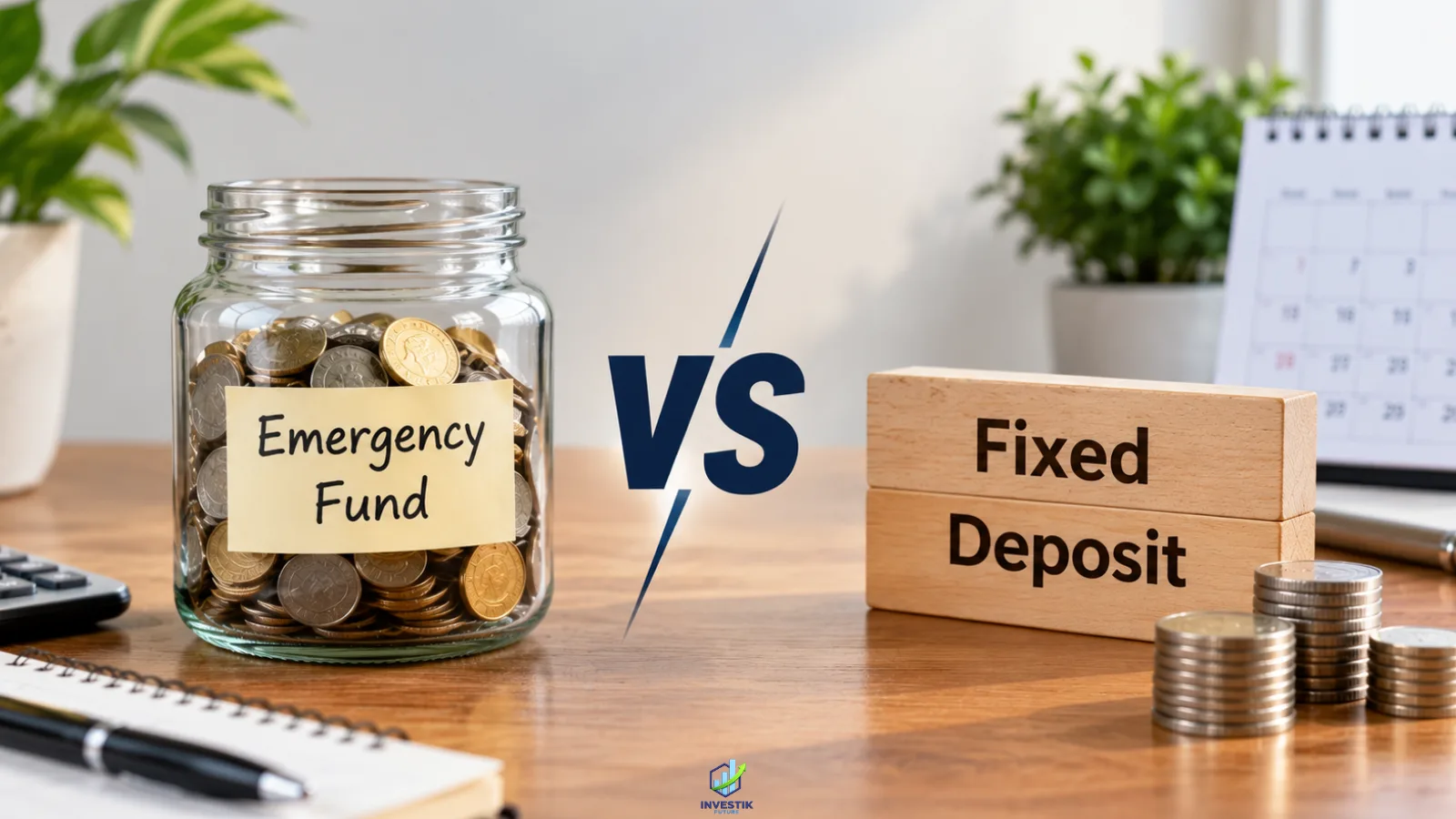

An emergency fund and a fixed deposit (FD) serve different purposes when it comes to managing your money. An emergency fund helps you cover unexpected expenses, while an FD allows you to save money for a fixed period and earn interest. But can a fixed deposit also serve as an emergency fund, or is it better to keep these savings separate?
This article explains the key differences between an emergency fund and a fixed deposit, including their accessibility, interest earnings, and withdrawal conditions, to help you decide where to keep your savings.
What Is an Emergency Fund?
An emergency fund is money kept aside only for unexpected, necessary expenses. A sudden medical bill, a job loss, or an urgent home repair are typical examples. A holiday, an annual insurance premium, or festival shopping is a planned expense and is better saved for separately.
The key requirement is access. When a bill arrives, the money should be available within hours, not days.
A commonly used guideline for an emergency fund in India is three to six months of essential expenses. Essentials include rent or EMIs, groceries, utilities, insurance premiums, school fees, and transport. It is a starting point, not a rule for everyone. Someone with a stable job and no dependants may be comfortable with three months. A single earner with a family or a home loan may want a bigger cushion.
If your essential spending is ₹25,000 a month, the guideline gives a range of ₹75,000 to ₹1,50,000.
What Is a Fixed Deposit?
A fixed deposit is money you place with a bank for a chosen period at an interest rate agreed in advance. People use FDs to set money aside for a known goal or to earn more than a savings account usually pays.
Early withdrawal is possible, but with conditions. Under RBI’s directions for commercial banks, a bank may offer term deposits without a premature withdrawal option, but deposits from individuals of ₹1 crore and below must have that facility. When a deposit is closed early, interest is paid at the rate for the period it actually stayed with the bank, not the contracted rate, and no interest is paid if it is closed before the minimum tenor of seven days. Banks must also make the components of any penalty clear when accepting the deposit, and if they do not, no penalty can be levied.
The penalty, the minimum period, and whether partial withdrawal is allowed vary by bank, tenure, and deposit type. Read the terms of your own deposit before relying on it.
Emergency Fund vs Fixed Deposit: Key Differences
| Emergency fund | Fixed deposit | |
| Main purpose | A purpose: money set aside for unexpected expenses | A bank product that holds money for a chosen period |
| Access to money | Needs to be quick | Depends on the bank’s process and the deposit type |
| Return or interest | Depends on where the money is kept | Rate is fixed at the time of deposit and varies by bank and tenure |
| Withdrawal restrictions | None by itself; set by the account or product holding it | Early withdrawal usually reduces interest; partial withdrawal depends on the bank |
| Suitability for unexpected expenses | Meant for exactly this | Suits money you are unlikely to need immediately |
| Risks and limits | Falls short if it is too small or hard to reach | Penalty and lost interest; deposit insurance is capped; not risk-free |
An FD can form part of someone’s emergency savings. Whether it suits that role depends on how easily the money can be accessed.
Can You Use a Fixed Deposit as an Emergency Fund?
Partly, yes. An FD can hold the portion of your emergency savings that you are unlikely to need in the first few days, as long as its withdrawal terms are acceptable.
Trouble starts when the entire reserve sits in deposits. Closing an FD may need a branch visit or an online request, and the interest earned shrinks. Some banks allow only full closure rather than partial withdrawal. A hospital advance does not wait for processing.
Not every FD behaves the same way, though. Some banks link a deposit to a savings account through a sweep facility, but this is a bank-specific feature and not a standard part of every FD.
SBI describes its Multi Option Deposit Scheme as a term deposit linked to a savings or current account, from which money can be withdrawn in multiples of ₹1,000. Minimum deposit amounts, balance requirements, and other conditions apply, so confirm the current terms with your bank before relying on such a feature.
Where Should You Keep Your Emergency Savings?
One practical approach is to split the money. Keep a portion in a savings account, where it can be used at once through UPI, ATM, or net banking. Place another portion in a short-term deposit or FD, if its withdrawal terms meet your needs.
The savings account covers the first bills, and the deposit may earn a higher rate on money you are less likely to need right away. Someone who prefers simplicity may keep everything in a savings account, and that is a reasonable choice too.
When comparing a savings account vs. a fixed deposit, check the minimum balance, withdrawal rules, premature closure conditions, and any charges.
How to Divide Emergency Savings: Simple Example
This is an illustration, not a recommendation. Take a person whose essential expenses are ₹25,000 a month and who aims for six months of cover, which is ₹1,50,000. They might keep ₹50,000 in a savings account and ₹1,00,000 in a deposit that allows premature withdrawal.
A ₹30,000 repair bill is covered by the savings account alone. An ₹80,000 hospital bill uses the full ₹50,000 in savings, and the remaining ₹30,000 comes from breaking the deposit. If partial withdrawal is not allowed, the whole deposit may have to be closed, and some interest is lost.
How much to keep immediately accessible depends on the urgent expenses a person is likely to face and on what else they can fall back on, such as health insurance or help from family. Someone with a different income or household may choose a very different split.
What Should You Check Before Choosing an FD for Emergency Savings?
Premature withdrawal rules and penalties: These decide how much it costs to access your money early.
Partial withdrawal: If it is allowed, you can take only what you need and leave the rest earning interest.
Speed of access: An online closure option is usually faster than a branch visit, but the process differs by bank.
Deposit insurance: DICGC insures principal and interest up to ₹5 lakh per depositor per bank, and funds held in the same type of ownership at one bank are added together. This means your savings account and FD at the same bank share one limit. The cover applies to bank deposits and does not extend to deposits with non-banking financial companies. No deposit is entirely free of risk.
Tax on interest: FD interest is added to your income and taxed at your slab rate. Banks deduct TDS only when the interest they pay you crosses ₹50,000 in a year, or ₹1,00,000 for senior citizens. TDS is not necessarily the final tax, so confirm the current rules for the relevant year before filing.
Emergency Fund vs Fixed Deposit: Which Should You Choose?
The emergency fund is the goal, and the FD is one place to keep part of it. Choosing between them is the wrong way to look at it.
The right mix depends on how quickly you may need the money, your monthly expenses, how steady your income is, who depends on you, and the terms of the deposit. Someone with irregular income may prefer more in a savings account. A salaried person with a second earner at home may be comfortable keeping more in a deposit.
Conclusion
The emergency fund vs fixed deposit comparison comes down to purpose and access. An emergency fund exists to support you when something unexpected happens. An FD can hold part of that money if its withdrawal conditions suit you, but a portion should stay where you can reach it immediately.
FAQs
Can a fixed deposit replace an emergency fund?
Not entirely. An FD can hold part of your emergency savings, but keeping everything in it may delay access and reduce your interest if you need the money early. Most people are better served by keeping some money in a savings account.
How much money should I keep in an emergency fund in India?
A common guideline is three to six months of essential expenses. The right amount depends on your job stability, dependants, and loans. It is a planning starting point, not a fixed rule.
Is a savings account or an FD better for emergency savings?
A savings account gives immediate access, while an FD may pay more but comes with early withdrawal conditions. Many people use both, keeping the first bill's worth in the savings account.
Can I withdraw an FD before maturity?
Usually yes. RBI's directions require commercial banks to give a premature withdrawal facility on term deposits from individuals of ₹1 crore and below. The penalty, partial withdrawal option, and interest paid depend on the bank and the deposit terms.
Is money kept in an FD covered by deposit insurance?
Eligible deposits in DICGC-insured banks are covered up to ₹5 lakh per depositor per bank, including principal and interest. Deposits held in the same capacity at one bank are added together for this limit.
ARN Disclosure: Investik Future is an AMFI-registered Mutual Fund Distributor. ARN-341107 — Verify on AMFI ↗. Komal Thakur is the content author and digital marketer; the ARN registration belongs to Investik Future, not to the author personally.