
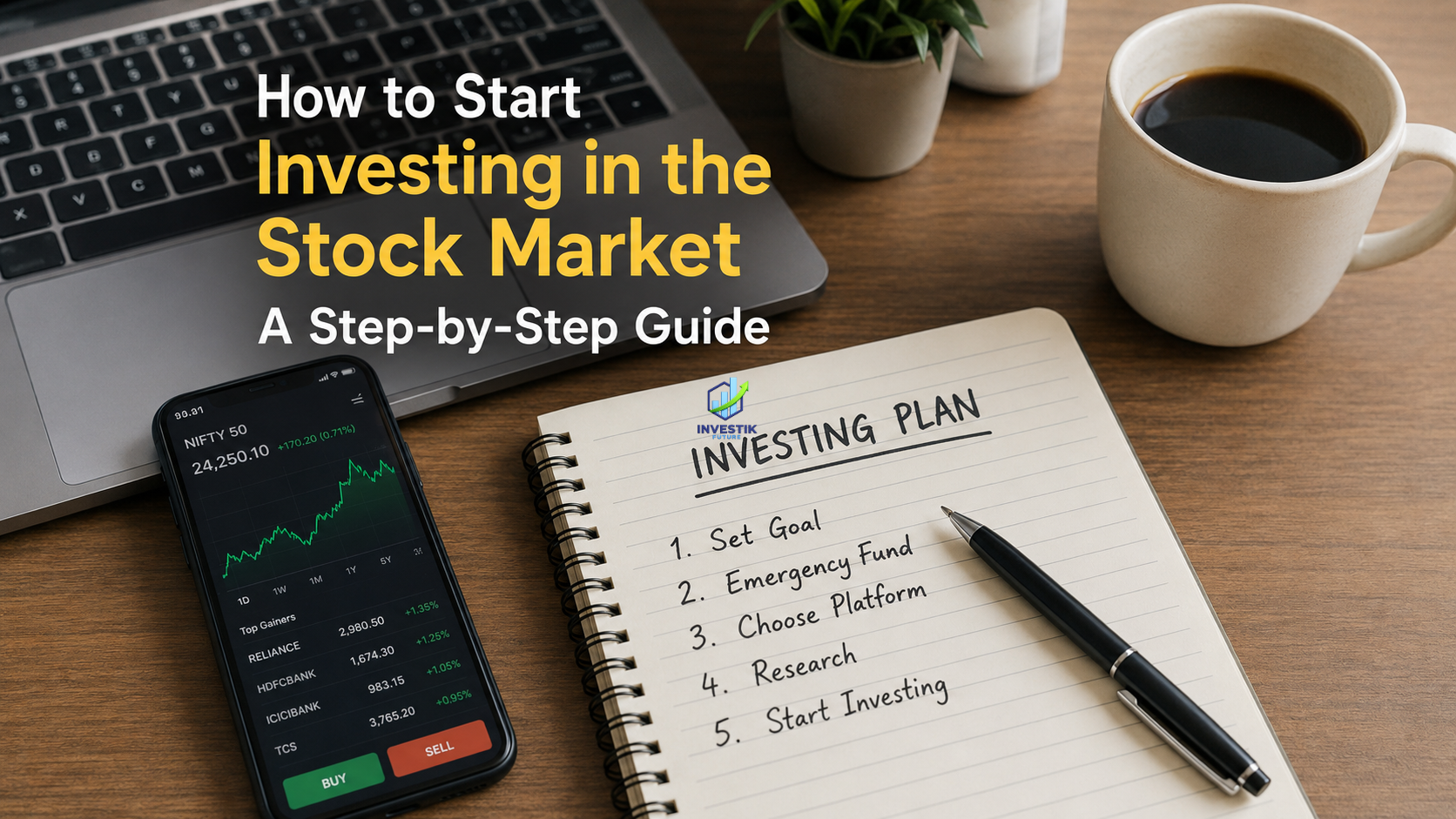

Most people don’t know how to start investing in the stock market and delay investing because the first step feels unclear. Which account do you open? How much money do you need? What do you actually buy first?
This guide answers those questions in order, with real numbers, so you can open an account and place your first trade by the end of it.
What the stock market actually is
A stock market is a regulated venue where investors buy and sell ownership shares in public companies. In the US, that’s the NYSE or Nasdaq. In the UK, the London Stock Exchange. In India, the NSE and BSE. The mechanics are the same everywhere: a company lists shares, buyers and sellers agree on a price, and an exchange records the trade.
You can read a deeper breakdown of the mechanics in our guide on how the stock market works, which covers order matching, indices, and how prices move.
Owning a share means owning a small piece of that company’s future profits. If the company grows earnings, the stock price tends to follow over years, even though it can swing wildly week to week.
Why people invest instead of just saving
A savings account protects your money from disappearing. It does not protect it from inflation.
If inflation runs at 5% a year and your savings account pays 3%, your money loses 2% of its real value every year. Equity markets have historically returned more than inflation over long periods, which is the entire argument for investing rather than only saving.
Here’s a simple comparison over 20 years on a one-time ₹5,00,000 (or $6,000) investment:
| Instrument | Assumed annual return | Value after 20 years |
|---|---|---|
| Savings account | 3% | ~1.8x |
| Fixed deposit | 6.5% | ~3.6x |
| Equity index fund | 12% | ~9.6x |
These are illustrative long-term averages, not guarantees. Markets fall in some years and rise in others. The gap over two decades is still the reason long-term investors stay in equities through the dips.
Step 1: Decide your goal and time horizon before you decide what to buy
Before opening any account, write down two things: what the money is for, and when you’ll need it.
- Money needed in under 3 years: keep it out of stocks. Use a savings account or short-term deposit.
- Money needed in 3 to 7 years: a mix of equity and debt, weighted more toward debt as the goal gets closer.
- Money needed in 7+ years (retirement, a child’s education, long-term wealth): an equity-heavy allocation makes sense, because you have time to ride out downturns.
This single decision prevents the most common beginner mistake: putting rent money or emergency funds into stocks and then panic-selling during a correction.
Step 2: Build an emergency fund first
Financial planners generally recommend 3 to 6 months of essential expenses sitting in a liquid, low-risk account before you invest a rupee or a dollar in equities. This isn’t optional caution. Without it, a job loss or medical bill forces you to sell stocks at whatever price the market happens to be offering that day, often the worst possible day.
Step 3: Open the accounts you need
In the US: open a brokerage account with a firm like Fidelity, Schwab, or Vanguard. If your employer offers a 401(k) match, contribute enough to get the full match before investing elsewhere. That match is an immediate, guaranteed return.
In the UK: open a Stocks and Shares ISA, which shelters gains from capital gains tax up to the annual allowance. Providers like Hargreaves Lansdown, AJ Bell, and Vanguard UK all offer one.
In India: you need three linked accounts:
- A savings bank account
- A Demat account, which holds your shares electronically
- A trading account, through which you place buy and sell orders
Discount brokers such as Zerodha, Groww, and Upstox let you open all three online in about 15 minutes with your PAN, Aadhaar, and a bank statement. If you’ve specifically been searching for how to start investing in the stock market through Zerodha, the process is: download the Kite app, complete e-KYC with your PAN and Aadhaar, link your bank account, and fund your account through UPI or net banking. You can start placing orders the same day once your account is verified, typically within 24 to 48 hours.
You can browse more account and platform comparisons under our stock market category.
Step 4: Understand what you can actually buy
Beginners often assume “investing in the stock market” means picking individual company shares. It’s one option among several.
| Option | What it is | Best for |
|---|---|---|
| Individual stocks | Shares of one company | Investors willing to research each business |
| Index funds | A basket tracking an index like the Nifty 50, S&P 500, or FTSE 100 | Beginners who want broad exposure with low effort |
| ETFs | Index-like funds traded on the exchange like a stock | Investors who want intraday liquidity |
| Actively managed mutual funds | A fund manager picks stocks on your behalf | Investors who prefer professional selection, for a fee |
For someone asking how to invest in the stock market for beginners with little money, index funds and ETFs solve two problems at once: you get instant diversification across dozens or hundreds of companies, and you can start with small, regular amounts instead of a lump sum.
Step 5: Start with a Systematic Investment Plan, not a lump sum
A Systematic Investment Plan, or SIP, lets you invest a fixed amount at a fixed interval, weekly or monthly, into a mutual fund or index fund. In the US and UK, the equivalent is often called “dollar-cost averaging” or a recurring investment plan.
Why this matters for beginners: you don’t need to time the market. You buy more units when prices are low and fewer when prices are high, which averages your purchase cost over time.
Example: investing ₹5,000 a month for 20 years at an assumed 12% annual return grows to approximately ₹49.9 lakh, from total contributions of just ₹12 lakh. That gap is compounding at work, which we cover in detail in our guide on the power of compounding. You can run your own numbers on our SIP calculator before committing to an amount.
This directly answers a common version of the question: how to invest in the share market on a daily basis or in small recurring amounts. Most Indian brokers and mutual fund apps now support SIPs starting at ₹100 to ₹500 a month.
Step 6: Diversify across market capitalisation and sector
Concentrating your entire portfolio in one stock or one sector multiplies your risk. A basic diversification framework:
- Large-cap stocks: established, stable companies. Lower volatility, steadier growth.
- Mid-cap stocks: medium-sized companies with room to grow. Higher risk and higher potential return than large caps.
- Small-cap stocks: early-stage or smaller companies. Highest volatility, highest potential return, highest chance of permanent loss.
A commonly cited starting allocation for a moderate-risk beginner is 60% large-cap, 30% mid-cap, and 10% small-cap, adjusted for your own risk tolerance and age. Our large-cap, mid-cap, and small-cap guide breaks down how to classify a stock before you buy it.
Step 7: Decide if you’re investing or trading, then act accordingly
Investing and trading are different games with different skills, time commitments, and tax treatment. Confusing the two is how beginners lose money fast.
- Investing means holding an asset for years based on a company’s underlying business quality.
- Trading means buying and selling within days, weeks, or months to profit from price movement.
If you’re asking how to start trading in the stock market for beginners specifically, know that trading demands daily chart analysis, strict stop-losses, and a much higher tolerance for short-term loss than investing does. Most people who call themselves traders in their first year lose money, because the skill takes time to build. Our full breakdown of trading versus investing covers which approach fits which goal.
For a first-time investor, we’d suggest starting with long-term investing through index funds or SIPs, and treating active trading as a separate, smaller, optional pursuit once you understand the basics.
How capital gains are taxed in India (FY 2025-26)
Tax rules change the actual return you keep, so they matter as much as the returns themselves. As of FY 2025-26 (AY 2026-27), under the Finance Act 2024:
| Holding period | Gain type | Tax rate |
|---|---|---|
| Listed equity held under 12 months | Short-term capital gains (STCG) | 20% flat, under Section 111A |
| Listed equity held over 12 months | Long-term capital gains (LTCG) | 12.5% on gains above ₹1.25 lakh per year, under Section 112A |
Worked example: you buy 500 shares at ₹1,200 and sell 14 months later at ₹1,700. Your gain is 500 × ₹500 = ₹2,50,000. Subtract the ₹1,25,000 annual exemption, leaving ₹1,25,000 taxable. Tax due: ₹1,25,000 × 12.5% = ₹15,625, plus applicable cess.
Sell one day before the 12-month mark and the entire ₹2,50,000 gets taxed at 20% instead, a difference of ₹34,375 in tax for holding one extra day. This is the clearest financial argument for patience over short-term trading.
For US and UK readers: the US taxes gains held under a year as ordinary income and gains held over a year at lower long-term capital gains rates (0%, 15%, or 20% depending on income). The UK’s Stocks and Shares ISA shelters gains from capital gains tax entirely, up to the annual ISA allowance, which is why most UK beginners are advised to use one before a general investment account.
Tax rules change with each budget. Always confirm current rates on the Income Tax Department website or with a qualified tax advisor before filing.
Common mistakes beginners make
- Investing money they’ll need within 3 years. Equities are a long-term tool, not a parking spot for short-term cash.
- Buying based on a tip from a friend or a social media post. A stock recommendation without research behind it is a guess, not an investment.
- Checking the portfolio daily and reacting to every dip. Daily price noise has little to do with a company’s long-term value.
- Putting the entire amount into one stock. A single company can fall 50% or go to zero. A diversified portfolio of 20 to 30 stocks or a broad index fund can’t.
- Ignoring fees. A 2% annual fund expense ratio compounds against you the same way returns compound for you. Over 20 years, that gap can cost you a meaningful share of your final corpus.
- Skipping the emergency fund. Covered above, and worth repeating because it’s the mistake that forces every other mistake.
Where to learn more for free
You don’t need a paid course to understand the basics. Reliable free resources include:
- SEBI’s investor education portal for regulatory basics and investor protection rules
- NSE India’s market data, indices, and educational material
- RBI’s publications on monetary policy and how it affects markets
- AMFI’s mutual fund investor resources
- Investopedia for definitions and concept explainers in plain English
Our own market glossary and Investment Guides category cover the same ground with India-specific context.
A practical first-30-days checklist
- Write down your investing goal and time horizon.
- Confirm you have 3 to 6 months of expenses in a liquid emergency fund.
- Open your Demat and trading account (India) or brokerage/ISA account (US/UK).
- Complete KYC and link your bank account.
- Start a SIP of an amount you won’t miss, even ₹500 or $50 a month.
- Choose one broad index fund or ETF as your core holding before picking individual stocks.
- Set a calendar reminder to review your portfolio quarterly, not daily.
- Read one new concept a week from a free, credible source rather than acting on random tips.
Conclusion
Starting is simpler than most beginners expect: open an account, fund it, and put a fixed amount into a diversified fund on a schedule. The part that takes discipline is staying invested through the years when the market falls, and resisting the urge to chase whatever stock is trending that week.
The numbers in this guide, the 12.5% LTCG rate, the ₹1.25 lakh exemption, the compounding math on a ₹5,000 SIP, are the mechanics. The behaviour of holding steady, diversifying, and reviewing quarterly instead of daily is what actually decides the outcome over 15 or 20 years.
Frequently Asked Questions
How much money do I need to start investing in the stock market?
You can start a SIP with as little as ₹100 to ₹500 a month in India, or a similar small recurring amount through a US or UK brokerage. There’s no minimum lump sum required at most discount brokers.
Is it safe to invest in the stock market as a complete beginner?
No investment is risk-free, but starting with diversified index funds rather than individual stocks reduces the risk of a single company’s failure wiping out your capital.
How long does it take to open a Demat account in India?
Most discount brokers complete online KYC and account activation within 24 to 48 hours, sometimes the same day.
Should I pick stocks myself or use a mutual fund?
If you don’t have time to research individual companies regularly, an index fund or professionally managed mutual fund is the more realistic starting point.
What’s the biggest risk for a first-time investor?
Behavioural, not technical: panic-selling during a downturn or chasing a stock after it has already risen sharply.
ARN Disclosure: Investik Future is an AMFI-registered Mutual Fund Distributor. ARN-341107 — Verify on AMFI ↗. Komal Thakur is the content author and digital marketer; the ARN registration belongs to Investik Future, not to the author personally.