
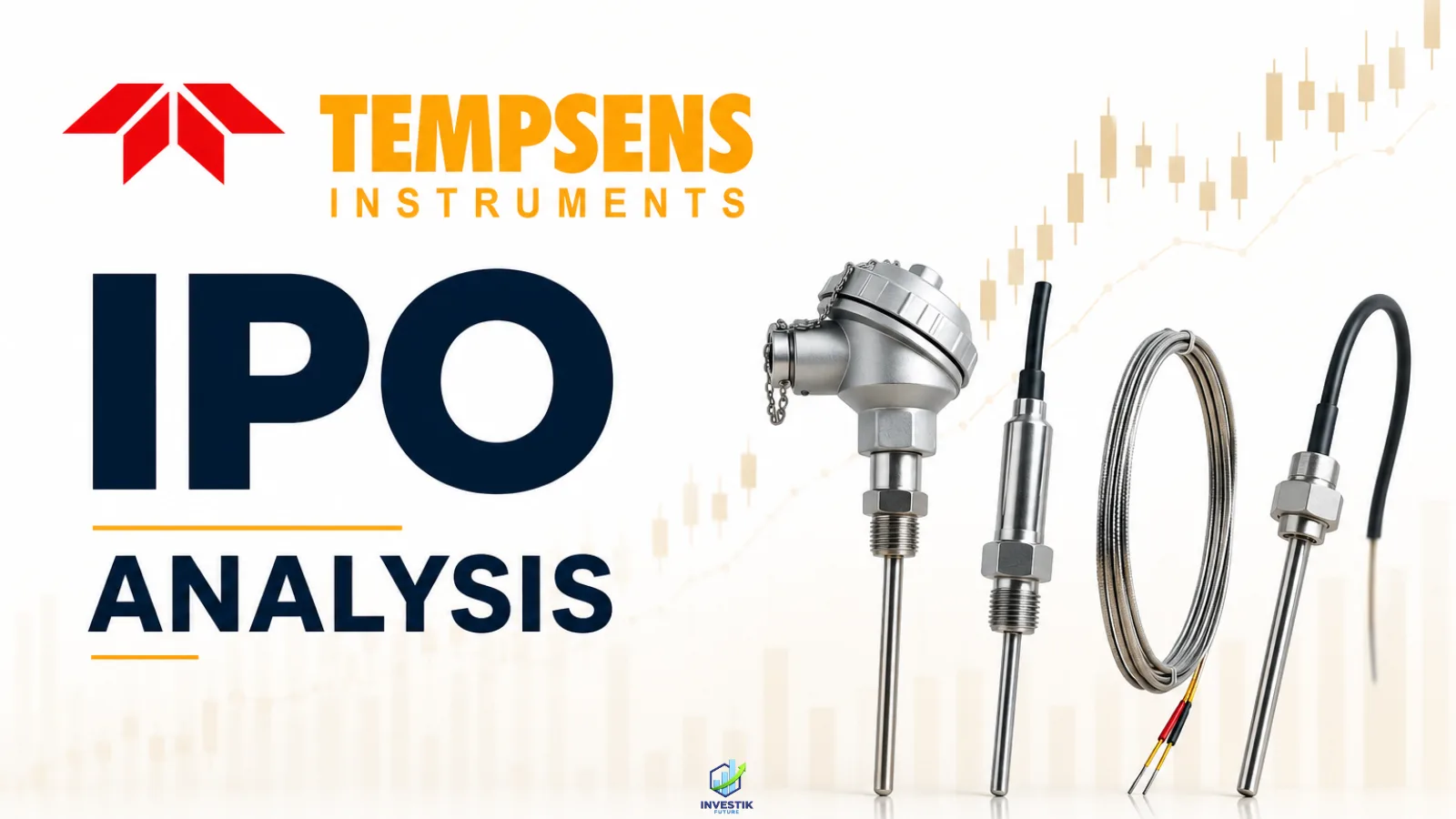

The Tempsens Instruments IPO opened for subscription on August 20, 2026, drawing investor attention as its grey market premium rose ahead of the issue. The GMP was quoted around ₹200–₹220 on the opening day, although it is an unofficial market indicator and does not guarantee the stock’s actual listing price. But the GMP is only one part of the IPO story. Tempsens Instruments operates in the industrial segment, making temperature sensors, electrical heating solutions and specialised cables.
This article looks at the Tempsens Instruments IPO in detail, including its price, GMP, financial performance, business model, key strengths, risks and valuation to help investors understand what they should consider before applying.
Quick IPO Snapshot
| Detail | Information |
| Company | Tempsens Instruments (India) Ltd |
| IPO size | ₹650 crore |
| Issue type | Fresh Issue (₹95 crore) + OFS (₹555 crore) |
| Price band | ₹285–₹300 per share |
| Lot size | 50 shares (₹15,000 at upper band) |
| IPO opens | August 20, 2026 |
| IPO closes | August 24, 2026 |
| Allotment | August 25, 2026 (expected) |
| Listing | August 28, 2026 (expected), on BSE and NSE |
Figures are based on the price band and dates disclosed as of the IPO opening. Always cross-check with the latest exchange filings before applying.
Why Is the Tempsens Instruments IPO Trending?
The IPO has opened. It’s live only from August 20 to August 24, which naturally pushes up search interest as investors scramble to decide before the window closes.
The GMP has jumped. The unofficial grey market premium has climbed sharply in the run-up to the opening; more on the exact numbers and what they mean in the dedicated GMP section below.
The business and the financials add substance. Tempsens isn’t a household name, but its products temperature sensors, heating elements, and cables- sit at the centre of India’s industrial supply chain, serving sectors like steel, power, cement, and petrochemicals. Revenue and profit have also grown every year for the last three fiscal years, which gives the IPO a fundamentals-backed story rather than a purely sentiment-driven one.
Tempsens Instruments IPO GMP
As of the morning of August 20, 2026, the Tempsens Instruments IPO GMP was being quoted in the ₹200–₹220 range, depending on the tracker, implying a listing price of roughly ₹500–₹520 against the ₹300 upper price band, a premium of about 67–73%.
In the days before that, the GMP moved around quite a bit: from roughly ₹65-85 in the middle of the previous week, up to ₹154–175 by August 18-19. That kind of swing shows how quickly sentiment can shift even before an IPO opens.
Here’s how the math works: if the upper price band is ₹300 and the GMP is, say, ₹220, the unofficial implied premium is ₹220, suggesting a theoretical listing price of around ₹520.
Note: This is only an indication from the unofficial grey market and should not be treated as a prediction or guarantee of the actual listing price. GMP is not published by the exchanges, isn’t regulated, and can and does change, sometimes sharply, right up until the listing day.
What Does Tempsens Instruments Do?
Founded in 1990 and headquartered in Udaipur, Tempsens Instruments makes three broad categories of industrial products:
- Temperature sensors: contact and non-contact devices used to measure heat in industrial processes. The company says it’s India’s largest manufacturer of these by revenue, holding roughly a 10.5% share of the domestic temperature sensor market in FY26, based on an independent industry report cited in its offer documents.
- Electrical heating solutions: industrial heaters used in manufacturing and process industries.
- Specialised cables: engineered cables built for demanding industrial environments.
In simple terms: its products are used in industrial applications where precise temperature measurement, heating and specialised cabling are required. The company doesn’t sell off-the-shelf items; most of its products are custom-engineered for a specific customer’s technical requirements, which is part of why it describes itself as having high entry barriers in its niche.
Tempsens Instruments Financial Performance
| Financial Year | Revenue from Operations | Profit After Tax |
| FY24 | ₹274.81 crore | ₹40.92 crore |
| FY25 | ₹378.53 crore | ₹62.56 crore |
| FY26 | ₹444.88 crore | ₹71.07 crore |
A few things stand out from these numbers:
- Revenue has grown every year, roughly 38% in FY25 and a further 18% in FY26, strong, though the pace has cooled a bit in the most recent year.
- Profit has grown too, though not quite as fast as revenue in the latest year, which is why the profit margin dipped slightly from around 16.4% in FY25 to about 15.6% in FY26.
- EBITDA margin stayed healthy, at close to 25% in both FY25 and FY26, a sign the core business is reasonably profitable, not just growing on thin margins.
- Debt levels remain modest, with a debt-to-equity ratio of around 0.15–0.2x, which is comfortable for a manufacturing business of this size.
For an ordinary investor, the takeaway is that this is a company that has been growing consistently and profitably, not one riding a one-off spike ahead of its IPO. That said, growth has moderated slightly, and working capital, the cash tied up in inventory and pending customer payments, has been rising, which is worth watching.
How Is the Tempsens Instruments IPO Structured?
Fresh Issue (₹95 crore)
The RHP indicates this money is earmarked for funding capital expenditure in electrical heating and specialised cable manufacturing, repayment of certain existing borrowings, and general corporate purposes.
Offer for Sale (₹555 crore)
This is the larger portion of the issue, about 85% of the total ₹650 crore. Money raised through an OFS goes to the selling shareholders, including the company’s promoters, not into the business itself. It’s worth knowing this distinction: a large OFS component means the IPO is primarily an opportunity for existing shareholders to partially exit, rather than a large capital infusion for growth.
Key Strengths of Tempsens Instruments
- A claimed leadership position in a specialised niche. The company positions itself as India’s largest manufacturer of contact and non-contact temperature sensors by revenue, which, if sustained, could give it pricing power and customer stickiness that smaller players struggle to match.
- Consistent revenue and profit growth. Both metrics have risen every year from FY24 to FY26, backed by healthy EBITDA margins near 25%.
- Diversified, deepening customer relationships. A growing share of customers now buy multiple product lines from the company, and the top-10-customer concentration has fallen, reducing dependence on any single account.
- Rising export presence. Overseas revenue has more than doubled in three years, pointing to demand for the company’s products beyond India.
- Comfortable balance sheet. Low debt-to-equity and manageable borrowings give the company some financial flexibility as it scales.
Risks Investors Should Know
- Industry and demand cyclicality: A large share of revenue comes from capital-intensive sectors such as metals, power and petrochemicals. When industrial capital spending slows, order flow for specialised equipment like this can slow too.
- Manufacturing concentration: A significant number of the company’s manufacturing units are based in and around Udaipur, Rajasthan. Any major regional disruption, whether logistical, regulatory,y or otherwise, could affect a large chunk of domestic production at once.
- Rising working capital intensity: Inventory days and receivable collection periods have both increased over the last three years, meaning more cash is tied up before it’s converted back into money the company can use. This can constrain the funds available for expansion even as accounting profits rise.
- Export and currency exposure: As overseas sales grow, currency fluctuations and international market conditions become a bigger factor in the company’s results.
- GMP is not guaranteed: However strong the grey market premium looks on the day of writing, it is an unofficial, unregulated figure that can swing quickly, and has already moved by well over ₹100 in the space of a week for this very IPO.
- Valuation isn’t cheap: At the upper price band, the IPO is valued at about 35.4 times FY26 earnings on a post-issue basis. That makes the valuation an important factor for investors to consider alongside the company’s growth and market position.
Tempsens IPO: GMP vs Fundamentals
It’s easy to let a strong GMP dominate the conversation around any IPO, but grey market sentiment and business fundamentals are answering two different questions.
A strong GMP can indicate high short-term demand, but it does not by itself tell investors whether a company is suitable for long-term investment.
| Factor | What Investors Should Look At |
| GMP | Current market sentiment |
| Revenue | Business growth |
| Profit | Earnings performance |
| Valuation | Price relative to earnings and business quality |
| Business model | Long-term earning potential |
| Risks | Factors that could hurt future growth |
The GMP tells you how eager grey-market participants are today. It says nothing about how the company will perform two or three years from now; that depends on order books, industrial demand cycles, and how well the company manages its working capital as it scales.
Should Investors Consider the Tempsens IPO?
This isn’t a call to subscribe or avoid; that decision depends on individual circumstances. What’s worth examining before applying:
- Whether the company’s growth trajectory (revenue, profit, margins) looks sustainable to you
- The valuation at the upper price band relative to the growth on offer
- The fact that most of the issue proceeds go to selling shareholders, not the business
- Industry exposure and how it might behave in a slower capex cycle
- Rising working capital needs and what that means for cash flow
- Your own investment horizon: are you looking at listing-day gains, or a multi-year hold?
Strong GMP alone shouldn’t be the deciding factor either way.
What Should Investors Watch After the IPO?
- How the stock performs on listing day, and whether it holds up in the sessions after
- Quarterly revenue and profit trends once the company starts reporting as a listed entity
- EBITDA and PAT margins: are they holding near current levels?
- Order inflows and export growth, where disclosed
- Working capital metrics: inventory and receivable days, specifically
- Broader industrial capex trends in sectors like steel, power and petrochemicals
- Commentary from management on demand visibility
- How the valuation looks relative to earnings once the initial listing excitement settles
Final Verdict
The Tempsens Instruments IPO has drawn attention because of a fast-rising grey market premium and a genuinely improving financial track record, consistent revenue and profit growth, healthy margins, and a leadership position in a specialised industrial niche. But investors should look past the GMP headline.
A large chunk of the issue is an offer for sale rather than fresh capital for the business; working capital needs have been climbing, and the valuation at the upper price band isn’t inexpensive. Whether this fits an investor’s portfolio will depend more on their view of the company’s fundamentals, industry outlook, and personal risk appetite than on how the grey market is pricing it this week.





FAQs
What is the Tempsens Instruments IPO?
It's a ₹650 crore initial ppublic offeringfrom Tempsens Instruments (India) Ltd, a Rajasthan-based manufacturer of temperature sensors, electrical heating solutions and specialised cables, open for subscription from August 20 to August 24, 2026.
What is the Tempsens Instruments IPO price?
The price band is set at ₹285 to ₹300 per share, with a lot size of 50 shares.
What is the Tempsens IPO GMP today?
As of the morning of August 20, 2026, the unofficial grey market premium was being quoted in the ₹200–₹220 range, implying a listing price of roughly ₹500–₹520, but this figure changes frequently and isn't a guaranteed outcome.
When does the Tempsens Instruments IPO close?
The issue closes on August 24, 2026, with allotment expected on August 25 and listing expected on August 28, 2026.
What does Tempsens Instruments do?
It designs and manufactures temperature sensors, electrical heating systems, and specialised cables used across industries like steel, power, cement,t and petrochemicals.
ARN Disclosure: Investik Future is an AMFI-registered Mutual Fund Distributor. ARN-341107 — Verify on AMFI ↗. Komal Thakur is the content author and digital marketer; the ARN registration belongs to Investik Future, not to the author personally.