
Say you start investing with a clear plan: some money in equity for growth, some in debt for stability. A year later, the stock market has done well, and your equity has grown much faster than your debt. Your portfolio no longer looks like the one you planned. It now has a higher equity share, and potentially more risk, than you originally intended.
Portfolio rebalancing is the simple habit of bringing your allocation back in line with the original plan. This article explains what it means, how it works with an example, and how to decide when to do it.
What Is Portfolio Rebalancing?
Portfolio rebalancing means adjusting your investments so they match your original asset allocation again. Asset allocation is how you divide your money between different types of investments, such as equity, debt, and gold.
Different assets grow at different speeds. Over time, the faster-growing one takes up a bigger share of your portfolio. Rebalancing brings the shares back to where you wanted them.
How Does Portfolio Rebalancing Work?
Let’s take a simple example. An investor has ₹1 lakh and splits it like this:
- ₹60,000 in equity (60%)
- ₹40,000 in debt (40%)
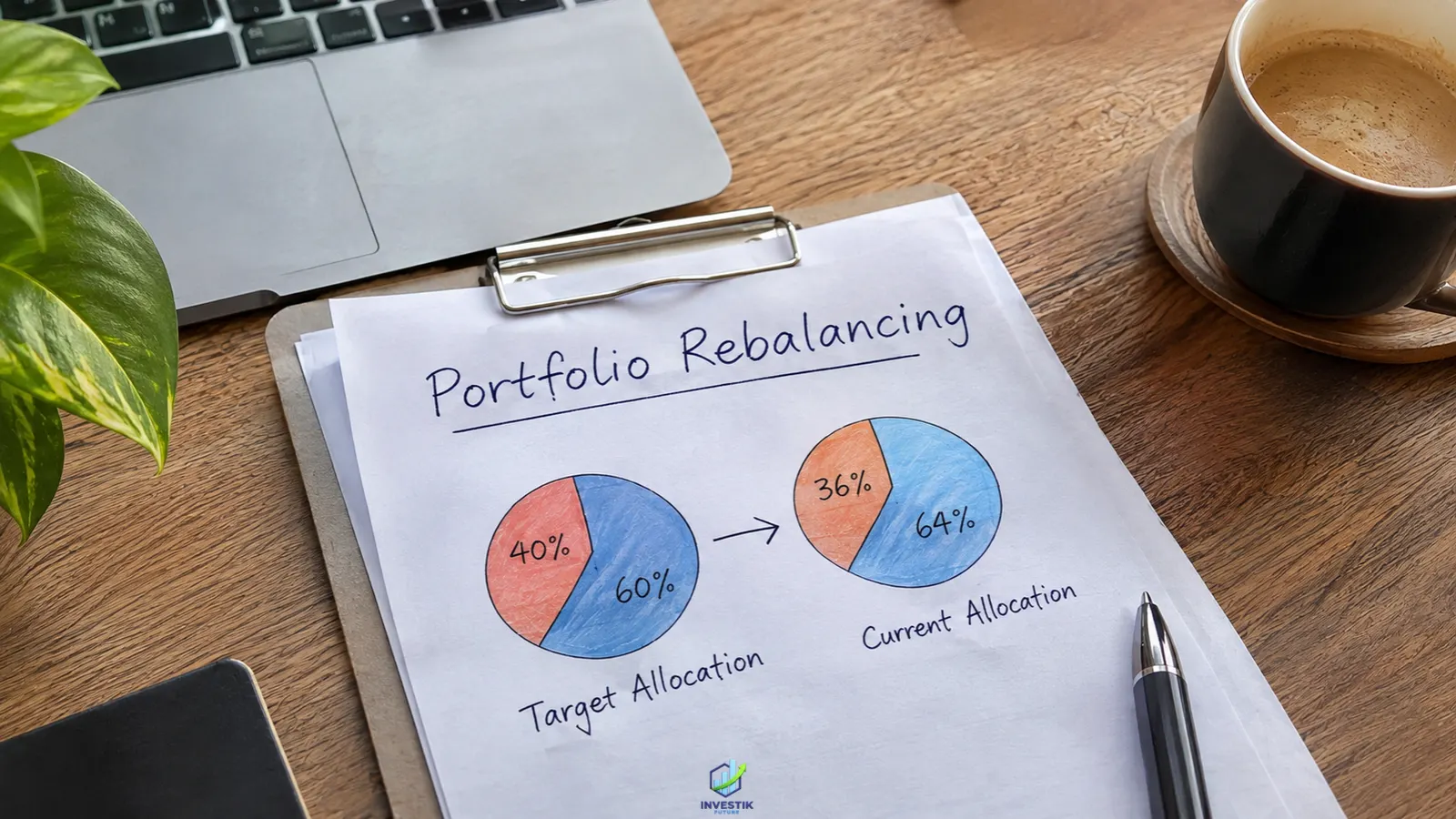
After some time, equity grows to ₹70,000, and debt stays at ₹40,000. The total is now ₹1,10,000.
| Value | Share of portfolio | |
| Equity | ₹70,000 | about 63.6% |
| Debt | ₹40,000 | about 36.4% |
| Total | ₹1,10,000 | 100% |
The investor wanted 60:40, but the portfolio is now closer to 64:36. Its equity exposure has increased without the investor actively changing the allocation.
To get back to 60:40, equity should be 60% of ₹1,10,000, which is ₹66,000. Debt should be 40%, which is ₹44,000. So the investor sells ₹4,000 of equity and moves it to debt. The portfolio is back to 60:40.
Rebalancing does not mean selling your winners out of fear. It means keeping your risk level where you set it.
Why Is Portfolio Rebalancing Important?
- It keeps risk in check: A portfolio with a higher equity share may see larger losses during a market downturn.
- It keeps you disciplined: You follow a plan instead of reacting to news or market mood.
- It keeps your plan connected to your goals: The allocation you chose had a reason. Rebalancing helps maintain the balance chosen for those goals.
Rebalancing does not guarantee profits, and it cannot remove investment risk. It only helps you manage risk in a planned way.
When Should You Rebalance Your Investment Portfolio?
There is no single right trigger. Investors usually use one of these approaches.
Calendar-based rebalancing
You pick a fixed date and review your portfolio on that date, say once a year. If the allocation has moved away from your target, you rebalance. It is simple, and you don’t need to watch the market daily.
Threshold-based rebalancing
You rebalance only when an asset moves beyond a limit you set. For example, with a 60% equity target and a 5 percentage point limit, you act when equity goes above 65% or below 55%. In our example, equity was at 63.6%, so this investor would not rebalance yet. With a tighter 3-point limit, they would.
When your goals or risk tolerance change
Sometimes the target itself needs to change, not just the portfolio. If a goal is getting closer, you lose your income, or you become less comfortable with market swings, your ideal allocation may shift. In that case, you are resetting your plan, not just rebalancing it.
How Can You Rebalance Your Portfolio?
- Sell some and buy others: You sell a part of the asset that has grown too large and invest that money in the one that has fallen behind. This is what we did in the example above.
- Invest fresh money in the lagging asset: If you invest regularly, you can direct new money into the underweight asset and sell nothing. In our example, equity is ₹70,000. For it to be 60% of the portfolio, the total should be about ₹1,16,667. That means adding roughly ₹6,667 to debt. This works only if you have enough fresh money available. If you invest through SIPs, you can also change where your future SIP amounts go.
- Use both: Many investors put new money into the lagging asset first and sell a small portion of the other only if needed.
How Often Should You Rebalance Your Portfolio?
There is no one frequency that suits everyone. Some investors review once a year. Some check every six months. Others look at it only when an asset crosses their limit.
Rebalancing too often can lead to extra taxes and costs without much benefit. Rebalancing too rarely can leave your risk level far from what you wanted. Pick a routine you can actually follow.
Things to Consider Before Rebalancing
Taxes on capital gains
If you sell an investment at a profit while rebalancing, you may have to pay capital gains tax. How much depends on the type of investment, how long you held it, and the rules that apply to it. The details below are for FY 2026-27.
- Equity shares and equity-oriented mutual funds: Equity-oriented funds generally invest at least 65% of their money in shares of domestic companies. Qualifying short-term gains on equity shares and equity-oriented fund units are taxed at 20%. Qualifying long-term gains, on units held for more than 12 months, are taxed at 12.5% on the amount above ₹1.25 lakh in a financial year. These lower rates are subject to the applicable Securities Transaction Tax (STT) conditions.
- Debt mutual funds: “Specified mutual funds” include funds that invest more than 65% in debt and money market instruments, as well as certain funds that invest at least 65% in units of such funds. If you bought units of these funds on or after 1 April 2023, your gain is treated as short-term and taxed at your income tax slab rate, however long you held them. Other debt and hybrid funds may follow different rules, depending on their type and when you bought them.
Surcharge and cess may apply on top. Tax rules can change, so check the provisions that apply to your investment before you sell.
The ₹1.25 lakh exemption applies to your eligible long-term capital gains, not to the amount you sell. In our example, selling ₹4,000 of equity would create only a small gain, if any. Other long-term equity gains in the same financial year also count towards the limit.
Exit loads and transaction costs
Some mutual funds charge an exit load if you redeem within a set period. Brokers and platforms may also charge fees. Check these before selling, because costs can eat into the benefit of rebalancing.
Goals and time horizon
An investor saving for a goal five years away may want a different mix than someone saving for retirement 25 years away. Rebalance toward the allocation that fits your goal and timeline, not a number you read somewhere.
Risk tolerance and risk capacity
Risk tolerance is how much ups and downs you are comfortable with. Risk capacity is how much loss you can actually afford without hurting your goals. Both matter when you decide your allocation. The 60:40 split in this article is only an example, not a recommended allocation.
FAQs
Does portfolio rebalancing increase returns?
Not necessarily. Its main job is to keep your risk in line with your plan. Returns depend on the market and on the investments you hold.
Is 60:40 the best asset allocation?
No. It is just a simple example. The right allocation depends on your goals, time horizon, and risk tolerance.
Do I have to pay tax when I rebalance?
Only if you sell investments at a profit. Using fresh money to rebalance can avoid selling and therefore avoid capital gains tax.
Can I rebalance using SIPs?
Yes. You can direct new SIP amounts toward the asset that is below its target. This is often a gentler way to rebalance.
How often should a beginner rebalance?
There is no fixed answer. Many beginners find a once-a-year review easy to follow. What matters is picking a routine and sticking to it.
ARN Disclosure: Investik Future is an AMFI-registered Mutual Fund Distributor. ARN-341107 — Verify on AMFI ↗. Komal Thakur is the content author and digital marketer; the ARN registration belongs to Investik Future, not to the author personally.