
Quick Answer
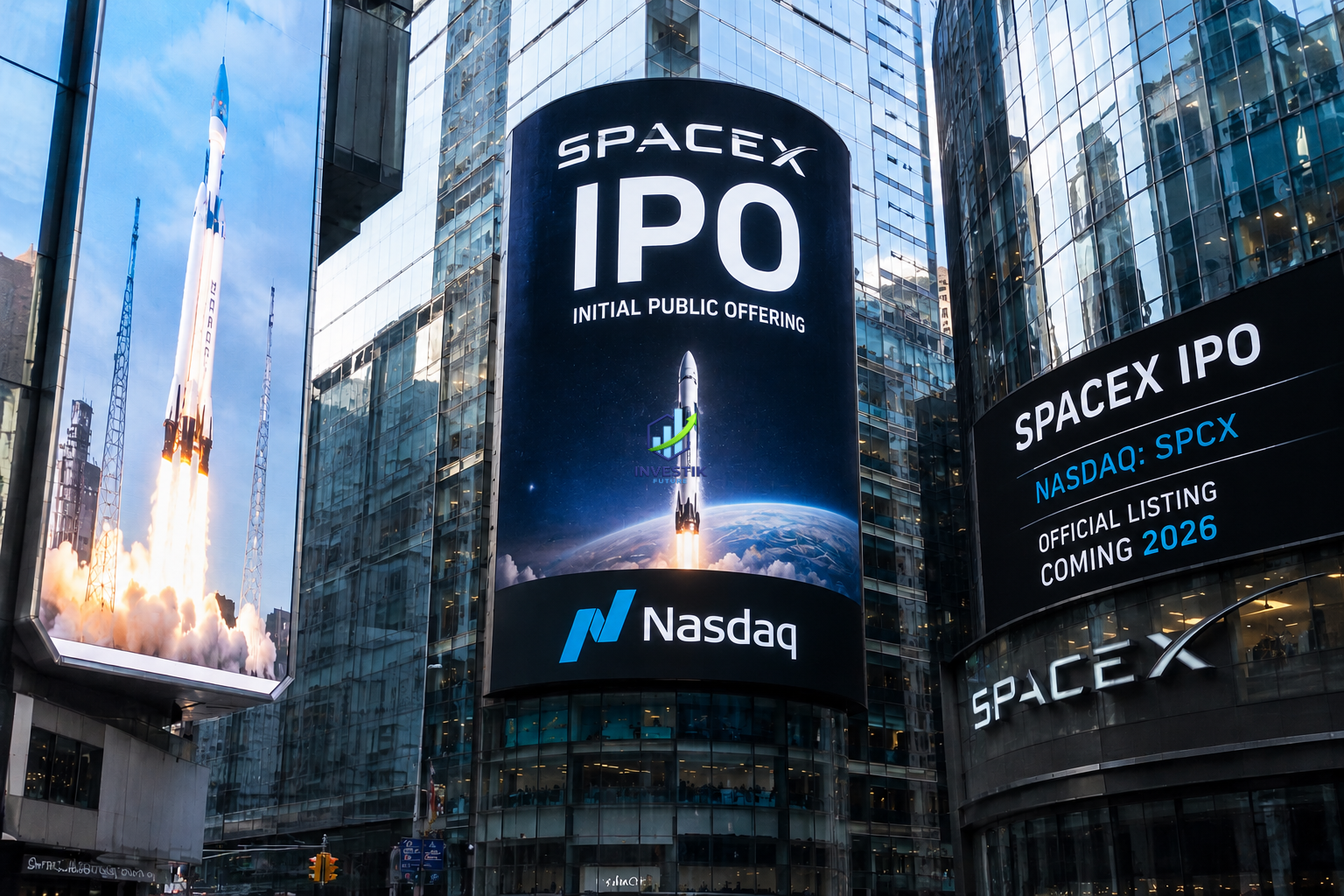
SpaceX’s IPO is priced at $135 per share. SpaceX is listing on the Nasdaq on June 12, 2026, under the ticker SPCX. The offering targets a $75 billion fundraise at a $1.75 trillion valuation, the largest IPO in financial history. Retail investors in the US can access SpaceX’s IPO shares through Fidelity, Robinhood, Charles Schwab, SoFi, and E*Trade. Indian retail investors cannot access the IPO price directly, but can purchase SPCX shares on the open market from June 12 onward through internationally enabled brokerage accounts.
What is SpaceX’s IPO Price, and Can I Purchase It Right Now?
SpaceX’s IPO is priced at $135 per share. Yes, retail investors can purchase SpaceX’s IPO shares through major US brokerages, including Robinhood, Fidelity, Charles Schwab, SoFi, and E*Trade. The offering is expected to list on the Nasdaq on June 12, 2026, under the ticker SPCX, making it the largest IPO in financial history at a targeted $1.75 trillion valuation.
If you have been searching “What is SpaceX’s IPO price can I purchase it?” you have arrived at the right moment in history. SpaceX’s IPO is no longer a question of “if.” It is a question of “how, at what price, and with what strategy.”
Here is what has happened: SpaceX confidentially submitted a draft registration statement to the US Securities and Exchange Commission on April 1, 2026. The company publicly filed its S-1 on May 20, 2026, and filed Amendment No. 1 (S-1/A) on June 1, 2026. The IPO roadshow launched on June 4, 2026. SpaceX’s IPO pricing was announced on June 11, 2026, today, and the first day of trading on Nasdaq under the ticker SPCX is June 12, 2026.
SpaceX’s IPO share price is fixed at $135 per share. The company is offering 555.6 million Class A common shares to raise approximately $75 billion. Underwriters hold an option to purchase an additional 83.33 million shares at the IPO price, which could push total proceeds to approximately $86.2 billion.
To put SpaceX’s IPO in historical context: Saudi Aramco’s 2019 IPO, previously the world’s largest, raised $25.6 billion. SpaceX’s IPO is nearly three times that size. For investors who have been waiting, the moment is finally here.
Is SpaceX publicly traded as of June 2026?
As of June 11, 2026 (the pricing date), SpaceX has priced its IPO at $135 per share. As of June 12, 2026, SpaceX will become a publicly traded company on the Nasdaq under the ticker SPCX. If you are reading this after June 12, 2026, SpaceX stock is publicly available for purchase through any brokerage with Nasdaq access.
For years, the answer to “Is SpaceX publicly traded?” was no. SpaceX operated as a private company funded by institutional investors, government contracts, employee secondary transactions, and Elon Musk himself. That changes on June 12, 2026.
Once listed, SPCX can be purchased through any standard brokerage platform the same way you would buy Apple, Tesla, or Nvidia shares. There is no accreditation requirement, no minimum investment, and no special access needed after the listing date.
For readers from India: You can learn more about how to evaluate IPO opportunities and understand the general investment process through our comprehensive IPO Guide on Investik Future.
Is SpaceX Going to Go IPO? The Answer Is Yes. Here Is the Full Timeline
Yes, SpaceX is going to go IPO, and it is happening now. SpaceX has priced its IPO at $135 per share and is listing on Nasdaq on June 12, 2026. The company filed its S-1 with the SEC on May 20, 2026, and completed its roadshow between June 4 and June 11, 2026. This is no longer speculation; SpaceX’s IPO is officially confirmed.
For investors who have been asking, “Is SpaceX going to go IPO?” for the last several years, the wait is over. Here is a complete, verified timeline:
| Date | Milestone |
| February 2026 | SpaceX acquires xAI (Elon Musk’s AI startup) in all-stock deal valued at $1.25 trillion |
| April 1, 2026 | SpaceX confidentially files draft registration statement with the SEC |
| May 4, 2026 | SpaceX executes a 5-for-1 stock split of Class A, B, and C shares |
| May 20, 2026 | SpaceX publicly files S-1 with SEC (registration no. 333-296070) |
| June 1, 2026 | SpaceX files S-1/A (Amendment No. 1) with SEC |
| June 4, 2026 | SpaceX IPO roadshow launches (ahead of schedule) |
| June 11, 2026 | SpaceX’s IPO priced at $135 per share |
| June 12, 2026 | First day of trading on Nasdaq under ticker SPCX |
| ~Early July 2026 | Expected Nasdaq-100 index inclusion (15 trading days after listing) |
Investor Takeaway: For anyone who was asking, “Is SpaceX going to go IPO?” the answer is confirmed. The SEC review was completed faster than expected, accelerating the roadshow by approximately one week. The IPO is not conditional on market conditions at this point; pricing is done.
Risk Note: While SpaceX’s IPO is confirmed, the post-listing share price will be determined by open market forces. A high IPO valuation of $1.75 trillion implies a price-to-earnings ratio of approximately 100x, far higher than established tech companies like Nvidia (~20-25x) or Apple (~10x). Investors entering at the IPO price or above should understand they are paying a significant premium for future growth expectations.
SpaceX IPO Latest News: Everything That Has Happened in June 2026
SpaceX ipo latest news as of June 11, 2026: SpaceX’s IPO is priced at $135 per share with trading beginning June 12. The company is raising $75 billion at a $1.75 trillion valuation on Nasdaq under ticker SPCX. SpaceX CFO Bret Johnsen confirmed this is the largest retail participation in IPO history, with 30% of shares allocated to individual investors.
Here is a comprehensive summary of all SpaceX ipo latest news relevant to investors:
Recent Key Developments (April–June 2026):
S-1 Filing (May 20, 2026): SpaceX’s public S-1 filing revealed, for the first time, consolidated financial statements of the merged SpaceX + xAI entity. The filing disclosed SpaceX had a reported $5 billion operating loss in 2025, attributed largely to xAI’s burn rate of approximately $1 billion per month. However, Starlink remains profitable and growing rapidly.
xAI Merger Impact: In February 2026, SpaceX acquired xAI (the creator of Grok AI) in an all-stock transaction. The combined entity is now referred to as SpaceXAI internally, combining satellite internet infrastructure with frontier AI capabilities. This fundamentally changes the SpaceX investment thesis it is no longer just a rocket and satellite company.
5-for-1 Stock Split (May 4, 2026): SpaceX executed a 5-for-1 stock split of all share classes. All figures in the S-1 have been retroactively adjusted to reflect post-split numbers. The IPO price of $135 reflects this split.
Retail Allocation Announcement: SpaceX’s S-1 explicitly names retail brokerage platforms Charles Schwab, Fidelity, Robinhood, SoFi, and E*Trade as official IPO distribution channels. Approximately 30% of the $75 billion offering (~$22.5 billion) is reportedly allocated to retail investors.
Nasdaq Fast-Entry Rule: Nasdaq modified its index inclusion criteria to allow large, newly listed companies to enter the Nasdaq-100 after just 15 trading days (rather than the usual 3 months). This is expected to trigger an estimated $22–$27 billion in forced mechanical buying from passive index funds (QQQ) within early July 2026.
Project Apex: SpaceX’s IPO, internally dubbed “Project Apex,” is supported by a syndicate of 21 financial institutions, led by Morgan Stanley, Goldman Sachs, JPMorgan, Bank of America, and Citigroup.
For ongoing SpaceX ipo latest news and updates, you can monitor the IPO Category on Investik Future.
SpaceX IPO Investor Demand: Why Demand Has Broken All Records
SpaceX ipo investor demand has broken all historical IPO records. The offering is reportedly oversubscribed multiple times over. Institutional investors, retail participants across five major brokerages, and sovereign wealth funds are all competing for a limited float. SpaceX ipo investor demand is driven by Starlink’s growth, the XAI merger, the Nasdaq-100 fast-track inclusion, and Elon Musk’s global brand equity.
SpaceX ipo investor demand is a story that has been building for years, and it has now peaked at one of the most extraordinary moments in capital markets history. Understanding the drivers of this demand is critical for any investor evaluating whether to buy SpaceX shares.
Key Drivers of SpaceX IPO Investor Demand:
- Starlink’s Revenue Engine Starlink is the primary revenue driver for SpaceX, accounting for approximately 58–70% of total company revenue. With over 9 million active subscribers globally and growing enterprise, maritime, aviation, and government contracts, Starlink represents a recurring revenue model that institutional investors find exceptionally attractive. The estimated 2026 full-year revenue is approximately $20 billion.
- Orbital AI Data Centres. The xAI merger introduced an entirely new growth narrative. SpaceX has stated in its S-1 that it intends to begin deploying space-based data centres “as early as 2028,” combining Starlink’s satellite network with AI compute infrastructure. SpaceX is pursuing FCC regulatory approval to launch up to 1 million satellites to support this initiative. This is the kind of long-duration growth story that justifies extreme valuation multiples.
- Nasdaq-100 Fast-Track Inclusion Fifteen trading days after listing (~early July 2026), SpaceX is expected to enter the Nasdaq-100. This will trigger an estimated $22–$27 billion in forced mechanical buying from every passive fund tracking the index. This structured demand creates a post-IPO price floor that many institutional investors are positioning around.
- Record Retail Participation SpaceX’s decision to allocate ~30% of the IPO to retail investors is unprecedented. In a typical large US IPO, retail investors receive 5–10% of shares. This structural difference has amplified spacex ipo investor demand by opening the offering to millions of individual investors through Robinhood, Fidelity, and other platforms.
- Scarcity of Space Sector Exposure. There is no other pure-play, vertically integrated commercial space company of SpaceX’s scale available on public markets. For investors wanting exposure to the space economy, which analysts project to exceed $1 trillion by 2040, SpaceX is the only large-cap option, creating structural scarcity demand.
SpaceX IPO Share Price: What Does $135 Per Share Mean for Investors?
SpaceX’s IPO share price is $135 per share as of June 11, 2026. This implies a fully diluted market capitalisation of approximately $1.75–$1.77 trillion, making SpaceX the seventh-largest company in the US by market cap, surpassing Tesla’s ~$1.6 trillion. At $135, SpaceX’s IPO share price implies a price-to-revenue multiple of approximately 50x and a P/E multiple of approximately 100x based on estimated 2026 earnings.
Understanding what the SpaceX IPO share price means and whether $135 is a fair entry point requires breaking down the valuation components.
SpaceX Valuation Timeline
| Year | Valuation | Basis |
| 2019 | ~$33 billion | Private funding round |
| 2021 | ~$74 billion | Secondary transaction |
| 2022 | ~$127 billion | Series Y funding round |
| January 2023 | ~$137 billion | Secondary transaction |
| 2024 | ~$350 billion | Secondary employee transaction |
| December 2025 | ~$800 billion | Secondary employee transaction |
| March 2026 | ~$1.5 trillion | Pre-IPO Bloomberg report |
| June 11, 2026 | $1.75–$1.77 trillion | Official IPO pricing |
Investor Takeaway: SpaceX’s valuation has grown approximately 53x in 7 years from its 2019 to its IPO price. However, at $1.75 trillion, investors are pricing in significant future growth from Starlink, Starship, and orbital AI infrastructure. This is a premium growth bet, not a value investment.
SpaceX Valuation vs. Comparable Companies
| Company | Market Cap (June 2026) | P/E Ratio | Revenue Multiple |
| SpaceX (IPO price) | ~$1.77 trillion | ~100x | ~50x |
| Tesla (TSLA) | ~$1.6 trillion | ~60x | ~8x |
| Nvidia | ~$3.5 trillion | ~25x | ~20x |
| Apple | ~$3.2 trillion | ~28x | ~8x |
| Amazon | ~$2.8 trillion | ~35x | ~3x |
| Saudi Aramco (2019 IPO) | $1.7 trillion | ~17x | ~2x |
Risk Interpretation: SpaceX’s IPO price implies a valuation premium that is difficult to justify on current-year earnings alone. The entire investment case rests on future growth from Starlink’s subscriber expansion, Starship commercial launches, and the SpaceXAI orbital data centre initiative. Investors accepting these growth assumptions at $135 are making a long-duration bet, not a near-term value play.
New Street Research analysts have set a 12-month price target of $165 per share (approximately 22% upside from $135), implying a $2.3 trillion valuation when accounting for SpaceX’s proposed acquisition pipeline.
SpaceX IPO Date and Price: What Is Officially Confirmed
SpaceX’s IPO date and price are officially confirmed. The IPO is priced at $135 per share on June 11, 2026. Trading begins on Nasdaq under ticker SPCX on June 12, 2026. SpaceX is offering 555.6 million Class A shares to raise $75 billion, with an underwriter overallotment option of 83.33 million additional shares worth ~$11.2 billion.
Here is the complete, verified SpaceX IPO date and price breakdown:
SpaceX IPO Key Facts Table (June 2026)
| Parameter | Detail |
| IPO Price | $135 per share |
| Shares Offered | 555.6 million Class A shares |
| Underwriter Overallotment | 83.33 million additional shares |
| Total IPO Raise (base) | $75 billion |
| Total IPO Raise (with overallotment) | ~$86.2 billion |
| Target Valuation | $1.75–$1.77 trillion |
| Exchange | Nasdaq |
| Ticker Symbol | SPCX |
| IPO Pricing Date | June 11, 2026 |
| First Trading Day | June 12, 2026 |
| Stock Split | 5-for-1 (May 4, 2026) |
| Share Class (Public) | Class A (standard voting rights) |
| Elon Musk Voting Control | ~79% (via super-voting Class B shares) |
| Retail Allocation | ~30% of total offering (~$22.5 billion) |
| Lead Underwriters | Morgan Stanley, Goldman Sachs, JPMorgan, BofA, Citigroup |
| Banking Syndicate | 21 financial institutions (Project Apex) |
| Lock-up Period | Standard (details in S-1/A filing) |
| SEC Filing | S-1 filed May 20, 2026; S-1/A filed June 1, 2026 |
| Registration Number | 333-296070 |
You can access SpaceX’s official S-1 filing directly on the US SEC EDGAR system.
Investor Takeaway: The SpaceX IPO date and price are now fixed. There is no ambiguity. Investors who want to participate at the IPO price must act through designated US retail brokerages on or before the June 11 pricing deadline. Post-June 12, shares trade freely on Nasdaq.
Can Retail Investors Buy SpaceX Stock Today?
Yes, retail investors can buy SpaceX stock. US-based investors can participate at the $135 IPO price through Fidelity, Robinhood, Charles Schwab, SoFi, and E*Trade before the June 11 deadline. After June 12, 2026, any investor with Nasdaq market access can purchase SPCX on the open market. Indian retail investors cannot access the IPO price directly, but can buy SPCX shares post-listing through internationally enabled accounts using the RBI Liberalised Remittance Scheme.
This is the most practically important section for everyday investors. Here is a structured breakdown of exactly how retail investors can access SpaceX’s IPO.
Retail Investor Access Options Table
| Access Method | Available To | Price | Minimum | Notes |
| Fidelity IPO Centre | US investors | $135 IPO price | Account balance minimum applies | Check Fidelity’s IPO Centre for eligibility |
| Robinhood IPO Access | US investors | $135 IPO price | No minimum balance | Submit IOI through the app’s IPO Access feature |
| Charles Schwab | US investors | $135 IPO price | Net worth ~$100,000 required | One of the largest IPO allocations |
| SoFi | US investors | $135 IPO price | No minimum reported | Limited allocation per user |
| E*Trade (Morgan Stanley) | US investors | $135 IPO price | Varies | Morgan Stanley’s retail arm |
| Open Market (Nasdaq) | Global investors | Market price (from Jun 12) | 1 share ($135+) | Any broker with Nasdaq access |
| International Brokers (Zerodha Global, INDMoney, Vested) | Indian investors | Market price post-listing | Varies | Via RBI LRS ($250,000 annual limit) |
| Space ETFs (post-listing) | Global investors | ETF market price | ETF minimum | Indirect exposure through ETFs, including SPCX |
| Baron Partners Fund (BPTRX) | US investors | Fund NAV | Fund minimum | ~13% SpaceX allocation pre-IPO |
| Destiny Tech100 (DXYZ) | US investors | Market price | 1 share | Carries ~50% premium to NAV |
Important Note for Indian Investors: Direct IPO allocation through US brokerages is generally not accessible to Indian retail investors without a qualifying US account (Charles Schwab requires ~$100,000 net worth minimum). The most practical route is to purchase SPCX shares on the open market from June 12 onward through internationally enabled Indian brokerage accounts. Purchases happen at secondary market prices, not the IPO allotment price of $135.
Key Restriction: Brokerages, including Fidelity, SoFi, Robinhood, and E*Trade, have policies discouraging the quick resale of IPO shares (flipping). Investors who sell IPO-allocated shares shortly after trading begins may face temporary or permanent bans from future IPO allocations on those platforms.
You can also explore how to calculate your average cost if you invest in multiple tranches using the Stock Average Calculator on Investik Future.
SpaceX IPO Prediction Bull Case vs. Bear Case
SpaceX IPO prediction is divided among analysts. The bull case sees SPCX reaching $165–$200 within 12 months of listing, driven by Starlink growth, Nasdaq-100 index buying, and Starship commercial scale-up. The bear case warns that a 100x P/E ratio, Elon Musk governance risk, xAI integration losses, and broad market volatility could push shares below the $135 IPO price within 6–12 months.
Investing without a scenario framework is speculation. Here is an honest, research-based SpaceX IPO prediction breakdown:
SpaceX IPO Prediction Scenarios Table
| Scenario | 12-Month Price Target | Key Assumptions | Probability Assessment |
| Ultra Bull | $200–$250 | Starlink hits 20M subscribers; Starship fully commercial; orbital AI approved; Nasdaq-100 buys drive continuous demand | Low (~15%) |
| Bull Case | $165–$200 | Starlink grows 30%+ YoY; xAI losses narrow; first space data centre milestone achieved | Moderate (~30%) |
| Base Case | $120–$165 | Steady Starlink growth; xAI integration challenges persist; typical post-IPO price discovery | Moderate (~35%) |
| Bear Case | $80–$120 | xAI losses exceed projections; Musk controversy impacts brand; broad tech sell-off; IPO lockup expirations create selling pressure | Low-Moderate (~15%) |
| Extreme Bear | Below $80 | SpaceX fails regulatory approvals; Starship grounding; market crash; governance crisis | Very Low (~5%) |
New Street Research 12-Month Target: $165 per share (22% upside from IPO price), implying $2.3 trillion valuation.
Behavioural Risk Note: History consistently shows that the largest IPOs in financial history do not necessarily produce the best investor returns in their first year. Alibaba (2014), Saudi Aramco (2019), and SoftBank (2018) all saw significant post-IPO price pressure. The largest IPO in history carries the largest expectation premium. Investors should calibrate entry points accordingly.
SpaceX vs. Starlink IPO: Understanding the Difference
SpaceX’s IPO is a single, unified listing of the entire SpaceX entity, which includes Starlink, SpaceX’s launch business, Starship development, and the newly integrated xAI/SpaceXAI division. There is no separate Starlink IPO. Earlier speculation about a spin-off of Starlink as an independent public company has been resolved. SpaceX chose a single, consolidated listing.
This distinction matters for investors. Earlier reports (2024–early 2025) suggested SpaceX might spin off Starlink separately, which would have created a different risk/reward profile. The final decision to list the entire SpaceX entity means investors buying SPCX are getting exposure to all of SpaceX’s business lines simultaneously.
SpaceX vs. Starlink Comparison Table
| Feature | SpaceX (SPCX) | Starlink (Standalone Not Listed) |
| Listed? | Yes, Nasdaq SPCX, June 12, 2026 | No part of SpaceX |
| Revenue | ~$20B estimated (2026) | ~$12–13B estimated (2026, ~65% of SpaceX total) |
| Profitability | Consolidated loss (~$5B in 2025 due to xAI) | Profitable on a standalone basis |
| Growth Rate | ~33% revenue growth YoY | High 9M+ subscribers and growing |
| Valuation Basis | Entire SpaceX entity at $1.75T | Implied ~$1 trillion (58% of SpaceX revenue) |
| Business Risk | Multi-segment (launch, Starlink, Starship, xAI) | Concentrated satellite internet risk |
| Investor Access | Open market from June 12 | Only through SPCX |
| Governance | Dual-class (Musk 79% voting control) | N/A |
Investor Takeaway: Buying SPCX means you are buying Starlink AND SpaceX launches AND Starship AND xAI/SpaceXAI. This is both a diversification advantage and a complexity risk. Investors who wanted a pure Starlink play may find the consolidated entity more complex than anticipated.
For context on how IPO structures work, read the comprehensive IPO Guide on Investik Future.
SpaceX Ownership Structure and Governance: What Investors Are Actually Buying
SpaceX’s S-1 filing confirms a dual-class share structure where Elon Musk controls approximately 79% of voting rights while holding ~42% of equity. Public investors purchasing Class A shares will have standard voting rights but no meaningful ability to influence SpaceX’s strategic direction. This is similar to Meta and Alphabet, but at a more extreme ratio.
Understanding what you own matters as much as knowing the price. Here is the complete SpaceX Ownership Structure Table:
SpaceX Ownership Structure Table
| Stakeholder | Equity Stake (Approx.) | Voting Control (Approx.) | Share Class |
| Elon Musk | ~42–43% | ~79% | Class B (super-voting) |
| Alphabet (Google) | ~7% | Standard | Class A |
| Fidelity Investments | Significant (undisclosed) | Standard | Class A |
| Founders Fund (Peter Thiel’s fund) | Significant | Standard | Class A |
| Sequoia Capital | Undisclosed | Standard | Class A |
| Andreessen Horowitz | Undisclosed | Standard | Class A |
| EchoStar (SATS) | Stake valued at ~$11B | Standard | Class A |
| Gwynne Shotwell (President & COO) | 7.1 million Class B shares | 10x voting power | Class B |
| Luke Nosek (Founders Fund) | 33 million Class A shares | Standard | Class A |
| Public Float (Post-IPO) | ~555.6 million Class A shares | Standard | Class A |
Investor Risk: The dual-class structure means public investors have limited governance rights. Musk’s decisions on strategy, acquisitions, capital allocation, and management succession cannot be overridden by public shareholders. For investors who value shareholder governance, this is a material consideration.
SpaceX Funding History From Startup to the World’s Largest IPO
SpaceX Funding History Table
| Round / Event | Year | Amount Raised / Valuation | Key Investors |
| Early funding (Angel/Seed) | 2002–2005 | ~$100M | Elon Musk (personal funds) |
| Series A–C | 2008–2012 | ~$1B total | Founders Fund, various VCs |
| Series D–G | 2015–2019 | ~$3.5B total | Alphabet/Google, Fidelity, Sequoia |
| Series H | 2020 | $1.9B | Multiple institutional investors |
| Series J | 2021 | $314M | Various |
| Secondary Transaction | January 2023 | Valuation ~$137B | Employee stock sales |
| Secondary Transaction | 2024 | Valuation ~$350B | Employee secondary market |
| Secondary Transaction | December 2025 | Valuation ~$800B | Employee secondary market |
| IPO (S-1 filed) | May 20, 2026 | $75B raise / $1.75T valuation | Public markets |
Investor Takeaway: SpaceX has been cash-flow positive for several years and has conducted periodic stock buybacks twice a year to provide liquidity for employees and investors. The company has never needed to go public for survival. This IPO is a strategic choice, not a financial necessity. That distinction matters: it means SpaceX controls the timing and terms.
SpaceX vs. Tesla IPO: A Historical Comparison
One of the most useful frameworks for evaluating SpaceX’s IPO is comparing it with Tesla’s 2010 IPO, another Elon Musk-led company with a visionary narrative and a sceptical Wall Street consensus at the time of listing.
SpaceX vs. Tesla IPO Comparison Table
| Parameter | Tesla IPO (June 29, 2010) | SpaceX’s IPO (June 12, 2026) |
| IPO Price | $17 per share | $135 per share |
| IPO Valuation | ~$1.7 billion | ~$1.75 trillion |
| Shares Offered | 13.3 million | 555.6 million |
| Amount Raised | ~$226 million | ~$75 billion |
| Exchange | Nasdaq | Nasdaq |
| Profitability at IPO | Unprofitable | Consolidated loss ($5B, 2025) |
| Core Narrative | EV revolution | Space economy + AI + Starlink |
| Retail Allocation | Standard (~5–10%) | ~30% (record-breaking) |
| Governance | Standard | Dual-class (Musk 79% votes) |
| Post-IPO 5-Year Return (Tesla) | +12,000% | Unknown |
| Key Risk | EV adoption uncertainty | Valuation premium, xAI losses |
Investor Takeaway: Tesla’s IPO taught the market that visionary, capital-intensive companies with disruptive narratives can deliver extraordinary long-term returns even when they are unprofitable at listing. However, Tesla was valued at $1.7 billion in 2010. SpaceX is valued at $1.75 trillion in 2026, approximately 1,000 times higher than at IPO. The margin of error for investors is proportionally smaller.
SpaceX Risks What Every Investor Must Understand Before Buying
No responsible investment analysis of SpaceX’s IPO is complete without a clear-eyed risk assessment.
SpaceX Risks Comparison Table
| Risk Category | Description | Severity | Mitigation |
| Valuation Risk | 100x P/E ratio; any growth disappointment reprices heavily | High | Position sizing; dollar-cost averaging |
| Musk Key-Person Risk | 79% voting control; distraction from Tesla, xAI, X, Neuralink | High | Diversification; stop-loss levels |
| xAI Integration Risk | xAI burning ~$1B/month; $5B consolidated loss in 2025 | High | Monitor quarterly filings |
| Regulatory Risk | FCC approval needed for 1M satellite constellation | Moderate-High | Follow regulatory filings |
| Starship Risk | Delays or failures affect commercial launch revenue | Moderate | Starlink offsets significantly |
| Governance Risk | No meaningful shareholder voting power post-IPO | Moderate | Understand before buying |
| Lock-up Expiry Risk | Insider selling after the lock-up period creates selling pressure | Moderate | Wait for the lock-up expiry signal |
| Macro Risk | Rising interest rates reprice high-multiple growth stocks | Moderate | Diversified portfolio construction |
| Geopolitical Risk | US government contracts are subject to political shifts | Moderate | Long-term space economy narrative |
| Competition Risk | Amazon Kuiper, OneWeb, Chinese satellite programs | Low-Moderate | Starlink’s existing subscriber base moat |
Investor Behavioural Takeaway: The biggest risk for retail investors is not company-specific; it is the tendency to buy hype-driven assets at peak sentiment. SpaceX’s IPO is the most talked-about offering in years. Peak enthusiasm is precisely when rational analysis matters most. Read the S-1 at SEC EDGAR before investing.
Why SpaceX IPO Investor Demand Is Driven by Investor Psychology
SpaceX ipo investor demand is not purely rational; it is significantly shaped by behavioural finance forces, including the Elon Musk Effect, scarcity psychology, Fear of Missing Out (FOMO), social media amplification, and the human tendency to confuse excitement with investment merit. Understanding these psychological forces is as important as understanding SpaceX’s financials.
This section is the part of SpaceX’s IPO story that most financial media ignore, but it is arguably the most important section for everyday investors.
The Elon Musk Effect
Elon Musk is arguably the most powerful single individual in global financial markets. His announcements on X (formerly Twitter), his public statements, and his media presence consistently move markets. SpaceX’s IPO benefits from this halo, and it also inherits the risk. When Musk’s public image is positive, SPCX sentiment is amplified. When it deteriorates (as it did briefly during the DOGE controversy in early 2026), SpaceX’s IPO faces headwinds.
Market watchers have described SpaceX’s IPO as a “referendum on Musk”, one of the most revealing characterisations of how personality-driven this investment is.
Scarcity Psychology
Humans consistently assign higher value to scarce things. SpaceX has been private for 24 years. There is no other large-cap pure-play space company on public markets. When something unavailable for a long time becomes accessible, investors perceive it as precious regardless of its objective valuation. This psychological mechanism is artificially inflating spacex ipo investor demand beyond what fundamentals alone would justify.
FOMO (Fear of Missing Out)
The narrative around Tesla’s IPO, “If you had invested $1,000 in Tesla’s 2010 IPO, you would have $120,000 today”, is driving a generation of retail investors to believe SpaceX’s IPO is their equivalent opportunity. This comparison is compelling emotionally but deeply flawed analytically. Tesla’s 2010 IPO valued the company at $1.7 billion. SpaceX’s 2026 IPO values the company at $1.75 trillion, meaning all of Tesla’s extraordinary growth is already priced into SpaceX before it opens for trading.
Social Media and Reddit Amplification
The keyword “Spacex ipo reddit” generates hundreds of thousands of searches because Reddit communities (r/investing, r/stocks, r/spacex) have been running multi-year threads on SpaceX’s IPO potential. Social media creates an information environment where excitement is shared far faster than caution, and community consensus, regardless of analytical rigor shapes sentiment and price expectations.
Private Market Hype Transfer
SpaceX’s private valuation going from $800 billion (December 2025) to $1.75 trillion (June 2026) in just six months created a momentum narrative that follows the company into its public listing. Investors anchored to this growth trajectory expect it to continue a classic recency bias in behavioural finance.
The Antidote: Process Over Emotion
For investors genuinely interested in SpaceX’s long-term potential, the behavioural finance antidote is simple: set a position size you are comfortable holding for 5–10 years, regardless of short-term price volatility, avoid leverage, and do not invest money you cannot afford to lose. If SpaceX’s IPO is truly transformative, patience will be rewarded. If it is not at a $1.75 trillion position, sizing will protect you.
Explore the broader Indian IPO Pipeline and global IPO opportunities on Investik Future to understand how SpaceX’s listing fits into the wider 2026 IPO market context.
Private Company vs. Public Company: What Changes for SpaceX After Listing
Private Company vs. Public Company Comparison Table
| Aspect | SpaceX Before IPO (Private) | SpaceX After IPO (Public, SPCX) |
| Investor Access | Accredited investors, secondary markets only | Any investor with Nasdaq access |
| Financial Disclosure | No public financial statements | Quarterly (10-Q) and Annual (10-K) SEC filings required |
| Valuation | Negotiated in funding rounds | Real-time market-determined |
| Liquidity | Limited (secondary platforms only) | High (open market trading) |
| Governance | Musk-controlled, private board | Dual-class structure; public board (still Musk-controlled) |
| Employee Equity | Exercised in secondary markets | Direct open-market liquidity |
| Press Scrutiny | Voluntary disclosures | Mandatory material disclosure requirements |
| Analyst Coverage | None (private) | 125+ analysts (21 bank syndicate) |
| Index Inclusion | Not applicable | Nasdaq-100 expected ~July 2026 |
| Capital Raising | Private funding rounds | Open market equity and debt |
SpaceX Secondary Market Trading: How Investors Accessed SpaceX Before IPO
SpaceX Secondary Market Trading Table
| Platform | Type | Access Level | Approximate Pre-IPO Price Range |
| Forge Global | Secondary market | Accredited investors | Varied (est. $60–$110 pre-split adj.) |
| EquityZen | Secondary market | Accredited investors | Varied |
| Hiive | Secondary market | Accredited investors | Varied |
| Destiny Tech100 (DXYZ) | Closed-end fund | Public (premium to NAV ~50%) | Market-traded |
| Baron Partners Fund (BPTRX) | Mutual fund | Public (13% SpaceX allocation) | Fund NAV |
| ARK Venture Fund (ARKVX) | Venture fund | Accredited/institutional | Fund NAV |
| Cambria ERShares (XOVR) | ETF | Public (~40%+ SpaceX allocation) | ETF market price |
| Fidelity Contrafund (FCNTX) | Mutual fund | Public (~$2.7B SpaceX exposure) | Fund NAV |
Investor Takeaway: Before SpaceX’s IPO, retail investors had limited options to access SpaceX, all with significant premiums or access restrictions. Post-June 12, 2026, SPCX on Nasdaq eliminates this premium and democratises access. However, investors who were previously paying 50%+ premiums through DXYZ or accessing via accredited platforms may already have superior cost basis positions.
Investik Future Final Verdict on SpaceX’s IPO
SpaceX’s IPO at $135 per share is the most significant capital markets event of 2026 and possibly the decade. SpaceX’s IPO democratises access to the space economy, Starlink’s recurring revenue engine, and the xAI orbital AI infrastructure thesis. However, at $1.75 trillion and a ~100x P/E ratio, SpaceX’s IPO is priced for near-perfection. The final verdict: SpaceX’s IPO is a legitimate long-term holding for patient, risk-aware investors with appropriate position sizing, but it is not a guaranteed near-term winner.
Here is the practical investor framework from Investik Future:
Should you buy at IPO ($135)? If you have a 5–10 year investment horizon, are comfortable with high-multiple growth investing, and can allocate a position size you can hold through potential near-term volatility (including a possible 20–40% drawdown without panic selling), SpaceX’s IPO is a legitimate consideration. The long-term space economy + AI infrastructure narrative is real. The valuation demands patience.
Should you wait for post-IPO price discovery? Many experienced IPO investors prefer to wait 3–6 months after large IPOs for the initial enthusiasm to cool, lock-up expirations to create supply, and first public earnings reports to establish a fundamental baseline. This is a rational, historically supported strategy for high-valuation IPOs.
The Nasdaq-100 Angle (~July 2026): The single most interesting near-term catalyst for SPCX is the expected Nasdaq-100 index inclusion approximately 15 trading days after listing (early July 2026). This will force $22–$27 billion in mechanical buying from passive index funds. Some institutional investors are positioning specifically for this event. This is a legitimate short-term technical catalyst distinct from the fundamental investment case.
For Indian Investors: SpaceX’s IPO is not directly accessible at the IPO price for Indian retail investors. Post-June 12, you can purchase SPCX shares through internationally enabled brokerages using the RBI Liberalised Remittance Scheme (up to $250,000 annually). Monitor SPCX’s post-listing price action and consider entry points based on your own risk assessment.
Final Assessment: SpaceX’s IPO represents a genuine generational opportunity in the space economy, but at a generational premium. Invest with your eyes open, your position sized conservatively, and your timeline calibrated to long-duration growth. SpaceX does not need to be bought today to be a great investment over the next decade.
Key Takeaways for Investors
- SpaceX’s IPO is priced at $135 per share, the first time retail investors can own direct equity in the world’s leading commercial space company.
- Trading begins June 12, 2026, on Nasdaq under ticker SPCX, confirmed, no longer speculation.
- US retail investors can access IPO price through Robinhood, Fidelity, Schwab, SoFi, and E*Trade unprecedented 30% retail allocation.
- Indian investors cannot access the $135 IPO price directly but can buy SPCX on the open market from June 12 via RBI LRS-enabled international brokerage accounts.
- SpaceX’s $1.75 trillion valuation implies ~100x P/E this is a long-duration growth bet, not a value investment.
- The Nasdaq-100 fast-track inclusion (~July 2026) could generate $22–$27 billion in forced mechanical buying, the single most important near-term technical catalyst.
- SpaceX has a reported $5 billion operating loss in 2025 due to xAI integration. Investors must understand this is a complex, multi-segment entity.
- Elon Musk controls ~79% of voting rights; public investors have limited governance influence.
- Behavioural forces (FOMO, Musk halo, scarcity psychology) are significantly inflating demand, and rational position sizing is more important than ever.
- Waiting for post-IPO price discovery (3–6 months) is a historically sound strategy for large, high-valuation IPOs. Patient investors often get better entry points.
SpaceX IPO Related Topics
SpaceX IPO Reddit
Reddit communities including r/investing, r/stocks, and r/spacex have been among the most active discussion forums for SpaceX’s IPO. Discussions on Spacex ipo reddit have covered secondary market access, valuation debates, retail allocation mechanics, and post-IPO price targets. The general consensus on Reddit leans bullish on SpaceX’s long-term potential but is divided on whether the $135 IPO price is a fair entry point given the 100x P/E ratio.
SpaceX Stock (SPCX)
SpaceX stock trades under the ticker symbol SPCX on the Nasdaq. As of June 12, 2026, SPCX is a publicly traded security accessible through any brokerage with Nasdaq market access. SpaceX stock represents Class A common shares with standard voting rights. The stock is expected to enter the Nasdaq-100 index approximately 15 trading days after listing.
SpaceX IPO Date and Price
SpaceX IPO date and price are officially confirmed: $135 per share on June 11, 2026 (pricing date), with trading beginning June 12, 2026. For the latest updates on SpaceX IPO date and price movements after listing, follow Investik Future’s IPO Category.
SpaceX IPO Prediction
SpaceX IPO prediction from New Street Research analysts targets $165 within 12 months (22% upside). Bull case projections range to $200–$250 based on Nasdaq-100 inclusion mechanics and Starlink subscriber growth. Bear case scenarios suggest sub-$120 if xAI losses persist and macro conditions tighten.
SpaceX IPO Prospectus
The SpaceX IPO prospectus consists of the S-1 filed on May 20, 2026, and the S-1/A (Amendment No. 1) filed on June 1, 2026, under registration number 333-296070. The prospectus is publicly available on the SEC’s EDGAR system. Key sections investors should read include: Starlink profitability, Starship capex projections, xAI integration costs, voting structure, use of IPO proceeds, lock-up provisions, and risk factors.
SpaceX IPO Prospectus PDF
The SpaceX IPO prospectus PDF can be downloaded directly from the US SEC EDGAR database. The official SpaceX website at spacex.com may also link to investor relations materials following the listing. No unofficial third-party PDF should be used as a primary source.
Questions About SpaceX’s IPO
- Can retail investors buy SpaceX stock?
Yes. Retail investors in the US can buy SpaceX stock at the $135 IPO price through Fidelity, Robinhood, Schwab, SoFi, and E*Trade. Global investors can purchase SPCX on the open Nasdaq market from June 12. Indian investors can buy post-listing through internationally enabled accounts within the RBI’s $250,000 annual LRS limit. - What is SpaceX’s IPO prediction?
SpaceX IPO prediction from New Street Research: $165 within 12 months (22% upside). Bull case targets $200+. Bear case warns of sub-$120 if xAI losses persist. The key near-term catalyst is the Nasdaq-100 index inclusion in ~July 2026, which is expected to generate $22–$27 billion in forced mechanical buying. - What is SpaceX’s IPO prospectus?
SpaceX’s IPO prospectus is the S-1 and S-1/A (Amendment No. 1) filed with the US SEC on May 20 and June 1, 2026, under registration number 333-296070. The prospectus contains SpaceX’s first-ever consolidated financial statements, details of the xAI merger, the governance structure, risk factors, and the use of IPO proceeds. - What is SpaceX’s IPO prospectus PDF?
The SpaceX IPO prospectus PDF is available for free download on the SEC’s official EDGAR system (sec.gov). Search registration number 333-296070 or company name “Space Exploration Technologies” on EDGAR. Do not rely on unofficial third-party copies. The official filing is the authoritative source. - Why is spacex ipo investor demand so high?
SpaceX ipo investor demand is high due to: 24 years of pent-up retail demand for the world’s leading space company; Starlink’s 9M+ subscriber recurring revenue model; Nasdaq-100 forced buying catalyst; xAI orbital AI infrastructure narrative; Elon Musk’s brand equity; record 30% retail allocation; and scarcity psychology from years of private-only access. - Is Starlink going public separately?
No. There is no separate Starlink IPO. Earlier speculation about a Starlink spin-off has been resolved. SpaceX chose a single, unified listing of the entire SpaceX entity (including Starlink, launch services, Starship, and xAI/SpaceXAI) on Nasdaq under ticker SPCX. Buying SPCX means buying exposure to Starlink as part of the whole. - Can Indian investors invest in SpaceX’s IPO?
Indian investors cannot access the $135 IPO price directly, as SpaceX’s retail distribution excludes India from the direct allocation list. Post-June 12, Indian investors can purchase SPCX shares at market prices through internationally enabled brokerage platforms (Vested, INDMoney, etc.) using the RBI’s Liberalised Remittance Scheme (up to $250,000 annually).
Read More From Investik Future
- What is an IPO? Meaning, Process & Investment Guide
- Indian IPO Pipeline 2026: The Boom Opportunity
- Stock Average Calculator: Calculate Your Average Cost
- Explore All IPO Coverage on Investik Future
- Visit Investik Future
Disclaimer
This article serves educational purposes and is not financial advice regarding SpaceX’s (SPCX) initial public offering (IPO). Financial data and estimates are based on information available as of June 11, 2026, and investing in IPO shares involves significant risks, including potential total capital loss. Details about SpaceX’s financials and IPO terms can be found in its publicly filed S-1 and S-1/A with the US SEC. Readers should review the official prospectus and consult a SEBI-registered financial advisor before investing. Investik Future is not a SEBI-registered advisor, and information may change with new filings.
FAQs
Yes. SpaceX's IPO is confirmed. SpaceX filed its S-1 on May 20, 2026, and priced its IPO at $135 per share on June 11, 2026. Trading begins on Nasdaq under ticker SPCX on June 12, 2026. Whether SpaceX is going to go IPO is no longer a question; it is happening. SpaceX's IPO is priced at $135 per share. US investors can purchase at IPO price through Robinhood, Fidelity, Schwab, SoFi, and E*Trade before June 11 pricing. After June 12, anyone with Nasdaq access can buy SPCX at the open market price. Indian investors can buy post-listing via internationally enabled brokerage accounts. SpaceX IPO date and price: Priced June 11, 2026, at $135 per share. First trading day is June 12, 2026, on the Nasdaq under ticker SPCX. The offering raises $75 billion at a $1.75 trillion valuation. Underwriters have an overallotment option for an additional $11.2 billion. SpaceX ipo latest news as of June 11, 2026: IPO priced at $135/share; trading begins June 12 on Nasdaq (SPCX); $75 billion raised; 30% retail allocation confirmed; Nasdaq-100 fast-track inclusion expected ~July 2026; New Street Research targets $165 within 12 months. SpaceX IPO share price is $135 per share as of the official June 11, 2026, pricing announcement. This reflects a post-5-for-1 stock split price. At $135, SpaceX targets a $1.75 trillion valuation and a $75 billion fundraise, the largest IPO in financial history.Is SpaceX going to go IPO?
What is SpaceX's IPO price, and can I purchase it?
What is SpaceX's IPO date and price?
What is SpaceX ipo latest news?
What is SpaceX's IPO share price?