
There is something quietly significant happening in the corridors of India’s central pay policy landscape this June, and most employees are reading it completely wrong.
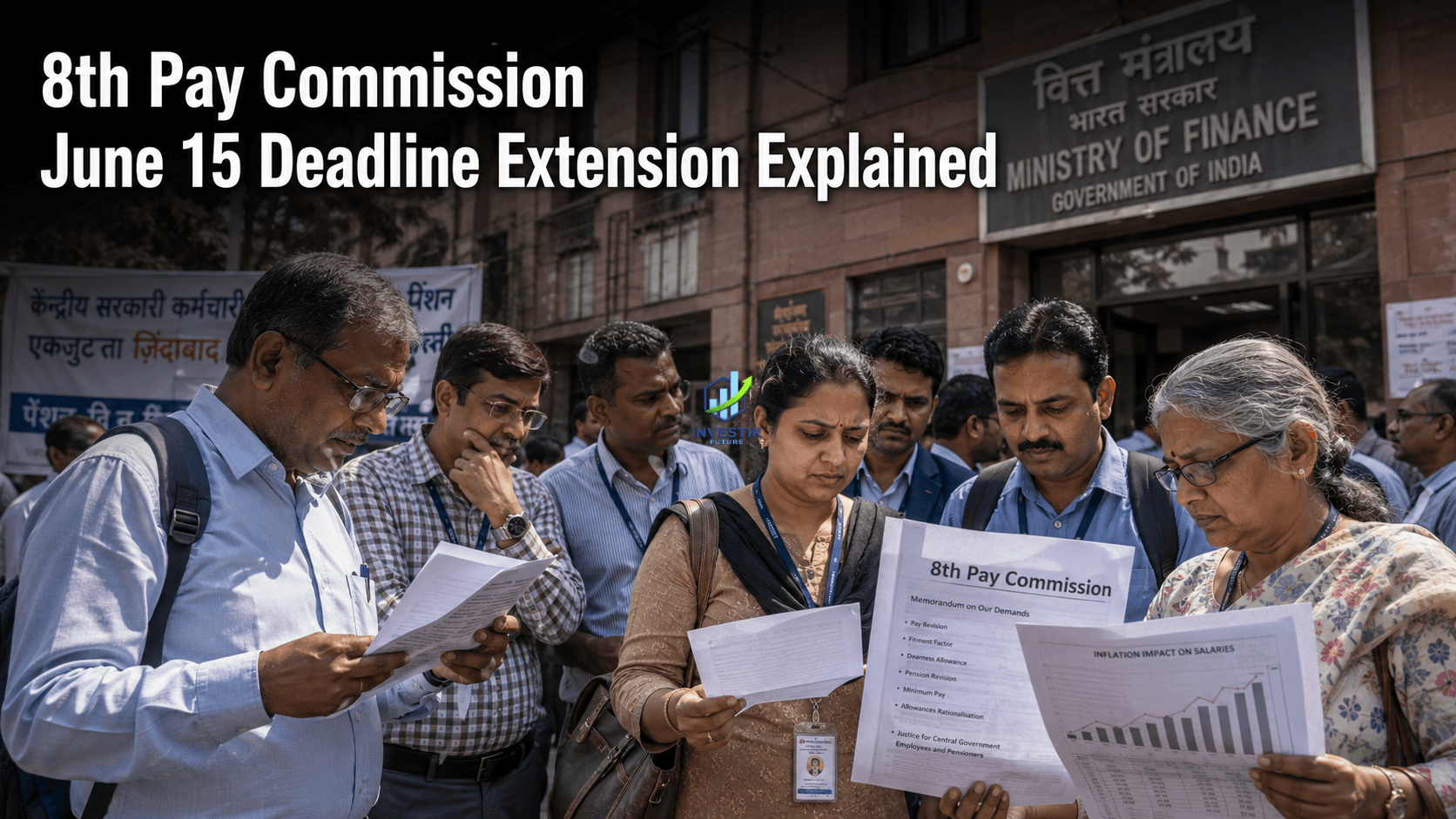
The 8th Pay Commission June 15 deadline extension is not a celebration. It is not a signal that salary hikes are accelerating. It is, in fact, the second time the Commission has pushed back the memorandum submission deadline, which was originally set for April 30, 2026. First, it moved to May 31. Now it sits on June 15. And the Commission itself has clarified: this is the final extension. No further revisions will be granted.
That single word, “final,” deserves more attention than any fitment-factor calculation going viral on WhatsApp.
For the nearly 50 lakh central government employees, approximately 65 lakh pensioners, and millions of state government workers watching this story unfold, the 8th Pay Commission June 15 deadline extension latest news is less about salary numbers and more about process reality. The Commission is still gathering inputs. Recommendations haven’t been drafted. Implementation is almost certainly 2027, not 2026. And the fitment factor figure of 3.83 is being demanded by unions? It exists in ambition, not policy.
This article from Investik Future cuts through the noise, behavioural bias, viral headlines, misread timelines and gives you the institutionally grounded, operationally honest analysis that government employees actually need right now.
What is the 8th Pay Commission June 15 deadline extension?
It is the second extension granted for stakeholders to submit memorandums and salary recommendations to the 8th Central Pay Commission. The original deadline was April 30, 2026, later extended to May 31, and now to June 15, 2026. The Commission has stated this is the final deadline.
8th Pay Commission June 15 Deadline Extension Latest News Explained
The 8th Pay Commission June 15 deadline extension is the second revision to the memorandum submission timeline, and it carries serious policy implications that mainstream headlines are underreporting. Here is what government employees, unions, pensioners, and HR departments need to understand about why this extension happened and what follows next.
The 8th Central Pay Commission was formally constituted on November 3, 2025, through a government notification. Its mandate is straightforward: review pay scales, allowances, pension structures, and service conditions for central government employees. The Commission was given 18 months from that date to submit its final report.
The consultation process, the phase we are currently in, began with the opening of the memorandum submission portal on March 5, 2026. Stakeholders, including central government employee unions, defence associations, pensioner bodies, All India Services officers, and Union Territory employees, were invited to submit their recommendations through the official portal at 8cpc.gov.in.
The original deadline was April 30, 2026. That was extended to May 31. And now, the 8th Pay Commission June 15 deadline extension pushes submissions to June 15, 2026, with the Commission explicitly stating that no further extensions will follow.
Why does this keep happening? Three reasons deserve honest analysis.
First, institutional preparation takes time. Major employee unions, particularly the National Council of Joint Consultative Machinery (NC-JCM), which represents millions of central government workers, need weeks to compile nuanced, data-backed memorandums that go beyond salary numbers. They address allowance structures, DA merger logic, fitment factor justification, pension parity, and promotion-linked pay anomalies. Rushing that process produces weak advocacy.
Second, the complexity of demands has grown. The debate around the fitment factor alone, with a single multiplier, is generating layered representations from different service categories, each arguing for a different baseline. The Commission is receiving thousands of pages of submissions, and it wants all of them before forming preliminary views.
Third, the government consultation cycle has its own rhythm. The 8th Pay Commission June 15 deadline extension latest news also reflects ongoing scheduled meetings across multiple cities, including upcoming sittings in Lucknow (June 22–23, 2026) and other regional centres, suggesting the process is expanding geographically, not contracting.
Table 1: 8th Pay Commission Memorandum Submission Timeline
| Event | Original Date | Revised Date 1 | Current Date (Final) |
| Memorandum Portal Opens | March 5, 2026 | — | March 5, 2026 |
| Initial Submission Deadline | April 30, 2026 | May 31, 2026 | June 15, 2026 |
| Regional Consultation Meetings | Ongoing | Ongoing | Lucknow: June 22–23 |
| Report Submission to Government | May 2027 (est.) | — | May 2027 (est.) |
| Expected Implementation | January 2026 (original) | 2027 (likely) | 2027 (realistic) |
Employee Takeaway: The 8th Pay Commission June 15 deadline extension is not a salary event it is an input-gathering event. The actual salary revision process begins only after this phase concludes. No numbers are final. No fitment factor has been decided.
8th Pay Commission Approval Latest News: What Employees Are Missing
The 8th Pay Commission approval latest news centres on the consultation phase, not salary finalisation. Most employees conflate these two entirely different stages. The Commission is still collecting stakeholder input as of June 2026. The approval, drafting, and notification stages are all still ahead.
Here is the process reality that rarely makes headlines:
Stage 1 Memorandum Submissions (Current): Unions, associations, and ministries submit their demands. This is where the June 15 deadline applies.
Stage 2 Internal Analysis: The Commission, chaired by former Supreme Court Justice Ranjana Prakash Desai, with IAS officer Pankaj Jain as Member-Secretary and Professor Pulak Ghosh (EAC-PM member) as technical member, analyses submissions.
Stage 3 Regional Hearings: The Commission holds city-level consultations. Lucknow (June 22–23) is one such scheduled meeting.
Stage 4 Draft Report: Commission prepares preliminary recommendations, including the fitment factor, pay matrix, and allowance revisions.
Stage 5 Final Report: Submitted to the government. This must happen within 18 months of November 3, 2025, i.e., by approximately May 2027.
Stage 6 Cabinet Approval and Notification: The government reviews, potentially modifies, and notifies the recommendations. Implementation follows.
This six-stage process is what separates the 8th Pay Commission approval latest news from actual salary hikes landing in employee bank accounts. The distance between these two points is, conservatively, 12 to 18 months from today.
Table 2: 8th Pay Commission Approval Stage-Wise Timeline
| Stage | Description | Expected Timeframe |
| Memorandum Collection | Union/association inputs | Completed by June 15, 2026 |
| Regional Consultations | City hearings across India | June–September 2026 |
| Internal Analysis | Commission review of all submissions | October–December 2026 |
| Draft Recommendations | Preliminary salary/fitment proposals | January–March 2027 |
| Final Report to Govt | 8th CPC submits official recommendations | April–May 2027 |
| Cabinet Review & Notification | Government approves and notifies | June–August 2027 |
| Salary Implementation | New pay matrix effective date | January 2026 (arrears likely) |
Policy Interpretation: The 8th Pay Commission approval latest news should be read as a process tracker, not a countdown to salary disbursement. Employees who understand this will plan their finances more rationally. Those who don’t will keep refreshing news apps, looking for a notification that is still 12+ months away.
When Will 8th Pay Commission Be Implemented for Government Employees?
When will 8th Pay Commission be implemented? Based on the current consultation timeline, the Commission’s 18-month mandate, and the pace of government notification processes, actual salary implementation is expected in late 2027, though the effective date may be backdated to January 1, 2026, with arrears payable to employees.
This distinction matters enormously for financial planning.
Implementation does not mean the date from which new salaries apply in the pay slip. It means the date the government notifies of the revised pay matrix. The effective date of January 1, 2026, is already established in principle. But the actual pay revision, with arrears from that effective date, will likely reach employees only after the Commission submits its report (May 2027), the Cabinet reviews and approves it (June–August 2027), and the Ministry of Finance issues the notification.
That means employees will receive a large arrear payment at some point in 2027, covering the period from January 2026 onward.
For state government employees, the question of when will 8th Pay Commission be implemented for state government employees has an even more delayed answer. State governments are not bound by the timeline of the Central Pay Commission. They typically adopt central recommendations with a gap ranging from 6 months to 2 years. Some states, like Rajasthan, Uttar Pradesh, and Maharashtra, have historically lagged by over a year. This is a fiscal reality. When will 8th Pay Commission will be implemented for state government employees depends almost entirely on that state’s revenue position, political priorities, and administrative bandwidth.
Table 3: Expected 8th Pay Commission Implementation Timeline: Central vs State
| Employee Category | Expected Report Date | Expected Notification | Expected Pay Revision | Arrears From |
| Central Govt Employees | May 2027 | July–Sept 2027 | Oct–Dec 2027 | Jan 1, 2026 |
| Central Pensioners | May 2027 | July–Sept 2027 | Oct–Dec 2027 | Jan 1, 2026 |
| Defence Personnel | May 2027 | July–Sept 2027 | Oct–Dec 2027 | Jan 1, 2026 |
| State Govt Employees (Fast States) | — | Late 2027 | 2028 | State-specific |
| State Govt Employees (Slow States) | — | 2028–29 | 2029+ | State-specific |
Employee Takeaway: If you are a central government employee planning your finances around a 2026 salary bump, recalibrate now. The arrears will come, but planning as if new pay starts appearing in the monthly CTC from 2026 is financially premature.
8th Pay Commission Salary Increase 2026: How Much Can Salaries Actually Rise?
The 8th Pay Commission salary increase 2026 depends primarily on the fitment factor the Commission recommends. Based on fiscal analysis and historical precedent, a fitment factor between 2.28 and 2.57 is most probable, raising minimum basic pay from ₹18,000 to approximately ₹41,000–₹46,260. Union demands of 3.83 (minimum salary ₹69,000) face serious fiscal headwinds.
Let’s translate this from percentages into actual numbers.
Under the 7th Pay Commission, the fitment factor was 2.57, which raised the minimum basic pay from ₹7,000 to ₹18,000, a 157% increase. The demand from unions in NC-JCM for the 8th Pay Commission salary increase 2026 involves a fitment factor of 3.83, which would take the minimum pay to ₹69,000.
Analysts and fiscal experts place the realistic range at 2.28 to 2.86. Here is what each scenario produces:
Table 4: 8th Pay Commission Salary Increase 2026 Fitment Factor Scenario Analysis
| Fitment Factor | Min Basic Pay (from ₹18,000) | Mid-Level Pay (from ₹56,100) | Senior Pay (from ₹1,12,400) | Pension (from ₹9,000) |
| 2.28 (Conservative) | ₹41,040 | ₹1,27,908 | ₹2,56,272 | ₹20,520 |
| 2.50 (Moderate) | ₹45,000 | ₹1,40,250 | ₹2,81,000 | ₹22,500 |
| 2.57 (7th CPC Repeat) | ₹46,260 | ₹1,44,177 | ₹2,88,868 | ₹23,130 |
| 2.86 (Optimistic) | ₹51,480 | ₹1,60,446 | ₹3,21,464 | ₹25,740 |
| 3.83 (Union Demand) | ₹68,940 | ₹2,14,863 | ₹4,30,492 | ₹34,470 |
Behavioural Insight: Notice how the gap between the union demand (₹69,000) and the realistic expectation (₹41,000–₹51,480) is not a rounding error; it is a ₹17,000–₹28,000 monthly difference. Employees anchoring their retirement or EMI planning to the union number are building on sand.
How much salary will increase in 8th pay?
Under a likely fitment factor of 2.28–2.57, minimum basic pay rises from ₹18,000 to approximately ₹41,000–₹46,260. Under the optimistic 2.86 scenario, minimum pay reaches ₹51,480. Union demands of 3.83 (minimum ₹69,000) are considered fiscally unlikely by analysts.
Table 5: 8th Pay Commission Salary List Category-Wise Expected Revisions
| Employee Category | Current Basic Pay | Expected Revised Pay (2.28x) | Expected Revised Pay (2.57x) | Expected Revised Pay (2.86x) |
| MTS / Group D | ₹18,000 | ₹41,040 | ₹46,260 | ₹51,480 |
| Lower Division Clerk | ₹19,900 | ₹45,372 | ₹51,143 | ₹56,914 |
| Upper Division Clerk | ₹25,500 | ₹58,140 | ₹65,535 | ₹72,930 |
| Section Officer | ₹47,600 | ₹1,08,528 | ₹1,22,332 | ₹1,36,136 |
| Under Secretary | ₹78,800 | ₹1,79,664 | ₹2,02,516 | ₹2,25,368 |
| Joint Secretary | ₹1,44,200 | ₹3,28,776 | ₹3,70,594 | ₹4,12,412 |
| Secretary to Govt | ₹2,25,000 | ₹5,13,000 | ₹5,78,250 | ₹6,43,500 |
Financial Implication: These projections use current basic pay figures and apply fitment factors directly. In reality, if DA (currently 60%) is merged into basic pay before applying the fitment factor, revised salaries at lower levels could be meaningfully higher. This is a key variable still being debated in the consultation process.
What Is the Fitment Factor of 8th Pay Commission 2026?
The fitment factor of the 8th Pay Commission 2026 is a salary multiplier applied to an employee’s existing basic pay to arrive at the revised pay under the new commission. In the 7th CPC, it was 2.57. For the 8th CPC, analyst consensus places the realistic range at 2.28–2.86, with union demands at 3.83. No official figure has been decided yet.
The fitment factor is arguably the most consequential number in the entire 8th Pay Commission architecture, and it is also the most misunderstood.
Here is the core logic: if your current basic pay is ₹50,000 and the fitment factor is 2.57, your new basic pay becomes ₹1,28,500. Simple multiplication. But what goes into choosing that multiplier is an exercise in macroeconomic balancing.
The Commission must weigh:
- Retail inflation since 2016, when the 7th CPC came into effect
- DA accumulation (currently at 60% of basic pay), whether it merges into basic before the factor applies
- Fiscal cost to the exchequer, the government’s total salary bill runs in the hundreds of crores
- Wage compression between levels, raising the fitment factor too sharply at lower levels while keeping it moderate at senior levels, creates distortions
- Private sector benchmarking particularly relevant for technical, scientific, and specialist roles
Union bodies, particularly through NC-JCM, are demanding 3.83. Their logic: inflation since 2016, revised family unit computation (from 3 to 5 members), and the sustained erosion of purchasing power despite DA adjustments. It is a legitimate argument backed by real data.
The government’s fiscal constraint, however, is equally real. A fitment factor of 3.83 would increase the annual salary bill by an estimated ₹3–4 lakh crore, a figure that competes directly with capital expenditure, welfare programmes, and debt servicing commitments.
When will fitment factor of 8th Pay Commission be announced? Almost certainly not before mid-2027, when the Commission submits its report.
Table 6: Fitment Factor Comparison 4th to 8th Pay Commission
| Pay Commission | Year | Previous Min Pay | Fitment Factor | Revised Min Pay | % Increase |
| 4th CPC | 1986 | ₹750 | — | ₹1,200 | 60% |
| 5th CPC | 1996 | ₹1,200 | — | ₹2,550 | 112.5% |
| 6th CPC | 2006 | ₹2,550 | — | ₹6,660 | 161.2% |
| 7th CPC | 2016 | ₹7,000 | 2.57 | ₹18,000 | 157.1% |
| 8th CPC (Union Demand) | 2026 | ₹18,000 | 3.83 | ₹69,000 | 283.3% |
| 8th CPC (Analyst Range) | 2026 | ₹18,000 | 2.28–2.86 | ₹41,040–₹51,480 | 128–186% |
Policy Interpretation: Historical pay commission cycles show that the government tends to land the fitment factor somewhere between employee demands and fiscal constraints. The 7th CPC delivered 2.57 against the union demands of 3.7 at the time. A repeat of that dynamic would suggest an 8th CPC outcome between 2.28 and 2.70, meaningful, but nowhere near the ₹69,000 headline.
Table 7: 7th vs 8th Pay Commission Comparative Outlook
| Parameter | 7th Pay Commission | 8th Pay Commission (Expected) |
| Constitution Date | February 2014 | November 3, 2025 |
| Effective Date | January 1, 2016 | January 1, 2026 |
| Report Submission | November 2015 | ~May 2027 |
| Implementation Delay | ~8 months | ~18–24 months (projected) |
| Fitment Factor | 2.57 | 2.28–2.86 (expected) |
| Min Basic Pay | ₹18,000 | ₹41,040–₹51,480 (expected) |
| Min Pension | ₹9,000 | ₹20,520–₹25,740 (expected) |
| Employees Covered | ~48 lakh | ~50 lakh (central) |
| Pensioners Covered | ~52 lakh | ~65 lakh |
Will the 8th Pay Commission Be Delayed?
Will the 8th Pay Commission be delayed? Technically, the recommendations were supposed to be effective from January 1, 2026, which has already passed without implementation. A delay in the sense of arrears is inevitable. A delay in the Commission’s report beyond May 2027 is possible but not confirmed. Implementation before 2027 is extremely unlikely.
Let us be precise about what “delay” means in this context.
The 8th Pay Commission June 15 deadline extension itself is not a delay in the Commission’s report it is a delay in data collection. The Commission still has months of analysis, regional consultation, and drafting work ahead. A mid-2027 report remains on track if proceedings proceed normally after June.
The more practical delay concern is this: will the government implement the revised pay matrix quickly after the report, or will it take 6–12 additional months? Historical precedent suggests the latter. The 7th CPC submitted its report in November 2015, and salary implementation, while backdated to January 2016, actually reached employees in mid-2016.
For central government employees, plan for a large arrears disbursement sometime in 2027 or early 2028, rather than a monthly pay revision in the near term. For state government employees, the timeline could extend well into 2028–29, depending on state-specific fiscal conditions.
Table 8: Inflation vs Government Salary Growth Comparison (2016–2026)
| Year | CPI Inflation (Annual) | DA Increase (%) | Effective Salary Protection | Real Salary Growth |
| 2016 | 4.9% | 7th CPC base | Baseline | Baseline |
| 2018 | 3.4% | +5% | Partial | Negative |
| 2020 | 6.6% | Frozen (COVID) | Poor | Significantly Negative |
| 2022 | 6.7% | +4% (partial) | Partial | Negative |
| 2024 | 4.8% | +4% (Jan 2024) | Partial | Marginally Negative |
| 2026 | ~4.5% (est) | DA at 60% | Better | Marginally Positive |
Behavioural Insight: The DA freeze during 2020–21 created a real salary loss that most employees have not recovered from on paper. The 8th Pay Commission salary increase 2026 isn’t just a raise; it is partially a compensatory correction for five years of below-inflation effective pay growth.
Table 9: DA Merger Impact on Revised Pay Calculation
| Current Basic Pay | DA @ 60% | Pay + DA (Current Effective) | If DA Merged Before Fitment (2.28x) | If DA Merged Before Fitment (2.57x) |
| ₹18,000 | ₹10,800 | ₹28,800 | ₹65,664 | ₹73,996 |
| ₹47,600 | ₹28,560 | ₹76,160 | ₹1,73,644 | ₹1,95,731 |
| ₹1,12,400 | ₹67,440 | ₹1,79,840 | ₹4,10,035 | ₹4,62,189 |
Key Takeaway: If the 8th Pay Commission recommends merging existing DA into basic pay before applying the fitment factor, as some unions are demanding, revised salaries could be dramatically higher than the simple fitment-on-basic calculation suggests. This is an active debate in the consultation process.
Government Employee Psychology: The 8th Pay Commission Anxiety Spiral
The 8th Pay Commission June 15 deadline extension latest news arrives in an information environment already saturated with misinformation, viral salary calculations, and anxiety-driven financial decisions. Understanding the behavioural finance dynamics at play here is not a soft topic; it is essential for making rational salary-planning decisions.
Every major pay commission cycle produces a predictable psychological pattern. And the 8th Pay Commission salary increase 2026 discussion has followed it to the letter.
The Anchoring Trap. The moment union bodies announced a fitment factor demand of 3.83 and a minimum salary of ₹69,000, that number became the psychological anchor for millions of employees. Subsequent, more realistic projections of ₹41,000–₹51,480 feel like “cuts,” even though they represent 128–186% increases over current pay. This anchoring effect distorts rational salary planning.
Social Media Amplification. WhatsApp groups for government employees have been circulating salary calculators showing ₹69,000 minimum pay as a near-certainty. These calculators use the union demand fitment factor without noting that it has never been formally proposed by the Commission itself. The 8th Pay Commission June 15 deadline extension latest news gets read through this amplified lens; every extension feels like a step closer to the ₹69,000 number, rather than what it actually is: a step in a long consultation process.
Retirement Anxiety. Employees in the 50–58 age bracket are acutely focused on what the 8th Pay Commission means for their pension. The transition from OPS (Old Pension Scheme) to NPS (National Pension System) remains contested. Some are hoping the 8th CPC addresses this. Others have filed representations demanding OPS restoration. Both hope and anxiety are running simultaneously.
The Financial Planning Gap. Behavioural finance research consistently shows that windfall-anticipation leads to underinvestment in the present. Government employees expecting a large salary revision are deferring SIP investments, delaying insurance reviews, and postponing retirement corpus planning, all on the assumption that the 8th CPC salary will solve future financial security. This is a structurally dangerous approach.
A salary revision is a one-time structural event. A disciplined, long-term investment strategy, whether through SIP, mutual funds, or other instruments, is what actually builds lasting wealth. The SIP guide at Investik Future explains in practical terms how to begin, even before the pay revision arrives.
Is salary increase 2026 approved?
No formal salary increase has been approved for 2026. The 8th Pay Commission is still in its consultation phase, with the memorandum submission deadline now set at June 15, 2026. Salary revision recommendations will not be submitted before mid-2027. Any disbursement, including arrears, is expected no earlier than late 2027.
Table 10: Government Employee Expectation vs Realistic Outcome
| Parameter | Employee Expectation (Popular Belief) | Realistic Outcome (Analyst Consensus) |
| Fitment Factor | 3.83 | 2.28–2.57 |
| Minimum Salary | ₹69,000 | ₹41,000–₹46,260 |
| Implementation Date | January 2026 | Late 2027 (with Jan 2026 arrears) |
| OPS Restoration | Possible | Highly Unlikely |
| Arrears Payment | Immediate | 2027–28 |
| State Govt Adoption | Same as Centre | 1–2 years after the Centre |
Behavioural Insight: The gap between expectation and realistic outcome is not trivial. Employees who plan finances based on popular belief rather than policy reality are systematically over-leveraging current debt, under-insuring, and under-investing.
Table 11: Pension Impact 8th Pay Commission Expected Revision
| Current Pension | Fitment 2.28x | Fitment 2.57x | Fitment 2.86x | Union Demand 3.83x |
| ₹9,000 | ₹20,520 | ₹23,130 | ₹25,740 | ₹34,470 |
| ₹20,000 | ₹45,600 | ₹51,400 | ₹57,200 | ₹76,600 |
| ₹35,000 | ₹79,800 | ₹89,950 | ₹1,00,100 | ₹1,34,050 |
| ₹60,000 | ₹1,36,800 | ₹1,54,200 | ₹1,71,600 | ₹2,29,800 |
Policy Interpretation: Pensioners stand to benefit significantly from the 8th Pay Commission salary increase 2026 cycle, even under conservative fitment scenarios. With the current DA at 60%, the effective pension is already 1.6x the basic. Post-revision, the base jumps, creating a compounding uplift that materially improves retirement income security.
Visual Analysis 8th Pay Commission June 15 Deadline Extension Data Charts
Chart 1: 7th vs 8th Pay Commission Salary Growth Comparison
The 8th Pay Commission salary increase 2026 against the 7th CPC baseline shows significant projected growth but also reveals how inflation has eroded real purchasing power since 2016, making this revision as much about catch-up as it is about genuine uplift.
7th vs 8th Pay Commission Minimum Basic Pay Growth
─────────────────────────────────────────────────────────────
Pay Level │ 7th CPC (2016) │ 8th CPC Est (2.57x) │ 8th CPC Est (2.86x)
─────────────────────────────────────────────────────────────
Level 1 │ ₹18,000 │ ₹46,260 │ ₹51,480
Level 4 │ ₹25,500 │ ₹65,535 │ ₹72,930
Level 7 │ ₹44,900 │ ₹1,15,393 │ ₹1,28,414
Level 10 │ ₹56,100 │ ₹1,44,177 │ ₹1,60,446
Level 12 │ ₹78,800 │ ₹2,02,516 │ ₹2,25,368
Level 14 │ ₹1,44,200 │ ₹3,70,594 │ ₹4,12,412
─────────────────────────────────────────────────────────────
Growth vs 2016: ~157% ~186%
Employee Takeaway: Every pay level shows a substantial nominal increase under the 8th CPC. However, adjusting for cumulative inflation since 2016, approximately 45–50% in CPI terms the real purchasing power gain is more modest, particularly at lower levels.
Chart 2: Expected Fitment Factor Projection
Understanding the fitment factor range is central to interpreting the 8th Pay Commission salary increase 2026. The following visual maps probability-weighted scenarios from the most conservative to the union demand.
Fitment Factor Probability Assessment
─────────────────────────────────────────────────────────────
Fitment │ Min Salary │ Probability │ Assessment
─────────────────────────────────────────────────────────────
2.28 │ ₹41,040 │ ████████░░ │ Most Fiscally Probable
2.50 │ ₹45,000 │ ███████░░░ │ Moderate Probability
2.57 │ ₹46,260 │ ██████░░░░ │ 7th CPC Repeat Scenario
2.86 │ ₹51,480 │ ████░░░░░░ │ Optimistic Ceiling
3.83 │ ₹69,000 │ █░░░░░░░░░ │ Union Demand (Unlikely)
─────────────────────────────────────────────────────────────
█ = ~10% probability weight (indicative, not official)
Financial Implication: Plan around the 2.28–2.57 range. Hope for 2.86. Do not plan life decisions around 3.83.
Chart 3: Salary Increase Timeline Visualisation
The 8th Pay Commission June 15 deadline extension is one step in a multi-year timeline. Here is where that step sits in the full implementation journey.
8th Pay Commission Full Implementation Timeline
─────────────────────────────────────────────────────────────
NOV 2025 │ Commission Constituted
MAR 2026 │ Memorandum Portal Opens
APR 2026 │ [Missed] First Deadline
MAY 2026 │ [Missed] Second Deadline
JUN 2026 │ ★ JUNE 15: FINAL DEADLINE (Current)
JUN-SEP │ Regional Consultations Across India
OCT-DEC │ Internal Commission Analysis
JAN-MAR │ Draft Recommendations Prepared
APR-MAY │ Commission Report Submitted to Govt
2027 │ ─────────────────────────────────────
JUN-AUG │ Cabinet Review & Approval
SEP-DEC │ Ministry Notification Issued
2027-28 │ Salary Revision + Arrears Disbursed
─────────────────────────────────────────────────────────────
Effective Date: January 1, 2026 (retroactive)
Policy Insight: The 8th Pay Commission June 15 deadline extension falls very early in a 24-month+ journey. No salary event is imminent from this milestone.
Chart 4: Inflation vs Salary Growth Visual Comparison
The gap between CPI inflation and effective salary growth since 2016 is one of the strongest arguments behind the 8th Pay Commission salary increase 2026 demand and it explains why even a 2.57 fitment factor may feel inadequate to many employees.
Cumulative Inflation vs Salary Protection (2016–2026)
─────────────────────────────────────────────────────────────
Year │ Cumulative Inflation │ DA Compensation │ Real Gap
─────────────────────────────────────────────────────────────
2016 │ Baseline │ 0% │ 0%
2018 │ ~10% │ +9% │ -1%
2020 │ ~22% │ +12% (frozen) │ -10%
2022 │ ~35% │ +28% │ -7%
2024 │ ~47% │ +50% │ +3%
2026 │ ~52% │ +60% │ +8%
─────────────────────────────────────────────────────────────
Note: The DA freeze in 2020 created a multi-year real-salary deficit
Salary Implication: DA at 60% has broadly compensated for inflation by 2026. However, years 2020–22 created a real loss period that some employees, particularly those who retired or made major financial decisions during that window never recovered from.
Chart 5: Central vs State Employee Salary Impact Visualisation
When will 8th Pay Commission be implemented for state government employees? The gap between central and state timelines is significant and has direct implications for 1.5+ crore state employees watching the 8th Pay Commission June 15 deadline extension news.
Central vs State Govt Implementation Gap Analysis
─────────────────────────────────────────────────────────────
Category │ Expected Implementation │ Adoption Gap
─────────────────────────────────────────────────────────────
Central Employees │ Late 2027 │ —
Fast-Adopter States │ 2028 │ ~6-12 months
Average States │ 2028-29 │ ~12-24 months
Slow-Adopter States │ 2029+ │ 24+ months
─────────────────────────────────────────────────────────────
States typically delayed in past: UP, Bihar, WB, Odisha
States historically faster: Maharashtra, Karnataka, Tamil Nadu
Table 12: Central vs State Employee Salary Expectation Comparison
| Parameter | Central Govt Employee | Fast-Adopter State Employee | Average State Employee |
| Effective Date | Jan 1, 2026 | Jan 1, 2027 (est.) | Jan 1, 2028 (est.) |
| Pay Revision In | Late 2027 | 2028 | 2028–29 |
| Arrears Coverage | ~24 months | ~12 months | ~6 months |
| Arrears Quantum | Large | Moderate | Small |
| Fitment Variation | As per 8th CPC | May differ | May differ |
Table 13: Public Sector vs Private Sector Salary Comparison (Indicative)
| Level/Role | Central Govt (Post-8th CPC) | PSU Equivalent | Private Sector Equivalent |
| Entry-Level Clerk | ₹41,000–51,480 + benefits | ₹35,000–45,000 | ₹20,000–30,000 |
| Mid-Level Officer | ₹1,15,000–1,44,000 + benefits | ₹90,000–1,20,000 | ₹80,000–1,50,000 |
| Senior Officer | ₹2,00,000–2,80,000 + benefits | ₹1,80,000–2,50,000 | ₹3,00,000–8,00,000 |
| Secretary-Level | ₹5,00,000+ | ₹4,00,000+ | ₹15,00,000+ |
Note: Government compensation includes pension, job security, healthcare benefits, and HRA, making the total package value significantly higher than CTC alone at junior levels.
Table 14: Minimum Salary Projection Under 8th Pay Commission
| Scenario | Fitment Factor | Minimum Basic Pay | HRA (30%) | TA | Gross Estimated |
| Conservative | 2.28 | ₹41,040 | ₹12,312 | ₹3,600 | ~₹56,952 |
| Moderate | 2.50 | ₹45,000 | ₹13,500 | ₹3,600 | ~₹62,100 |
| Likely | 2.57 | ₹46,260 | ₹13,878 | ₹3,600 | ~₹63,738 |
| Optimistic | 2.86 | ₹51,480 | ₹15,444 | ₹3,600 | ~₹70,524 |
| Union Demand | 3.83 | ₹69,000 | ₹20,700 | ₹3,600 | ~₹93,300 |
Employee Takeaway: Even under the conservative 2.28 scenario, the gross estimated in-hand at entry level improves by 70–80% over today’s equivalent. When planning salary, use EMIs, investments, and savings models against the moderate or likely scenarios, not the union demand.
Table 15: Employee Financial Planning Comparison Pre vs Post 8th CPC
| Financial Decision | Current Approach | Recommended Approach |
| SIP Investment | Deferred pending pay hike | Start immediately, even ₹2,000/month |
| Emergency Fund | Insufficient (relying on arrears) | Build a 6-month fund from your current salary |
| Home Loan EMI | Based on the expected ₹69,000 salary | Based on current salary with buffer |
| Insurance Coverage | Underpurchased | Buy adequate term + health coverage now |
| Retirement Planning | NPS passive / OPS hope | Active supplemental corpus building |
| Equity Exposure | None (waiting for lump sum) | Systematic via mutual funds now |
Behavioural Insight: Waiting for the 8th CPC to begin investing is the same as waiting for a raise to start running. Wealth builds on time, not income level. Even a ₹3,000/month SIP started today, explored in detail through Investik Future’s mutual fund wealth-building guide, creates a meaningfully different retirement outcome than beginning after implementation.
What is the 8th Pay Commission: ₹69,000 minimum pay claim?
This figure is based on unions’ demand for a 3.83 fitment factor applied to the current minimum basic pay of ₹18,000. It represents the employee association’s demand position, not a Commission recommendation or government approval. Analysts and fiscal experts place the realistic minimum pay at ₹41,000–₹51,480.
Investik Future Final Verdict on 8th Pay Commission June 15 Deadline Extension
The 8th Pay Commission June 15 deadline extension is a bureaucratic milestone in a policy process that will unfold over the next 18–24 months. It is not a salary announcement. It is not an approval. And employees who treat it as either will make avoidable financial planning errors.
Here is the Investik Future position, stated plainly:
On timing: Implementation before late 2027 is extremely unlikely. Employees should plan their current finances, EMIs, savings, and investments as if no salary change is coming in 2026.
On the fitment factor: The realistic range is 2.28–2.57. A 2.86 outcome is possible but requires fiscal conditions aligning favourably. A 3.83 fitment factor involves a level of government expenditure expansion that current macroeconomic conditions do not easily accommodate.
On state government employees: When will 8th Pay Commission be implemented for state government employees is an open question. Many states will follow 12–24 months after the Centre. Do not conflate the central notification date with state adoption.
On arrears: Yes, they will come. A large backdated payment from January 2026 to the implementation date will be a significant one-time financial event. Plan how to use it wisely, preferably into investments rather than consuming it entirely.
On financial planning right now: The 8th Pay Commission salary increase 2026 is a certainty in terms of direction. The quantum and timing carry uncertainty. The rational response is to invest today using available income, use tools like the position sizing calculator or stock average calculator for those building equity portfolios, and apply a structured wealth formula rather than waiting for a windfall.
The Investik Future wealth formula guide lays out exactly how to build long-term financial security on a government salary before, during, and after a pay commission revision.
The 8th Pay Commission June 15 deadline extension is a process step. It does not change your financial future. Your daily investment discipline does.
What should government employees do right now?
Begin or continue SIP investments. Build a 6-month emergency fund. Avoid over-leveraging on the assumption of imminent salary hikes. Use tools like SIP calculators, position size calculators, and structured wealth plans. The 8th Pay Commission will revise your salary; your investment habits determine whether that revision changes your life.
Read More From Investik Future
If you found this analysis useful, these resources from Investik Future will help you take the next step in your financial planning:
- SIP Basics & Benefits: Everything you need to start a Systematic Investment Plan. Read the complete SIP guide here
- Mutual Fund Wealth Building: How to build long-term wealth through mutual funds on a government salary. Explore the wealth-building framework
- Position Size Calculator: A practical risk management tool for those investing in equities. Use the calculator
- Stock Average Calculator: Understand averaging strategies before deploying arrears into equity. Try the stock average calculator
- Wealth Bachat Formula: The structured approach to building wealth on a fixed government income. Read the wealth formula guide
8th Pay Commission June 15 Deadline Extension Key Questions Answered
How much salary will increase in 8th pay? Under a likely fitment factor of 2.28–2.57, minimum basic pay rises from ₹18,000 to ₹41,040–₹46,260. Under the optimistic 2.86 scenario, minimum pay reaches ₹51,480. Salary increase varies significantly by pay level and the final fitment factor approved.
Will the 8th Pay Commission be delayed? Implementation in 2026 has already been delayed it will not happen. The Commission is still gathering inputs with the June 15 deadline. A report before May 2027 is the target. Post-report notification and implementation add 6–12 more months. Delay beyond 2027 is possible but not yet confirmed.
Is salary increase 2026 approved? No. The 8th Pay Commission salary increase 2026 has not been approved. The Commission is in the consultation stage. No recommendations have been submitted to the government. No Cabinet approval has occurred. No notification has been issued. Salary revision will be backdated to 2026 via arrears, likely paid in 2027–28.
What is the 8th Pay Commission approval latest news? As of June 2026, the 8th Pay Commission approval latest news relates to the extended memorandum submission deadline (now June 15, 2026), regional consultation meetings including Lucknow on June 22–23, and ongoing stakeholder discussions on fitment factor, pension revision, and DA merger.
What is the 8th Pay Commission salary calculator? The 8th Pay Commission salary calculator is a tool that applies an expected fitment factor to your current basic pay to project your revised salary. For example, if your basic pay is ₹50,000 and the fitment factor is 2.57, the calculator projects ₹1,28,500 as your revised basic pay.
Disclaimer
This article is published for educational and informational purposes only. The salary projections, fitment factor estimates, and implementation timelines provided here are based on publicly available data, analyst reports, and policy analysis as of June 2026. They do not constitute official government announcements. No salary revision has been formally approved or notified by the Government of India as of the date of publication. Readers should refer to official sources, including 8cpc.gov.in, the Ministry of Finance, and PIB for authoritative updates. This content does not constitute financial, legal, or investment advice. Readers are encouraged to consult a qualified financial advisor before making investment or financial planning decisions based on anticipated salary changes.
Investik Future is committed to providing accurate, research-driven financial content. Visit https://investikfuture.com/ for more guides on investing, wealth building, and personal finance.
External References:
- Official 8th Pay Commission Portal https://8cpc.gov.in
- Ministry of Finance, Government of India https://finmin.nic.in
- Press Information Bureau (PIB) https://pib.gov.in
- Reserve Bank of India Inflation Data https://rbi.org.in
- Cabinet Approval Notification, November 2025 https://newsonair.gov.in
FAQs
No official fitment factor has been decided. Analysts expect the 8th Pay Commission 2026 fitment factor to fall between 2.28 and 2.86. Employee unions have demanded 3.83, which would deliver a minimum salary of ₹69,000. This demand is considered fiscally optimistic by most policy observers. The 8th Pay Commission is expected to be implemented in late 2027. The Commission submits its report by approximately May 2027, followed by Cabinet review and notification. Actual salary revision, with arrears from January 2026, will likely reach employees between late 2027 and early 2028. The 8th Pay Commission June 15 deadline extension means stakeholders have until June 15, 2026, to submit memorandums and representations through 8cpc.gov.in. This is the second extension (from April 30 → May 31 → June 15) and has been declared the final one. It signals process complexity, not salary acceleration. State government implementation follows central government adoption with a delay. Fast-adopter states may revise salaries by 2028. Most states will follow in 2028–29. Some states with fiscal constraints may take until 2029 or beyond. The 8th Pay Commission June 15 deadline extension affects only the central process directly. The 8th Pay Commission salary list the full pay matrix has not been officially released. Based on fitment factor projections of 2.28–2.86, the minimum entry-level salary ranges from ₹41,040 to ₹51,480, with all pay levels scaling accordingly. The official matrix will be published with the Commission's final report.What is the fitment factor of 8th Pay Commission 2026?
When will 8th Pay Commission be implemented?
What does the June 15 deadline extension mean?
When will 8th Pay Commission be implemented for state government employees?
What is the expected 8th Pay Commission salary list?