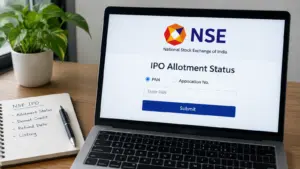


NSE shares listed at ₹1,800 on the BSE on September 24, 2026, a premium of 0.84% over the issue price of ₹1,785. The stock then moved higher, touching a high of ₹1,869 during the session.
NSE share price is trending today as the National Stock Exchange has made its long-awaited stock-market debut, the culmination of a decade-long effort that had faced regulatory and legal hurdles along the way.
This article explains NSE’s stock-market debut, its listing price versus the IPO issue price, and why the NSE share price is trending. It also covers the IPO GMP, subscription, financial performance, and key factors investors may watch after listing.
NSE Share Price Today
| Detail | Value |
| Exchange | BSE |
| Listing price | ₹1,800 |
| IPO issue price | ₹1,785 |
| Day’s high (so far) | ₹1,869 |
| Change from listing price | +3.83% |
| Date | September 24, 2026 |
Since trading is still underway on listing day, this price can keep moving through the session. Treat the numbers above as where things stood as the stock made its move higher after opening, not as a final closing figure.
NSE IPO Listing Price vs Issue Price
Here’s the simple comparison:
| Detail | Price |
| IPO Issue Price | ₹1,785 |
| BSE Listing Price | ₹1,800 |
| Premium | 0.84% |
The listing price was ₹15 higher than the issue price, giving the stock a 0.84% premium at debut.
Why Is NSE Share Price Trending Today?
A few things are driving the search interest and the trading volumes today:
- It’s NSE’s own stock-market debut. The exchange that runs India’s cash and derivatives markets is now, itself, a listed company.
- The IPO was huge. The roughly ₹22,562-crore public offer received an overall subscription of 5.71 times, with the QIB category subscribed 12.68 times, and it surpassed LIC’s Rs 21,000 crore offering from 2022, though it remains below Hyundai Motor India’s record public offer.
- Years of anticipation finally ended. People have been tracking this listing since NSE first filed its IPO papers.
- The listing came in below recent grey-market expectations, which also became a focus of listing-day coverage.
NSE IPO GMP vs Actual Listing Price
Before we go further, a quick reminder: grey market premium (GMP) is not an official price. It’s just what unlisted shares were changing hands for in the unofficial market before listing, and it doesn’t guarantee anything.
With that out of the way, here’s how the GMP story unfolded for NSE:
- NSE IPO GMP hit a high of around ₹285–₹310 in early September, which implied a higher potential listing price at the time.
- By September 23, a day before listing, the GMP had cooled off to around ₹68. At that level, NSE shares were expected to list around ₹1,853, a premium of about 3.8 per cent over the ₹1,785 issue price.
- On the morning of listing itself, different trackers were quoting GMP anywhere between roughly ₹38 and ₹72, a reminder that GMP figures vary by source and by the hour, so any GMP number is only meaningful alongside its date and time.
- The actual listing price was lower than the price implied by the reported GMP a day earlier. This shows why GMP should be treated as an unofficial sentiment indicator rather than a guaranteed listing-price forecast.
NSE IPO Subscription and Allotment
The NSE IPO was subscribed 5.71 times overall by the time bidding closed. The QIB category recorded the highest subscription at 12.68 times, followed by NII at 6.55 times, retail at 1.39 times, and employees at 2.40 times.
Quick timeline for reference:
- IPO opened: September 17, 2026
- IPO closed: September 21, 2026
- Basis of allotment finalised: September 22, 2026
- Refunds and demat credit: September 23, 2026
- Listing: September 24, 2026
NSE’s Business and Market Position
Incorporated in November 1992, NSE is India’s largest stock exchange by several key market measures. It operates trading, clearing and settlement across equities, derivatives, currency, debt and mutual funds.
Its scale shows up clearly in the numbers. In FY26, NSE accounted for 92.99 per cent of cash-market turnover and 99.79 per cent of equity futures turnover, with its share of equity options premium turnover at 74.71 per cent. As of June 2026, NSE had 13.2 crore unique registered investors and 1,328 trading members, with more than 3,000 companies listed on the exchange. Options trading is also an important part of NSE’s revenue, making its share of the equity-options market an important metric to watch.
NSE Financial Performance
NSE’s consolidated revenue from operations stood at approximately ₹16,601 crore in FY26, compared to around ₹17,141 crore in FY25, a slight decline. Profit after tax for FY26 came in at approximately ₹10,302 crore, down from around ₹12,188 crore in FY25.
NSE’s FY26 profit was affected by provisions and settlement-related expenses connected with regulatory matters. The company had provided around ₹1,297 crore during the year in relation to settlement applications involving SEBI matters concerning colocation and dark fibre issues.
These costs affected the reported FY26 profit and are relevant when comparing the year’s profit with the previous year. Transaction charges made up 78.65 per cent of NSE’s revenue from operations in FY26, with options alone contributing 60.22 per cent of the total and futures adding another 8.9 per cent, according to figures in NSE’s red herring prospectus.
What Investors Will Watch After NSE’s Listing
A few things are likely to matter once the initial listing-day noise settles down:
- How trading volumes and price hold up over the coming sessions
- Whether options market share continues shifting toward BSE, since options are NSE’s biggest revenue driver
- NSE’s quarterly revenue and profit trends without one-off SEBI-related costs in the mix
- Any further regulatory developments involving SEBI
- How the stock’s valuation is judged against BSE, the only other listed Indian exchange
Key Takeaway
NSE shares listed on the BSE at ₹1,800, just 0.84% above the ₹1,785 IPO issue price. The stock moved higher after listing and touched ₹1,869 during the session. The debut is attracting attention because NSE has finally become a listed company after years of efforts to go public. Going ahead, investors will be watching trading activity, market share, financial results, and regulatory developments.







FAQs
What is the NSE share price today?
NSE shares listed on the BSE at ₹1,800 on September 24, 2026, and touched a high of ₹1,869 during the session. Since the market is live, this can change through the day.
At what price did NSE shares list?
NSE shares listed at ₹1,800 on the BSE, a premium of 0.84 per cent over the ₹1,785 issue price.
What was the NSE IPO issue price?
The final issue price was ₹1,785 per share, the upper end of the ₹1,700–₹1,785 price band.
Did NSE shares list at a premium or discount?
At a premium, though a modest one, 0.84 per cent above the issue price.
Why is NSE share price trending today?
Because NSE, India's largest stock exchange by several key market measures, made its own stock-market debut today after a decade-long effort to go public, backed by a heavily subscribed ₹22,561.57-crore IPO.
ARN Disclosure: Investik Future is an AMFI-registered Mutual Fund Distributor. ARN-341107 — Verify on AMFI ↗. Komal Thakur is the content author and digital marketer; the ARN registration belongs to Investik Future, not to the author personally.