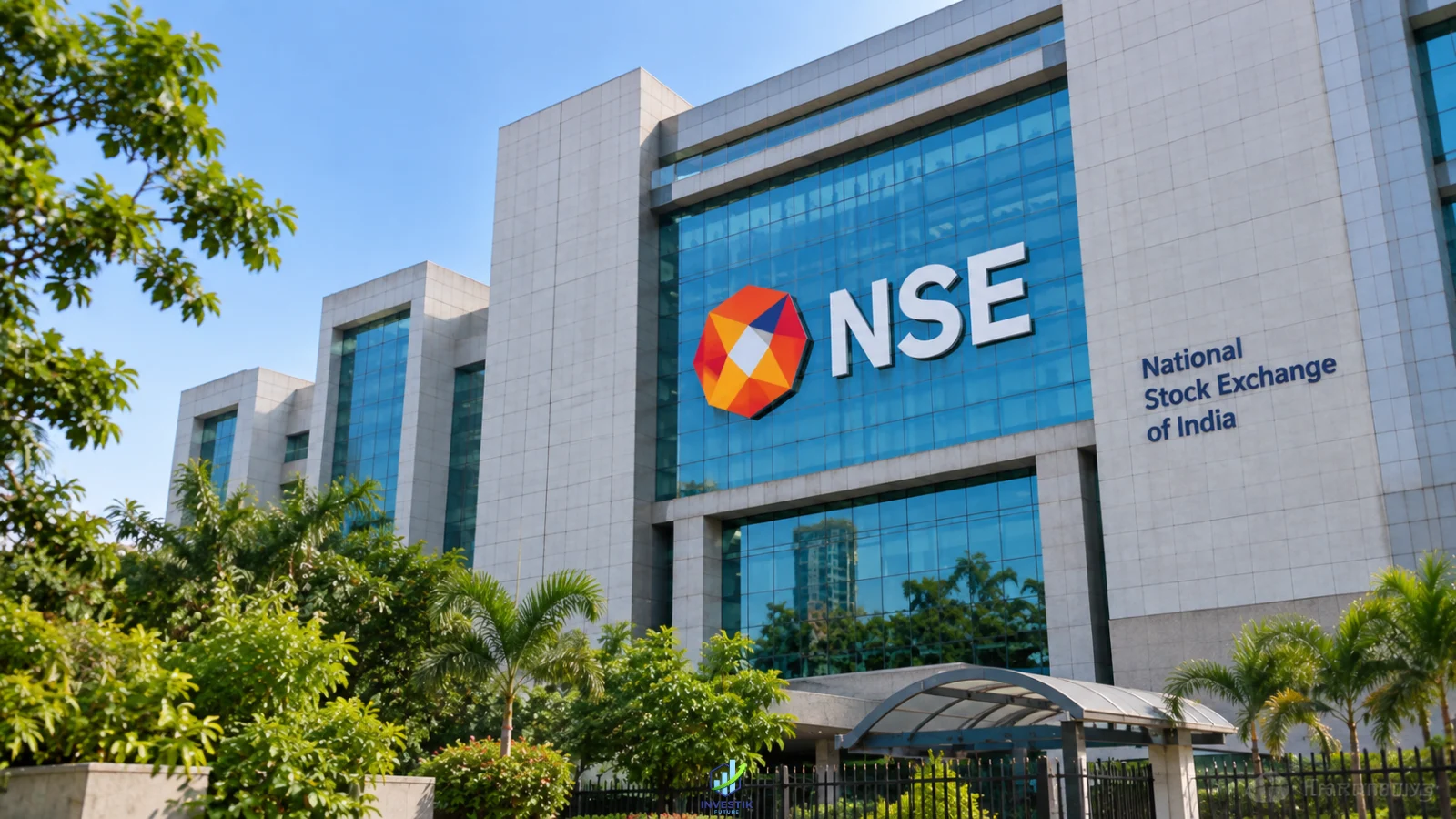

The National Stock Exchange of India (NSE), the country’s largest stock exchange, is finally going public. After years of delays, NSE’s initial public offering (IPO) opens on September 17, 2026, and it has become one of the most talked-about market events of the year.
Here’s a simple guide to the NSE IPO, its key numbers, and the factors investors may want to understand before applying.
What Is the NSE IPO?
An IPO, or Initial Public Offering, is the process through which an unlisted company offers its shares to the public for the first time and gets listed on a stock exchange. Once listed, ordinary investors can buy and sell its shares just like they do with any other listed company.
NSE is India’s largest stock exchange by trading activity and has a dominant share of several major market segments. When you buy or sell shares of companies like Reliance or TCS through your broker, that trade usually takes place on NSE’s platform. Until now, NSE has been an unlisted company, with its shares held by existing institutional and other shareholders. This IPO will make NSE’s shares available to public investors for the first time through a listed offering.
Investors are interested because NSE is not an ordinary business. It sits at the center of India’s capital markets, and its financial performance is closely tied to how active Indian investors are in buying and selling shares.
NSE IPO 2026: Key Details
| Detail | Information |
| Company | National Stock Exchange of India Ltd. |
| IPO opening date | September 17, 2026 |
| IPO closing date | September 21, 2026 |
| Anchor investor bidding | September 16, 2026 |
| Price band | ₹1,700 – ₹1,785 per share |
| Lot size | 8 shares |
| Minimum investment (upper band) | ₹14,280 |
| Issue size | Approximately ₹22,562 crore |
| Issue type | 100% Offer for Sale (OFS) |
| Listing exchange | BSE |
| Expected listing date | September 24, 2026 |
These details are based on the price band NSE announced this month. Always check the final figures on the official NSE or BSE website, or in your broker’s app, closer to the application date, since regulatory processes can shift timelines slightly.
NSE IPO Price Band
The price band is the range within which investors can bid for shares. NSE’s price band is ₹1,700 to ₹1,785 per share. This means you cannot bid below ₹1,700 or above ₹1,785; you choose a price within this range, or simply bid at the “cut-off price,” which lets the exchange decide the final price for you.
You cannot buy just one share in an IPO. Shares are sold in fixed batches called a “lot.” For NSE, one lot equals 8 shares.
Here’s a simple example: if you apply for one lot at the upper price band of ₹1,785 per share, your cost would be:
8 shares × ₹1,785 = ₹14,280
So the minimum amount a retail investor needs to apply for the NSE IPO is around ₹14,280. Retail investors can apply for up to 14 lots (112 shares), which would cost close to ₹2,00,000 at the upper price band.
What Is the NSE IPO Issue Size?
The NSE IPO issue size, the total value of shares being sold, is around ₹22,562 crore at the upper price band. This is lower than the ₹30,000 crore figure discussed earlier in the year because some selling shareholders reduced the number of shares they planned to sell.
This IPO is entirely an Offer for Sale (OFS). There is no fresh issue involved.
An OFS means existing shareholders are selling their shares. The company itself does not receive the money from those shares. In NSE’s case, this means NSE as a company will not raise any fresh capital through this IPO; the proceeds go directly to the shareholders who are selling.
Who Is Selling Shares in the NSE IPO?
Since the IPO is entirely an OFS, all shares being offered come from existing shareholders who are reducing their stake. Some of the major selling shareholders include:
- State Bank of India (SBI), the largest selling shareholder, offering up to about 1.6 crore shares
- Canada Pension Plan Investment Board
- Aranda Investments (Mauritius) Pte Ltd
Other institutional shareholders, including some public sector insurers, are also part of the selling group. NSE’s largest shareholder, LIC, is not participating in this particular sale. The exact list and quantities are confirmed in NSE’s official offer document (the Red Herring Prospectus).
NSE Financial Performance
Here is a simple look at NSE’s recent consolidated financial numbers:
| Financial Metric | FY24 | FY25 | FY26 |
| Total Income (₹ crore) | 16,352 | 19,177 | 18,713 |
| Total Assets (₹ crore) | 65,464 | 69,467 | 87,937 |
| Net Profit (₹ crore) | 8,306 | 12,188 | 10,302 |
Note that these figures are “total income,” which includes revenue from operations plus other income such as investment gains. Looking specifically at revenue from operations,-the money NSE earns from its core business of running the exchange- it fell from ₹17,141 crore in FY25 to ₹16,601 crore in FY26.
In simple terms: NSE’s total income peaked in FY25 and eased slightly in FY26. The moderation in FY26 was partly linked to changes in the derivatives market, including restrictions on weekly options expiries and a higher securities transaction tax. Profit followed a similar path; it jumped sharply in FY25, partly helped by a one-time gain from selling its stake in another company, and then declined in FY26 as trading-related income cooled off.
Even with the FY26 dip, NSE remains highly profitable, with a very high operating margin and no debt on its books. It also continues to dominate its market; NSE handles the vast majority of cash market and equity futures trading in India.
NSE’s latest quarterly numbers also remain strong. In Q1 FY27 (the quarter ended June 2026), consolidated total income rose 9% year-on-year to ₹5,252 crore, while consolidated profit after tax grew 7% to ₹3,120 crore, driven mainly by higher income from transaction charges.
NSE IPO Valuation
Valuation tells you how much the company is worth in the market compared to what it earns. At the upper end of the price band (₹1,785 per share), NSE’s implied market valuation works out to roughly ₹4.42 lakh crore.
Market capitalisation simply means the total value of all the company’s shares combined, calculated by multiplying the share price by the total number of shares. It gives you a sense of the overall size of the company as valued by the market.
Whether this valuation is high or low compared to NSE’s profits is something analysts will debate using ratios like price-to-earnings (P/E), which compares the share price to how much profit the company earns per share. This article does not label the valuation as cheap or expensive; that judgment depends on assumptions about NSE’s future growth, and investors should form their own view or refer to licensed analyst research before deciding anything.
What Is NSE IPO GMP?
GMP stands for Grey Market Premium. It is an unofficial price at which people informally trade IPO shares before the company is actually listed on the stock exchange. If the GMP is ₹200, it means that in this unofficial market, buyers are currently willing to pay ₹200 more than the IPO price for a share, once it lists.
NSE’s GMP has been moving in the grey market in the days leading up to the IPO opening. Because GMP is unofficial and can change quickly, sometimes within the same day, readers should check the latest figure from a live tracker close to the IPO opening date rather than rely on any single older number.
It is important to understand what GMP is not:
- GMP is not an official price set by NSE, BSE, or SEBI.
- GMP is not a guarantee of what the listing price will actually be.
- GMP can rise or fall sharply within a single day, based on overall market mood, subscription numbers, and investor sentiment.
- A high GMP today does not mean the stock will list at a premium; by the listing date, the figure could be completely different.
Treat GMP only as one informal indicator of sentiment, not as a prediction.
NSE vs BSE: How Are They Different?
| Feature | NSE | BSE |
| Full name | National Stock Exchange of India | Bombay Stock Exchange |
| Founded | 1992 | 1875 |
| Main index | Nifty 50 | Sensex |
| Key role | India’s largest exchange by trading volume, especially in derivatives | India’s oldest stock exchange, strong in equity listings |
| Listed status | Expected to list on BSE in September 2026 | Listed on NSE since 2017 |
| Market presence | Dominant share of cash and derivatives trading | Smaller trading volumes than NSE, but a long-standing historical presence |
Both exchanges provide core market services such as trading and listing, while clearing and settlement are handled through the relevant market infrastructure. Many companies, including NSE itself, plan to list on both exchanges over time. The two are not competitors in the sense of one being simply “better” for investors; they serve overlapping but distinct roles in India’s capital markets.
Why Is the NSE IPO Getting So Much Attention?
- NSE is India’s most dominant stock exchange, with a leading share of both cash market and derivatives trading.
- It has been an unlisted company for decades, and market participants have anticipated its public listing since it first filed for an IPO back in 2016.
- At around ₹22,562 crore, this is one of the largest IPOs in India’s market history by issue size.
- Investors get a rare opportunity to directly own a stake in the infrastructure that underlies India’s entire stock market, rather than just the companies that trade on it.
- NSE’s business model, earning fees on trading activity, is different from most listed companies, which adds to investor curiosity.
What Could Investors Look At Before Applying?
Rather than asking “should I buy this IPO,” it may help to look at these factors and form your own view:
- Valuation: How the ₹4.42 lakh crore valuation compares to NSE’s profit and growth trend.
- Financial performance: The decline in FY26 revenue and profit, and what caused it.
- Business model: How much of NSE’s income depends on trading volumes, which can rise and fall with market conditions.
- Market position: NSE’s dominant share of cash and derivatives trading in India.
- Regulatory environment: How SEBI rules around trading (like expiry-day rules and STT) affect NSE’s revenue.
- Issue structure: This is a 100% OFS; no money raised goes into NSE’s own business.
- GMP: Useful as a sentiment indicator, but not reliable for predicting the actual listing price.
Risks of the NSE IPO
- Regulatory risk: NSE’s revenue is sensitive to SEBI’s rules on derivatives trading, transaction taxes, and market structure, which can change with little notice.
- Dependence on trading volumes: A large part of NSE’s income comes from transaction charges. If overall market activity slows, NSE’s revenue can fall, as seen in FY26.
- Competition: Other exchanges, including BSE, and newer trading venues could compete for volumes over time.
- Valuation risk: At the IPO’s implied valuation, the stock could see sharp price swings if growth expectations are not met.
- OFS structure: Since this is entirely an Offer for Sale, the IPO proceeds do not strengthen NSE’s own balance sheet; they only benefit the selling shareholders.
- Technology and operational risk: As a market infrastructure company, NSE depends heavily on uninterrupted technology systems; any major outage could affect its reputation and business.
These risks reflect the general themes NSE has flagged in its offer documents; the exact wording and additional risk factors are listed in full in the Red Herring Prospectus.
What the NSE IPO Does NOT Mean
- Applying for the NSE IPO does not guarantee you will be allotted shares; allotment depends on demand and is often done through a lottery-like process for retail investors.
- A high GMP today does not guarantee listing gains on the actual listing day.
- NSE being a strong, profitable business does not automatically mean the IPO will deliver good returns; the price you pay matters just as much as the quality of the business.
- The IPO price and the actual listing price on the stock exchange can be different, in either direction.
- Once listed, NSE’s share price will move based on regular market conditions, just like any other stock, and can go up or down after listing.
Key Takeaway
The NSE IPO gives ordinary investors a chance to directly own a part of the institution that sits at the center of India’s stock market for the first time. It is a significant event because of NSE’s scale, its dominant market position, and the long wait since it first began IPO plans back in 2016.
At the same time, this is entirely an Offer for Sale, meaning no fresh money goes into NSE’s business, and the company’s FY26 financials show that its revenue and profit can be affected by regulatory changes and market activity. Investors should look closely at the valuation, financial trend, and risks laid out in NSE’s official documents before making any decision.







FAQs
What is the NSE IPO?
It is the process through which the National Stock Exchange of India, which is currently unlisted, is offering its shares to the public for the first time and getting listed on the BSE.
When will the NSE IPO open?
The IPO opens for subscription on September 17, 2026, and closes on September 21, 2026. Anchor investors bid a day earlier, on September 16, 2026.
What is the NSE IPO price band?
The price band is ₹1,700 to ₹1,785 per share.
What is the NSE IPO lot size?
The lot size is 8 shares.
What is the minimum investment for the NSE IPO?
At the upper price band, one lot of 8 shares costs about ₹14,280.
ARN Disclosure: Investik Future is an AMFI-registered Mutual Fund Distributor. ARN-341107 — Verify on AMFI ↗. Komal Thakur is the content author and digital marketer; the ARN registration belongs to Investik Future, not to the author personally.