
Every time a new IPO opens for subscription, one phrase starts doing the rounds: IPO GMP. You might see headlines saying “GMP is at ₹50” or “GMP has cooled off to ₹20” and wonder what that number is actually telling you. Is it the price the stock will list at? Is it official? Does it come from NSE or BSE?
For most first-time investors, GMP sounds important but stays confusing. This article breaks down what IPO GMP means, how it’s calculated, how it’s different from the issue price and the actual listing price, and why it should never be treated as a guaranteed prediction of listing gains.
What Is GMP in an IPO?
GMP stands for Grey Market Premium. It refers to the premium that is reportedly associated with an IPO’s shares in the unofficial grey market, before those shares are actually listed on a stock exchange.
The grey market itself operates outside the official stock exchanges. It does not take place on NSE or BSE and is outside the official exchange trading mechanism, and trades happen through informal arrangements between parties rather than through any exchange platform.
This is the first thing worth remembering: GMP is not the IPO issue price, and it is not an NSE or BSE trading price either. It’s simply a number that grey-market participants and trackers report, based on informal buying and selling interest before listing.
Here’s a simple example. Suppose:
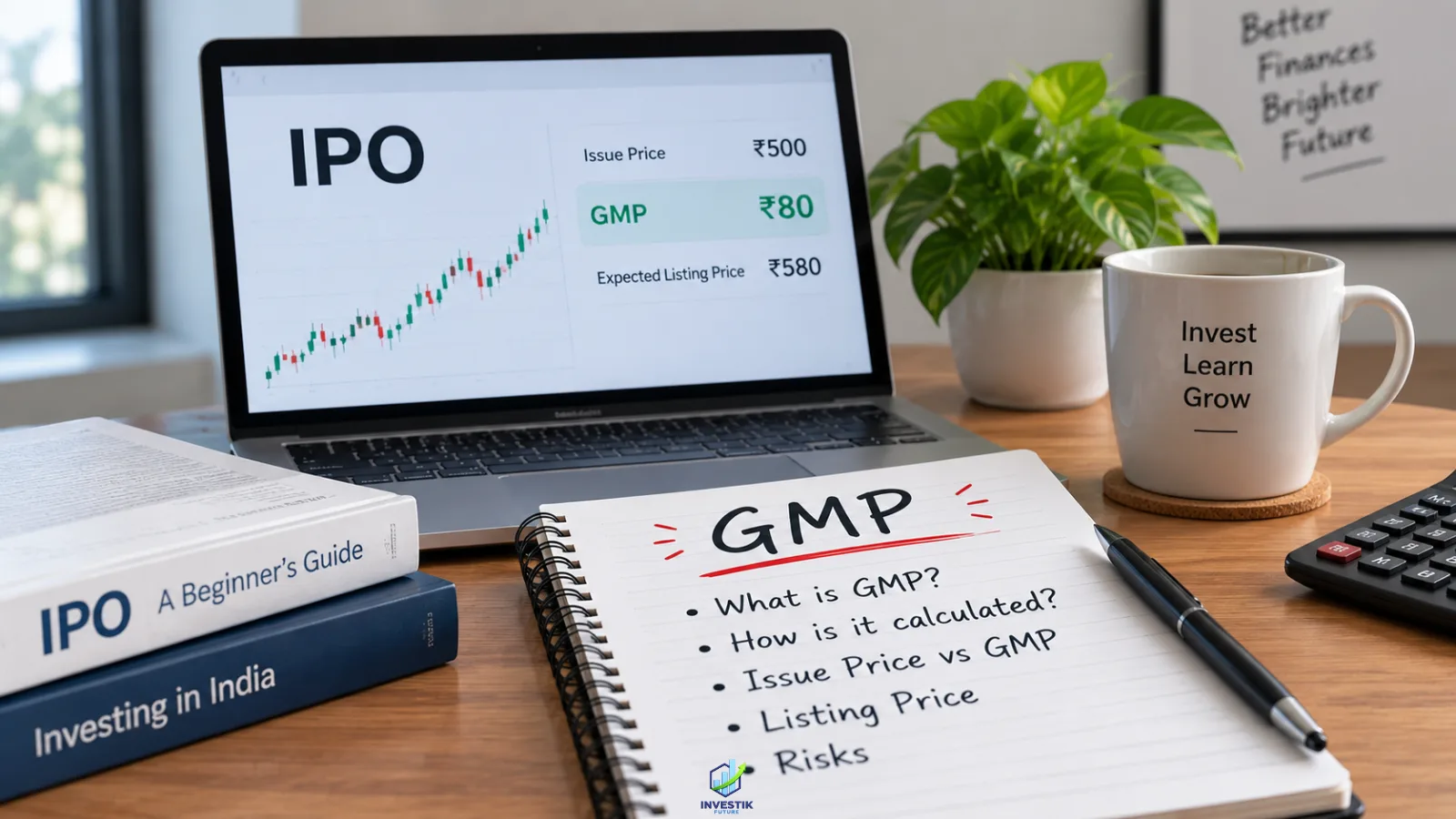
- IPO issue price = ₹500
- GMP = ₹80
The reported grey-market price in this case would be around ₹580. That’s an indicative figure based on informal market discussion, not a confirmed or guaranteed price.
How Is IPO GMP Calculated?
The basic formula used to arrive at an indicative GMP-based price is straightforward:
Indicative GMP-based price = IPO issue price + GMP
Using the same numbers as before:
- IPO issue price = ₹500
- GMP = ₹80
- Indicative price = ₹580
There’s also a way to express GMP as a percentage, which tells you the reported premium relative to the issue price:
GMP percentage = (GMP ÷ IPO issue price) × 100
So here, ₹80 ÷ ₹500 × 100 = 16%.
This 16% simply reflects the premium being reported over the issue price in the grey market. It isn’t a guaranteed listing gain, and it shouldn’t be read as one.
What Does GMP Actually Tell You?
GMP can give a rough sense of the sentiment or demand building up around an IPO in the unofficial market before it lists. If GMP numbers are being widely reported and are on the higher side, it may suggest that there’s some grey-market interest in the stock.
But it’s worth being clear about what GMP does not tell you. It doesn’t tell you:
- What the company is actually worth
- What the official listing price will definitely be
- Whether the stock will rise after listing
- Whether an IPO is fundamentally a good or bad investment
GMP is one small, unofficial data point. It isn’t a substitute for looking at the company’s financials, business model, or valuation.
Why Does IPO GMP Change?
GMP isn’t a fixed number. It moves, sometimes several times a day, while an IPO is open or waiting to list. A few things that can influence it include:
- IPO subscription numbers as they come in
- QIB (Qualified Institutional Buyer) demand, the portion of the issue reserved for large institutional investors
- Retail investor demand
- General investor sentiment
- The company’s valuation
- The IPO price itself
- Broader stock market conditions
- News related to the company
- How much time is left before listing
As new information comes in, the reported GMP can move up or down. For example, if GMP moves from ₹100 to ₹70, that simply means the reported premium has reduced. It doesn’t automatically mean the company has become less valuable; it just means grey-market sentiment has shifted for that specific IP.
IPO GMP vs Issue Price vs Listing Price: What’s the Difference?
These three terms often get mixed up, so it helps to see them side by side.
| Term | What it means |
| IPO Issue Price | Official price at which shares are offered in the IPO |
| GMP | Unofficial grey-market premium reported before listing |
| Listing Price | Actual price at which the shares begin trading on the stock exchange |
Here’s an example that shows how these can differ in practice:
- Issue price = ₹500
- GMP = ₹80
- Indicative GMP-based price = ₹580
- Actual listing price = ₹560
Notice that the actual listing price (₹560) turned out to be different from the GMP-based estimate (₹580). This happens because GMP is based on informal, unofficial activity, while the listing price is determined by actual trading on the exchange once the stock lists.
Can GMP Predict the IPO Listing Price?
No. GMP cannot guarantee or accurately determine what the actual listing price will be.
There are a few reasons for this:
- GMP is unofficial and isn’t tied to exchange mechanisms.
- It can change right up until listing day.
- The actual listing price is determined by real trading activity on the stock exchange, based on live buy and sell orders.
- Broader market conditions can shift quickly, even overnight.
- Grey-market activity is limited to certain participants and may not reflect the full picture of investor demand.
That said, GMP isn’t meaningless either; it’s just limited. It can offer a loose sense of sentiment, but it shouldn’t be treated as a forecast you can rely on.
What Does Positive GMP Mean?
A positive GMP simply means a premium is being reported over the issue price in the grey market.
For example:
- Issue price = ₹500
- GMP = ₹100
This means a ₹100 premium is being reported, which would put the indicative price at ₹600.
But the actual listing price could end up higher than ₹600, lower than ₹600, or somewhere around that level. Positive GMP is not a confirmation of listing gains.
What Does Negative GMP Mean?
A negative GMP means the reported grey-market price is below the IPO issue price.
For example:
- Issue price = ₹500
- GMP = -₹30
Here, the reported grey-market price would be around ₹470.
This indicates that grey-market sentiment, then, was reportedly below the issue price. It does not guarantee that the stock will actually list at a discount.
What Does GMP of ₹0 Mean?
A GMP of ₹0 means no premium (or discount) is being reported over the issue price in the grey market at that time.
This doesn’t guarantee that the stock will list exactly at the IPO price either. It simply reflects that, at that particular moment, no premium was being reported.
GMP vs IPO Subscription
These two terms are often used together, but they measure different things.
IPO subscription refers to the demand shown through official applications submitted during the IPO process- how many times an issue has been subscribed based on real bids placed through the official system.
GMP, on the other hand, reflects reported sentiment or activity in the unofficial grey market.
| Term | What it measures |
| IPO Subscription | Official demand through actual IPO applications |
| GMP | Reported sentiment in the unofficial grey market |
It’s possible for an IPO to be heavily subscribed and still have a fairly low GMP. It’s also possible for an IPO to show a high GMP while its subscription numbers tell a slightly different story. The two don’t automatically move together, because they’re measuring different kinds of demand through different channels.
What Is the IPO Grey Market?
The grey market, in the context of IPOs, refers to informal trading activity that happens outside official stock exchanges, before a company’s shares are listed.
A few points worth knowing:
- It takes place outside the NSE and BSE.
- It’s separate from regular exchange-based trading.
- Transactions here are based on informal arrangements between parties rather than a regulated exchange mechanism.
- It doesn’t offer the same transparency, oversight, or investor protection that comes with exchange-based trading.
Because of this, information from the grey market should be treated as informal and unofficial, not as data from a regulated market.
Is IPO GMP Official?
This is worth stating plainly: there is no official NSE or BSE GMP price.
The GMP figures you see reported online come from grey-market sources and IPO-tracking platforms, not from the stock exchanges themselves. GMP is not an official price published by NSE or BSE.
So when you see a GMP number on a website, it’s useful to remember that it’s an unofficial, informally sourced figure, not something sanctioned by the exchanges.
Where Can You Check IPO GMP?
Readers typically come across GMP figures on:
- IPO tracking websites
- Financial news websites
- Market publications
- IPO research platforms
Since there’s no official NSE/BSE GMP figure, different platforms may show slightly different numbers depending on their own sources. It’s worth keeping this in mind rather than treating any single figure as definitive.
Why Can GMP Be Misleading?
GMP has some real limitations that are worth understanding clearly:
- It’s unofficial and isn’t tracked or regulated by the exchanges.
- It can change quickly, sometimes within the same day.
- It isn’t the actual price at which the stock trades on the exchange.
- It may not represent the full picture of investor demand.
- It doesn’t measure the company’s fundamentals or actual valuation.
- It cannot guarantee listing gains.
- Different platforms may report different GMP figures for the same IPO.
None of this makes GMP useless as a talking point; it just means it should be treated as one small, informal signal rather than something to base a decision on.
GMP vs Actual Listing Price: A Simple Example
Here’s an illustrative example that puts everything together:
- IPO issue price: ₹500
- GMP before listing: ₹100
- Indicative GMP-based price: ₹600
- Actual listing price: ₹570
In this example, the GMP suggested an indicative price of ₹600, but the stock actually listed at ₹570 once real trading began on the exchange. This gap is exactly why GMP is best understood as an unofficial indicator rather than a guaranteed forecast of where a stock will list.
Key Takeaway
GMP is an unofficial grey-market indicator that reflects a reported premium or discount over the IPO issue price before a stock lists. It can offer a loose sense of market sentiment, but it does not guarantee the actual listing price or how the stock will perform afterward.
The IPO issue price and the actual exchange-listed price are both separate from GMP, and it’s worth keeping that distinction clear before drawing any conclusions from a GMP figure.






FAQs
What is GMP in an IPO?
GMP stands for Grey Market Premium, the premium reportedly associated with an IPO's shares in the unofficial grey market before they list on a stock exchange.
What does GMP mean in an IPO?
It refers to an unofficial, informally reported premium (or discount) over the IPO issue price, based on grey-market activity.
How is IPO GMP calculated?
It's calculated as the IPO issue price plus the reported GMP amount, giving an indicative grey-market price.
Is IPO GMP official?
No. There is no official NSE or BSE GMP figure. Reported numbers come from grey-market sources and IPO-tracking platforms.
Can GMP predict the listing price?
No. GMP is an unofficial indicator and cannot guarantee or accurately predict the actual listing price.
ARN Disclosure: Investik Future is an AMFI-registered Mutual Fund Distributor. ARN-341107 — Verify on AMFI ↗. Komal Thakur is the content author and digital marketer; the ARN registration belongs to Investik Future, not to the author personally.