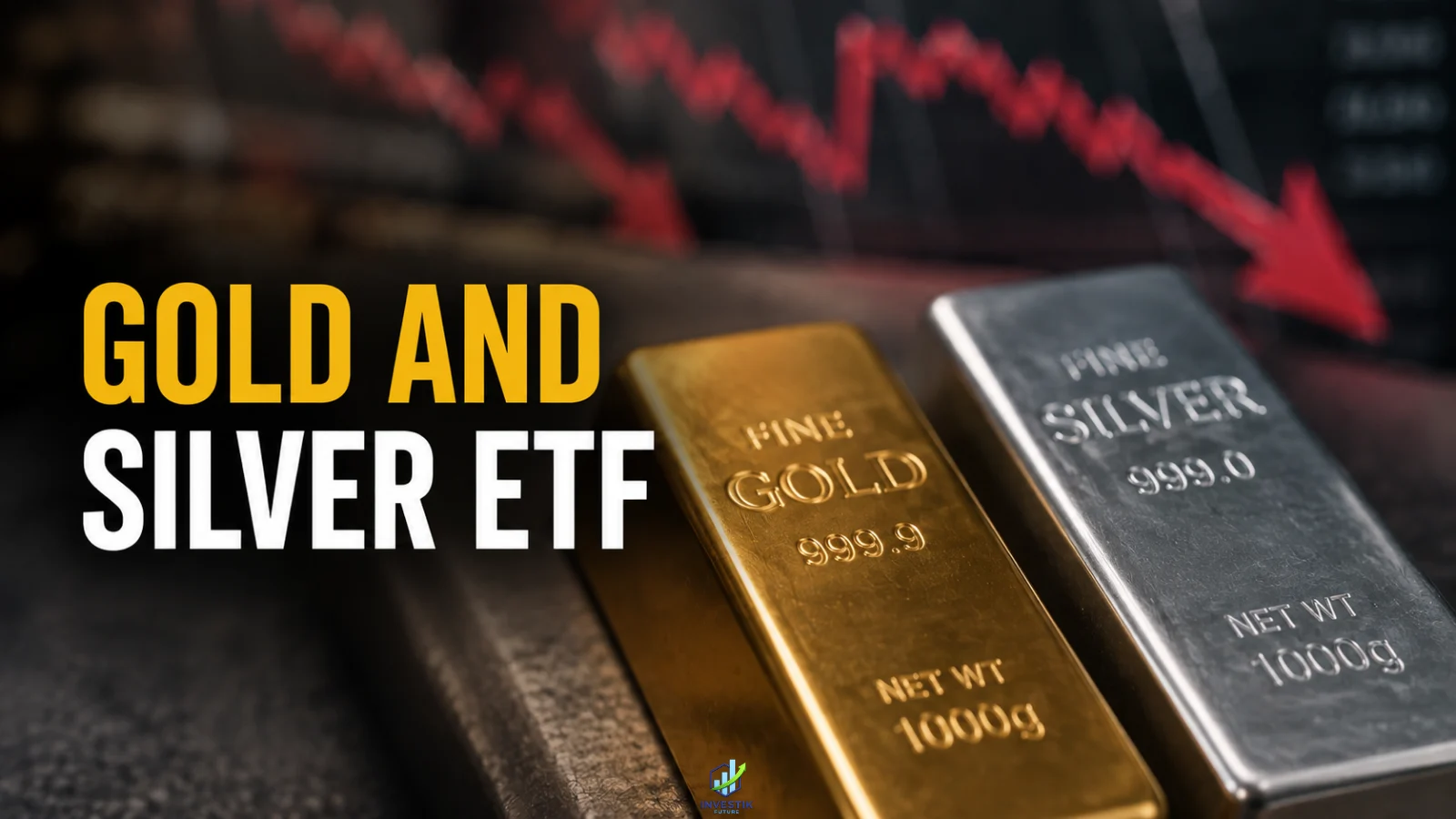

Gold and silver ETFs are taking a sharp hit today, with some funds falling around 4%. The drop comes after a strong run for precious metals and has left investors wondering what has suddenly changed.
The immediate trigger is growing expectations around the US Federal Reserve’s next interest-rate move, along with a stronger dollar and profit booking after the recent rally. So, is this just a short-term correction, or is there more investors need to watch?
This article explains why gold and silver ETFs have fallen around 4%, what is driving the recent sell-off, why silver is more volatile than gold, and what investors should watch before making a decision.
Gold and Silver ETFs Are Falling: What Happened?
The selling has been particularly sharp in silver ETFs, while gold ETFs have also moved lower.
The fall comes after a strong rally in precious metals, with gold recently touching a three-month high before the sell-off began. Spot gold had touched around $4,697 an ounce on August 25, before the mood shifted and prices started cooling off. Domestic gold prices in India have also slipped for three straight sessions. Gold and silver ETFs generally track the prices of the metals they hold, so the weakness in bullion has carried over to the funds as well.
Silver has moved more up and down than gold. This is because the silver market is smaller, so its price can change more quickly.
Why Are Gold and Silver Prices Falling?
1. Growing Expectations of a US Fed Rate Hike
The US Federal Reserve sets interest rates for the world’s largest economy, and its decisions ripple through global markets, including gold and silver. Fed Chair Kevin Warsh’s comments at the Jackson Hole economic symposium last week led markets to reassess the outlook for interest rates, increasing expectations of a possible rate hike at the Fed’s September meeting. That shift in expectations has put pressure on gold and silver.
2. Rising Bond Yields
Bond yields are simply the return you earn from holding a bond. When yields rise, investments like government bonds start offering better returns than before. Gold doesn’t pay any interest, dividend, or coupon, so when safer, interest-paying options become more attractive, some money tends to move away from gold.
3. A Stronger US Dollar
Gold and silver are priced in US dollars globally. When the dollar strengthens, gold becomes more expensive for buyers using other currencies, which can dampen demand and pull prices down. This has been playing out over the past few sessions, with rate-hike expectations helping lift the dollar.
4. Profit Booking After a Strong Rally
Prices don’t move up forever. Gold’s rise to a three-month high on August 25 meant a lot of investors were sitting on solid gains. When prices climb quickly, some investors choose to sell and lock in profits, and that selling alone can push prices down even if nothing fundamental has changed.
5. Uncertainty Around the Fed’s Next Move
Markets are also reacting to uncertainty over what the US Federal Reserve will do next. When investors are unsure about the path of interest rates, gold and silver can see sharper moves as expectations change.
Why Do Silver ETFs Tend to Move More Sharply Than Gold ETFs?
Gold and silver are both precious metals, but they aren’t used the same way. Gold is mostly bought for investment and jewellery. Silver, on the other hand, has a large industrial-use component; it goes into solar panels, electronics, and various manufacturing processes.
Because of this industrial link, silver prices are also influenced by expectations around economic and industrial activity, not just investment demand. Combine that with a smaller, less liquid market, and you get a metal that is generally more volatile than gold; it can rise faster during rallies, but it can also fall more sharply during corrections. This isn’t a reason to call silver a “better” or “worse” investment; it simply behaves differently, and that’s worth knowing before you invest.
What Is a Gold ETF and Silver ETF?
A Gold ETF is a fund that gives you exposure to gold through the stock market, without needing to buy or store physical gold yourself. A Silver ETF works the same way for silver. You buy and sell units of the fund just like you would a stock, and the fund holds physical gold or silver (or related instruments) to back those units.
ETF prices generally track the underlying metal closely, but not perfectly. Small gaps can show up because of fund expenses, tracking differences, and day-to-day demand and supply for the ETF units themselves.
What Does the Recent Fall Mean for Investors?
Not necessarily. A few days of decline doesn’t automatically mean the reasons you invested in gold or silver have stopped making sense. Precious metals often go through corrections after strong rallies; that’s normal market behaviour, not a sign that something has broken.
What matters more is understanding why prices are falling. A pullback driven by shifting rate expectations and profit booking is a very different situation from one driven by, say, a permanent change in demand. Understanding whether the fall is a short-term correction or part of a bigger change in the market will take more than a few trading sessions. That said, this isn’t a signal to buy the dip either; it simply means one bad week doesn’t tell the whole story.
Gold ETF vs Silver ETF: What Is the Difference?
| Factor | Gold ETF | Silver ETF |
| Volatility | Generally lower | Generally higher |
| Main demand | Investment and jewellery | Investment + industrial |
| Price swings | Usually smaller | Usually larger |
| Industrial exposure | Lower | Higher |
| Portfolio role | Often used for diversification | Adds exposure to silver and industrial demand |
Both funds move with their respective metals, but silver’s industrial link and thinner market mean its ups and downs tend to be bigger.
What Should Investors Watch Next?
- The Fed’s September meeting: Whether the Fed actually raises rates, holds steady, or signals a different path will matter more than the speculation around it.
- US bond yields: Rising yields tend to pressure gold; falling yields tend to support it.
- The US dollar: A stronger dollar generally weighs on gold and silver; a weaker one tends to help.
- Global gold and silver prices: Since Indian ETFs track international prices (adjusted for the rupee and local costs), global moves set the tone here too.
- Profit booking trends: After a strong rally, further bouts of selling are possible even without new negative news.
- Silver’s industrial demand signals: Data on solar and electronics demand can move silver independently of gold.
Should Investors Sell Their Gold or Silver ETFs?
A fall in prices alone isn’t enough to decide whether to sell. The answer depends on why you bought the ETF in the first place, how long you plan to stay invested, and how much volatility you’re comfortable with. Someone holding gold as a long-term hedge is in a very different position from someone who bought in recently hoping for a quick gain.
That doesn’t mean every investor should just hold on no matter what. If the investment no longer fits your goals or your comfort with risk, it may be worth reassessing; just try not to make that call purely because of a few red days.
What Are the Risks of Gold and Silver ETFs?
- Price volatility: Both metals can move sharply in either direction over short periods.
- Commodity-price risk: ETF returns depend entirely on how the underlying metal performs.
- Currency movements: Since global prices are in dollars, rupee movements can add another layer of change.
- Interest-rate sensitivity: Rising rates can make non-interest-paying assets like gold less attractive.
- Silver’s added volatility: Its industrial-demand link and smaller market size make swings bigger.
- Tracking error: ETF returns may not perfectly match the metal’s actual price move.
- Fund expenses: Ongoing costs can slightly reduce your returns over time.
Gold or Silver ETF: Which Is Better?
There isn’t one answer for everyone. Gold may suit investors who want relatively steadier precious-metal exposure. Silver may suit those who are comfortable with bigger price swings and want some exposure to industrial demand alongside the investment angle.
If you’re interested in both, remember they don’t always move in lockstep; silver’s industrial ties mean it can behave differently from gold depending on what’s driving the market at a given time.
Conclusion
Gold and silver ETFs in India fell sharply on August 31, with some silver ETFs down around 4% and gold ETFs seeing smaller declines, largely because of growing expectations around the US Fed’s September rate decision, a stronger dollar, and profit booking after a strong rally. Silver has moved more sharply than gold in the current sell-off.
None of this alone answers whether you should buy or sell; that depends on your own goals and risk appetite. For investors, the key is to understand what is driving the fall before deciding what to do next.



FAQs
Why are gold ETFs falling?
Gold ETFs have fallen mainly because of growing expectations that the US Federal Reserve could raise interest rates in September, along with a stronger dollar and profit booking after gold's recent rally to a three-month high.
Why are silver ETFs falling?
Silver ETFs are falling for similar reasons as gold: a stronger dollar and shifting rate expectations, but silver's smaller, more industrial-linked market has amplified these moves, with some silver ETFs down around 4% compared to smaller declines in gold ETFs.
Why are silver ETFs more volatile than gold ETFs?
Silver has significant industrial demand from areas like solar panels and electronics, in addition to investment demand. Combined with a smaller, less liquid market than gold, this makes silver prices swing more sharply in both directions.
Is it normal for gold ETFs to fall after a rally?
Yes. After a sharp price rise, some investors typically sell to lock in gains, which can push prices down for a while even if the broader reasons for holding gold haven't changed.
Should investors sell gold ETFs when prices fall?
Not necessarily just because of a price drop. The decision should depend on why you invested, your time horizon, and your comfort with volatility, rather than reacting to a short-term move.
ARN Disclosure: Investik Future is an AMFI-registered Mutual Fund Distributor. ARN-341107 — Verify on AMFI ↗. Komal Thakur is the content author and digital marketer; the ARN registration belongs to Investik Future, not to the author personally.