
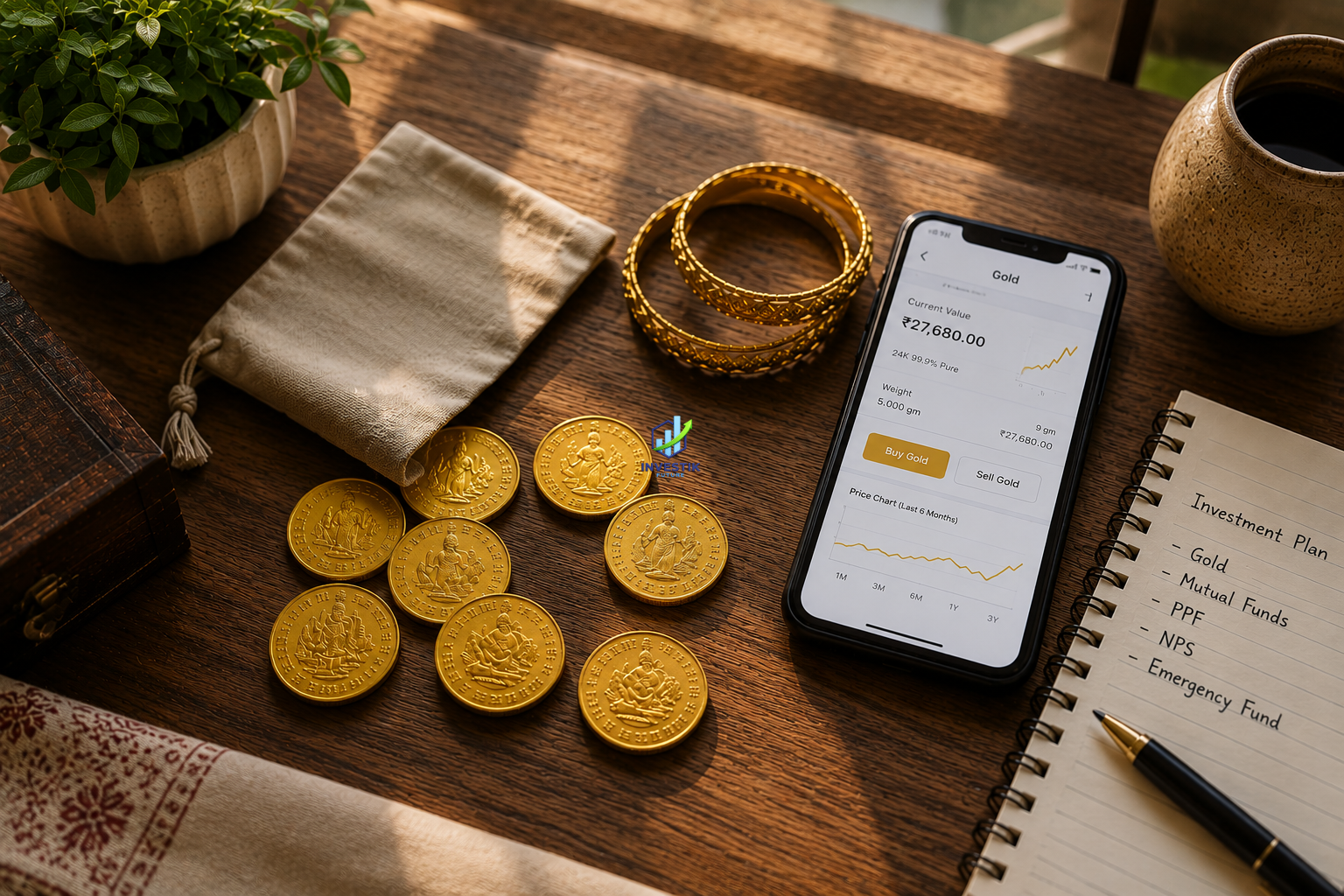

Gold sits in almost every Indian household, but very few people compare their options before buying it. A wedding-season jewellery purchase, a Diwali coin, and a Sovereign Gold Bond bought five years ago all sit in the same portfolio, yet they behave completely differently on tax, liquidity, and safety. This guide lays out every practical way to invest in gold in India today, what each one costs, how each is taxed under the current rules, and which option fits which goal.
If you’re building a broader investment plan and not just a gold allocation, it helps to look at gold alongside your other holdings on the personal finance section of Investik Future, where we cover budgeting, saving, and asset allocation as a whole.
Why gold still matters in an Indian portfolio
Three reasons keep gold relevant even in a stock-and-mutual-fund-heavy market:
Inflation hedge. Over long stretches, gold has preserved purchasing power better than cash sitting idle in a savings account. Between 2019 and 2026, gold prices in India climbed sharply, moving 10-gram rates from roughly ₹26,300 in 2015 territory to well above ₹84,000 by early 2025, and higher since.
Low correlation with equities. When stock markets fall on a rate shock or a geopolitical event, gold often moves the opposite way. That makes it a genuine diversifier, not just a cultural habit.
Liquidity and universal acceptance. You can convert gold to cash almost anywhere in India, at a jeweller, a bank, or through an app, within minutes. Few other assets offer that combination of stability and speed.
None of this means gold should dominate a portfolio. Most financial planners suggest a 5% to 15% allocation to gold, with the rest spread across equity, debt, and other instruments. Treat this guide as the “how,” while your overall asset mix is the “how much.”
The 7 main ways to invest in gold in India
Here’s the complete list before we go deep into each one:
- Physical gold (jewellery, coins, bars)
- Digital gold
- Gold ETFs (Exchange Traded Funds)
- Gold mutual funds
- Sovereign Gold Bonds (SGBs) — existing holdings and secondary market
- Gold savings and jewellery accumulation schemes
- Gold mining company stocks and international gold funds
1. Physical gold: jewellery, coins, and bars
This is still how most Indians start investing in gold, largely because it doubles as an asset and an ornament. There are three sub-types worth separating:
- Jewellery carries making charges (typically 5% to 25% of the gold value, sometimes higher for intricate designs) that you rarely recover when you sell.
- Coins and bars from banks or certified dealers (BIS-hallmarked, 999 or 995 purity) carry minimal making charges, which makes them a cleaner investment format than jewellery.
- Old or inherited gold carries no fresh GST, but its capital gains cost is based on the original owner’s purchase price and date, not today’s value.
Cost breakdown on a ₹1,00,000 jewellery purchase (illustrative):
| Component | Rate | Approx. amount |
|---|---|---|
| Gold value | — | ₹90,000 |
| GST on gold | 3% | ₹2,700 |
| Making charges (assume 8%) | 8% of gold value | ₹7,200 |
| GST on making charges | 5% | ₹360 |
| Total payable | ₹1,00,260 (approx.) |
Pros: universal acceptance, can be worn, no demat account needed, works as loan collateral instantly. Cons: making charges are a sunk cost, storage and theft risk, purity disputes at resale, no interest income.
Practical tip: Always insist on BIS hallmarking (a mandatory purity certification in India) and keep the original invoice. Without an invoice, resale value and tax-cost calculations become guesswork, and the CBDT’s informal holding limits without proof of purchase are capped at 500 grams for married women, 250 grams for unmarried women, and 100 grams for men.
2. Digital gold
Digital gold lets you buy gold in fractions, starting from as little as ₹1 to ₹10, through apps like Google Pay, PhonePe, Paytm, Groww, and dedicated platforms such as MMTC-PAMP and SafeGold. The provider stores physical gold of equivalent value in an insured vault on your behalf.
How it works in three steps:
- You pay the current gold rate plus 3% GST through the app.
- The platform credits the equivalent grams to your digital gold account.
- You can sell back to the platform, convert to physical gold/jewellery (with extra making charges), or transfer it, depending on the provider.
Important caveat most articles skip: digital gold is not regulated by the RBI or SEBI. It runs on a contractual arrangement between you and the platform’s bullion partner. That’s a real point of due diligence, not a technicality, before you park large sums there.
Tax treatment: Digital gold is treated as a capital asset, just like physical gold. Gains on holdings sold within 24 months are taxed at your income slab rate (short-term); beyond 24 months, gains are taxed at a flat 12.5% with no indexation benefit (long-term).
Because you pay 3% GST upfront and cannot claim it back, digital gold works best for small, recurring purchases and gifting, not for large lump-sum allocations meant to compound over years — a gold ETF is more cost-efficient for that purpose.
3. Gold ETFs (Exchange Traded Funds)
A Gold ETF is a fund traded on the NSE or BSE, where each unit typically represents around 1 gram of physical gold, backed by 99.5% purity bullion held by a custodian. You need a demat and trading account to buy and sell units, exactly like buying shares.
Why serious investors prefer ETFs:
- No GST at purchase, since it’s treated as a security, not physical goods.
- No storage risk or making charges.
- High liquidity: you can buy or sell during market hours at prices tracking the live gold rate.
- Expense ratio is usually low, typically 0.4% to 0.8% annually depending on the fund house.
Tax treatment (a genuinely recent change): for gold ETF units bought on or after 1 April 2025, long-term capital gains apply after just 12 months of holding, at a flat 12.5% rate. Units sold within 12 months are taxed at your income slab rate. This 12-month threshold is shorter than the 24-month rule that still applies to physical and digital gold, which makes ETFs comparatively more tax-efficient for medium-term holders.
4. Gold mutual funds
Gold mutual funds are fund-of-funds: they invest in gold ETF units on your behalf, so you don’t need a demat account. You can buy them the same way you’d buy any other mutual fund scheme, including through a Systematic Investment Plan (SIP).
This is where gold investing connects directly to habit-based investing. If you already run SIPs in equity or debt mutual funds, adding a small gold mutual fund SIP is a straightforward way to build a gold allocation without timing the market. You can model how a monthly SIP compounds over time using the SIP calculator on Investik Future, and if you’re new to the concept altogether, our explainer on what an SIP is and how it works covers the mechanics in detail.
Key difference from ETFs on tax: gold mutual fund units are unlisted, so they don’t get the shorter 12-month LTCG window that listed ETFs enjoy. They retain the 24-month threshold, taxed at 12.5% long-term or slab rate short-term. If tax efficiency on a shorter horizon matters more to you than SIP convenience, an ETF edges ahead; if automated monthly investing matters more, a gold mutual fund is simpler to run.
For a broader look at how gold mutual funds fit next to equity and debt funds, our guide on what a mutual fund is and how it builds wealth is a useful companion read, and you can browse more fund comparisons under the mutual funds category.
5. Sovereign Gold Bonds (SGBs)
This is the option where outdated information causes the most confusion, so it needs a direct, current answer.
Can you still buy a new SGB from the government today? No. The government stopped issuing new SGB tranches after February 2024, and as of 2026, no fresh issuance calendar has been announced by the Reserve Bank of India. The scheme became an expensive borrowing method for the government as gold prices rose sharply, and it has effectively been paused rather than relaunched.
That doesn’t make SGBs irrelevant. Two paths still exist:
A. If you already hold SGBs from an earlier tranche:
- You earn a fixed 2.5% annual interest (taxable at your income slab rate) on top of any price appreciation.
- You can hold until the 8-year maturity, or opt for premature redemption after 5 years, on RBI-notified windows (specific dates are published every 6 months).
- If you are the original subscriber (bought directly from RBI in the primary issue) and hold until maturity, capital gains on redemption remain tax-exempt.
- If you bought your SGB from the secondary market (NSE/BSE) rather than the original RBI issue, a change from Budget 2026 means you now pay 12.5% long-term capital gains tax on maturity gains, instead of the earlier full exemption.
B. If you want new gold exposure and were hoping to buy a fresh SGB: you currently cannot, through the primary route. Your realistic alternatives are Gold ETFs or Gold mutual funds, which is exactly why demand for both has picked up since 2024.
Should you sell an existing SGB or hold to maturity? That depends on your entry price, tax status as original subscriber or secondary buyer, and how many years remain. Given the specific redemption windows and tax exemption rules involved, this is worth checking against RBI’s official notifications before you act, rather than relying on a rule of thumb.
6. Gold savings and jewellery accumulation schemes
Jewellers (Tanishq, Kalyan, Malabar Gold, and regional chains) run monthly deposit schemes where you pay a fixed amount for 10-11 months, and the jeweller adds a bonus instalment or a discount on making charges if you redeem the accumulated value as jewellery from their store.
What to check before joining one:
- These schemes are typically not insured or regulated like a bank deposit.
- The “bonus” is usually redeemable only as jewellery from that jeweller, not as cash, which limits flexibility.
- Read the exit and refund clause carefully; some schemes penalise early withdrawal heavily.
This route suits someone planning a specific jewellery purchase (a wedding, for instance) more than it suits someone building a general investment allocation.
7. Gold mining stocks and international gold funds
For investors comfortable with equity-style risk, international mutual funds or ETFs that invest in gold mining companies (mostly listed on US or Australian exchanges) offer indirect exposure to gold prices, amplified by company-specific performance, currency movement, and mining operational risk. Returns can outpace physical gold in a bull market and underperform sharply if a mining company stumbles operationally, so this is a higher-risk, higher-volatility route, not a substitute for a core gold allocation.
Comparing all 7 gold investment options side by side
| Option | Min. investment | GST at purchase | Liquidity | Storage risk | LTCG holding period | LTCG rate |
|---|---|---|---|---|---|---|
| Physical gold | Any amount | 3% + 5% on making | Medium (needs a buyer) | High | 24 months | 12.5%, no indexation |
| Digital gold | ₹1–10 | 3% | High | None (vault-backed) | 24 months | 12.5%, no indexation |
| Gold ETF | 1 unit (~1 gram) | None | High (market hours) | None | 12 months (units from Apr 2025) | 12.5%, no indexation |
| Gold mutual fund | ₹500 (SIP) | None | High (T+2/3 redemption) | None | 24 months | 12.5%, no indexation |
| SGB (existing/secondary) | 1 gram equivalent | None | Medium (redemption windows/exchange) | None | Varies; see section 5 | 0% for original subscribers at maturity; 12.5% for secondary buyers |
| Jeweller gold schemes | Fixed monthly amount | 3% on redemption | Low (locked to scheme term) | Jeweller’s custody | Not applicable (goods, not security) | N/A |
| Gold mining stocks/funds | Varies (fund NAV) | None | High | None | Standard equity fund rules apply | Per equity/international fund taxation |
How to actually start: a step-by-step process for beginners
- Decide your purpose first. Wearing jewellery, building a long-term hedge, or short-term trading each point to a different instrument from the list above.
- Fix an allocation, not a purchase. Decide what percentage of your total investable savings should sit in gold (5% to 15% is a common starting range) before you pick a product.
- Open the right account. A demat account for ETFs, a mutual fund folio (many apps let you start in minutes) for gold mutual funds, or simply a UPI-linked app for digital gold.
- Start small and recurring rather than one lump sum, especially with digital gold or gold mutual fund SIPs, to average out entry price volatility.
- Track your holding period. Since capital gains tax hinges on 12 or 24 months depending on the instrument, note your purchase dates so you’re not forced into an unfavourable short-term sale.
- Keep every invoice and statement. For physical and digital gold, this determines your cost basis and holding period when you eventually sell or transfer the asset.
- Review annually. Gold’s role is to balance your portfolio, not dominate it. If a price rally pushes gold well above your target allocation, rebalancing back to your original percentage locks in gains without you needing to predict the top.
Taxation of gold in India: the complete 2026 picture
| Gold type | Holding period for LTCG | LTCG rate | STCG treatment | GST at purchase |
|---|---|---|---|---|
| Physical gold (jewellery, coins, bars) | 24 months | 12.5%, no indexation | Slab rate | 3% + 5% on making charges |
| Digital gold | 24 months | 12.5%, no indexation | Slab rate | 3% |
| Listed Gold ETF (units bought on/after 1 Apr 2025) | 12 months | 12.5%, no indexation | Slab rate | Nil |
| Gold mutual fund (unlisted units) | 24 months | 12.5%, no indexation | Slab rate | Nil |
| SGB, original subscriber, held to 8-year maturity | Not applicable | Exempt | Not applicable | Nil |
| SGB, secondary market purchase (from FY 2026-27) | 12 months (bond) | 12.5% | Slab rate | Nil |
A few compliance points worth remembering regardless of which instrument you choose:
- PAN is mandatory for jewellery and bullion purchases above prescribed thresholds, and cash payments above ₹2 lakh are restricted under the Income Tax Act.
- Gold received as a gift from specified relatives (parents, spouse, siblings, children) is not taxed at the time of gifting; tax applies only when you eventually sell it, and your cost basis carries over from the original owner.
- Report every gold sale, digital or physical, under Schedule Capital Gains in your income tax return, even when there’s no TDS deducted on the transaction.
You can cross-check the latest official notifications directly on the Reserve Bank of India’s Sovereign Gold Bond page, current GST rates on the GST Council’s official portal, and capital gains filing rules on the Income Tax Department’s e-filing portal.
10 reasons to invest in gold
- It hedges against inflation better than idle cash over long periods.
- It has historically moved independently of equity markets, smoothing overall portfolio returns.
- It’s globally liquid: convertible to cash in almost any country.
- Digital and ETF routes now let you start with amounts as small as ₹1 to ₹500.
- SGBs (for existing holders) added a fixed annual interest on top of price gains, a feature no other gold format offers.
- Gold can be used as loan collateral almost instantly, unlike most other assets.
- It carries no default risk the way a corporate bond or fixed deposit with a weak issuer might.
- It diversifies currency exposure indirectly, since gold prices in India move with both global dollar-denominated rates and the rupee’s exchange rate.
- Gold ETFs and mutual funds now offer redemption within a few working days, closing the liquidity gap that used to exist versus stocks.
- It’s one of the few assets with multi-generational acceptance in India, useful for estate and gifting planning within family tax-exempt limits.
Best digital gold investment apps and platforms in India
Popular platforms for buying digital gold include Google Pay, PhonePe, Paytm, Groww, and dedicated bullion-backed apps such as MMTC-PAMP and SafeGold, each partnering with a licensed vault custodian for physical backing. Before committing meaningful amounts, compare three things across platforms: the buy-sell spread, whether physical delivery/conversion to jewellery is offered and at what extra cost, and how transparent their vault insurance and auditing disclosures are, since digital gold itself sits outside direct RBI or SEBI oversight.
Common mistakes to avoid
- Treating jewellery as a pure investment. Making charges of 8% to 25% mean you’re starting every jewellery purchase at a loss versus the metal’s spot value.
- Ignoring the holding-period rule. Selling an ETF at month 11 instead of month 13 can push you from a 12.5% LTCG rate into a much higher slab rate.
- Assuming SGBs are still available for fresh purchase. They aren’t, through the primary route, since early 2024; check current status before planning around them.
- Skipping invoices on digital or physical gold, which makes proving your cost basis and holding period difficult at tax time.
- Over-allocating to gold during a price rally, chasing returns instead of sticking to a fixed percentage of your portfolio.
- Confusing digital gold with a regulated financial product. It runs on a private contractual arrangement with the platform’s bullion partner, not RBI or SEBI oversight.
Pros and cons of gold as an asset class
Pros: inflation protection over long horizons, portfolio diversification, high liquidity, cultural and gifting utility, usable as loan collateral, multiple entry points from ₹1 upward.
Cons: no ongoing income (apart from SGBs’ 2.5% interest, now only relevant to existing holders), making charges erode physical gold returns, price can stay flat or fall for multi-year stretches, digital gold sits outside formal financial regulation, and returns depend heavily on entry timing versus a systematic approach.
How much gold should you actually hold?
Financial planners commonly suggest 5% to 15% of a diversified portfolio in gold, with the exact number depending on your other holdings, age, and goals. Someone heavily weighted toward equity might lean toward the higher end for stability during market corrections; someone already holding significant real estate or fixed deposits might need less. The specific instrument matters less than making sure your gold allocation is a deliberate decision, not an accumulation of jewellery bought at weddings and festivals without a plan.
Quick action checklist
- Decide your target gold allocation as a percentage of total investments.
- Pick the instrument that matches your goal: ETF for liquidity, mutual fund SIP for automation, digital gold for small recurring buys, physical only for use or gifting.
- Open a demat account if you’re choosing ETFs.
- Confirm BIS hallmarking and keep invoices for any physical purchase.
- Note your purchase date to track the 12-month or 24-month LTCG threshold correctly.
- If you hold an existing SGB, check the current RBI premature redemption calendar before deciding to exit or hold to maturity.
- Review your gold allocation once a year and rebalance if it has drifted far from your target.
Frequently Asked Questions
What are the different ways to invest in gold in India for beginners?
The most beginner-friendly routes are digital gold (starting from ₹1) and gold mutual fund SIPs, since both need minimal setup and let you start with small, recurring amounts rather than a large lump sum.
How to invest in physical gold in India safely?
Buy only BIS-hallmarked gold from a certified jeweller or bank, insist on a proper invoice showing purity and making charges separately, and prefer coins or bars over jewellery if your goal is pure investment rather than wearing it.
How to invest in gold on Groww?
Groww offers gold ETFs and gold mutual funds through its regular investment platform; you select the fund, enter the amount (lump sum or SIP), and complete the purchase the same way you would for an equity mutual fund, using your existing KYC.
Is SGB gold investment still available in 2026?
Not through a fresh RBI issue. New SGB tranches have not been issued since early 2024, and no new issuance calendar has been announced for FY 2026-27. Existing SGB holders can still redeem prematurely on notified windows or hold to maturity; new investors looking for gold exposure currently rely on ETFs or mutual funds instead.
Which is the best digital gold investment app in India?
There’s no single universal answer, since the “best” app depends on the spread between buy and sell price, delivery options, and platform transparency; Google Pay, PhonePe, Groww, MMTC-PAMP, and SafeGold are among the most widely used, and comparing their spreads before a large purchase is worth the extra few minutes.
Conclusion
Gold in India has moved well beyond a single jewellery-box decision. Physical gold, digital gold, ETFs, mutual funds, and existing Sovereign Gold Bonds each solve a different problem: ceremonial use, small recurring savings, tax-efficient liquidity, automated investing, or a fixed-interest legacy holding. The right mix depends on your time horizon, your appetite for handling a demat account versus a UPI app, and how much you value tax efficiency over convenience.
Start with a clear allocation target, match it to the instrument that fits your habits, and track your holding periods so tax rules work in your favour rather than against you. For a wider view of how gold should sit alongside equity, debt, and other assets in your overall plan, explore more guides under Investik Future’s personal finance section, or head back to the Investik Future homepage to browse the full range of calculators and investment guides.
ARN Disclosure: Investik Future is an AMFI-registered Mutual Fund Distributor. ARN-341107 — Verify on AMFI ↗. Komal Thakur is the content author and digital marketer; the ARN registration belongs to Investik Future, not to the author personally.