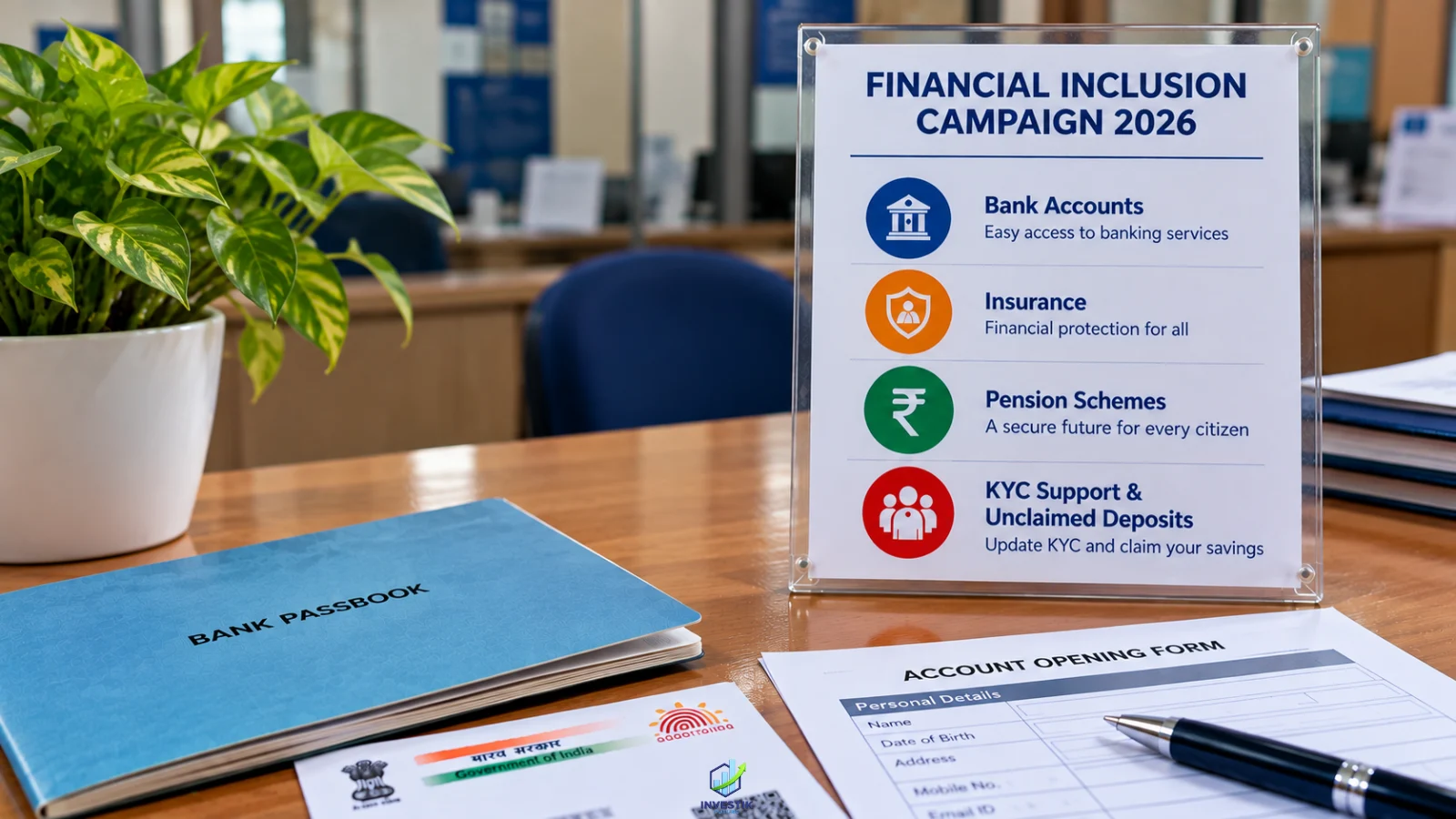

The Department of Financial Services (DFS), under the Ministry of Finance, is running a nationwide drive to bring more people into the formal banking system. The Government Financial Inclusion Campaign 2026 runs from 21 October to 31 December 2026. Banks will hold camps in gram panchayats and urban local bodies to help eligible people with bank accounts, insurance, pensions, KYC updates and more.
For many families, a bank account is the first step towards safe savings, direct payments and basic protection against accidents or death. This article explains what the campaign covers, which schemes are involved, who may benefit and what to check before enrolling.
The article explains the Government Financial Inclusion Campaign 2026, running from October 21 to December 31, to expand access to banking, insurance, and pension schemes. It covers eligibility, benefits, KYC updates, unclaimed deposits, and how people can access services through bank camps.
What Is the Government Financial Inclusion Campaign 2026?
Financial inclusion means making useful financial services reachable for people who may find them hard to get. That includes a bank account, a small insurance cover and a way to save for old age.
The government’s official name for this drive is the “Saturation Campaign of Financial Inclusion (FI) Schemes”. The official PIB announcement, issued on 19 October 2026, says the campaign will run from 21 October to 31 December 2026. It covers 2.70 lakh gram panchayats (GPs) and urban local bodies (ULBs) across the country. Banks will conduct the camps, and the DFS, state administrations, and banks will monitor progress.
“Saturation” means the aim is to reach every eligible person in an area. It does not mean everyone will qualify for every scheme.
A similar drive ran from July to October 2025, so the camp format will be familiar in many districts.
What Services Are Available Under the Campaign?
The PIB release lists nine activities for the camps. Here they are in plain terms.
- Enrolment in PMJJBY, PMSBY and APY: These are the government’s low-cost life insurance, accident insurance and pension schemes. They are explained in the next section.
- Aadhaar seeding in PMJJBY and PMSBY: This means linking your Aadhaar number to the account used for the two insurance schemes.
- Opening PMJDY accounts: People without a bank account can open a basic account under the Pradhan Mantri Jan Dhan Yojana.
- Re-KYC for existing accounts: KYC (Know Your Customer) is the identity and address check banks require. The release specifically mentions existing PMJDY and other savings accounts.
- Generating C-KYC IDs, where pending: A C-KYC ID is a number linked to your KYC record that lets you complete KYC once and reuse it across financial institutions. Camps will help generate it where it is still pending.
- Updating nominations, where pending: This covers savings accounts and other facilities such as lockers. A nominee is the person who receives the money or contents if the account holder dies.
- Awareness sessions: These cover financial inclusion schemes, digital fraud, and “Aapki Poonji, Aapka Adhikar”, the awareness effort on unclaimed financial assets.
- Kisan Credit Card (KCC) applications: Banks will source KCC applications to support the saturation of eligible PM-Kisan beneficiaries.
- Pradhan Mantri Fasal Bima Yojana enrolment: This crop insurance enrolment is meant to support saturation of KCC accounts for the coming Rabi season.
Not every camp may offer every activity, so confirm with your bank what will be available locally.
What About Unclaimed Financial Assets?
This is the part of the campaign many readers may overlook. Money left in a bank account that nobody has used for years can end up as an unclaimed deposit. This often happens when an account holder dies and the family does not know about the account, or when someone simply forgets an old account.
The campaign includes awareness sessions under “Aapki Poonji, Aapka Adhikar” (Your Money, Your Right) to help people find and claim such money. Under the usual rules, bank deposits that stay unclaimed for a long period, generally ten years, are transferred to a fund managed by the RBI. The original holder or their legal heirs can still claim them through the bank.
The RBI’s UDGAM portal (udgam.rbi.org.in) lets people search for unclaimed deposits across participating banks. The portal is a search tool only. A claim has to be made through the relevant bank, which will explain the documents it needs. Other kinds of unclaimed assets, such as insurance proceeds or shares, have their own claim processes.
For families, a camp can be a chance to ask about old accounts of parents or grandparents and to learn what a claim may need.
Which Government Schemes Are Covered?
The PIB release names PMJJBY, PMSBY, APY and PMJDY, along with the KCC and crop insurance activities. The table summarises the three Jan Suraksha schemes. Rules can change, so confirm the current terms with your bank or the official scheme pages before enrolling.
| Scheme | What it offers | Age group | Cost |
| PMJJBY | ₹2 lakh life cover for death from any cause | 18-50 (renewable up to 55) | ₹436 a year. First-time joiners pay ₹342 (Sep–Nov) or ₹228 (Dec–Feb) |
| PMSBY | ₹2 lakh for accidental death or total disability, ₹1 lakh for partial disability | 18-70 | ₹20 a year |
| APY | Guaranteed monthly pension of ₹1,000–₹5,000 after age 60 | 18-40; not open to current or past income-tax payers | Varies by joining age and chosen pension |
PMJDY is a basic banking scheme. The account can be used to receive payments and to enrol in the other schemes.
PMJJBY is a one-year life insurance plan. The cover year runs from 1 June to 31 May. The ₹342 and ₹228 amounts are pro-rata premiums that apply only to first-time enrolment in those months. The annual renewal premium is the full ₹436. Under the scheme rules, a 30-day waiting period applies to deaths not caused by accident.
PMSBY is a one-year accident insurance plan. It pays for accidental death or disability, not for illness.
APY is a pension scheme. You contribute until age 60, and the amount depends on your age when you join and the monthly pension you choose. Since 1 October 2022, anyone who is or has been an income-tax payer is not eligible to join.
Who Can Benefit From the Campaign?
The campaign is aimed at people who have been left out of formal banking and at those who need to fix gaps in existing accounts. That includes:
- People who do not have a bank account.
- Existing account holders whose KYC, C-KYC, or nominee details are pending.
- Eligible people who want to look at low-cost insurance or a pension plan.
- Farmers who may want to explore a Kisan Credit Card or crop insurance.
- Families who suspect there may be forgotten accounts or unclaimed deposits.
Attending a camp does not make anyone eligible for a scheme. Each scheme has its own age limit and conditions.
How Can You Access the Campaign’s Services?
The PIB release does not announce a single national portal or booking system for the camps. Banks conduct them locally, so the practical route is local.
- Ask your bank branch or Banking Correspondent whether a camp is planned in your gram panchayat or ward.
- Check with the panchayat office or municipal body.
- Confirm which services will be offered at that camp.
- Carry the documents needed for the service you want.
- Check eligibility and terms before signing up for any scheme.
- Keep the acknowledgement or enrolment confirmation.
For PMJJBY and PMSBY, the Jansuraksha portal is the official government site. The DFS has asked banks to enrol new beneficiaries through it.
What Documents May Be Required?
Document requirements differ by service, scheme and bank. Opening an account, updating KYC, claiming a deposit, and enrolling in a scheme each have their own rules, and no single checklist applies to everyone. Some services may need an identity or address document, while others may need account details or nominee information.
Before you visit, ask your bank which documents apply to the specific service you want.
What Should You Check Before Enrolling?
- Eligibility: Check age limits and other conditions, such as the income-tax rule for APY.
- Cost: PMJJBY and PMSBY premiums are auto-debited from your account. The first PMJJBY premium depends on the month you join, and renewals are at the full amount. APY contributions continue until age 60.
- Coverage and exclusions: PMSBY covers accidents only. PMJJBY has a waiting period for deaths not caused by accident.
- Renewals: Cover can lapse if your account lacks funds when the premium is due.
- Nominee: Make sure the nominee’s details are correct.
- Receipts: Keep the confirmation, and check the amount debited from your account.
These are voluntary schemes with their own conditions, not free benefits for everyone. Read the terms before agreeing.
Why Does Financial Inclusion Matter?
An account lets a person receive wages or government payments directly, build savings, and avoid carrying cash. A small insurance cover can stop a sudden accident or death from pushing a family into debt. A pension plan gives workers without an employer pension something to rely on later.
Some of the benefit is simply tidying up. An account with a missing nominee or an incomplete KYC can create trouble for a family at the worst possible time. A camp gives people a chance to fix such gaps in one visit.
Government Financial Inclusion Campaign 2026: Key Takeaways
- The official name is the Saturation Campaign of Financial Inclusion (FI) Schemes, run by the DFS from 21 October to 31 December 2026.
- It covers 2.70 lakh gram panchayats and urban local bodies.
- Banks will hold camps for scheme enrolment, PMJDY accounts, Re-KYC, C-KYC IDs, nominations, KCC applications, crop insurance and awareness on digital fraud and unclaimed assets.
- Eligibility depends on each scheme’s own rules.
- Your bank, the local panchayat office, and the Jansuraksha portal are the places to start.
Conclusion
The campaign gives people in villages and towns a nearby place to deal with banking tasks that are often put off. It can help you open an account, update your records, look into old unclaimed money, or consider low-cost insurance and pension options. The terms of each scheme still decide whether it suits you, so check eligibility, cost, and conditions before you enrol.
FAQs
What is the Government Financial Inclusion Campaign 2026?
It is the DFS's nationwide Saturation Campaign of Financial Inclusion (FI) Schemes. Banks hold camps at gram panchayat and urban local body level for account opening, KYC updates, scheme enrolment,t and awareness sessions.
When does the campaign run?
It runs from 21 October to 31 December 2026.
Which government schemes are included?
The PIB release names PMJJBY, PMSBY, APY and PMJDY. It also covers Kisan Credit Card applications and enrolment under the Pradhan Mantri Fasal Bima Yojana.
Who can participate?
Anyone can approach a camp for banking help. Enrolment in a scheme depends on that scheme's own eligibility rules, such as age limits.
How can I find a camp near me?
Ask your bank branch, banking correspondent,nt or local panchayat or municipal office. The release does not announce a national camp finder, and not every service may be available at every camp.
ARN Disclosure: Investik Future is an AMFI-registered Mutual Fund Distributor. ARN-341107 — Verify on AMFI ↗. Komal Thakur is the content author and digital marketer; the ARN registration belongs to Investik Future, not to the author personally.