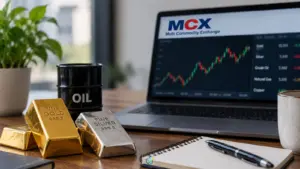
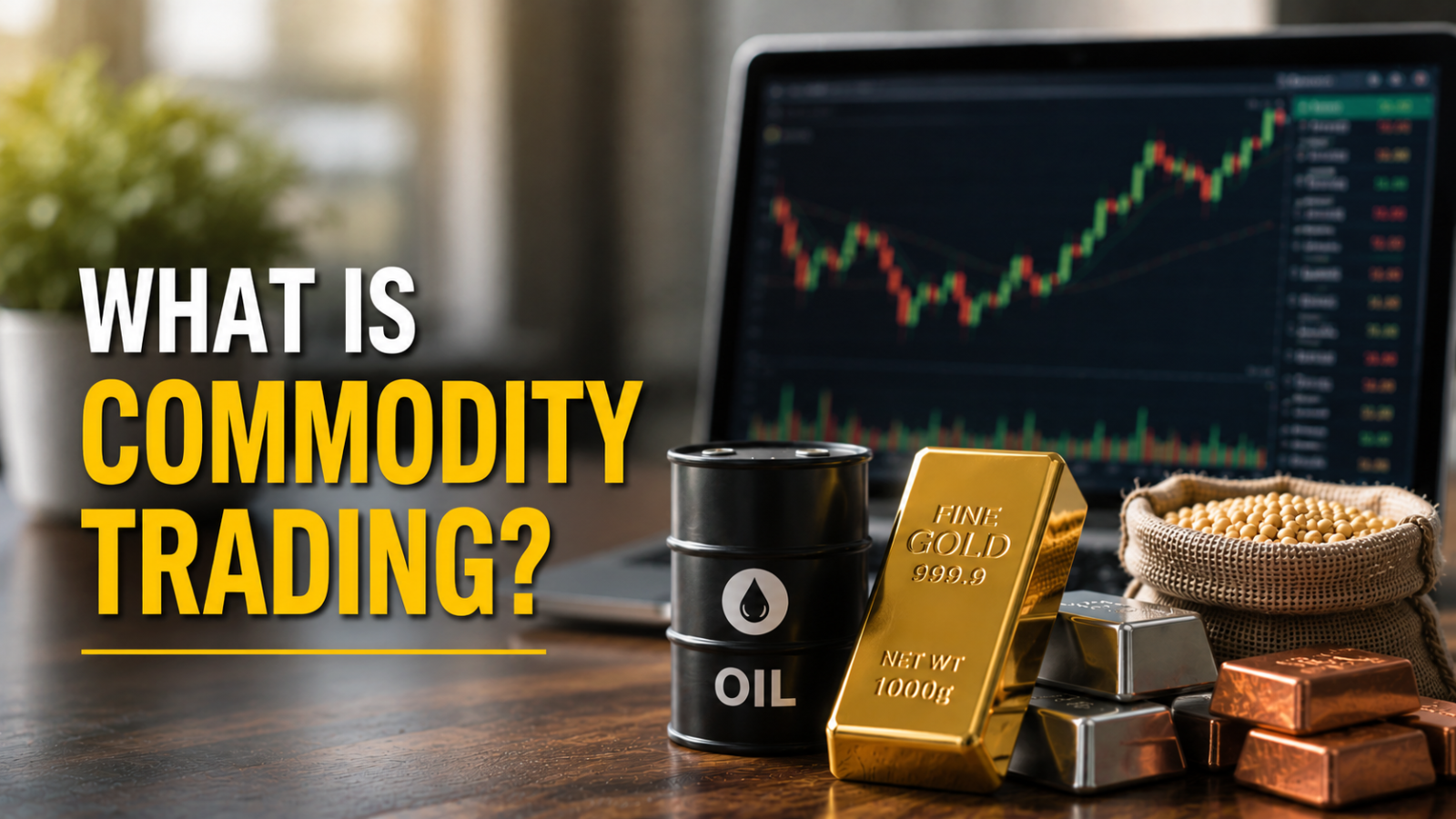

Gold, silver, crude oil, and natural gas aren’t just physical commodities used in everyday life. They’re also traded in financial markets, where their prices move up and down every day based on demand, supply,y and global events. Commodity trading is how investors and traders take positions on these price movements, without necessarily ever touching the actual commodity.
Commodity trading is not the same as buying physical gold or silver. When you trade commodities, you’re usually dealing in exchange-traded contracts whose value is linked to the underlying commodity, not the commodity itself, and there are real risks you need to understand before going anywhere near it.
This article explains what commodity trading is, how it works, the role of MCX and futures, and the key risks beginners should understand.
What Is Commodity Trading?
A commodity is a raw material or primary product that can be bought and sold, things like gold, silver, crude oil, natural gas, copper, and various agricultural products. In financial markets, commodity trading generally refers to buying and selling contracts linked to commodities such as gold, silver, crude oil,l and natural gas to profit from price changes.
Here’s the important distinction: there’s a difference between buying a physical commodity and trading it financially.
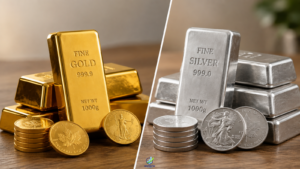
Gold: If you walk into a jewellery shop and buy a gold coin, that’s a physical purchase. You own the metal, and you have to store it. When you trade gold through commodity contracts, you generally don’t take physical delivery at all; you’re taking a position on where the price is headed.
Crude oil: Nobody trading crude oil is buying barrels and storing them at home. You’re trading a contract whose price moves in line with crude oil prices.
In most cases, commodity trading involves exchange-traded contracts, usually futures contracts, whose value is derived from the price of the underlying commodity. You’re trading the price movement, not the physical goods.
How Does Commodity Trading Work?
The process usually follows a few basic steps.
- Choose a commodity. This could be gold, silver, crude oil, natural gas, copper, or others available on Indian commodity exchanges.
- Choose a contract. Rather than buying the physical commodity, traders pick a specific contract linked to it, for example, a gold futures contract with a defined size and expiry date.
- Take a position. If you expect the price to rise, you buy. If the exchange and contract allow it and you expect the price to fall, you can also sell or go short; both directions are possible in commodity derivatives, unlike buying physical gold, where you can only benefit from a price rise.
- Margin is involved. You don’t pay the full contract value upfront; instead, you deposit a margin, a fraction of the contract’s value, with your broker (more on this below).
- The position is closed or settled. Contracts can be closed out before expiry, or settled according to the exchange’s rules and the specific contract’s terms. Physical delivery is possible in some contracts, but most retail traders close their positions before that stage.
What Commodities Can You Trade?
| Commodity Category | Examples |
| Precious metals | Gold, Silver |
| Energy | Crude Oil, Natural Gas |
| Base metals | Copper, Aluminium, Zinc |
| Agricultural commodities | Relevant exchange-traded contracts, where applicable |
In India, the commodities most actively traded by retail participants tend to be gold, silver, crude oil, and natural gas, largely because of their price sensitivity and trading volumes.
What Is MCX?
MCX stands for Multi Commodity Exchange of India. It’s India’s leading exchange for commodity derivatives, particularly contracts linked to metals and energy.
MCX is where standardised, exchange-traded contracts for commodities like gold, silver, crude oil, natural gas and base metals are bought and sold. It provides the infrastructure, contract specifications and price transparency needed for commodity derivatives trading in India.
It isn’t the only exchange in the country dealing in commodities; agricultural commodity contracts, for instance, are handled through other exchanges, but MCX is the primary venue for non-agricultural commodity futures.
What Are Commodity Futures?
Futures contracts are central to how commodity trading works, so it’s worth spending time on this.
A commodity futures contract is an agreement to buy or sell a specific commodity at a predetermined price, for settlement at a future date, subject to the contract’s terms. Every futures contract has a few defining features:
- Contract size: the standardised quantity of the commodity the contract represents
- Expiry: the date by which the contract must be closed or settled
- Margin: the amount you need to deposit to hold the position
- Settlement: how the contract is finally closed, either in cash or through delivery, depending on the contract
Here’s a simplified illustration, purely to explain the mechanics, not a prediction or a guaranteed outcome. Say a gold futures contract represents 100 grams of gold (the size of MCX’s Gold Mini contract):
- Gold price: ₹70,000 per 10 grams
- Contract value (100 grams): ₹7,00,000
- Illustrative margin at 5%: ₹35,000
- If gold moves 2%, that’s a swing of ₹14,000, about 40% of the margin amount, not 2%
Actual margin requirements vary by contract and market conditions; the 5% figure here is purely for illustration.
What Is Margin in Commodity Trading?
You generally don’t need to pay the entire contract value upfront. Instead, you maintain the required margin with your broker or exchange, and that margin is what lets you control a much larger contract value with a smaller amount of money.
This is often described as leverage, and it’s frequently marketed as an advantage, but it cuts both ways. Because you’re controlling a larger contract value with a smaller upfront margin, even a relatively small price movement can result in a large gain or loss relative to the margin deposited. Leverage shouldn’t be thought of as free upside; it’s a multiplier that applies equally to losses.
Why Do Commodity Prices Move?
Different commodities respond to different sets of factors.
Gold tends to move with interest rates, US dollar movements, inflation expectations, global uncertainty, and central-bank buying.
Crude oil is driven by global supply and demand, OPEC+ production decisions, geopolitical events, disruptions to production, and the pace of global economic growth.
Agricultural commodities respond to weather conditions, crop production levels, supply disruptions, and global demand patterns.
Metals like copper and aluminium are influenced by industrial demand, economic activity in China and other major economies, supply disruptions,s and currency movements.
None of this is predictable with certainty, which is exactly why commodity trading carries real risk rather than being a straightforward bet on a rising or falling market.
Commodity Trading vs Investing in Physical Commodities
| Feature | Commodity Trading | Physical Commodity Investment |
| Example | Gold futures | Physical gold |
| Ownership | Contract-based | Physical asset |
| Storage | Generally not required by trader | Required |
| Price movement | Directly affects position | Affects asset value |
| Leverage | Can be involved | Usually not |
| Risk | Higher, due to derivatives and margin | A different set of risks |
Commodity trading and buying physical gold are not the same thing, even though both are connected to the same underlying price. One is a leveraged, time-bound financial position; the other is a long-term physical asset you hold and store.
Commodity Trading vs Stock Trading
Both involve trading price movements, but the mechanics differ.
In commodity trading, you’re trading contracts tied to physical goods like metals or energy, whereas stock trading involves ownership stakes in companies. Commodity contracts usually carry defined expiry dates, while stocks don’t expire. Margin and leverage tend to be more central to commodity derivatives trading than to plain equity investing. And price drivers are different too: commodities respond to global supply-demand and geopolitical factors, while stocks respond to company performance, sector trends, and broader market sentiment.
Neither is inherently better or safer; they’re different instruments with different risk profiles, and suit different kinds of traders.
What Are the Risks of Commodity Trading?
- High price volatility: commodity prices can move sharply on short notice
- Margin and leverage: even a small price move can produce a large gain or loss relative to what you’ve deposited
- Possibility of rapid losses: positions can move against you quickly
- Contract expiry: positions need to be managed or closed before expiry
- Liquidity risk: some contracts may be harder to exit at a fair price
- Global events: geopolitical developments can move prices overnight
- Currency movements: many commodities are priced in dollars, so rupee movements matter too
- Gap risk: prices can open sharply higher or lower than the previous close
- Emotional or overtrading risk: chasing losses or overtrading can compound damage
Commodity trading is not the same as putting money into a commodity for the long term. A trader can lose a significant amount of money, especially when using leveraged positions, and the losses can be significant relative to the initial margin.
Who Is Commodity Trading For?
Commodity trading requires more preparation than simply buying and holding an investment. It tends to be more relevant to people who:
- Understand how derivatives and futures contracts work
- Understand margin requirements and how leverage affects risk
- Can handle volatility without making impulsive decisions
- Have a clear risk-management approach before entering a trade
- Understand the specific contract they’re trading, including its expiry and settlement terms
On the other hand, some people should be especially cautious about commodity trading:
- Those who don’t understand how futures contracts actually work
- Those looking for guaranteed returns
- Those using emergency savings or funds they can’t afford to lose
- Those who cannot absorb significant potential losses
How to Start Commodity Trading in India
At a high level, here’s what’s involved:
- You need a trading account with a broker that offers commodity derivatives trading
- You need to understand the exchange (such as MCX) and the specifications of the contract you’re trading
- You need to understand the margin requirements for that specific contract
- You should understand how expiry and settlement work before entering a position
- You should understand the risks involved before putting any money into a trade
Commodity Trading Taxation in India
Tax treatment for commodity trading in India depends on how the position is settled and is subject to specific statutory conditions being met; it isn’t automatic just because a trade happens on an exchange.
Eligible commodity derivatives traded on a recognised exchange, such as MCX, can qualify for treatment as non-speculative business income under Section 43(5) of the Income Tax Act, provided the applicable conditions are satisfied, including that Commodity Transaction Tax (CTT) has been paid where required on non-agricultural commodities. Delivery-based contracts, where the commodity is actually delivered, are also treated as non-speculative. Trades that are settled without delivery and don’t meet the recognised-exchange criteria, such as certain off-market trades, can fall under speculative business income instead.
This distinction matters mainly for losses: non-speculative losses can be set off against other business income and carried forward for up to eight years, while speculative losses can only be set off against speculative profits and carried forward for up to four years.
There’s no separate short-term or long-term capital gains rate for commodity trading; profits are taxed at your applicable income tax slab rate rather than a flat capital gains rate. On top of income tax, Commodity Transaction Tax is charged at 0.01% of the transaction value on the sale of non-agricultural commodity futures contracts, and agricultural commodities are exempt from CTT. Commodity trading income is typically reported using the business income schedules in your income tax return (ITR-3), not the simpler forms meant for salaried individuals.
Tax treatment can vary depending on the type of commodity transaction and the investor’s circumstances, so check the latest tax rules or consult a tax professional before filing.
Final Verdict
Commodity trading gives investors and traders exposure to price movements in commodities like gold, silver, crude oil, and metals, without the need to buy or store the physical goods. But the presence of futures contracts, margin, and leverage makes it substantially different from simply buying and holding a physical commodity; the risks, mechanics, and outcomes aren’t comparable. Understanding the contract, margin requirements, expiry, and risks involved matters far more than trying to predict whether a commodity’s price will go up or down.


FAQs
What is commodity trading?
Commodity trading is the buying and selling of contracts linked to commodities like gold, silver, crude oil, and natural gas, to profit from price movements, generally without taking physical delivery of the commodity.
How does commodity trading work?
Traders choose a commodity and a specific exchange-traded contract, take a position based on their price expectation, deposit the required margin, and later close or settle the position according to the contract's terms.
What commodities can be traded in India?
Commonly traded commodities in India include gold, silver, crude oil, natural gas, copper, and other base metals, largely through contracts available on MCX.
What is MCX?
MCX, or the Multi Commodity Exchange of India, is a major Indian exchange for commodity derivatives, including contracts linked to gold, silver, crude oil and metals.
Can beginners trade commodities?
Beginners can technically open an account and trade, but commodity derivatives require a solid understanding of contracts, margin and risk before it makes sense to put real money in.
ARN Disclosure: Investik Future is an AMFI-registered Mutual Fund Distributor. ARN-341107 — Verify on AMFI ↗. Komal Thakur is the content author and digital marketer; the ARN registration belongs to Investik Future, not to the author personally.