

You have probably heard someone say “Nifty is up today” or “Sensex fell 500 points.” These lines are everywhere, in newspapers, on TV, in WhatsApp forwards. But if you have never invested before, the numbers themselves don’t mean much. What exactly went up? What exactly fell?
The answer is simpler than it sounds. A stock market index is just a way of tracking the performance of a selected group of stocks, so that people don’t have to check hundreds of companies one by one.
This article explains what an index is, how Nifty and Sensex work, how they differ, and how ordinary people can actually use them.
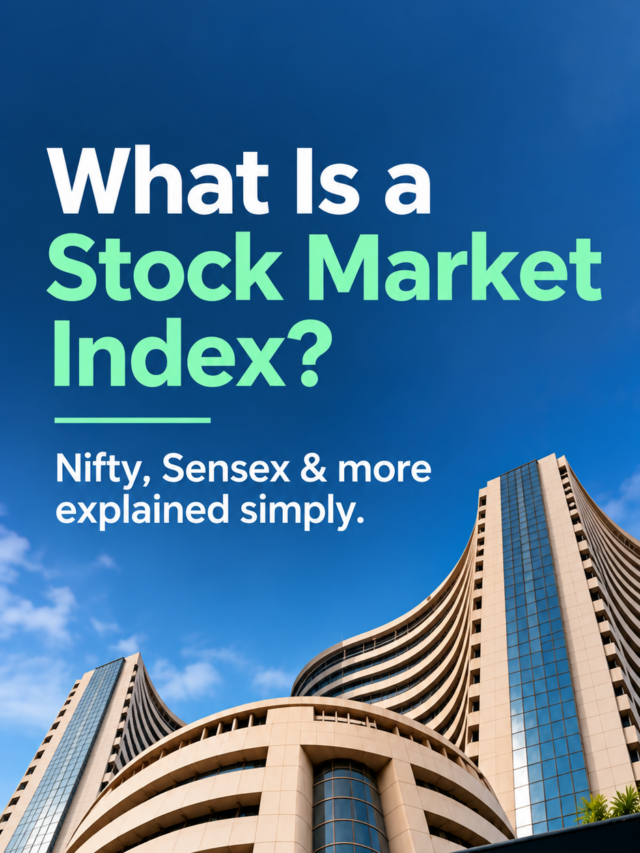
What Is a Stock Market Index?
Think of a school with 50 students. If you wanted to know whether the class did better or worse than last year, you wouldn’t read out every student’s marks one at a time. You would want one simple number that reflects the group’s overall performance.
A stock market index does something similar for a group of stocks. Instead of tracking every single company listed on an exchange, an index picks a specific set of stocks and creates one number that shows how that group is doing as a whole.
It helps to be clear about two things from the start:
- An index is not a company. You cannot walk into its office or check its balance sheet.
- An index is not a single stock. It represents many stocks put together.
An index is really just a measurement tool, a way of summarising the combined performance of a chosen basket of stocks.
Why Do We Need Stock Market Indices?
Indices exist because tracking the entire market, stock by stock, is impractical for most people. They serve a few practical purposes:
- Measuring overall market performance. A single number gives a quick sense of whether the market is broadly rising or falling.
- Comparing investment performance. Investors can check whether their own portfolio did better or worse than the broader market.
- Creating benchmarks. Mutual funds and other investment products are often compared against an index to see how well they performed.
- Making market news easier to follow. It’s far simpler to say “the market rose 1%” than to describe the movement of thousands of individual stocks.
In short, indices turn a huge, complicated market into something that can be understood at a glance.
How Does a Stock Market Index Work?
An index works through a fairly simple process:
- A group of stocks is selected based on certain rules.
- Each stock is given a certain weight in the index, based on its size.
- During the trading day, the prices of these stocks keep changing.
- These price changes affect the index value.
- The index rises or falls depending on the combined movement of all the stocks in it.
The idea of “weight” is important. A stock with a larger weight has a bigger impact on the index than a stock with a smaller weight. So if a heavily weighted stock moves sharply, it can move the whole index even if most other stocks barely changed. We don’t need to go into the exact mathematics here; the main thing to understand is that not all stocks in an index pull equally.
What Is Nifty 50?
Nifty 50 is one of India’s most widely tracked stock market indices. It is maintained by NSE Indices Limited, a subsidiary of the National Stock Exchange (NSE), and it tracks 50 of the largest and most liquid companies listed on the NSE.
These 50 companies come from different sectors of the Indian economy, banking, IT, energy, consumer goods, healthcare, and more, so Nifty 50 gives a fairly broad picture of how large Indian businesses are performing.
People watch Nifty 50 closely because it is often treated as a proxy for “how the Indian stock market is doing” on any given day. When a stock with a large weight in Nifty 50, say, a major bank or an energy company, moves sharply, that movement can visibly shift the index, even if smaller companies in the index barely move.
It’s worth repeating: Nifty 50 is an index, not a company. You cannot buy “one share of Nifty 50” directly, a point we’ll return to later in this article.
What Is Sensex?
Sensex is the other major benchmark of the Indian stock market. It tracks 30 well-established companies listed on the Bombay Stock Exchange (BSE) and is maintained by Asia Index Private Limited, a joint venture connected to BSE.
Sensex is one of India’s oldest and most widely followed stock market indices, and it is tracked alongside Nifty 50 as a quick signal of how large, established Indian companies are performing. Like Nifty, Sensex is not a company; it is a summary measure built from the prices of its 30 constituent stocks.
Nifty vs Sensex: What’s the Difference?
Both indices are followed closely, and they usually move in the same broad direction, since many of the same types of large companies are represented in both. But they are not identical.
| Feature | Nifty 50 | Sensex |
| Exchange | NSE | BSE |
| Number of companies | 50 | 30 |
| Managed by | NSE Indices Limited | Asia Index Private Limited |
| What it represents | Major companies listed on NSE | Major companies listed on BSE |
| Commonly followed for | Indian market performance | Indian market performance |
Nifty 50 has more companies than Sensex, but the level of diversification also depends on the sectors and the weight of each company in the index. In practice, both are treated as reliable indicators of how India’s large, established companies are performing as a group.
What Are the Other Important Indian Stock Market Indices?
Nifty 50 and Sensex are the most talked-about indices, but they are far from the only ones. Here are a few others that regularly come up:
Nifty Next 50: This index tracks the 50 companies that come right after the Nifty 50 companies in terms of size. In simple terms, these are large companies that could potentially grow into future Nifty 50 constituents.
Nifty Midcap 100: “Mid-cap” refers to medium-sized companies, smaller than the large, well-established firms in Nifty 50, but still fairly sizeable. This index tracks 100 such mid-sized companies.
Nifty Smallcap 100: “Small-cap” refers to smaller listed companies. This index tracks 100 such companies, which tend to be less established and can be more volatile than large-cap or mid-cap stocks.
Nifty Bank: This index focuses only on major banking stocks, giving a sense of how the banking sector specifically is performing.
Nifty IT: This tracks major information technology companies, useful for those interested in how the IT sector is doing on its own.
BSE 500: A broader BSE index covering 500 companies across various sectors, offering a wider view of the market than Sensex alone.
Index rules and constituents are reviewed and updated periodically by NSE Indices and Asia Index Private Limited, so it’s always worth checking the official NSE or BSE index websites for the current, exact list of companies in any of these indices.
How Are Stocks Selected for an Index?
Index providers follow a defined set of rules when deciding which companies belong in an index. These rules generally look at factors such as:
- Market capitalisation (the overall value of the company based on its share price)
- Liquidity (how easily and frequently the stock is bought and sold)
- Trading activity
- Basic listing requirements
- Representation across different sectors
For indices like Nifty 50 and Sensex, the list of companies is not fixed forever. Companies can be added or removed during periodic reviews if they no longer meet the relevant criteria, or if another company becomes a better fit. This is why the composition of these indices gradually changes over the years, even though the index names stay the same.
How Is an Index Value Calculated?
A common misunderstanding is that an index value is simply the average price of all its stocks. It isn’t. Most modern indices, including Nifty 50 and Sensex, use a method based on free-float market capitalisation.
Here’s what that means in plain terms:
- Market capitalisation is the total value of a company’s shares, roughly the share price multiplied by the number of shares.
- Free-float refers to the portion of those shares that are actually available for the public to buy and sell, rather than shares held by promoters, the government, or other strategic holders who are unlikely to sell.
So, instead of using a company’s entire size, the index calculation focuses on the shares that are genuinely available for trading in the open market. Larger companies (by free-float value) get a bigger weight in the index, which means their price movements have a stronger pull on the index value than smaller companies do.
You don’t need to memorise a formula to understand indices; the key idea is simply that bigger, more freely traded companies influence the index more than smaller ones.
What Does It Mean When Nifty or Sensex Rises or Falls?
This is one of the most useful things for a beginner to understand clearly.
- If Nifty or Sensex rises, it generally means the overall value of the stocks it tracks has gone up.
- If it falls, the overall value has generally gone down.
But here’s the important part: a rising or falling index does not mean every single stock in it moved the same way. Some stocks in the index can go up while others go down; the index reflects the combined effect, weighted by each stock’s size.
For example, if a handful of heavily weighted companies rise sharply, the index can go up even if many smaller companies in the same index actually fell that day. This is why looking only at the index number doesn’t tell you everything about what happened in the market.
Can You Invest Directly in Nifty or Sensex?
Not directly. An index itself is not something you can buy; it isn’t a stock or a company; it’s a measurement of a group of stocks. So you cannot walk up and purchase “one unit of Nifty 50” the way you would buy a share.
However, investors can get exposure to an index’s overall performance through:
- Index mutual funds
- Exchange-Traded Funds (ETFs)
For example, a Nifty 50 index fund tries to hold roughly the same stocks, in roughly the same proportions, as the Nifty 50 index itself, rather than a fund manager picking individual stocks by their own judgment. This means the fund’s performance tends to move closely in line with the index it tracks.
What Is an Index Fund?
An index fund is a type of mutual fund that is built to follow, or “track,” a specific index as closely as possible. If the index has 50 stocks in certain proportions, the index fund tries to hold the same 50 stocks in similar proportions.
Because the fund isn’t trying to beat the market by picking specific winning stocks, it’s simply trying to mirror the index; this approach is often called passive investing. This is different from an actively managed mutual fund, where a fund manager actively chooses which stocks to buy or sell, aiming to perform better than a benchmark index.
What Is an ETF?
An ETF, or Exchange-Traded Fund, is similar to an index fund in that it can also be built to track a specific index. The key difference is how it is bought and sold: an ETF trades on a stock exchange throughout the day, just like an individual stock, whereas a regular index mutual fund is bought or sold at the end of the trading day at a single calculated price.
Both an index ETF and an index mutual fund aim to reflect the performance of the index they are based on; they are simply structured and traded a little differently.
Stock Market Index vs Individual Stock
It helps to see the two side by side:
| Feature | Stock Market Index | Individual Stock |
| What it represents | A group of selected companies | One single company |
| Number of companies | Many (e.g., 30 or 50) | Just one |
| Risk exposure | Spread across many companies | Concentrated in one company |
| Diversification | Built-in, by design | None on its own |
| What movement tells you | Combined performance of the group | Performance of that one company only |
An index, by its nature, spreads exposure across many businesses, while a single stock’s fortunes depend entirely on that one company.
Why Do Investors and the Media Track Nifty and Sensex?
Nifty and Sensex are followed so closely because they offer:
- A quick snapshot of overall market direction
- A talking point for market news and daily commentary
- A general read on economic sentiment
- A benchmark to compare investment or fund performance against
- A simple way to compare different mutual funds against the broader market
- An easy way to understand broad market movements without checking every stock
That said, a rising or falling index on its own doesn’t tell you whether any specific stock, fund, or investment decision is right for you; it’s a broad indicator, not personalised advice.
Important Things to Remember
- An index tracks a group of stocks, not a single company.
- Nifty 50 tracks 50 major companies listed on the NSE.
- Sensex tracks 30 major companies listed on the BSE.
- An index is not a company and cannot be bought directly.
- Not every stock in an index moves in the same direction on a given day.
- Stocks with a higher weight have a bigger impact on the index’s movement.
- Investors can get exposure to an index through index funds and ETFs.
Key Takeaway
Nifty 50 and Sensex make it easier to understand what is happening in the Indian stock market. Instead of looking at hundreds of individual stocks, they use a selected group of major companies to give a quick picture of overall market movement. They are useful indicators, but they do not tell you how every stock or investment is performing.





FAQs
What is a stock market index?
It is a tool that tracks the combined performance of a selected group of stocks, giving a single number that reflects how that group is doing overall.
What is Nifty 50?
Nifty 50 is an index that tracks 50 major companies listed on the National Stock Exchange (NSE), maintained by NSE Indices Limited.
What is Sensex?
Sensex is an index that tracks 30 major, well-established companies listed on the Bombay Stock Exchange (BSE), maintained by Asia Index Private Limited.
What is the difference between Nifty and Sensex?
Nifty 50 tracks 50 companies on the NSE, while Sensex tracks 30 companies on the BSE. Both are widely used indicators of the Indian stock market.
Can I invest directly in Nifty or Sensex?
Not directly; an index cannot be bought like a stock. You can get exposure to it through index mutual funds or ETFs that track the index.
ARN Disclosure: Investik Future is an AMFI-registered Mutual Fund Distributor. ARN-341107 — Verify on AMFI ↗. Komal Thakur is the content author and digital marketer; the ARN registration belongs to Investik Future, not to the author personally.