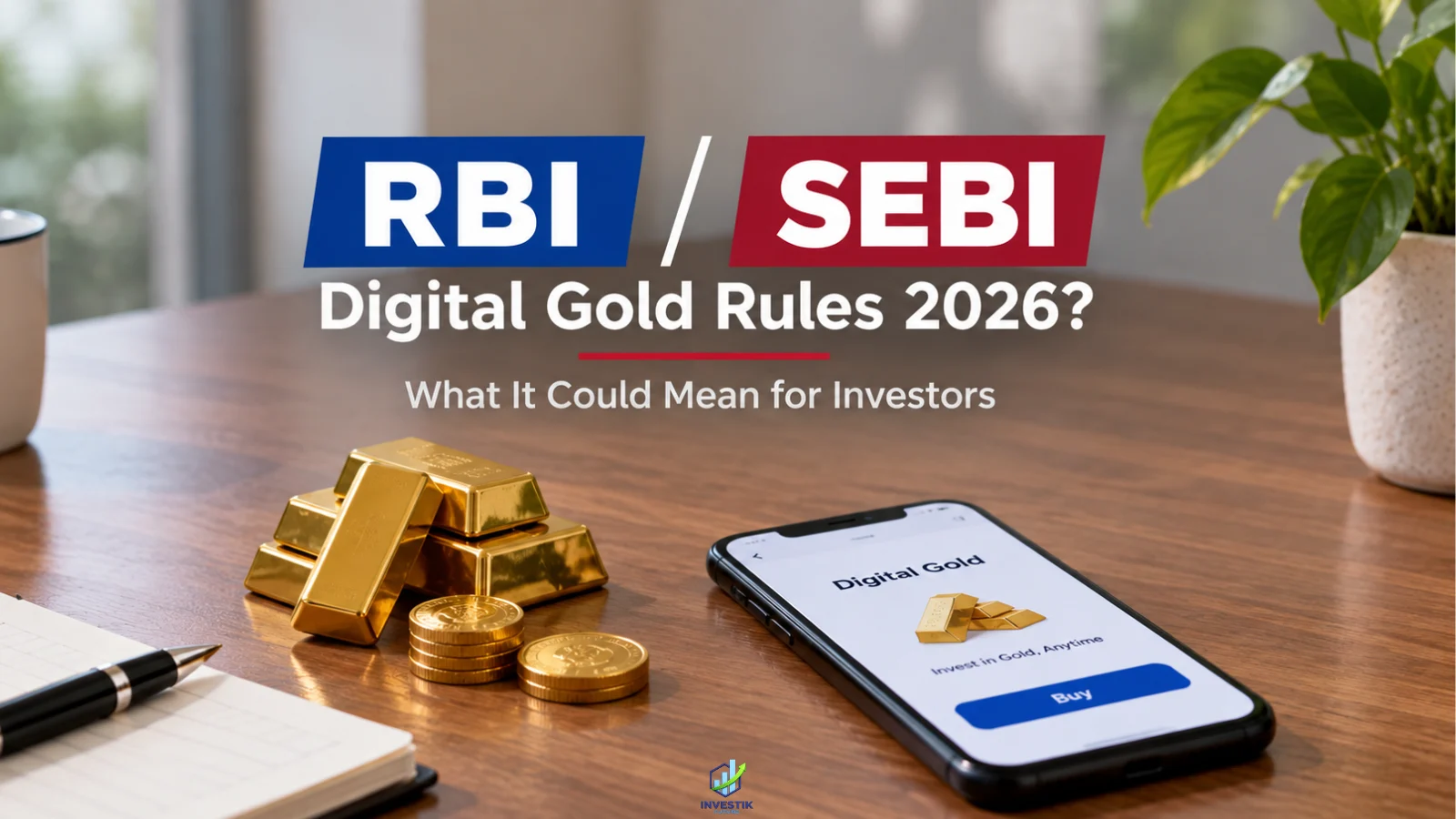

Digital gold in India could soon come under much closer watch from regulators. According to recent reports from mid-September 2026, the government is looking at a framework that would bring digital gold rules under the joint oversight of the Reserve Bank of India (RBI) and the Securities and Exchange Board of India (SEBI), with a proposal that every unit of digital gold sold should be backed by an equal amount of physical gold.
This matters because digital gold has become a popular way for Indians to buy small amounts of gold through apps and payment platforms. Right now, digital gold operates outside the regulatory framework that applies to SEBI-regulated gold products such as Gold ETFs, and until now, no single regulator has taken direct responsibility for it. If the proposed changes go through, they could change how digital gold is stored, verified, and protected.
It’s important to be clear from the start: this is still a proposal under discussion, not a finalised rule. No official notification from the RBI, SEBI, or the Ministry of Finance has confirmed the exact framework yet.
What Is Happening With Digital Gold?
Reports from around September 17–18, 2026, say the central government is discussing new rules for digital gold investments. The two ideas being talked about are:
- Physical gold backing: every unit of digital gold sold to an investor should be matched by real, physical gold held somewhere.
- Joint regulatory oversight: instead of no clear regulator, both the RBI and SEBI could share responsibility for overseeing the sector.
The Finance Ministry is reportedly consulting banks and regulatory bodies as part of this process. This tells us the idea is still being shaped, not a rule that has already been signed off.
The digital-gold market has grown significantly in recent years, and that growth is likely one reason regulators are now paying closer attention to how these products are structured and regulated.
Why Is the Government Looking at New Digital Gold Rules?
To understand this, it helps to know how digital gold normally works. When someone buys digital gold on an app, the platform tells them that real gold, equal to what they paid for, is being stored on their behalf in a vault. The investor doesn’t see or physically hold this gold. The investor relies on the platform and its custody arrangements to hold the underlying gold.
This is where the concern comes in. Some of the issues regulators have flagged in past advisories include:
- Who actually holds the gold: there hasn’t been a standard, independent way to confirm that every rupee of digital gold sold is truly backed by physical metal in a vault.
- Counterparty risk: this is the risk that if the platform selling digital gold runs into financial trouble or shuts down, investors may find it hard to get their gold or their money back.
- Operational risk: problems in how the platform manages, records, or audits its gold holdings.
- Consumer protection: unlike regulated investment products, digital gold hasn’t had the same disclosure rules, standard grievance processes, or audit requirements.
It’s worth being precise here: “not regulated in the same way as other financial products” does not automatically mean “unsafe” or “fraudulent.” The regulatory concern is about the product’s current framework and investor protections, not a finding that digital gold platforms are fraudulent.
What Could RBI and SEBI Oversight Mean?
The idea being discussed involves two different regulators, each with a different possible role.
RBI (Reserve Bank of India): RBI could have a role under the proposed framework, but its exact responsibilities for digital gold have not yet been officially defined.
SEBI (Securities and Exchange Board of India): SEBI regulates securities markets, including products like Gold ETFs. SEBI has already flagged digital gold’s regulatory gap in an advisory. If SEBI takes on oversight of digital gold, it could mean bringing some of the same disclosure, audit, and investor-protection standards used for regulated market products.
If this joint oversight is eventually implemented, it may involve requirements such as regular audits of gold reserves, clearer disclosure to investors, and defined accountability if a platform fails. Again, none of this has been confirmed as final. These are directions being discussed, not rules already in force.
What Does Physical Gold Backing Mean?
This is one of the simpler ideas in the whole story, even though it sounds technical.
Physical gold backing means that for every unit of digital gold an investor buys, there should be an equal amount of real, physical gold sitting in a vault somewhere. So, if you hold ₹10,000 worth of digital gold, the idea is that an equivalent amount of physical gold should exist to support that holding, not just a number on an app.
Digital gold providers generally state that the gold purchased by customers is backed by physical gold. What’s different about the current proposal is the idea that the backing could be subject to formal independent verification rather than relying only on the platform’s own disclosures.
Why does this matter to you as an investor? Because right now, when a platform says “your gold is backed,” you’re largely relying on the platform’s own word. Independent checks would reduce that reliance. That said, a proposal to require backing doesn’t by itself guarantee investor protection; the details of how it’s audited, stored, and enforced will decide how meaningful it actually is.
Is Digital Gold Currently Regulated Like Gold ETFs?
No, and this is one of the most common points of confusion. Even though both let you invest in gold without buying jewellery or coins, they work under very different structures.
| Feature | Digital Gold | Gold ETF |
| What it represents | A claim on physical gold stored by a private platform | Units of a fund that holds physical gold bullion |
| Regulatory framework | Outside SEBI’s securities-market framework | Regulated by SEBI as mutual fund products |
| Where it is bought | Apps, fintech platforms, UPI-linked services | Stock exchanges, through a demat and trading account |
| How it is held | Platform claims custody in its own or partner vaults | Held by a SEBI-regulated fund with independent custodians |
| Trading/liquidity | Sell back to the same platform, or request physical delivery | Buy and sell anytime during market hours at market prices |
| Main risks | Counterparty risk, limited independent verification, platform-specific charges | Market-linked price risk, brokerage and fund charges |
Gold ETFs are SEBI-regulated mutual fund products that trade on stock exchanges, with standard rules on disclosure and custody. Digital gold, as it stands today, hasn’t operated under that same structure, which is exactly the gap the current discussions are trying to address.
What Are the Risks of Digital Gold?
None of these risks mean digital gold is a scam. They’re simply factors that come from the product not yet having a dedicated regulatory framework.
- Counterparty risk: If the platform selling digital gold faces financial difficulty, getting your gold or money back could become complicated.
- Custody and storage risk: Investors don’t personally verify the vault or the gold, they rely on the platform’s claims and any audits it chooses to share.
- Operational risk: Errors in record-keeping, reconciliation, or vault management could affect how accurately your holdings are tracked.
- Platform/provider risk: Different platforms have different levels of transparency, audit practices, and financial strength.
- Regulatory uncertainty: Since formal rules are still being worked out, the rights and protections available to digital gold investors could change once a framework is finalised.
- Pricing and spread considerations: Platforms often charge a difference between buying and selling prices, along with GST and sometimes delivery or storage charges, which can affect overall returns.
What Could Change for Existing Digital Gold Investors?
If a new framework is introduced, existing investors may eventually see changes in how their holdings are backed, disclosed, and verified. Possible areas that could be affected include:
- How platforms prove and report physical gold backing
- What disclosures platforms must make to investors
- How gold is custodied and by whom
- Independent verification and audit requirements
- Overall investor protection measures
- Compliance requirements platforms must meet to keep operating
To be clear, this article isn’t suggesting that current investors should buy, sell, or switch products. The actual impact will depend entirely on the final rules once they’re notified, and that’s the part worth watching closely.
What Has NOT Been Finalised Yet?
- The final regulatory framework for digital gold
- The exact roles RBI and SEBI would each play
- The specific requirements around physical gold backing
- Any implementation or compliance timeline
- Compliance obligations digital gold platforms would need to follow
- Whether or how existing investors’ holdings would be affected
Since this is still a developing story, it’s worth checking official sources before assuming any of these details are locked in.
Digital Gold vs Gold ETF: What Should Investors Understand?
Rather than asking which one is “better,” it helps to understand how differently they’re built. The biggest differences are the regulatory framework, how ownership is structured, how you buy and sell the product, and what costs and risks you face.
- Buying method: ETFs require a demat and trading account. Digital gold can usually be bought instantly through an app or UPI.
- Liquidity: ETFs trade on exchanges during market hours. Digital gold is typically bought back by the same platform you purchased it from.
- Costs: ETFs involve brokerage and fund expenses. Digital gold often involves buy-sell spreads, GST, and sometimes delivery or storage charges.
- Transparency: ETF holdings and custody follow SEBI’s standard disclosure norms. Digital gold’s transparency currently depends on each platform’s practices.
These differences don’t make one product inherently right or wrong for every investor; they simply mean the two products carry different kinds of risk and oversight, which is useful to know before comparing them.
What Should Investors Watch Next?
- Official announcements from the RBI
- Official announcements or advisories from SEBI
- Any formal notification from the Ministry of Finance or the central government
- The final shape of the regulatory framework, once published
- Any implementation timeline that gets officially confirmed
- Changes that individual digital gold platforms may announce in response
None of these outcomes can be predicted with certainty at this stage; they’re simply the developments worth tracking.
Key Takeaway
Digital gold may see greater regulatory oversight from the RBI and SEBI, with physical gold backing as part of the discussion. But as of September 2026, these remain proposals under consideration, not confirmed rules. Digital gold and regulated products like Gold ETFs currently operate under different frameworks, with different levels of oversight. The eventual rules, once officially notified, will determine exactly how backing, custody, disclosures, and investor protection will work for digital gold going forward.
FAQs
What is digital gold?
Digital gold is a way to buy small amounts of gold online through an app or platform, without needing to buy physical coins or jewellery. The platform claims to store an equivalent amount of physical gold on your behalf.
Is digital gold regulated by SEBI?
As things stand, digital gold has not been directly regulated by SEBI. SEBI has previously flagged this regulatory gap in an advisory, and discussions are underway about bringing digital gold under formal oversight.
Is RBI going to regulate digital gold?
Reports suggest RBI could be involved in a joint oversight framework alongside SEBI, but its exact role hasn't been officially confirmed yet.
What does physical backing of digital gold mean?
It means that for every unit of digital gold sold, an equivalent amount of real, physical gold should exist to support it, ideally verified independently rather than only claimed by the platform.
Is digital gold the same as a Gold ETF?
No. Gold ETFs are SEBI-regulated mutual fund products that trade on stock exchanges and are backed by bullion held with regulated custodians. Digital gold is currently offered by private platforms under a different structure from SEBI-regulated gold products.
ARN Disclosure: Investik Future is an AMFI-registered Mutual Fund Distributor. ARN-341107 — Verify on AMFI ↗. Komal Thakur is the content author and digital marketer; the ARN registration belongs to Investik Future, not to the author personally.