

India’s retail inflation rose to 6.09% in October 2026, moving above the Reserve Bank of India’s upper tolerance limit of 6%. The Ministry of Statistics and Programme Implementation (MoSPI) released the data on 12 November, marking the highest retail inflation reading in about two years.
The increase means households are paying more for everyday essentials such as vegetables, milk and sugar compared with a year ago. It also matters to investors because rising inflation can influence the RBI’s interest rate decisions, which in turn affect loan EMIs, bond prices and stock market performance. Understanding what is driving inflation and how it could affect the economy can help investors make more informed decisions.
This article explains why India’s retail inflation rose to 6.09% in October 2026, the factors driving the increase, and what it could mean for the RBI’s interest rate decisions, household expenses, and investors.
What Is India’s Latest Retail Inflation Figure?
Retail inflation is measured through the Consumer Price Index, or CPI. It tracks how the prices of commonly bought goods and services, such as food, housing, transport, healthcare and education, change over time.
Retail inflation was 6.09% in October 2026, up from 5.54% in September. The figure is provisional. The first reading under the current CPI series, for January 2026, was under 3%. Inflation has risen every month since then.
Year-on-year inflation compares prices with the same month a year earlier. So 6.09% means the same basket of goods and services costs about 6% more than it did in October 2025.
The comparison month also matters. According to MoSPI data, the CPI index was almost unchanged between September and October last year. This means the rise in prices this October has a stronger effect on the year-on-year inflation figure.
Why Has India’s Retail Inflation Increased?
Food prices are the main reason. Inflation in the food and beverages group of the CPI rose to 8.51% in October from 7.36% in September. This group accounts for about 36.75% of the CPI basket, so changes in its prices have a large effect on overall retail inflation.
Food inflation is also tracked separately through the Consumer Food Price Index (CFPI). It rose to 8.94% in October, compared with 7.74% in September. The two figures measure slightly different things, so both appear in news reports.
The increase was also broad. According to ICRA’s chief economist Aditi Nayar, inflation rose in 11 of the 12 CPI categories. Rural inflation was 6.63%, compared with 5.41% in urban areas.
There is one softer detail. Month-on-month price rises have slowed for four months, from 1.03% in June to 0.51% in October. The yearly figure is still climbing because the comparison period a year ago saw almost no price rise.
Some of what follows is expectation, not confirmed data. Nayar expects food inflation to stay above 8% in November, with pressure from milk, sugar and onion prices. She also pointed to concerns about the rabi crop after a deficient monsoon.
What Is the RBI’s Inflation Target?
The RBI is tasked with keeping retail inflation at 4%, with a tolerance band of 2% to 6%.
Think of 4% as the centre of a road and 2% to 6% as the lane. Small drifts inside the lane are acceptable. Above 6%, inflation is outside the range the RBI is comfortable with.
A single month above 6% does not mean the RBI has formally failed to meet its inflation target. Under the framework, failure is assessed when average inflation stays outside the tolerance band for three consecutive quarters.
One reading above 6% also does not automatically mean a rate hike. The RBI looks at growth, global conditions and the inflation outlook together.
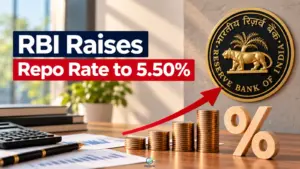
The RBI repo rate was raised before the October inflation figures came out. On 7 October, it unanimously raised the rate by 25 basis points to 5.50%. It was the first hike since February 2023. The RBI also changed its stance to “calibrated tightening”, signalling that rate cuts are off the table for now. The repo rate is the rate at which the RBI lends to banks.
The next Monetary Policy Committee meeting is on 2-4 December. ICRA expects another 25-basis-point increase. That is one forecaster’s view, and the RBI has announced nothing yet.
How Does Rising Inflation Affect the Indian Economy?
- Household spending: Purchasing power means how much you can buy with the same money. If prices rise 6% over a year, a basket of goods that cost ₹10,000 a year ago would cost about ₹10,600 now.
- Cost of borrowing: When the RBI raises the repo rate, banks may raise rates on floating-rate loans, and EMIs can go up.
- Business expenses: Costlier raw materials, fuel, and transport raise what it costs to run a business. Companies may pass this on to customers or absorb it.
- Savings and interest rates: Fixed deposits pay a set rate. If inflation is higher than that rate, savings lose value in real terms. If interest rates keep rising, banks may offer better deposit rates over time.
- Economic growth: Higher prices and costlier loans can slow demand. Growth has stayed firm so far. The RBI has projected GDP growth of 7.1% for FY27.
What Does Rising Inflation Mean for Investors?
The effect is not the same for every sector or investment.
- Stock market investors: Higher inflation and higher interest rates can make markets cautious, because borrowing becomes costlier for companies. Markets do not move on inflation alone, though, and companies are affected differently.
- Banking and financial stocks: Higher rates can improve lending income, but costlier loans can slow credit demand. The impact is mixed.
- Consumer companies: Higher input costs and tighter household budgets can hurt sales and margins. Companies with strong brands often find it easier to raise prices.
- Companies with high operating costs: Businesses that spend heavily on fuel, raw materials, or transport may see margins shrink if they cannot raise prices.
- Debt mutual funds and bonds: Bond prices generally fall when interest rates rise. Funds holding longer-maturity bonds tend to be more sensitive than those holding short-term ones.
- Fixed deposits and savings: An FD rate is fixed when you book it. If inflation runs above it, the real return is low. New deposits may offer better rates if interest rates rise.
What Should Investors Keep in Mind?
- One reading is not a trend. Look at how inflation moves over several months.
- Check real returns. A real return is what is left after subtracting inflation. If an FD pays 6.5% and inflation is 6%, the real return is about 0.5%, before tax.
- Review goals and time horizons. A goal five years away needs a different approach from one twenty years away.
- Avoid decisions based only on headlines.
- Follow RBI announcements and the next CPI release. Both will show whether this rise continues.
FAQs
What is India's retail inflation rate?
It was 6.09% in October 2026, according to MoSPI data. The figure is provisional.
What happens when retail inflation crosses 6%?
It moves outside the RBI's comfort range, and everyday goods get costlier. The RBI watches the trend before deciding on policy.
Why does the RBI target 4% inflation?
The 4% target, with a 2%–6% band, is the level set for the RBI under India's inflation-targeting framework. It keeps prices rising slowly enough for households and businesses to plan.
How does rising inflation affect the stock market investors?
Costlier borrowing and higher input costs can affect company profits. The impact varies by sector and company.
Does high inflation affect mutual funds?
It can. Debt funds are sensitive to interest rate changes. Equity funds depend on how the companies they hold handle higher costs.
ARN Disclosure: Investik Future is an AMFI-registered Mutual Fund Distributor. ARN-341107 — Verify on AMFI ↗. Komal Thakur is the content author and digital marketer; the ARN registration belongs to Investik Future, not to the author personally.