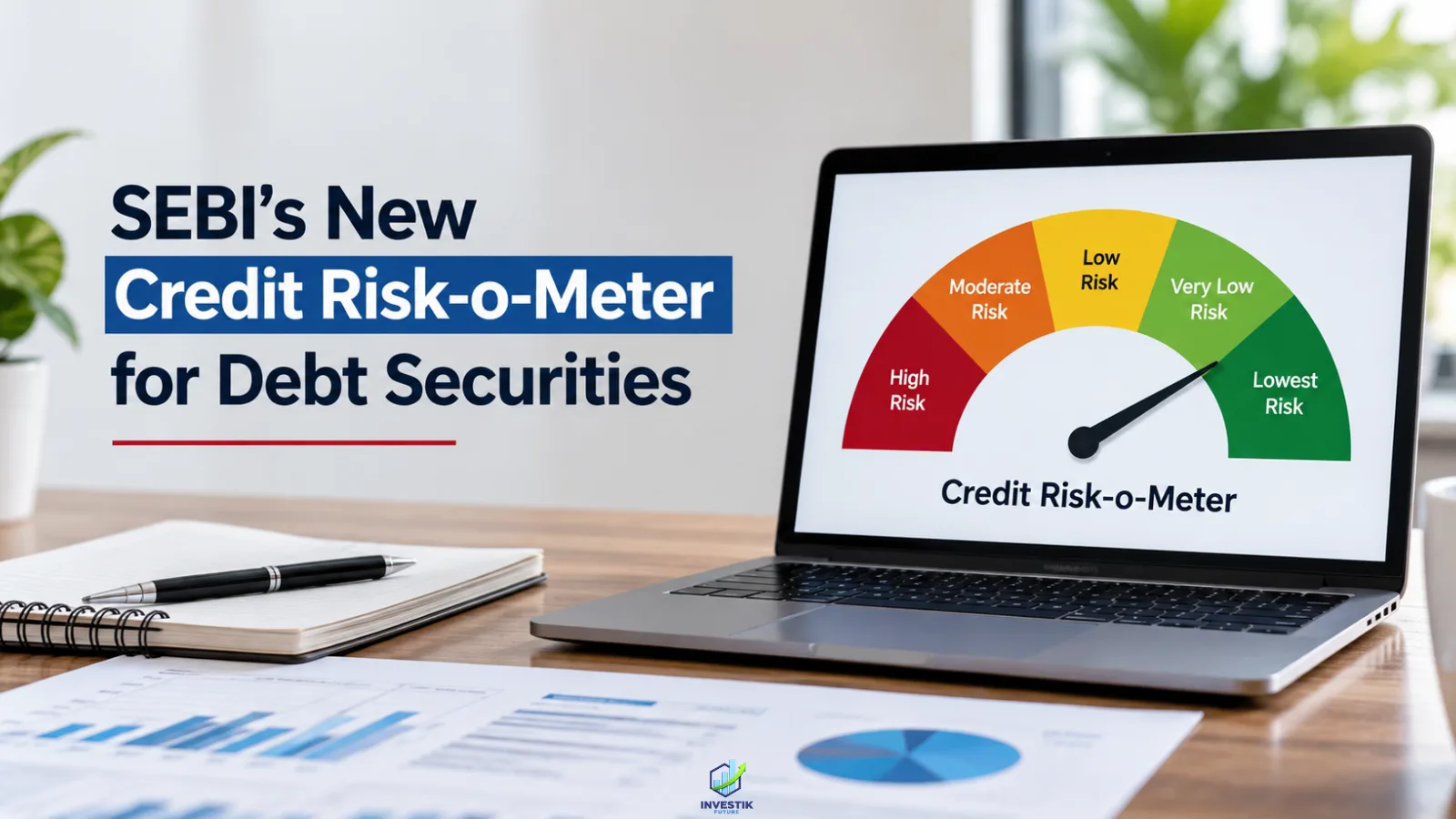

SEBI has made a colour-coded Credit Risk-o-Meter mandatory for debt securities. Under a circular issued on October 7, 2026, issuers and online bond platforms must show a security’s credit risk on a simple visual scale, based on its existing credit rating. For investors, the new meter is designed to make a debt security’s credit risk easier to understand at a glance. The meter shows only one kind of risk, though. This article explains how SEBI’s Credit Risk-o-Meter works and what it does and doesn’t tell you.
What Is SEBI’s Credit Risk-o-Meter?
Credit risk is the possibility that a company or issuer may not be able to repay the money it owes, or may not pay the interest on time. When you invest in a debt security, you are generally lending money to the issuer, so this risk matters.
The Credit Risk-o-Meter is a picture-based meter that shows this risk level for a particular debt security. SEBI has said the meter must make clear that it represents only the credit risk of that security.
It is not a new rating system. The meter takes the credit ratings that already exist, from AAA down to D, and maps them onto six colour-coded levels.
How Does the Credit Risk-o-Meter Work?
The meter groups ratings into six levels. Long-term ratings and short-term ratings (for instruments that mature sooner) each have their own symbols.
| Risk level | Long-term rating | Short-term rating |
| Lowest credit risk | AAA | A1+ |
| Very low credit risk | AA+, AA, AA- | A1 |
| Low credit risk | A+, A, A- | A2 |
| Moderate credit risk | BBB+, BBB, BBB- | A3 |
| Moderate risk of default | BB+, BB, BB- | A4+ |
| High to very high risk of default | B+, B, B-, C+, C, C-, D | A4, D |
The colours run from green at the lowest-risk end to red at the highest-risk end. In simple terms, the better the rating, the lower the credit-risk category shown on the meter.
A few other rules shape how the meter appears:
- Below the meter, the issuer must show the name of the credit rating agency and the actual rating in text.
- If the security is unsecured, the word “unsecured” must appear in bold red text. Unsecured means no specific asset is pledged to back the money.
- If a security has ratings from more than one agency, the meter reflects the lowest rating. The other ratings may still be shown alongside it.
- Where a rating agency has marked “Issuer Not Cooperating”, the meter must show this, and the status must also appear in the text below it.
Which Debt Securities Will Have the Credit Risk-o-Meter?
The meter applies to listed debt securities and those proposed to be listed, whether sold through a public issue or a private placement. The circular covers these types:
- Non-convertible securities (NCS): bonds and debentures that cannot be converted into company shares.
- Commercial papers: short-term borrowing instruments issued by companies.
- Securitised debt instruments: securities backed by a pool of loans or receivables.
- Security receipts: instruments linked to loans that lenders have sold off.
- Structured debt or market-linked debentures: debt products whose returns are tied to a market index or similar measure.
Where Will Investors See the Credit Risk-o-Meter?
SEBI has listed these places:
- Offer documents
- Abridged prospectuses (the shorter version of a prospectus)
- Private placement memorandums (the document used when securities are sold privately to select investors)
- All advertisements by issuers and online bond platform providers (OBPPs)
- Web and mobile platforms of OBPPs
OBPPs are platforms that sell bonds online. They must show the meter on the bond listing and details page before the buttons used to invest. If a rating changes, the platform must update the meter within 24 hours of receiving intimation of the change from NSDL or CDSL, the depositories. They must also use ratings only from SEBI-registered rating agencies and cannot manually override the meter.
Credit Rating vs Credit Risk-o-Meter
The two are related, but they are not the same.
Credit rating: a grade such as AAA, AA, or BBB given by a rating agency to show the credit quality of an issuer or security.
Credit Risk-o-Meter: a visual summary that converts that grade into one of six risk levels.
The meter does not replace the rating. The actual rating must still be shown right below it, along with the name of the agency that assigned it.
What Does the Credit Risk-o-Meter Tell Investors?
It gives a quick, visual idea of where a security sits on the credit-risk scale. A glance can tell you whether it falls in a lower or higher credit-risk band.
It also makes comparison easier. Two bonds from different issuers will show the same kind of meter, so you don’t have to remember what each rating symbol means.
What Does the Credit Risk-o-Meter Not Tell You?
Credit risk is not the only risk in a debt security. SEBI’s required disclaimer says as much: the meter is based on the issuer’s credit risk, is not investment advice, and investments in debt securities also carry market and liquidity risks.
Here is what those other risks mean:
- Interest-rate and market-price risk: bond prices can move when interest rates change, which matters if you sell before maturity.
- Liquidity risk: you may not find a buyer quickly, or at a fair price, when you want to sell.
- Issuer-specific risks: details of the issuer’s business or the terms of the instrument that a rating alone may not capture.
A lower credit-risk level does not mean zero risk. For some complex or unsecured debt instruments, SEBI requires additional warnings because the Credit Risk-o-Meter does not capture every structural risk.
What Should Investors Check Before Investing in a Debt Security?
The meter is a starting point. Investors may want to check:
- Credit rating and agency: the actual rating and which agency gave it.
- Credit Risk-o-Meter: where the security sits on the six-level scale.
- Issuer’s financial position: whether the company’s finances look stable.
- Interest (coupon) rate: the interest rate offered and the risks associated with the security.
- Maturity period: how long your money stays locked in.
- Secured or unsecured status: whether any asset backs the security.
- Liquidity: how easily the security can be sold before maturity.
- Offer document: the other terms and risks the issuer has disclosed.
When Will the New Credit Risk-o-Meter Rules Apply?
According to the circular, the provisions will come into force 45 days from the date of issuance, October 7, 2026. Stock exchanges and depositories have been asked to put the required systems and processes in place and inform existing and prospective issuers.
Key Takeaway
SEBI has made a colour-coded Credit Risk-o-Meter mandatory for debt securities. It turns existing credit ratings into six easy-to-read risk levels, helping investors compare securities more easily. But it covers only credit risk and does not replace the rating. Market, liquidity, and other risks still matter, so it should not be the only factor when evaluating a debt security.









FAQs
What is SEBI's Credit Risk-o-Meter?
It is a mandatory, colour-coded visual that shows the credit risk of a debt security. It is based on the security's existing credit rating. SEBI introduced it through a circular dated October 7, 2026.
What does the Credit Risk-o-Meter show?
It shows which of six risk levels a security fall into, from lowest credit risk to high-to-very-high risk of default. The issuer must also show the rating agency's name and the actual rating below it.
Is the Credit Risk-o-Meter the same as a credit rating?
No. A credit rating is a grade such as AAA or BBB given by a rating agency. The meter converts that grade into a simpler visual scale, and the rating itself must still be disclosed.
Which debt securities will have a Credit Risk-o-Meter?
It covers listed and proposed-to-be-listed non-convertible securities, commercial papers, securitised debt instruments, security receipts, and structured debt or market-linked debentures. This applies to both public issues and private placements.
Does a low credit-risk level mean the investment is risk-free?
No. The meter reflects only credit risk. Debt securities can still carry market, liquidity, and other risks, and SEBI requires a disclaimer saying so.
ARN Disclosure: Investik Future is an AMFI-registered Mutual Fund Distributor. ARN-341107 — Verify on AMFI ↗. Komal Thakur is the content author and digital marketer; the ARN registration belongs to Investik Future, not to the author personally.