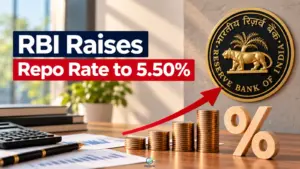

The RBI’s Monetary Policy Committee (MPC) is meeting from October 5 to 7, 2026. The repo rate decision is due on October 7. The meeting is being closely watched because the RBI could raise rates for the first time in over three years.
The repo rate has stayed unchanged for a while now. But inflation has risen, crude oil prices are high, and the rupee is under pressure. That is why the October meeting is being watched more closely than the recent ones.
This article explains what could happen to the RBI repo rate in October 2026, why economists expect a possible hike, and how a rate change could affect home loan EMIs and FD rates.
RBI MPC October 2026: When Is the Repo Rate Decision?
The six-member MPC began its three-day meeting on October 5. The decision is scheduled for October 7.
The repo rate is currently 5.25%. The RBI has kept it unchanged in its last four policy reviews, after cutting it by a total of 125 basis points in 2025. A basis point is one-hundredth of a percentage point.
If the RBI does raise the rate, it will be the first hike since February 2023, when the repo rate went up by 25 basis points to 6.50%.
What Is the Repo Rate?
The repo rate is the rate at which the RBI lends money to banks for the short term. Think of it as the RBI’s basic lending price.
When this price goes up, borrowing becomes costlier for banks. Over time, that can push up the rates banks charge on loans. When it comes down, loans can get cheaper.
You don’t pay the repo rate yourself. But it sits behind many of the rates you do pay and earn. The change is not instant, and it is not the same at every bank.
Why Is the RBI Reviewing the Repo Rate Now?
The RBI reviews rates at every scheduled MPC meeting. This time, though, several things are pulling in the same direction.
Inflation is rising: Headline retail inflation was 4.82% in August, according to reports. That is above the RBI’s medium-term target of 4% for the third month in a row. Wholesale inflation was 9.92% in August, up from 9.78% in July.
Crude oil is expensive: Crude oil prices have remained high, adding to India’s inflation concerns. Oil matters a lot for India because the country imports most of its crude. Costlier oil can push up transport costs and prices of many other goods.
The rupee is weak: Some reported that the rupee has fallen about 6% against the US dollar this year. Foreign investors have also been pulling money out of Indian equities and debt.
Other central banks have raised rates: The US Federal Reserve raised rates by 25 basis points in September, to a range of 3.75–4%. It was the Fed’s first hike in three years. The Bank of Japan also raised its rate to 1.25% in September. Higher rates in other major economies can make overseas assets more attractive and can also put pressure on the rupee.
Growth is strong: India’s GDP grew 7.8% in April–June 2026, above the RBI’s own estimate of 7%. Strong growth means the RBI is not facing the same pressure from a weak economy.
Minutes of the RBI’s August meeting also showed that some MPC members were open to higher rates if price pressures became broader.
What Are Economists Expecting?
Most economists are expecting a hike, but not all of them.
Most economists expect a 25-basis-point hike in the repo rate to 5.50%. Around eight in 10 economists expect a hike, while nearly 60% of economists in another survey shared the same view.
Some economists see it differently. Madan Sabnavis, chief economist at Bank of Baroda, expects the MPC to leave both the repo rate and its policy stance unchanged.
These are forecasts, not decisions. The final call belongs to the MPC.
What Happens If RBI Hikes the Repo Rate?
If the RBI raises the repo rate by 25 basis points, borrowing could become costlier across the system. Here is how that may play out.
- Banks: Their cost of funds could go up, and they may pass some of it on to customers.
- Home loans and floating-rate EMIs: Rates on loans linked to the repo rate could rise. Depending on the lender, you may see a higher EMI, a longer loan tenure, or both.
- Personal and business loans: These could also get costlier, though the timing varies by lender.
- FD rates: Banks may raise deposit rates over time. We look at this below.
- Demand: If borrowing stays expensive for long, people may delay big purchases like homes and cars.
Banks do not all react at the same speed. A single 25-basis-point move may have a small immediate effect. It matters more if rates stay high or rise further.
What If RBI Keeps the Repo Rate Unchanged?
If the MPC keeps the rate at 5.25%, loan rates linked to the repo rate would not automatically change because of the policy decision. Banks may continue with their current pricing.
An unchanged rate could also mean the RBI wants more clarity on inflation, oil prices, and global conditions before acting. In that case, the tone of the Governor’s statement could matter as much as the rate. It may hint at what could happen at the next meeting.
What Could Happen to FD Rates?
A repo rate hike can put upward pressure on deposit rates. Banks may offer higher rates on fresh FDs if their cost of funds goes up.
But it is not automatic. Banks may change FD rates at different times, by different amounts, and for different tenures. Some may not change them at all.
An FD you have already opened keeps its locked-in rate until maturity. A higher rate matters only for new deposits or when you renew a maturing FD. After the decision, it is worth watching your own bank’s updated rate card.
What Could Happen to Home Loan EMIs?
It depends on what kind of loan you have.
Floating-rate loans are generally more directly affected. If your loan is linked to the repo rate, your rate can change when the repo rate changes, usually when your lender resets it. The change may show up as a higher EMI or a longer tenure. Older loans linked to a bank’s MCLR may respond differently.
Fixed-rate loans have a rate that is set in the agreement. An existing fixed-rate loan is generally not affected by a repo rate change.
Here is a simple example. This is a hypothetical, not a bank offer. Take a ₹50 lakh loan for 20 years. If the rate goes from 8.50% to 8.75%, the EMI would rise from about ₹43,400 to about ₹44,200. That is roughly ₹800 more per month.
Your actual change would depend on your lender, your loan type, and your remaining tenure.
What Should Borrowers and Savers Watch?
- The actual October 7 decision: Everything above is a forecast until the RBI announces it.
- The policy stance and guidance: Is the RBI hinting at more hikes, or signalling a pause?
- The inflation outlook: The RBI’s updated inflation forecast will show how worried it is about prices.
- Your lender’s rate update: Banks usually announce changes in lending rates after a policy move. Check how and when yours passes on the change.
- FD rate cards: If you are opening or renewing a deposit, look at what your bank offers after the decision.
Key Takeaway
The RBI’s MPC meets from October 5 to 7, with the repo rate decision due on October 7. The repo rate is currently 5.25%. Most economists polled expect a 25-basis-point hike to 5.50%, but some expect no change. The decision could affect loan rates and FD rates, although the impact will vary from bank to bank. After the announcement, borrowers and savers should check their lender’s or bank’s updated rates.










FAQs
What is the repo rate in October 2026?
The repo rate is currently 5.25%. The RBI's MPC is meeting from October 5 to 7, 2026, and the next repo rate decision is due on October 7.
Will the RBI increase the repo rate in October 2026?
Most economists polled expect a 25-basis-point increase to 5.50%, but some expect the RBI to keep the rate unchanged. The final decision will be announced by the MPC on October 7.
How does a repo rate hike affect home loan EMIs?
A repo rate hike can increase the interest rate on floating-rate home loans linked to the repo rate. This can result in a higher EMI, a longer loan tenure, or both, depending on the lender and loan terms.
Will FD interest rates increase if the repo rate rises?
They may. Banks could raise rates on fresh or renewed FDs if their funding costs increase, but the timing and size of any change will vary between banks.
When will the RBI announce the October 2026 repo rate decision?
The RBI's MPC meeting is scheduled from October 5 to 7, 2026. The repo rate decision is due on October 7.
ARN Disclosure: Investik Future is an AMFI-registered Mutual Fund Distributor. ARN-341107 — Verify on AMFI ↗. Komal Thakur is the content author and digital marketer; the ARN registration belongs to Investik Future, not to the author personally.