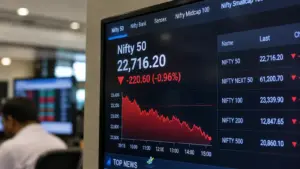
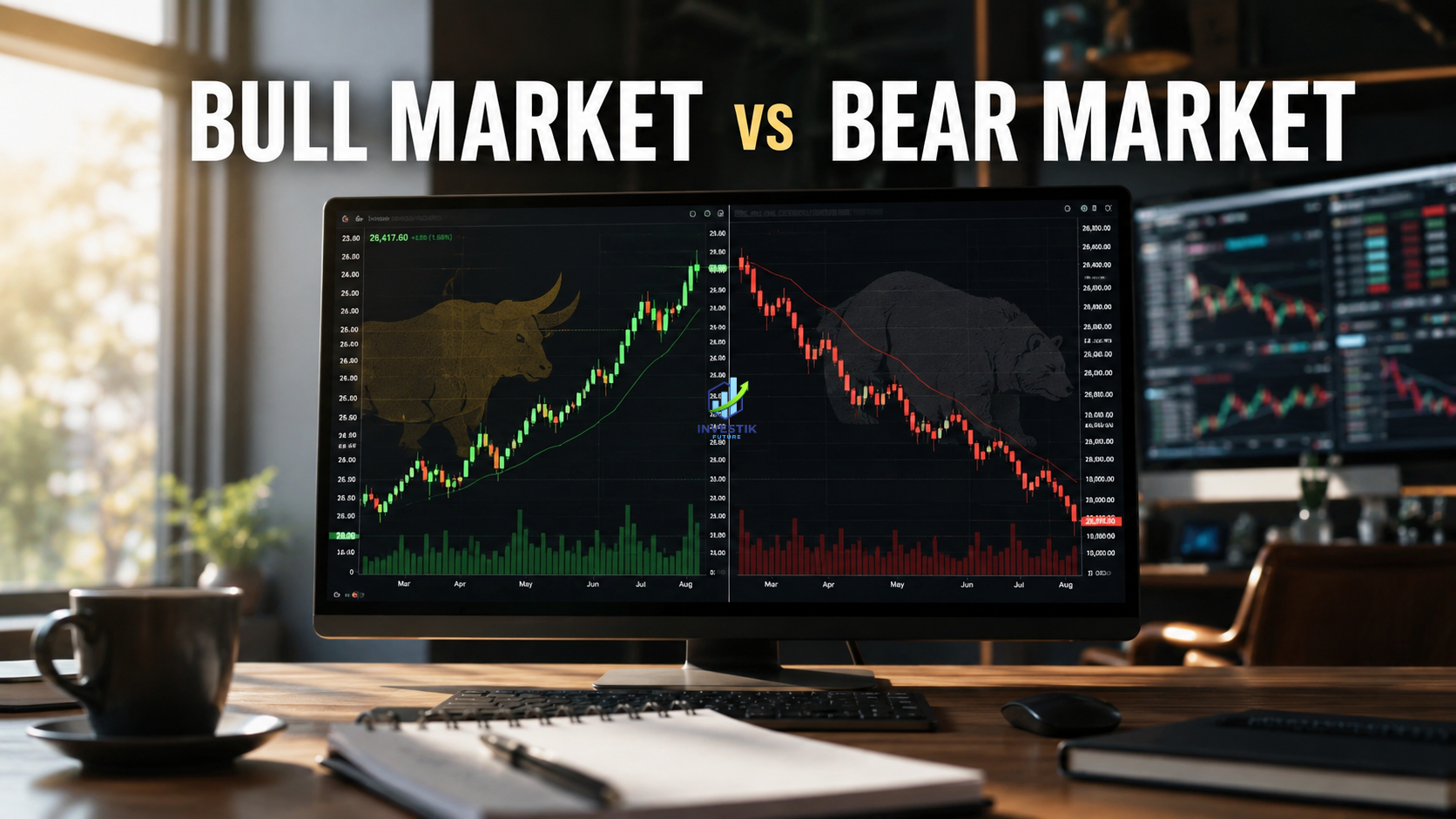

Every investor eventually hears these two words and needs a straight answer: is this a bull market or a bear market, and what should you actually do about it? A bull market is a sustained period of rising asset prices and investor confidence. A bear market is a sustained period of falling prices, usually a drop of 20% or more from a recent high, paired with pessimism and reduced spending.
That’s the short version. The rest of this guide covers where the terms came from, how to read the signs early, what history’s biggest bull and bear markets looked like, how India’s markets have moved through both, and what a practical playbook looks like in each phase. If you’re building a long-term plan, our Market Fundamentals section and the broader Investik Future resource library go deeper into related concepts referenced here.
Why is it called a bull market and a bear market
The animal imagery isn’t random. A bull attacks by driving its horns upward. A bear attacks by swiping its paws downward. Traders borrowed those motions to describe price direction: a market that charges upward is “bullish,” one that swipes downward is “bearish.”
There’s a second, less colorful explanation tied to old trading practices. 18th-century London bearskin traders would sell bear pelts before they’d even caught the bear, betting the price would fall by delivery time. That practice, called “selling the bearskin,” is where short-selling language partly comes from, and it stuck to the bear market name. Whichever origin story you prefer, the working definitions haven’t changed in over 200 years.
Bullish and bearish meaning in the stock market
“Bullish” and “bearish” describe outlook, not just price action.
Bullish means an investor, analyst, or the broader market expects prices to rise. You’ll hear “I’m bullish on IT stocks this year” or “sentiment turned bullish after the earnings season.” It reflects confidence: buyers expect growth, so they’re willing to pay more today for tomorrow’s expected gains.
Bearish means the opposite: expectation of falling prices. A bearish investor might hold cash, buy put options, or short a stock, betting its price drops. Bearish sentiment often shows up before an official bear market does, since fear spreads faster than the 20% price threshold gets hit.
Both words apply beyond stocks too. You’ll see “bullish on gold,” “bearish on the rupee,” or “bearish on crude oil.” The underlying meaning stays the same: which direction does this person expect the asset to move. If you’re new to how prices move in the first place, our beginner’s guide to how the stock market works is a good starting point.
Bull market vs bear market: key differences
Here’s a side-by-side comparison of how the two phases behave across the metrics that matter to an investor.
| Factor | Bull Market | Bear Market |
|---|---|---|
| Price direction | Rising, typically 20%+ from a recent low | Falling, typically 20%+ from a recent high |
| Investor sentiment | Optimism, confidence, FOMO | Fear, caution, panic selling |
| Typical duration | Longer on average, often 2 to 5 years | Shorter on average, often 9 to 18 months |
| Trading volume | High, driven by new entrants | Volatile, spikes during sell-offs |
| Economic backdrop | GDP growth, rising employment, strong corporate earnings | Slowing growth, layoffs, falling corporate profits |
| IPO activity | Heavy new listings, high valuations | IPO window mostly shut |
| Investor behavior | Buying dips, increasing risk exposure | Selling into rallies, moving to cash and debt |
| Best-performing assets | Growth stocks, small caps, cyclicals | Defensive stocks, gold, government bonds |
| Common investor mistake | Overconfidence, chasing momentum | Panic selling at the bottom |
A quick way to hold this table in your head: bull markets reward patience and staying invested; bear markets reward discipline and not making decisions out of fear. If any of the terms in this table are unfamiliar, our market glossary covers the vocabulary in more depth.
Bull vs bear market: when to buy
This is the question everyone actually wants answered, and the honest response is that timing the exact bottom or top is close to impossible, even for professional fund managers. What works instead is a rules-based approach.
Buying in a bull market: The risk isn’t missing out, it’s overpaying. Valuations run hot late in a bull cycle. A disciplined approach is to keep investing through a SIP rather than lump-sum buying at market highs, so your average purchase price smooths out across the cycle.
Buying in a bear market: This is historically when long-term wealth gets built, because quality assets trade at a discount. The catch is that nobody rings a bell at the bottom, and prices can keep falling for months after you start buying. Staggered buying, spreading purchases over several months rather than deploying all capital at once, reduces the risk of buying too early.
A practical rule many long-term investors follow: increase equity allocation gradually as prices fall in a confirmed bear market, and avoid increasing risk aggressively once a bull market is already mature. Your entry price matters less over a 10-year horizon than your ability to stay invested through both phases.
What does bear market mean for a portfolio
A bear market doesn’t just mean red numbers on a screen. It changes portfolio behavior in specific ways:
- Correlation rises. Asset classes that normally move independently often fall together during sharp bear phases, especially in the first shock (2020’s COVID crash showed this clearly, when even gold dipped briefly as investors sold everything for cash).
- Liquidity tightens. Companies with weak balance sheets struggle to raise funds, and this shows up first in small caps and IPO-stage businesses.
- Dividend and quality stocks hold up better. Businesses with stable cash flows and low debt tend to fall less than speculative, high-growth names.
- Volatility spikes. Daily price swings of 2 to 5% become common, compared to under 1% in calmer bull phases.
Understanding this helps set expectations: a bear market test isn’t just “can I handle losses,” it’s “can I handle losses without changing my plan.”
Bull and bear market examples
History gives concrete reference points for both.
Dot-com bear market (2000 to 2002): The Nasdaq fell nearly 78% from its March 2000 peak as speculative internet-company valuations collapsed. Companies with no profit and no clear business model, some trading at hundreds of times revenue, lost almost all their value.
Global Financial Crisis bear market (2007 to 2009): Triggered by the US subprime mortgage collapse, the S&P 500 fell roughly 57% peak to trough. Major banks failed or were bailed out, and the recovery took years.
COVID-19 bear market (February to March 2020): One of the fastest bear markets on record. The S&P 500 fell about 34% in roughly five weeks as economies shut down globally. It was also one of the fastest recoveries, with markets reclaiming pre-crash highs within months, aided by aggressive central bank stimulus.
Post-pandemic bull market (2020 to 2021): Fueled by low interest rates, stimulus spending, and retail investor participation, global equity markets rallied sharply, with several indices more than doubling from their March 2020 lows.
2022 bear market: Rising inflation and aggressive interest rate hikes by central banks, including the US Federal Reserve, pushed major indices down over 20% from their highs, ending the pandemic-era bull run.
Bull and bear market in India
Indian markets have followed the same broad pattern as global markets, with some local drivers layered on top.
The 2008 crash hit Indian indices hard alongside global markets, with the Sensex falling more than 50% from its January 2008 peak, driven by foreign investor outflows and the global credit crisis.
The 2013 to 2017 bull run coincided with economic reforms, falling inflation, and strong foreign and domestic institutional inflows, with the Nifty and Sensex posting multi-year gains.
The March 2020 COVID crash saw the Sensex and Nifty fall roughly 38% in weeks, followed by one of the sharpest recoveries in Indian market history through 2020 and 2021, supported by record retail participation and low interest rates.
The 2022 correction mirrored global markets, with FII (foreign institutional investor) selling and rate hikes by the RBI pressuring valuations, though Indian markets held up relatively better than several global peers.
India’s market cycles are shaped by a mix of global liquidity, monsoon and inflation trends, RBI policy, and domestic retail investor flows through mutual funds and SIPs, which have grown into a structural source of demand over the past decade. If you want the mechanics behind how that inflow works, our guide on what an SIP is and how it works breaks it down.
Is 2026 a bull market or a bear market
This is one of the most searched questions on this topic, and the honest answer is that it depends on when you’re reading this and which asset or index you’re asking about, since market phases shift and this article is written to stay useful regardless of the exact month. Rather than name a specific verdict that will age quickly, here’s the framework analysts actually use to answer it for themselves:
- Check the drawdown from the recent high. A fall of 20% or more from a peak is the standard bear market threshold; under that, it’s typically called a correction.
- Look at the trend over 200 days, not 20. Short-term rallies happen inside bear markets, and short-term dips happen inside bull markets. The 200-day moving average is a common reference line for the broader trend.
- Check earnings, not just prices. Prices can fall on sentiment alone, but a bear market becomes structural when corporate earnings and GDP growth are also declining.
- Watch central bank policy. Rate cuts often support bull phases by making borrowing cheaper; rate hikes to control inflation often precede or accompany bear phases.
For a current read on where major indices stand, check live data on NSE India rather than relying on any article’s snapshot, since index levels change daily and this guide is built to stay accurate for years, not days.
How bull and bear markets affect different investors
New investors often experience their first bear market as shocking, because bull markets teach the wrong lesson: that prices mostly go up. The investors who build long-term wealth are usually the ones who keep investing through the downturn instead of stopping their SIPs.
Retirees and near-retirees face a different risk: sequence-of-returns risk, where a bear market early in retirement, combined with withdrawals, can permanently damage a portfolio’s ability to recover. This group typically needs a higher allocation to debt and defensive assets going into a market top.
Traders treat both phases as opportunity, going long in bull markets and short in bear markets, but this requires active risk management, since even confirmed trends can reverse sharply on a single data point or policy announcement.
Investment strategy for a bull market
- Stay invested, don’t chase. Late-stage bull markets tempt investors into overpriced, hyped sectors. Stick to your allocation plan.
- Rebalance periodically. If equities have run up and now form 80% of your portfolio instead of a planned 60%, trim back to your target allocation rather than letting winners take over your risk profile.
- Use compounding, don’t fight it. Time in the market during a bull phase is what builds real wealth; our explainer on the power of compounding shows the math behind why patience outperforms timing.
- Book partial profits on stretched valuations, especially in sectors trading well above historical averages, without exiting the market entirely.
Investment strategy for a bear market
- Don’t stop your SIPs. Pausing systematic investments during a downturn locks in losses and removes the benefit of buying at lower prices.
- Rebalance into equity, gradually. If your equity allocation has fallen below target due to price declines, use fresh money or rebalancing to bring it back up in stages.
- Prioritize quality. Companies with low debt, consistent cash flow, and defensible market positions tend to recover faster than speculative names.
- Keep an emergency fund separate from investments, so a market downturn never forces you to sell equity at a loss to cover a personal cash need.
- Avoid leverage. Borrowed money to invest amplifies losses exactly when you can least afford it.
Common mistakes investors make in both phases
- Panic selling near the bottom of a bear market, which converts a temporary paper loss into a permanent real one.
- Overexposure to a single sector during a bull run, chasing whichever theme is currently outperforming.
- Timing the market instead of time in the market, trying to guess exact tops and bottoms rather than following a consistent plan.
- Ignoring asset allocation, letting a portfolio drift into a risk level that doesn’t match personal goals or timeline.
- Checking the portfolio too often during volatility, which increases the temptation to make emotional, short-term decisions.
For a deeper look at how diversified instruments like index funds and ETFs can reduce single-stock risk in both phases, see our dedicated guide. For plain-language definitions of terms used across the investing world, Investopedia is a reliable external reference.
Taxation on gains during bull and bear markets in India
Bull markets create realized capital gains when you sell winning positions; bear markets can create losses that are useful for tax purposes.
Under current Indian tax rules, equity shares and equity mutual funds held for more than 12 months qualify for long-term capital gains (LTCG), taxed at 12.5% on gains above ₹1.25 lakh in a financial year. Gains on equity held for 12 months or less are short-term capital gains (STCG), taxed at 20%. Losses booked during a bear market can be set off against gains and, if unused, carried forward for up to 8 assessment years under current rules.
Tax rules change with each Union Budget, so verify the current rates on the Income Tax Department website or through SEBI’s investor resources before filing, rather than relying solely on this or any other article.
Bull market vs bear market checklist
Use this before making a portfolio decision in either phase:
- Have I checked the actual drawdown or gain percentage from the recent high or low?
- Does my asset allocation still match my risk tolerance and timeline?
- Am I making this decision based on a plan, or based on fear or excitement?
- Is my emergency fund intact and separate from my investments?
- Have I reviewed my SIPs to confirm they’re still running?
- Am I diversified across sectors and asset classes, not concentrated in one theme?
- Have I checked current interest rate and earnings trends, not just price charts?
Frequently asked questions
How long does a bull market usually last?
Historically, bull markets have lasted longer than bear markets, often running 2 to 5 years or more, though duration varies significantly by cycle and region.
How long does a bear market usually last?
Bear markets have historically been shorter, often 9 to 18 months, though some, like the one following the 2000 dot-com crash, lasted longer.
Can a bear market happen inside a bull market?
Yes, in the form of a correction, typically a 10 to 20% pullback that doesn’t meet the 20% threshold for a full bear market before the uptrend resumes.
Is it safe to invest during a bear market?
Investing during a bear market carries short-term risk since prices can keep falling, but historically it has offered better long-term entry points for investors with a multi-year horizon and a diversified approach.
What sectors perform best in a bear market?
Defensive sectors such as consumer staples, utilities, and healthcare, along with gold and high-quality government bonds, have historically held up better than cyclical and growth sectors during downturns.
Conclusion
A bull market and a bear market aren’t just labels for good days and bad days. They’re recurring phases with distinct behavior in prices, sentiment, sector performance, and investor psychology, and every long-term portfolio will pass through both more than once. The investors who come out ahead over a decade aren’t the ones who correctly predicted every top and bottom. They’re the ones who kept a plan, stayed diversified, and treated both phases as normal parts of investing rather than emergencies.
If you’re building or reviewing your allocation across market cycles, our Personal Finance section and SIP calculator are good next stops to turn this framework into an actual plan.
ARN Disclosure: Investik Future is an AMFI-registered Mutual Fund Distributor. ARN-341107 — Verify on AMFI ↗. Komal Thakur is the content author and digital marketer; the ARN registration belongs to Investik Future, not to the author personally.