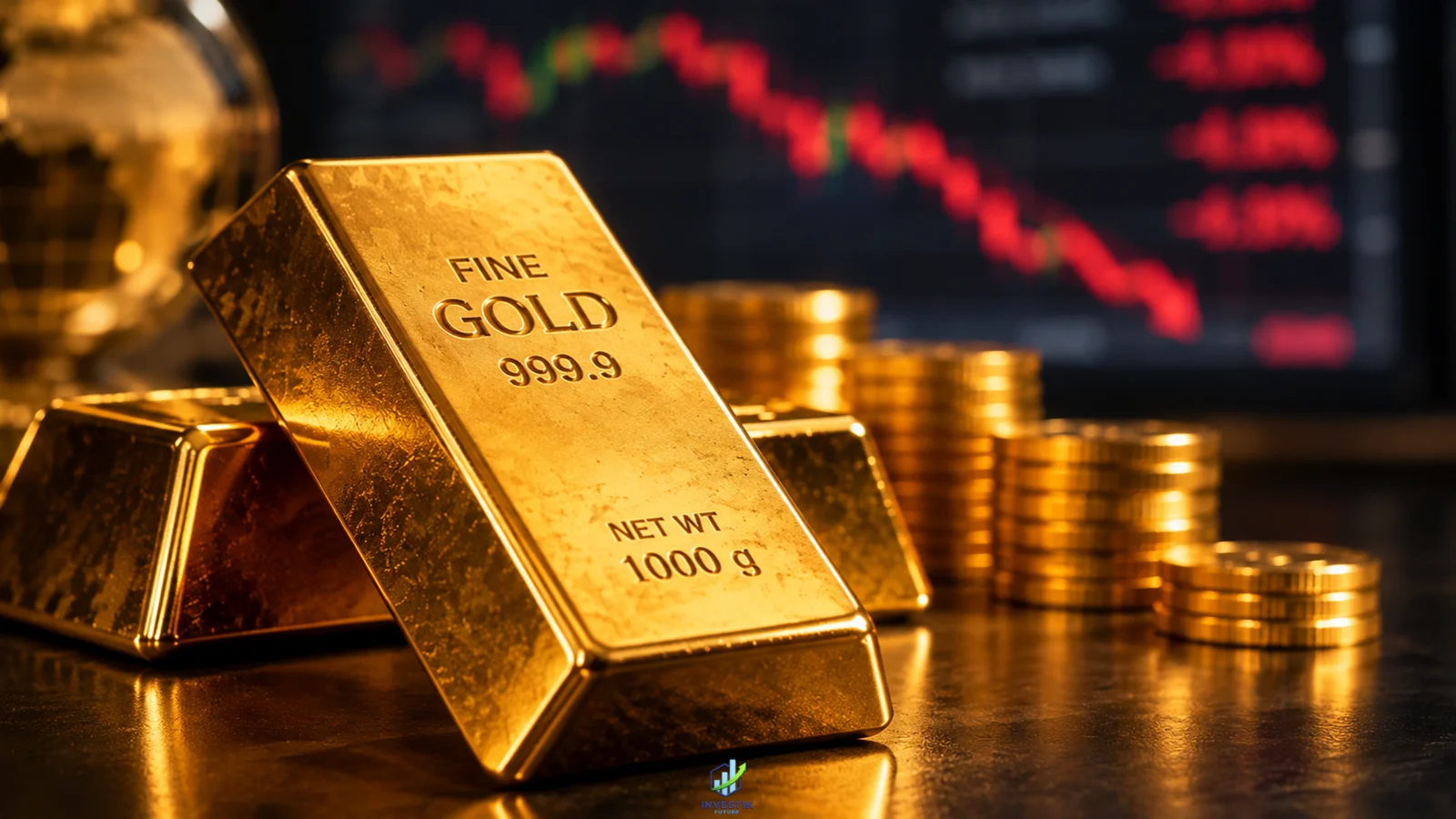

MCX gold prices fell nearly 2% on Wednesday, 18 November 2026, as selling pressure pushed December futures down to ₹1,31,420 per 10 grams in morning trade. The decline came amid a stronger US dollar, rising US Treasury yields and growing expectations of an interest rate hike by the US Federal Reserve.
The fall in gold prices is not limited to the Indian market, as international prices have also come under pressure. But what is driving this decline, and how could it affect people buying jewellery, investing in gold ETFs or holding physical gold?
The article explores why MCX gold prices fell nearly 2%, examining the impact of a stronger US dollar, rising US Treasury yields, and expectations of a Fed rate hike. It also explains what the decline could mean for Indian gold buyers and investors.
MCX Gold Prices Fall Nearly 2%
The December contract opened at ₹1,31,622, which was ₹2,601 lower than its previous close of ₹1,34,223. It declined further to ₹1,31,420.
Three numbers are worth keeping apart. The previous close (17 November) was ₹1,34,223, the opening price on 18 November was ₹1,31,622, and the latest price quoted was ₹1,31,420. The figure is an intraday quote, not a closing price, and it keeps changing through the session.
A gold futures contract is an agreement to buy or sell gold at a fixed price on a future date. Traders on MCX buy and sell these contracts all day, so the price keeps changing.
This is not a one-day move. In the week ended 13 November, the same contract fell ₹5,847, or 4.10%, to close at around ₹1.36 lakh per 10 grams.
Why Is MCX Gold Falling?
No single reason explains the fall. Analysts point to a mix of factors, and most of them are linked to US interest rates.
- Stronger US dollar: The dollar is near its highest level in 19 months. Gold is priced in dollars worldwide. When the dollar gains strength, gold becomes more expensive for buyers who pay in other currencies. That can weaken demand and pull prices down.
- Higher US Treasury yields: A Treasury yield is the interest the US government pays on its bonds. The 10-year yield is above 5%, at about 5.1%. When US Treasury bonds offer yields of around 5%, they can become more attractive because they provide interest income, while gold does not.
- Expectations of a Fed rate hike: CME’s FedWatch tool shows about a 96% chance of a quarter-point hike next month. The Fed’s next meeting is on 8-9 December. A quarter-point is 0.25 percentage points. Higher interest rates can support the US dollar and Treasury yields, while making non-interest-paying assets such as gold less attractive. Inflation data has added to this. US consumer prices rose 0.4% in October, above the 0.3% that analysts expected. St. Louis Fed President Alberto Musalem has said the Fed may need several rate hikes. Markets are also awaiting the minutes of the Fed’s October meeting, scheduled for release later on Wednesday in the US.
- Investor selling: Ajay Kedia of Kedia Advisory said gold was seeing “long unwinding”. That means traders who bought earlier are closing those positions. Rajeev Sharan of Brickwork Ratings said gold has entered a consolidation phase after a strong rally earlier this year. These are analysts’ views. The reports reviewed do not say how much of the selling is profit-booking.
- Oil and geopolitics: Higher oil prices and geopolitical developments can also influence inflation expectations. However, analysts currently see US yields and Fed pricing as mattering more for gold than geopolitical headlines.
What Is Happening in the International Gold Market?
Spot gold slipped below $3,800 an ounce in Asian trade on 18 November, for the first time since 29 September 2025. It fell about 1.4% to around $3,795. One data feed showed a low near $3,792, so exact levels differ slightly by source.
Spot gold is the price for immediate delivery in the global market, quoted in dollars per ounce. One ounce is about 31 grams. MCX gold futures are quoted in rupees per 10 grams and are for delivery in December.
The two prices usually move in the same direction. India depends heavily on imported gold, so global prices, the dollar, and the rupee all feed into domestic rates.
How Does the Falling Gold Price Affect Indian Buyers and Investors?
- Jewellery buyers: Jewellers price ornaments using the domestic gold rate, then add making charges and GST. A 2% fall on MCX does not automatically mean jewellery gets 2% cheaper.
- Coins and bars: These follow the same domestic rate, plus GST and the seller’s premium. Final prices vary from seller to seller.
- Gold ETF investors: Gold ETFs generally track domestic gold prices, so their NAV can also decline when gold prices fall. The exact movement depends on the fund’s expenses and tracking difference.
- Existing holders: The market value of their gold holdings falls when prices decline. The gain or loss becomes realised when they sell the gold.
MCX futures are also not the same as the rate on your jeweller’s board. On 16 November, December gold futures were quoted at around ₹1,35,680 per 10 grams, while the reported 24-carat gold rate was around ₹1,36,800. These figures come from different markets and pricing methods, so they should not be compared as identical rates.
Taxes and the rupee also matter. Since 13 May 2026, imported gold bars carry a 15% customs duty (10% basic duty plus 5% cess), with 3% IGST on imports. This is part of the landed cost of imported gold. It is not a separate charge added to every jeweller’s quoted rate.
The rupee works the same way. It closed at 94.24 per dollar on 13 November. If the rupee weakens, imported gold costs more in rupees, which can soften a global price fall. For example, if international gold prices fall 2% but the rupee weakens 1% against the dollar, the decline in the rupee value of gold could be closer to 1%, assuming other factors remain unchanged.
What Should Investors and Buyers Watch Next?
Several developments can influence gold prices in the coming days:
- US dollar: whether it stays near its 19-month high.
- US Treasury yields: especially the 10-year yield near 5%.
- Federal Reserve: the October meeting minutes and signals ahead of the December meeting.
- International gold prices: how spot gold behaves around the $3,800 mark.
- Rupee-dollar rate: movements that change the rupee cost of gold.
- Global developments: inflation data, oil prices and tensions in West Asia.
Conclusion
MCX gold has fallen mainly because of a stronger dollar, high US yields and expectations of a Fed rate hike, along with some selling by traders. These factors are linked, and none of them alone explains the move.
Domestic gold prices follow global trends and the rupee-dollar rate. Local taxes and jewellers’ charges then decide what buyers finally pay. The fall changes the market value of gold, but how it affects each person depends on whether they are buying, holding, or selling.
FAQs
Why is gold falling on MCX?
MCX gold is falling mainly because of a stronger US dollar, high US Treasury yields, and expectations of a US Federal Reserve rate hike in December. Some traders are also closing earlier buy positions. These factors work together, and none of them alone explains the fall.
Why are gold prices falling today?
International prices are under pressure, and MCX follows them. Spot gold slipped below $3,800 an ounce on 18 November, for the first time since 29 September 2025. A firm dollar and rising US bond yields make gold less attractive to global investors, and that feeds into Indian prices.
Why did gold prices suddenly fall?
The fall was not caused by one sudden event. In the week ended 13 November, MCX December gold futures fell 4.10%. Higher-than-expected US inflation data and stronger rate-hike expectations built up over the week. The 18 November drop of nearly 2% came on top of that.
Will gold prices rise or fall in the coming days?
No one can say for certain. Gold prices depend on the US dollar, Treasury yields, the Fed’s decisions, international gold prices, and the rupee-dollar rate. Global economic and geopolitical news can also move prices.
Is the MCX gold price the same as the gold rate today at my jeweller?
No. MCX shows futures prices for a contract, quoted per 10 grams. Jewellers use the domestic gold rate, then add GST, making charges, and their own margin. The two figures are usually close but rarely identical.
ARN Disclosure: Investik Future is an AMFI-registered Mutual Fund Distributor. ARN-341107 — Verify on AMFI ↗. Komal Thakur is the content author and digital marketer; the ARN registration belongs to Investik Future, not to the author personally.