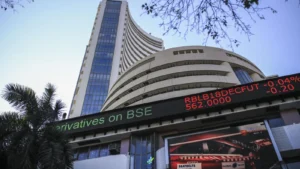


Sensex and Nifty slipped over 1.5% today, and I’ve been watching the markets closely to understand why this steep drop happened. To me, it feels less like a sudden shock and more like a harsh reality check after a brief bull run.
Markets often move on expectations, and right now, those expectations are being shaped far more by global tensions than domestic strength. The fact that the Nifty slipped below the crucial 23,000 mark tells me that sentiment has clearly turned cautious.
At around midday, the Sensex was down over 1,200 points while the Nifty lost more than 350 points. But beyond the numbers, what really matters here is why this is happening and, more importantly, what it tells us about the future.
The article explains that Sensex and Nifty fell over 1.5% today, post profit booking following recent gains, as well as geopolitical tensions between the US and Iran, bearish movement in crude oil prices, and a weak rupee weighed on investor sentiments. It also discusses how those entangled global and domestic factors are impacting market sentiment, and what investors will need to keep a close eye on in the coming days.
Profit Booking: The First Trigger I Noticed
One of the basic reasons I see behind today’s fall is profit booking.
Over the last two sessions, markets had rallied sharply by nearly 3.5%. Whenever I see such quick gains in a short span, I automatically expect some level of consolidation or pullback. That’s exactly what played out today. What stood out to me was the breadth of the decline:
- Almost all major sectors were in the red
- Mid-cap and small-cap stocks dropped around 1.5% each
- Declining stocks heavily outnumbered advancing ones
This tells me that the selling wasn’t isolated; it was broad-based and sentiment-driven. From my experience, profit booking alone doesn’t cause panic. But when it coincides with bigger global risks, it can accelerate the fall, which is exactly what happened today.
Geopolitical Tensions: The Bigger Story Driving Markets
If there’s one thing I’m watching more than anything right now, it’s the continuing geopolitical tension between the US and Iran.
Some optimism was initially reflected in the market when the US signalled that it may postpone drastic measures. But that optimism faded quickly. Here’s what caught my attention:
- The US extended a pause on attacks, but only temporarily
- Iran referred to the proposal as “one-sided and unfair.”
- Reports suggest possible escalation, including troop deployment
This to-and-fro uncertainty is precisely what markets despise. Global markets reacted sharply:
- US equities fell nearly 2%
- Treasury yields climbed above 4.4%
- Asian markets followed with declines
Whenever I see synchronized global selling like that, I say this is not just a local issue; it’s a risk-off environment.
Crude Oil Above $100: The Real Pressure Point
If there’s one metric that I believe is quietly driving most of the panic, it’s crude oil prices.
Despite some pullback, Brent crude is still hovering above $100 per barrel. For India, this is critical. Here’s how I interpret it:
- Higher crude leads to a higher import bill
- A higher import bill puts pressure on the fiscal balance
- That eventually impacts inflation, currency, and markets
Even though oil prices dipped slightly after diplomatic signals, the volatility itself is a concern. From what I’ve observed over the years, markets don’t just react to high prices; they react to uncertainty in prices. And right now, crude is unpredictable.
Also Read: Bond Yields Jump 1 bps: Oil Surge Triggers Concern
Weak Rupee: A Signal I Never Ignore
A related, big red flag I am seeing is the sharp drop of the Indian rupee.
The rupee hitting a record low beyond ₹94 per dollar is not something I take lightly. Here’s why this matters to me:
- It reflects global investor nervousness
- It increases the cost of imports (especially oil)
- It discourages foreign investment flows
What’s interesting is that foreign investors were still selling, even during the recent market rally. That tells me the underlying confidence wasn’t strong to begin with. In my view, the rupee is often a leading indicator of deeper stress in the system, and right now, it’s clearly under pressure.
Also Read: Rupee Drops to 93.84: RBI Intervention in Sharp Focus
Rising VIX: Fear Is Back in the Market
One indicator I always keep an eye on during volatile times is the India VIX, often called the “fear gauge.”
Today, it jumped around 7.5%, signalling rising uncertainty. Whenever VIX rises sharply:
- Traders become more cautious
- Short-term volatility increases
- Markets tend to remain under pressure
To me, this proves that the current fall isn’t only technical but also emotional and sentiment-driven.
What This Means for the Indian Market
So now the big question I’ve been asking myself: Is this merely a temporary correction, or something deeper? Based on all that I’m seeing, the answer hinges largely on one thing: how long the geopolitical tension continues.
There are two possible scenarios:
1. If the Conflict Eases
- Crude prices could cool down
- Rupee may stabilize
- Markets could recover quickly
India’s fundamentals are still strong, and I genuinely believe the economy can absorb short-term shocks.
2. If the Conflict Prolongs
- Crude may stay elevated
- Inflation risks could rise
- Rupee may weaken further
- Markets could correct more deeply
In this case, markets will start pricing in long-term economic stress.
How I’m Looking at This as an Investor
Personally, I’m not reacting emotionally to today’s fall. Instead, I’m focusing on:
- Whether crude stabilizes
- Movement in the rupee
- Global market trends
- FII (foreign investor) behaviour
Short-term volatility doesn’t change long-term opportunities, but it does demand caution. If anything, this phase reminds me that markets are not just about earnings and growth; they’re deeply influenced by global events.
Final Thoughts
Today’s market decline isn’t merely about numbers; it is about uncertainty, global risk and changing sentiment. The market, at least from what I see, isn’t panicking yet, but it’s certainly getting cautious.
Everything right now comes down to one thing: How the global situation unfolds, especially the Iran conflict. Until then, I’m staying alert, not reactive.
Also Read: Stock Market Rally: Sensex 900-Point Surge Signals Relief
Disclaimer
This article is intended for informational and educational purposes only. It is an opinion piece based upon personal observations, and one should not use this as financial advice. Investors are advised to consult their financial adviser before making any decisions based on the above. Market investments are subject to risks, including loss of capital.

Himani Soni
I’m Himani Soni, a finance content strategist with 2+ years at Investik Future. I decode market trends and simplify complex investing concepts into clear, actionable insights for the everyday investor.