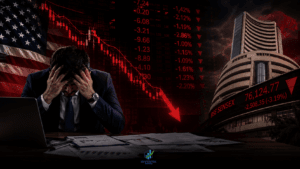

I’ve been following global markets closely these last few sessions, and Wednesday’s move on Wall Street definitely stood out. It was no ordinary decline; it felt as if several risks were finally showing up, all at once, in investor sentiment.
I wasn’t surprised that the Federal Reserve decided to leave rates alone, but Jerome Powell’s caution and the expectation of just one rate cut this year left a sense that policymakers aren’t sure where inflation and growth will settle. At the same time, escalating geopolitical tensions and a significant jump in oil prices have added a new cause for worry.
What really caught my attention was the widespread selling across sectors, which makes me think this was not just an overreaction to one event; it seems part of a larger movement toward caution in the market.
This article explains why U.S. markets dropped sharply, what the latest Federal Reserve stance really means, and how rising oil prices and a conflict in the Middle East could affect investors for the rest of 2026.
What Triggered the Market Sell-Off?
From my perspective, this wasn’t just a routine market dip; it was a combination of policy caution, geopolitical fear, and inflation pressure all hitting at once.
Wall Street ended sharply lower after the Federal Reserve decided to hold interest rates steady, which wasn’t surprising on its own. What caught my attention was the Fed’s projection: Only one rate cut expected this year, and even that without a clear timeline.
That signals something important: the Fed is not yet confident that inflation is under control. At the same time, tensions involving the U.S., Israel, and Iran are escalating, and markets hate uncertainty. Add rising oil prices into the mix, and you have a perfect storm.
Fed’s Cautious Stand Signals Deeper Uncertainty
Listening to Jerome Powell, the tone was clear, and uncertainty is still very high. As I understood it, the Fed is juggling a tricky balancing act:
- Inflation is still above target
- The economy remains relatively robust.
- Geopolitical risks are rising rapidly.
That leaves the Fed in a position where lowering rates too hastily could reignite inflation, but maintaining elevated rates for an extended period could meaningfully temper the economy. One of the things that stood out to me is the Fed not rushing to support markets anymore.
Inflation Data Adds to the Pressure
Another thing that was notable was the recent inflation numbers.
The Producer Price Index (PPI) rose 3.4% year-on-year, higher than expectations. That might sound like just a number, but here’s why it matters:
- It signals upstream cost pressure
- Businesses will likely pass these costs on to consumers
- Inflation might reaccelerate rather than cool
And then when I put this together with rising oil prices, the picture gets much clearer; inflation risks are not going away anytime soon.
Oil Prices Surge: A Hidden Risk to Markets
One of the most troubling developments, I think, is the spike in crude oil prices. Brent crude rose toward $110 a barrel, supported by reports of assaults on Iranian oil infrastructure. This is significant because:
- Higher oil prices increase transport and production costs
- They directly impact inflation
- They reduce consumer spending power
In the past, whenever we got a sharp spike in oil, the markets tended to react negatively, and we are seeing it come into play again.
Market Reaction: Broad-Based Weakness
What really caught my eye was how widespread the sell-off was.
- S&P 500 fell 1.36%
- Nasdaq dropped 1.46%
- Dow Jones declined 1.63%
But more importantly, all 11 sectors in the S&P 500 ended in the red. That tells me this wasn’t sector-specific; it was a risk-off sentiment across the board.
Consumer-focused sectors like consumer staples and consumer discretionary were among the worst hit, which signals concern about future spending trends.
Stocks That Defied the Trend
There were a handful of stocks that were strong even in a down market, and I always find the moves interesting because they point to where money is still moving.
- Advanced Micro Devices (AMD) gained after announcing the extension of its AI partnership.
- Apollo Global Management bounced back from losses earlier
- Lululemon Athletica surged on strong earnings
- Macy’s surged after topping profit estimates
What this tells me is simple: Even in weak markets, stock-specific stories still matter.
Tech Signals Mixed Sentiment
I think it’s worth noting that the tech space was sending mixed signals.
- NVIDIA edged lower despite regulatory progress there in China
- Micron Technology dropped after the forward guidance
This indicates that even in fast-growing industries such as A.I. and semiconductors, investors are getting more selective.
What This Means for Investors Going Forward
After looking at all of this, here’s how I’m interpreting the situation:
- The Easy Rally Phase May Be Over: Markets were pricing in multiple rate cuts in 2026. That narrative is now weakening.
- Geopolitical Risk Is Back in Focus: The worries over Iran aren’t just a headline; they’re already impacting oil, inflation, and sentiment.
- Volatility Could Increase: As Fed policy remains uncertain, inflation is sticky, and global tensions are rising, markets could be rocky in the near term.
How I Would Approach This Market
What I can tell you personally is that there’s no reason to panic at this point, but also a reason to be cautious. Some strategies I’m considering:
- Concentrating on quality stocks that have strong earnings visibility
- Avoiding overexposure to highly volatile sectors
- Ensuring to have cash for dips and bargains
- Keeping an eye on oil prices as a potential leading indicator
Final Thoughts
What I find most striking about this market move is not the actual decline, but its cause. This is a market that is:
- No longer fully confident about rate cuts
- Increasingly sensitive to geopolitical shocks
- Closely watching inflation signals
And when all these elements align, even a stable policy decision can set off a strong reaction. For now, I think the important thing is to stay informed, stay selective, and avoid being swept up by short-term fluctuations in market prices.
Also Read: Coal India Jumps 4% Amid Energy Supply Fears
Disclaimer
This article is for informational purposes only and represents personal opinions. This should not be financial advice. Before making any investment, you should consult your financial adviser.

Himani Soni
I’m Himani Soni, a finance content strategist with 2+ years at Investik Future. I decode market trends and simplify complex investing concepts into clear, actionable insights for the everyday investor.