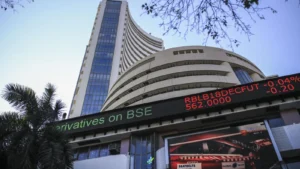


Today, I watched the markets slip sharply into the red, and the scale of the fall immediately stood out. The Sensex dropped 1,532.38 points, or 2.1%, to 71,601.94, while the Nifty fell 479.85 points, or 2.12%, to 22,199.55. What made this even more concerning for me was the broader market picture, only about 810 shares advanced, while 2,545 declined and 142 remained unchanged.
This wasn’t just a minor correction. With the Nifty and Sensex down about 16% and 17%, respectively, from their lifetime highs now, there seemed to be a stronger top-down blanket of pessimism.
In this article, let me explain what, in my opinion, caused this massive market drop, and what it truly indicates.
The Real Trigger: Rising Global Tensions
The biggest trigger, in my opinion, came from rising geopolitical risks. US President Donald Trump’s announcement that the US would hit Iran “very hard” in the coming two to three weeks disturbed the global mood. What compounded the uncertainty was the lack of a clear road map to end the conflict.
The immediate response was reflected in crude oil prices. Brent crude climbed nearly 5 per cent to around $105 per barrel. That’s an issue where India is seriously concerned. Higher crude prices usually translate into:
- Rising inflation
- Pressure on the rupee
- A widening trade deficit
All of this creates a negative backdrop for equities, and that’s precisely what I think happened today.
Foreign Investors Continue to Sell
A key reason for today’s fall was sustained selling by foreign investors. FPIs sold shares worth ₹8,331 crore while DIIs purchased stocks worth ₹7,172 crore. It has to be noted that despite the support from DII, the selling pressure in the case of FPIs clearly took over.
To me, this signals:
- Persistent risk aversion by global investors
- Capital outflows from emerging markets
- Increasing pressure on the rupee
When FPI selling matches with negative global cues, markets react sharply, and that’s what we saw.

The Market Was Already Technically Weak
Even before today’s fall, I felt the market was struggling to sustain higher levels. The inability of the Nifty to hold above 22,770 signalled underlying weakness. From a technical perspective, key levels now stand at:
- Support: 22,250 and 22,000
- Resistance: 22,900-23,000
There are also projections that if the market breaks below 22,250, it could slip further toward 22,100-22,000, and in an extended fall, even test the 71,500-71,200 range on the Sensex. For me, this confirms that the market was already vulnerable, and today’s global developments simply accelerated the decline.
Volatility Spikes Again
Another key indicator I closely watch is volatility, and it has clearly picked up. India VIX rose 5%, reversing a sharp 10% decline seen earlier. This kind of sudden spike suggests that traders are now pricing in higher uncertainty and potential downside risk.
In my experience, rising VIX usually means:
- Increased fear in the market
- Larger price swings
- Weak short-term sentiment
This is not the kind of setup where markets stabilise quickly.
Banking Stocks Drag the Market
Banking and financial stocks were among the biggest losers today. The Reserve Bank of India’s recent tightening of rules around speculative activity in the rupee market has impacted banks directly. Financials and banks were down about 2.5%, while the PSU bank index fell 3.1%. While these measures are aimed at stabilising the currency, they may:
- Reduce arbitrage opportunities
- Increase compliance pressure
- Lead to short-term earnings impact
Since banking stocks have a substantial weightage in the indices, the drop in these stocks weighed on the broader market decline.
Pharma Stocks Also Under Pressure
Pharma stocks, which tend to be a defensive sector, were also sharply sold off, down about 3.75%. The trigger in this case was reports that the US could place duties of as much as 100% on imported branded and patented medicines.
If implemented, this could:
- Impact of Indian pharma exports
- Reduce profit margins
- Weigh on sector sentiment
It makes this another source of uncertainty for me, particularly for export-oriented companies.

Sector-Wide Sell-Off
What most struck me today was the breadth of the decline. All 16 major sectors ended in the red. Heavyweight financials and banks lost around 1.6% each, while broader markets also took a hit:
- Mid-cap stocks fell 1.2%
- Small-cap stocks declined 1.5%
This kind of broad-based selling indicates that the weakness wasn’t limited to a single sector; it was a market-wide reaction.
What This Means for Investors
As I look at the bigger picture, I don’t see this as a purely fundamental breakdown. Instead, it feels like a sentiment-driven correction triggered by global uncertainty. Right now:
- Geopolitical risks are high
- Crude oil prices are rising
- Foreign investors are selling aggressively
- Volatility is increasing
These factors together form a challenging backdrop for equities in the near term.
Also Read: Sensex and Nifty Fall 1.5% Amid Global Market Uncertainty
What I’m Watching Next
So rather than reacting immediately, I watch how things play out. Here’s what I’m closely tracking:
- Whether crude oil sustains above $100
- Continued FPI selling trends
- Nifty’s behaviour around 22,000 support
- Any further escalation in global tensions
These indicators are likely to set the next direction for the market.
My Strategy Right Now
I’m not running out to buy aggressively, but I’m also not panicking. My approach is simple:
- Stay invested in quality stocks
- Avoid impulsive trades
- Keep cash ready for better opportunities
Because, at least from my perspective, fear-based markets generally provide the best entry points if one has both patience and timing.
Final Thoughts
On April 2, there was the combined impact of geopolitical tension, FPI selling, technical weakness and rising volatility. Though the numbers may appear alarming, I think this period is less one of structural weakness and more about sentiment.
Markets have experienced such phases previously, and they’ve always recovered somehow. The key question is: how ready are we as investors?
Also Read: Govt Firmly Caps ATF Hike at 25% Amid Global Fuel Shock
Disclaimer
This article is for informational purposes only and reflects personal views. This is not intended to be, nor should it be construed as, investment advice or a solicitation to purchase or sell any securities. Investors must do their own research or seek advice from a certified financial adviser before making investment decisions. Investments in the market are subject to risks, including the loss of capital.

Himani Soni
I’m Himani Soni, a finance content strategist with 2+ years at Investik Future. I decode market trends and simplify complex investing concepts into clear, actionable insights for the everyday investor.