
A stock exchange is an organized, regulated marketplace where shares of publicly listed companies, bonds, and other securities are bought and sold. Every time you hear that “the market went up today” or see a stock’s price update in real time, that number is being set on a stock exchange, through millions of buy and sell orders matched against each other every second.
If you’ve ever opened a trading app, watched a business news channel, or read about a company going public, you’ve run into this term already. This guide breaks down what a stock exchange actually is, how it functions behind the screen, the different types that exist globally, and the practical steps to start using one so you don’t need to piece the answer together from five different articles. For a broader look at how markets connect to your overall money plan, the Market Fundamentals section on Investik Future covers related concepts in depth, and the Investik Future homepage has calculators and guides that pair well with what’s covered here.
What is the stock market in simple words?
In simple words, a stock market is the system of buying and selling ownership stakes in companies. A stock exchange is the physical or electronic venue where that buying and selling actually happens.
Think of a company as a large pizza cut into thousands or millions of slices. Each “share” is one slice. When you buy a share of a company, you own a tiny fraction of that business: its profits, its assets, and its future growth. The stock exchange is simply the place where people agree on a price for each slice and trade it.
Two things sit at the centre of this system:
- The company which lists its shares to raise money for growth, without taking on debt.
- The investor who buys those shares, hoping the company grows in value over time, or pays dividends along the way.
The exchange sits between both sides. It doesn’t buy or sell shares itself. It provides the rules, technology, and oversight that let strangers trade with each other safely and at a fair, transparent price.
What is a Stock Exchange in Economics?
In economics, a stock exchange is defined as an institutionalized market for the purchase and sale of financial securities, equities, bonds, debentures, and derivatives under a defined set of rules and regulatory supervision. It performs a specific economic function: channelling household and institutional savings into productive business investment.
Without an exchange, if you wanted to buy part of a private business, you’d have to negotiate directly with the owner, agree on a price with no reference point, and hope you can find a buyer later if you want to exit. A stock exchange removes all three problems. It standardizes the security (one share of Company X is identical to every other share of Company X), it sets a transparent price through open competition between buyers and sellers, and it guarantees liquidity the ability to convert your shares back into cash within a day or two.
Economists generally treat well-functioning stock exchanges as a signal of a country’s financial development, since they connect capital formation (companies raising funds) with capital allocation (investors deciding where their money goes based on risk and return).
How Does a Stock Exchange Function?
This is the core of the question, so let’s walk through it in order from the moment a company decides to go public to the moment your buy order becomes a share sitting in your account.
Step 1: The Primary Market where companies raise money
Before a company’s shares can trade on an exchange, the company has to list them. This happens through an Initial Public Offering (IPO), where the company sells a portion of itself to the public for the first time. This first sale of the company to investors, with the money going directly to the company, happens in what’s called the primary market.
The company works with investment banks (called underwriters), files disclosure documents with the market regulator, sets a price band, and opens the offer to institutional and retail investors. Once the shares are allotted and the IPO closes, the company has raised its capital, and its shares move on to the next stage.
Step 2: The Secondary Market where trading actually happens
Once shares are listed, they start trading between investors, not between the company and investors. This ongoing buying and selling is called the secondary market, and it’s what people usually mean when they say “the stock market.” The company already has its money from the IPO; every trade after that is one investor’s shares changing hands with another investor, with the exchange facilitating the transaction. For a fuller walkthrough of this everyday trading process, see how the stock market works for beginners.
Step 3: Order matching and price discovery
Here’s the mechanical part. When you place a buy order through your broker, it’s electronically routed to the exchange, where it enters a system called the order book alongside every other outstanding buy and sell order for that stock.
Modern exchanges match orders using price-time priority:
- Orders are first matched by the best price (the highest price a buyer offers, the lowest price a seller accepts).
- If two orders are at the same price, the one placed first gets matched first.
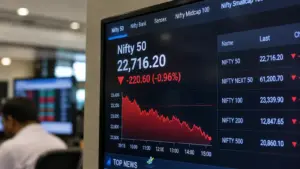
This constant matching of buy and sell orders is called price discovery; it’s the mechanism by which a stock’s price reflects, in real time, what buyers are actually willing to pay and what sellers are actually willing to accept. There’s no committee setting the price. The market sets it, trade by trade, often thousands of times per second for actively traded stocks.
Step 4: Clearing and settlement
A trade being “matched” isn’t the same as the transaction being complete. After a trade executes, it goes through clearing (verifying and reconciling both sides of the trade) and settlement (actually transferring the shares and the money).
India moved to a T+1 settlement cycle, meaning if you buy a share on Monday, the shares are credited to your demat account on Tuesday. This is handled by clearing corporations that act as the counterparty to every trade, which is one reason exchange-based trading is dramatically safer than an informal, unregulated deal between two individuals.
Step 5: Regulation and oversight
None of this works without a regulator standing behind it. In India, the Securities and Exchange Board of India (SEBI) sets listing rules, monitors trading for manipulation and insider trading, and enforces disclosure standards for listed companies. The Reserve Bank of India (RBI) also plays a role where market activity intersects with the broader financial system, such as foreign investment flows. In the United States, this function is performed by the Securities and Exchange Commission (SEC); in the UK, by the Financial Conduct Authority (FCA).
This regulatory layer is what separates a stock exchange from an unregulated betting market. Listed companies must publish audited financial statements, disclose material events, and follow corporate governance rules and the exchange itself is required to maintain fair, orderly trading.
Types of Stock Exchange
Not every exchange works the same way. Broadly, stock exchanges fall into these categories:
- Physical (Floor-Based) Exchanges. Historically, exchanges operated with traders physically present on a trading floor, shouting or signalling orders, a method called open outcry. The New York Stock Exchange retained a hybrid floor presence long after most exchanges went fully digital, though even NYSE trading today is overwhelmingly electronic.
- Electronic (Screen-Based) Exchanges: Nearly all major exchanges today, including the NSE and BSE, run on fully electronic order-matching systems. Orders are placed through a broker’s app or terminal and matched by computers in milliseconds. This model reduced costs, widened access, and improved transparency compared to floor trading.
- Auction Market Exchanges: In this structure, buyers and sellers submit competitive bids and offers, and the highest bid meets the lowest offer. Most equity exchanges, including NSE and NYSE, function primarily as auction markets.
- Dealer Market Exchanges (Over-the-Counter): Some markets don’t have a centralized exchange floor at all. Instead, a network of dealers quotes prices and trades directly with investors. Nasdaq began as a dealer market, though it now blends dealer and electronic auction features. Over-the-counter (OTC) markets operate similarly for securities that don’t meet formal listing requirements.
- Primary vs. Secondary Market Function: As covered above, this isn’t a separate exchange but a distinction in function; the same exchange infrastructure supports both the initial sale of new shares (primary) and the ongoing trading of existing shares (secondary).
- Regional and Sector-Specific Exchanges: Beyond the major national exchanges, many countries operate smaller regional exchanges, or exchanges dedicated to specific segments such as NSE’s Emerge platform for small and medium enterprises, which lets smaller companies list under relaxed requirements.
Major Stock Exchanges Around the World
Stock exchanges exist on every continent, and their relative size shifts as markets move and new companies list. Based on domestic market capitalization figures tracked by the World Federation of Exchanges, here’s how the largest exchanges compare:
| Exchange | Country | Approx. Domestic Market Cap | Notable Feature |
| Nasdaq | United States | ~$35 trillion | Technology and growth-stock concentration |
| New York Stock Exchange (NYSE) | United States | ~$31 trillion | World’s largest exchange by number of blue-chip listings |
| Shanghai Stock Exchange | China | ~$10 trillion | Dominant mainland China exchange |
| Euronext | Europe (multi-country) | Multi-trillion | Combines exchanges across France, the Netherlands, Belgium, and others |
| Tokyo Stock Exchange | Japan | Multi-trillion | Oldest major exchange in Asia, founded in 1878 |
| Hong Kong Stock Exchange | Hong Kong | Multi-trillion | Key gateway for China-linked listings |
| National Stock Exchange (NSE) | India | Trillions (INR) | India’s largest exchange by trading volume |
| Bombay Stock Exchange (BSE) | India | Trillions (INR) | Asia’s oldest exchange, founded in 1875 |
Figures are illustrative snapshots based on 2026 World Federation of Exchanges data and shift daily with market movement; treat them as a sense of relative scale, not a live quote.
Globally, exchanges collectively list more than 30,000 companies with a combined market capitalization above $160 trillion, according to aggregated exchange data. In India specifically, the NSE lists close to 2,800 companies, and the BSE lists more than 5,600, making BSE one of the largest exchanges in the world by sheer number of listings, even though NSE handles the larger share of daily trading volume.
Functions of Stock Exchange
This section covers the core functions of stock exchange operations: the practical jobs an exchange performs for the economy and for individual investors.
- Capital formation: Exchanges let companies raise long-term funds from the public instead of relying only on bank loans, which supports business expansion and job creation.
- Price discovery: Continuous trading establishes a fair, transparent price for every listed security based on real supply and demand.
- Liquidity: Investors can convert shares into cash quickly, usually within a day or two of placing a sell order, because a ready market of buyers exists.
- Safety and regulation: Exchanges enforce listing standards, disclosure requirements, and trading rules, reducing fraud risk compared to unregulated, off-market deals.
- Economic barometer: Broad market indices (like the Nifty 50, Sensex, S&P 500, or Dow Jones) are widely used as indicators of overall economic sentiment and investor confidence.
- Mobilization of savings: Exchanges give households a productive outlet for savings beyond fixed deposits or gold, connecting personal wealth-building with national economic growth.
- Facilitating mergers, buybacks, and corporate actions: Beyond day-to-day trading, exchanges provide the infrastructure for rights issues, buybacks, mergers, and other corporate events involving listed shares.
- Continuous disclosure: Listed companies must regularly report financial results and material developments, which improves the quality of information available to investors and analysts.
Advantages of Stock Exchange
The advantages of stock exchange participation extend to companies, investors, and the broader economy:
For investors:
- Access to ownership in businesses without needing to run them
- The ability to start with small amounts of capital
- Liquidity: you’re rarely stuck holding an asset you can’t sell
- Regulatory protection through mandated disclosures and oversight
- The potential for capital appreciation and dividend income over time
For companies:
- Access to large pools of capital without taking on debt
- Increased public visibility and credibility
- A liquid currency (publicly traded stock) that can be used for acquisitions and employee compensation
- Market-based valuation feedback on business performance
For the economy:
- Efficient allocation of capital toward productive businesses
- Job creation through funded business expansion
- A transparent gauge of investor and business sentiment
That said, exchange-based investing carries real risk. Prices can swing sharply based on company performance, interest rates, or broader sentiment shifts between what’s commonly called a bull market and a bear market. Unlike a fixed deposit, there’s no guaranteed return, and short-term volatility is normal, not a sign of malfunction.
Stock Exchange Example
Concrete examples make this easier to hold onto:
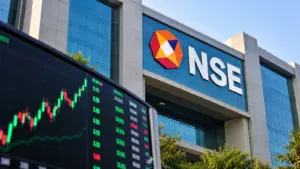
- National Stock Exchange of India (NSE): Founded in 1992, headquartered in Mumbai, and known for introducing electronic trading to India. Its benchmark index is the Nifty 50, tracking the 50 largest listed companies by free-float market capitalization.
- Bombay Stock Exchange (BSE): Established in 1875, making it Asia’s oldest stock exchange. Its benchmark index, the Sensex, tracks 30 major companies.
- New York Stock Exchange (NYSE): Operating on Wall Street since 1792, NYSE is known for hosting large-cap, established companies across finance, energy, healthcare, and consumer sectors.
- Nasdaq: Founded in 1971 as the world’s first electronic stock exchange, Nasdaq is closely associated with technology companies and, as of 2026, overtook NYSE as the largest exchange globally by domestic market capitalization according to World Federation of Exchanges data.
- London Stock Exchange (LSE): One of the oldest exchanges globally, central to European and international listings.
- Tokyo Stock Exchange (TSE): Asia’s major exchange outside China, founded in 1878.
If you buy one share of a company listed on the NSE through your broker, and someone else sells their share of the same company at the same moment, the exchange’s system matches those two orders; that single event is a stock exchange transaction in its simplest form.
How to Start Investing Through a Stock Exchange: A Practical Walkthrough
- Open a demat and trading account. A demat account holds your shares electronically; a trading account lets you place buy and sell orders. Most brokers bundle both.
- Complete KYC verification. Identity and address proof are mandatory under SEBI regulations before you can trade.
- Fund your trading account: Transfer money from your bank account to your broker’s linked trading account.
- Research before you buy: Look at a company’s financials, growth trends, and valuation rather than acting on tips or short-term price movement alone.
- Place your order: Choose between a market order (executes immediately at the current price) or a limit order (executes only at your specified price or better).
- Track settlement: Under India’s T+1 cycle, purchased shares typically appear in your demat account the next trading day.
- Monitor and rebalance periodically: Review your holdings against your goals every few months rather than reacting to daily price swings.
Worked example: calculating a real transaction cost
Say you buy 100 shares of a company at ₹250 per share through delivery (not intraday).
- Transaction value: 100 × ₹250 = ₹25,000
- Securities Transaction Tax (STT) on delivery-based equity: 0.1% on both buy and sell legs
- STT on the buy: ₹25,000 × 0.1% = ₹25
- If you sell later at ₹280, transaction value = ₹28,000, and STT on the sell: ₹28,000 × 0.1% = ₹28
- Your gross profit before other charges: ₹28,000 − ₹25,000 = ₹3,000
- Total STT paid across both legs: ₹53
On top of STT, brokers charge brokerage fees, exchange transaction charges, GST, SEBI turnover fees, and stamp duty, all of which show up on your contract note. These are usually small for delivery-based trades but add up quickly for frequent intraday trading.
Taxation and Regulatory Rules on the Stock Exchange (India)
Understanding the tax treatment of exchange-based transactions is part of investing responsibly, though tax rules change with each Union Budget, so always verify current rates before filing:
| Item | Current Treatment (as of the 2026 Budget cycle) |
| Securities Transaction Tax (delivery equity) | 0.1% of transaction value, on both buy and sell |
| Securities Transaction Tax (intraday equity, sell side only) | 0.025% |
| Short-Term Capital Gains (STCG) on listed equity, held under 1 year | Flat 20%, under Section 111A, where STT has been paid |
| Long-Term Capital Gains (LTCG) on listed equity, held over 1 year | 12.5%, with the first ₹1.25 lakh of annual gains exempt |
| Dividend income | Taxed at the investor’s applicable income tax slab rate |
STT applies automatically at the time of the trade and is collected by the exchange, so investors don’t need to calculate or remit it separately. Capital gains tax, on the other hand, must be reported and paid when filing your income tax return. These figures are based on regulations effective through 2026; because tax law is one of the fastest-moving parts of this topic, cross-check the latest figures directly on the SEBI or Income Tax Department website before making tax-driven decisions.
Common Mistakes New Investors Make on the Stock Exchange
- Treating the exchange like a casino. Frequent, unresearched trading based on tips or short-term price momentum tends to underperform a disciplined, research-based approach over time.
- Ignoring diversification: Putting most capital into one stock or sector concentrates risk unnecessarily.
- Confusing trading with investing: Day trading and long-term investing require different skills, time commitments, and risk tolerance; conflating the two often leads to disappointment.
- Skipping the fine print on corporate disclosures: Annual reports and exchange filings contain material information that price charts alone don’t show.
- Underestimating costs: Brokerage, STT, and taxes reduce net returns, especially for high-frequency trading.
- Panic-selling during downturns: Reacting emotionally to a temporary bear phase, instead of sticking to a plan, is one of the most common reasons investors lock in losses that would otherwise have recovered.
Stock Exchange vs. Stock Market: What’s the Difference?
These two terms get used interchangeably, but they aren’t identical.
- The stock market is the broad concept: the entire system of buying, selling, and owning company shares, including all participants: investors, brokers, regulators, and companies.
- A stock exchange is the specific, regulated venue or platform where that trading physically or electronically takes place.
In other words, the NSE and BSE are stock exchanges. “The Indian stock market” refers to the whole ecosystem those exchanges operate within, including every investor and company participating in it.
Frequently Asked Questions
Is a stock exchange the same as a stock market?
No. A stock exchange is a specific regulated venue for trading; the stock market is the broader system that includes exchanges, investors, brokers, and regulators.
Can anyone buy shares on a stock exchange?
Yes, as long as you open a demat and trading account with a registered broker and complete KYC verification. Retail investors, institutions, and foreign investors (subject to regulatory limits) can all participate.
How does a stock exchange make money?
Exchanges earn revenue from listing fees charged to companies, transaction fees on trades, data licensing fees, and membership fees charged to brokers.
What happens if a stock exchange shuts down for a day?
Trading halts, and no orders can be executed or settled until the exchange resumes operations. Exchanges publish scheduled holidays in advance and rarely have unscheduled closures, which are typically limited to extreme technical or infrastructure failures.
Is investing through a stock exchange safe?
The exchange infrastructure itself is regulated and secure, with clearing corporations guaranteeing settlement. That doesn’t remove market risk; share prices can still fall based on company or economic performance, so the safety of the mechanism is different from the safety of the investment outcome.
Do all countries have their own stock exchange?
Most, but not all. Many countries operate national exchanges (like NSE and BSE in India, or NYSE and Nasdaq in the US), while some smaller economies rely on regional exchanges shared across neighbouring countries.
Conclusion
A stock exchange is the regulated marketplace that turns company ownership into something you can buy, sell, and track in real time, connecting businesses that need capital with investors who have savings to put to work. It functions through a chain of steps: companies raise money in the primary market, shares trade continuously in the secondary market, orders are matched electronically for price discovery, and trades are cleared and settled under regulatory oversight from bodies like SEBI.
Whether you’re evaluating the NSE, the BSE, the NYSE, or any of the dozens of major exchanges operating worldwide, the underlying mechanics stay consistent: transparent pricing, liquidity, and rules designed to protect the people trading on them. Understanding those mechanics is the foundation for every other investing decision that follows, from picking your first stock to reading a company’s quarterly results.
Related reading on Investik Future: How the Stock Market Works: A Beginner’s Guide | What is an IPO? Meaning, Process, and Investment | Bull Market vs Bear Market: Key Differences
ARN Disclosure: Investik Future is an AMFI-registered Mutual Fund Distributor. ARN-341107 — Verify on AMFI ↗. Komal Thakur is the content author and digital marketer; the ARN registration belongs to Investik Future, not to the author personally.