
Every trade starts with an order. Before a single share changes hands, you have to tell your broker three things: what to buy or sell, how much, and under what price conditions. That third piece, the price condition, is what separates a market order from a limit order from a stop-loss order, and it’s the single biggest factor in whether your trade executes the way you expected it to.
Most new traders learn this the hard way. They place a market order on a low-volume stock and get filled 3% away from the price they saw on screen. Or they set a stop-loss too close to the current price and get shaken out of a position an hour before it moves in their favor. The order type you choose isn’t a technical formality. It’s a decision about what you’re willing to trade off between price, speed, and certainty of execution.
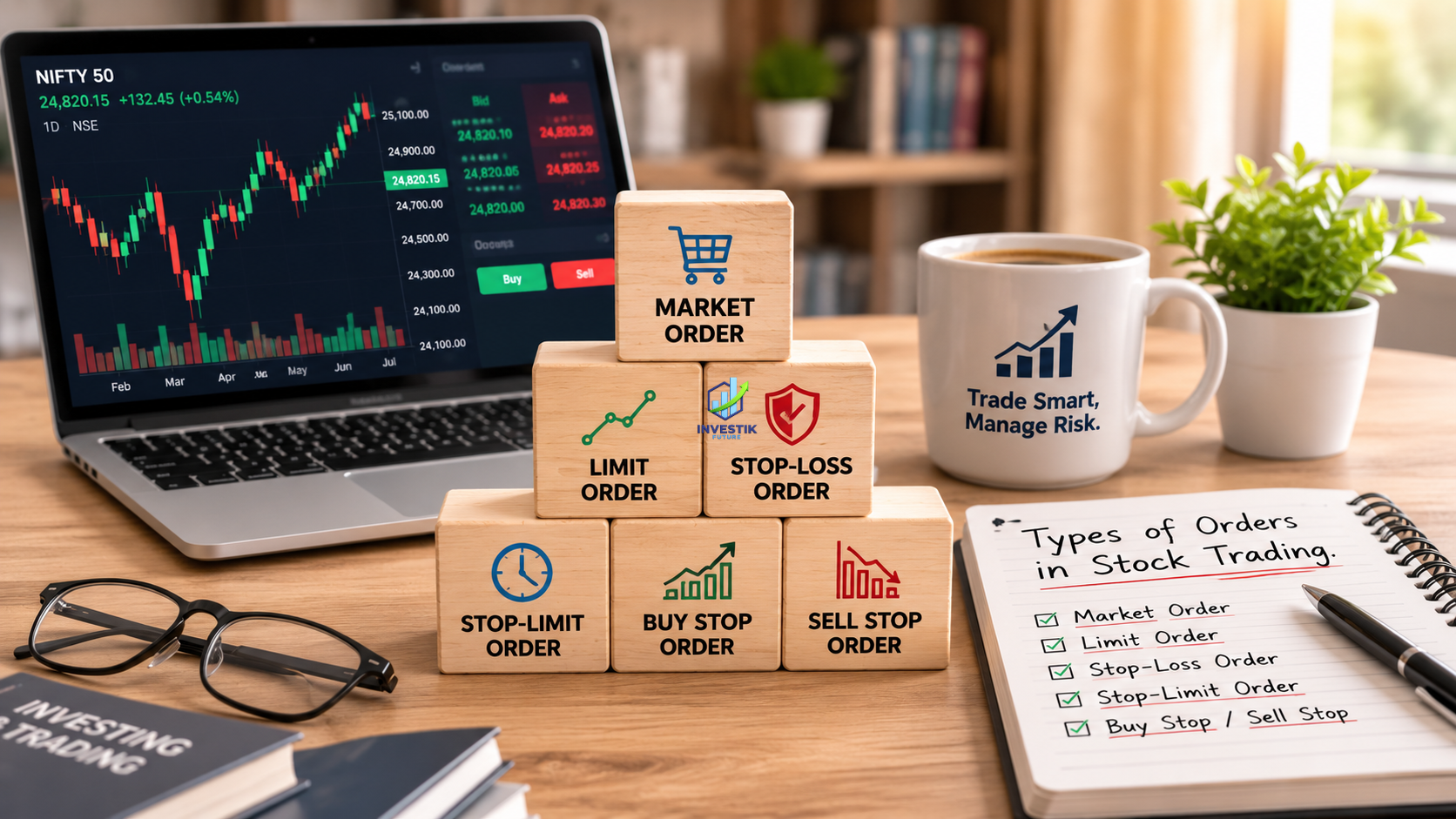
This guide covers the types of orders in stock trading used by retail and institutional traders in India, the US, and the UK: market orders, limit orders, stop-loss orders, stop-limit orders, and the time-based and quantity-based conditions that modify them. You’ll find worked examples with real numbers, a comparison table, common mistakes, and the exchange rules that govern how each order type behaves.
If you’re building your broader trading knowledge alongside this, our market fundamentals section covers the exchange mechanics, order books, and terminology this article assumes you already understand at a basic level.
What is an order in stock trading
An order is an instruction sent to a stock exchange, through your broker, to buy or sell a specific quantity of a security under specific conditions. Every order has four core components:
- Side: buy or sell
- Quantity: number of shares or contracts
- Price condition: market, limit, or stop
- Duration: how long the order stays active if it isn’t filled immediately
Exchanges like the NSE and BSE in India, the NYSE and NASDAQ in the US, and the London Stock Exchange in the UK all match buy and sell orders through an order book, a running list of buy orders (bids) and sell orders (asks) sorted by price. The type of order you place determines where and how it sits in that book, and that in turn determines the price you actually get.
Market orders
A market order is an instruction to buy or sell immediately at the best available price. You don’t set a price. You’re telling the exchange: fill this now, whatever it costs.
Market orders are the fastest way to enter or exit a position. During normal trading hours in a liquid stock, a market order typically fills within a second or two, at or very close to the last traded price.
When a market order makes sense:
- You’re trading a high-volume stock like Reliance, Apple, or HDFC Bank, where the bid-ask spread is a few paise or cents wide
- Speed matters more than price precision, for example, exiting a position fast during a news event
- You’re buying or selling a small quantity relative to the average daily volume
The risk: slippage. Slippage is the gap between the price you expected and the price you actually got. It shows up most in two situations: low-liquidity stocks with wide bid-ask spreads, and fast-moving markets where the price changes between the moment you click “buy” and the moment the order reaches the exchange.
Worked example: Suppose a small-cap stock has a last traded price of ₹248, but the order book shows only 50 shares available to sell at ₹248, then the next 200 shares at ₹251, then 500 more at ₹255. If you place a market buy order for 700 shares, your average fill price won’t be ₹248. It’ll be a blend across all three price levels, working out to roughly ₹252.50 per share, about 1.8% above the price you saw when you placed the order. On a large or illiquid order, that gap can be far wider.
Market orders carry no price protection at all. In an extreme, low-volume scenario, a market order can fill dozens of percentage points away from the last traded price, which is exactly the kind of scenario that led exchanges to restrict certain market-linked stop orders (more on that below).
Limit orders
A limit order sets the maximum price you’re willing to pay (on a buy) or the minimum price you’re willing to accept (on a sell). The order will only execute at your specified price or better. If the market never reaches your price, the order simply doesn’t fill.
This is the core trade-off in the market order vs limit order decision: a market order guarantees execution but not price; a limit order guarantees price but not execution.
How a limit order works, step by step:
- You set a limit price; say you want to buy a stock currently trading at ₹500, but only if you can get it at ₹495 or lower
- The order sits in the exchange’s order book at ₹495
- If the stock’s ask price falls to ₹495 or below, your order fills, fully or partially depending on available volume
- If the price never drops to ₹495, the order stays open (subject to its duration setting) or expires unfilled
Buy limit vs sell limit:
- A buy limit order is placed below the current market price. You’re saying you’ll only buy if the price drops to your level.
- A sell limit order is placed above the current market price. You’re saying you’ll only sell if the price rises to your level.
When a limit order makes sense:
- Trading in illiquid or highly volatile stocks, where a market order could fill far from the price you see
- Entering a position at a specific technical level, such as a support zone or a breakout price
- Any situation where getting a bad price is a bigger risk to you than missing the trade entirely
The trade-off: in a fast-moving market, your limit price can simply get skipped over. If a stock gaps up from ₹500 to ₹530 overnight on positive earnings, a sell limit order at ₹510 won’t magically capture the ₹530 open; it will fill at ₹510 only if the price comes back down to that level, which it may never do.
Stop-loss orders
A stop-loss order (often shortened to “stop order” or “SL order”) is a risk-management instruction that becomes active only after the stock reaches a price you specify, called the trigger price or stop price. Until that price is hit, the order sits dormant. Once triggered, it converts into either a market order or a limit order, depending on the sub-type you chose.
The U.S. Securities and Exchange Commission defines a stop order as an instruction to buy or sell once a stock reaches a specified stop price, at which point it becomes a market order. On Indian exchanges, the NSE describes a Stop Loss order as one that gets activated only when the market price of the security reaches or crosses a threshold price, and holds it separately from the regular order book until that trigger is met.
Two ways to use a stop-loss:
- Protecting an existing position. You bought a stock at ₹300 and set a sell stop at ₹270. If it falls to ₹270, your stop triggers and you exit, capping your loss at roughly 10%, before any slippage.
- Entering a breakout. You believe a stock will run higher once it clears resistance at ₹450. You place a buy stop at ₹452, so the order only activates and only buys if the price actually breaks above that level.
This is the difference between a sell stop order (used to exit a long position or open a short) and a buy stop order (used to enter a long position on a breakout or cover a short position).
Stop-loss market vs stop-loss limit
This is where a lot of traders get tripped up, and it’s directly tied to a real regulatory change worth knowing about.
- Stop-Loss Market (SL-M): once triggered, the order becomes a market order and fills at the best available price, whatever that happens to be.
- Stop-Loss Limit (SL-L), also called a stop-limit order: once triggered, the order becomes a limit order at a price you set in advance, rather than a market order.
In 2021 and again in 2023, Indian exchanges (NSE and then BSE) discontinued SL-M orders in the equity, derivatives, and commodity segments, after a series of freak trades where a triggered stop-loss market order executed at a wildly distorted price during a period of thin liquidity. BSE stated at the time that the move was meant to prevent erroneous order placement arising from manual or algo trades, and the exchange recommended traders shift to SL-L orders instead.
If you’re trading on NSE or BSE today, this means your stop-loss orders on these exchanges are, in practice, always stop-limit orders, not stop-market orders. The distinction still matters conceptually, and it’s still standard on US and UK exchanges, so it’s worth understanding both.
Worked example: stop-limit order
Say you hold a stock bought at ₹800. You want to protect against a sharp fall, but you’re worried a pure market-triggered exit could fill you at a terrible price during a crash. You set a stop-limit order:
- Trigger (stop) price: ₹760
- Limit price: ₹755
If the stock trades down to ₹760, the order activates and becomes a limit sell at ₹755 or better. If the stock is falling fast and skips straight from ₹762 to ₹740 without trading at ₹755, your order won’t fill at all, because the limit price was never reached. This is the core risk of a stop-limit order: in a sharp, gapping move, it can fail to execute exactly when you need it most.
Comparison table: order types side by side
| Order type | Price control | Execution certainty | Best used for | Key risk |
|---|---|---|---|---|
| Market order | None | Very high | Fast entry/exit in liquid stocks | Slippage in low-volume names |
| Limit order | Full | Not guaranteed | Precise entry/exit price | Order may never fill |
| Stop-loss (SL-M) | None once triggered | High once triggered | Simple stop-loss exits | Bad fill price in volatile moves; discontinued on NSE/BSE |
| Stop-limit (SL-L) | Full once triggered | Not guaranteed once triggered | Controlled stop exits/entries | May not fill in fast gaps |
| Trailing stop | Adjusts with price | High once triggered | Locking in gains as price rises | Can trigger on normal volatility |
Other common order conditions
Beyond the four core price types above, brokers let you attach duration and quantity conditions to any order. These aren’t separate order categories so much as modifiers.
Day order: valid only for the current trading session. If unfilled by market close, it’s automatically cancelled.
Good-Till-Cancelled (GTC/GTD): stays active across multiple sessions until it either fills or you cancel it, subject to a maximum validity period set by the broker.
Immediate-or-Cancel (IOC): must execute immediately, in full or in part; whatever portion doesn’t fill right away is cancelled rather than left open.
Fill-or-Kill (FOK): must execute in full, immediately, or the entire order is cancelled. No partial fills allowed.
Trailing stop order: a stop-loss that automatically adjusts as the price moves in your favour. If you set a trailing stop 5% below the current price and the stock rises, your stop price rises with it, locking in more of your gain while still protecting against a reversal. If the stock falls, the trailing stop stays fixed at its last adjusted level.
Which order type should you actually use?
There’s no single correct answer; it depends on what you’re trying to protect against.
- Trading a large-cap, high-volume stock and want speed: a market order is usually fine; spreads are tight enough that slippage is minimal.
- Trading a small-cap or thinly traded stock: use a limit order; price certainty matters more than speed.
- Holding a position and want downside protection without watching the screen all day: a stop-loss (stop-limit, on Indian exchanges) does that job.
- Want to lock in profits as a stock trends upward: a trailing stop adjusts automatically so you don’t have to keep manually moving your stop price.
- Placing a large order in a volatile stock: consider splitting it, or using a limit order with a realistic price band, since a single large market order can move the price against you as it eats through the order book.
If you’re sizing a position alongside your stop-loss placement, our position size calculator works out how many shares to buy based on your stop-loss distance and how much of your capital you’re willing to risk on the trade, which is a more reliable way to size positions than picking a round number of shares.
Common mistakes traders make with order types
Using market orders on illiquid stocks. This is the single most common and most costly mistake. Always check the bid-ask spread and available depth before placing a market order on anything outside the most liquid large-cap names.
Setting a stop-loss too tight. A stop placed a fraction of a per cent below your entry will get triggered by ordinary intraday noise, not just a genuine reversal. Base your stop distance on the stock’s normal volatility (its average daily range), not a fixed number that feels comfortable.
Confusing stop price and limit price on a stop-limit order. Setting them too close together, as in the earlier example with a ₹5 gap, increases the odds your order won’t fill in a fast-moving market. A wider gap improves fill odds but gives up price control.
Forgetting to cancel GTC orders. A limit order left open for weeks can execute unexpectedly if the price eventually reaches your level, at a time and market context you may have completely forgotten about.
Not accounting for after-hours and pre-market gaps. A stop-loss set during regular hours won’t necessarily protect you against a stock that gaps down at the next day’s open, since exchanges match orders to the first available price after the gap, which can be well below your stop level.
Order types on Indian exchanges: the regulatory picture
SEBI (the Securities and Exchange Board of India) sets the overarching framework for order types, but the specific mechanics, like the discontinuation of SL-M orders, are implemented at the exchange level by NSE and BSE. Both exchanges publish current order-type rules and trading system documentation, and it’s worth checking these directly if you’re trading actively, since exchange-level rules on order types, self-trade prevention checks, and circuit limits do get revised periodically.
For the underlying exchange documentation on how Indian markets classify and process stop-loss and other order books, see NSE India’s trading system reference. For the equivalent US framework on stop orders, the SEC’s own investor guidance is a reliable primary source: SEC: Stop Order.
If you’re newer to how the exchange itself functions before you get into order mechanics, our guide on how the stock market works and our broader explainer on the stock exchange and how it operates are good starting points.
Order types in the US and UK markets
The core order types, market, limit, stop, and stop-limit, work the same way conceptually across US, UK, and Indian exchanges, though the exact naming and available variants differ by broker and market.
In the US, the SEC and FINRA oversee order handling rules across NYSE and NASDAQ, and most US brokers offer the full range of order types described above, including trailing stops and more advanced conditional orders. In the UK, the London Stock Exchange and FCA-regulated brokers offer equivalent order types, generally under the same names (market, limit, stop-loss, stop-limit). The main practical difference for traders moving between markets is trading hours, settlement cycles, and, as covered above, whether stop-loss orders convert to a market fill or a limit fill once triggered, since that detail is set by exchange rules, not by a universal standard.
Frequently asked questions
What are the 5 types of orders in stock trading?
The five most commonly used are market orders, limit orders, stop-loss (stop) orders, stop-limit orders, and trailing stop orders. Duration conditions like day, GTC, IOC, and FOK are typically layered on top of these rather than counted as separate order types.
What is a stop-limit order example?
If a stock trades at ₹500 and you want to sell if it falls, but only within a controlled price range, you might set a stop price of ₹480 and a limit price of ₹475. Once the stock trades at or below ₹480, your order becomes a limit sell at ₹475 or better. It fills only if the market actually trades at ₹475 or higher after triggering.
What is a stop order in stocks?
A stop order is an instruction that stays inactive until the stock reaches a price you specify (the stop or trigger price). Once that price is reached, the order activates, and either becomes a market order (stop-market) or a limit order (stop-limit), depending on the type you chose.
Limit order vs market order, which is better?
Neither is universally better. A market order prioritises speed and certainty of execution over price. A limit order prioritises price control over certainty of execution. The right choice depends on the stock’s liquidity and how much price precision matters for that specific trade.
What’s the difference between a buy stop and a sell stop order?
A buy stop order is placed above the current market price and is used to enter a long position on a breakout, or to cover a short position. A sell stop order is placed below the current market price and is used to exit a long position or open a short, typically as a loss-limiting measure.
Conclusion
The types of orders in stock trading aren’t interchangeable tools; each one solves a different problem. A market order buys you speed. A limit order buys you price control. A stop-loss buys you discipline, an exit plan that doesn’t depend on you watching a screen. A stop-limit order tries to combine risk protection with price control, at the cost of execution certainty in a fast market.
None of these order types replaces a trading plan. They execute the plan you’ve already made. Before you place any order, know why you’re using that specific type, what price outcome you’re accepting in exchange for it, and what happens if the market moves faster than the order can react.
Related reading: Bull market vs bear market: key differences
ARN Disclosure: Investik Future is an AMFI-registered Mutual Fund Distributor. ARN-341107 — Verify on AMFI ↗. Komal Thakur is the content author and digital marketer; the ARN registration belongs to Investik Future, not to the author personally.